If you want to know how to join an amateur esports team, the route is shorter than most beginners expect: pick one game and one role, build proof of your skill in that game’s ranked ladder, then make yourself visible in the communities where amateur captains recruit. When someone replies with a trial scrim invitation, you are in the process.
Amateur rosters are not looking for fame or a legendary rank. They are looking for someone who shows up, communicates clearly, learns fast and can commit to a schedule. That is a much lower bar than most beginners assume, and it means the game is only half the work.
This guide walks through the whole route: what to have ready, the eight steps from game choice to roster spot, the message you send a captain, what a tryout actually feels like, and the red flags that should send you looking elsewhere. Budget a few weeks of steady effort. It is a side project, not a weekend.
Table of Contents
- What You Need Before You Apply
- How to Join an Amateur Esports Team: Step by Step
- 1. Choose Your Game, Role, and Competitive Goal
- 2. Build a Reliable Practice Setup
- 3. Improve Until You Are Competitive at One Level
- 4. Find Open Amateur Teams and Tryouts
- 5. Check the Team Before You Apply
- 6. Contact the Team With a Strong Application
- 7. Prepare for and Pass the Tryout
- 8. Agree on Expectations and Join the Roster
- If Nobody Replies: Start Your Own Team
- Common Mistakes That Cost People a Roster Spot
- Frequently Asked Questions
- Do I need to be a high-ranked gamer to join an amateur esports team?
- How old do I have to be to join an amateur esports team?
- Where can I find amateur esports teams with open tryouts?
- How much does it cost to join an amateur esports team?
- Can I join an amateur team if I am a complete beginner?
- What should I do if I do not pass my first tryout?
- Conclusion
What You Need Before You Apply
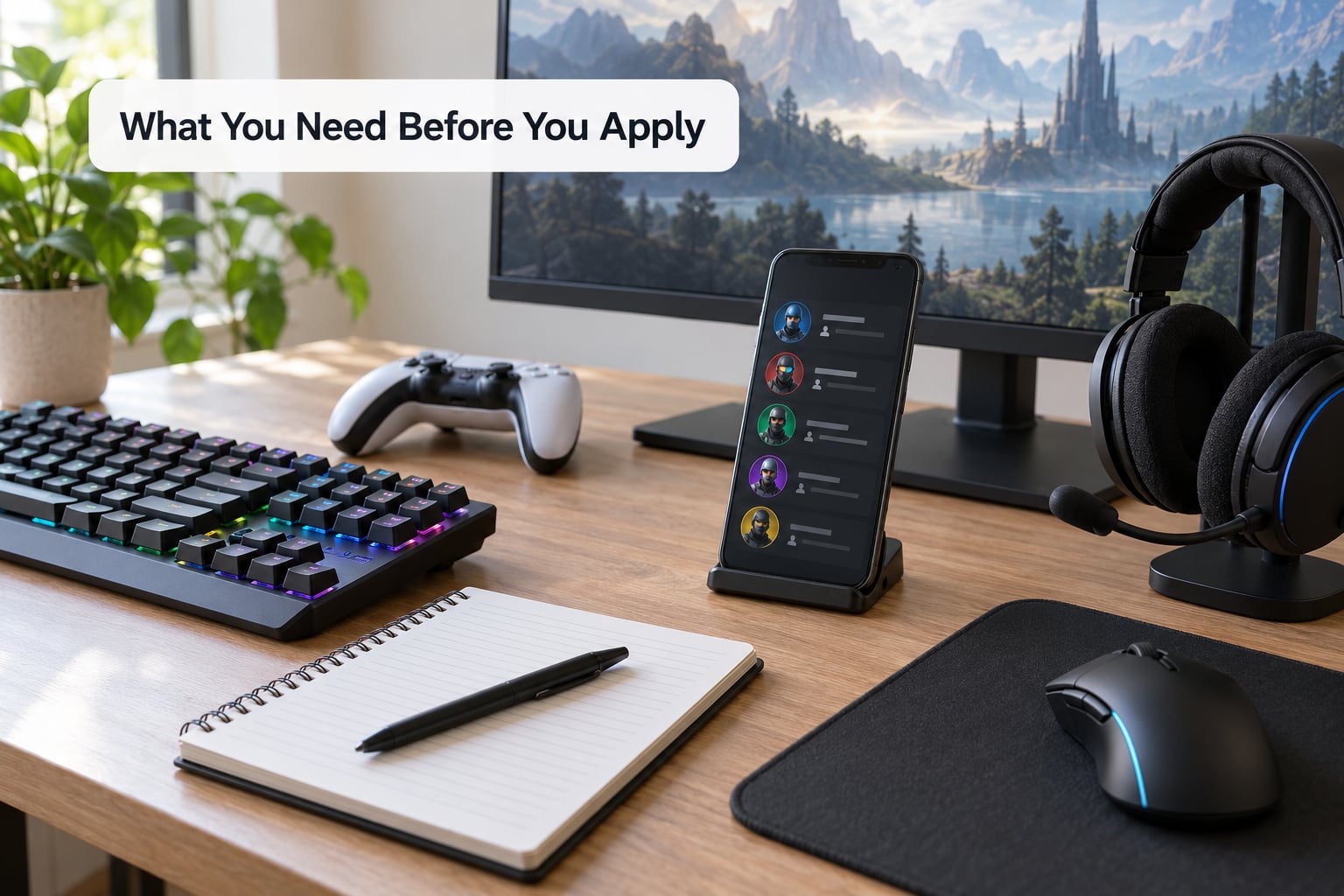
Six things. Most beginners arrive with three of them and wonder why nobody replies.
- One chosen game. Teams are almost always single-title. Playing six games at a beginner level in each is weaker than playing one at a competitive level.
- One role you can perform consistently. In a shooter that might be a duelist or support; in a MOBA it is a lane or jungle role. “I fill” is not an answer a captain can use.
- A ranked account with a visible history. Your match history, tracker profile or in-game rank card is the receipt you hand over instead of a claim that you are good.
- A stable connection and usable gear. Wired or strong 5GHz Wi-Fi, a headset with a working mic, and a mouse or controller you are comfortable with for three-hour sessions.
- A stated availability window. Three evenings a week is a real answer. So is weekends only. What does not work is “whenever”.
- Something to show beyond your rank. A short clip reel, a tracker page, or a folder of VODs. A few captains scroll past a bare username.
You do not need a streaming setup, a sponsorship deck or an expensive desk. Those come later, if they come at all.
How to Join an Amateur Esports Team: Step by Step
1. Choose Your Game, Role, and Competitive Goal
Start with the game you already know best and will still enjoy in six months. The second decision is your role, and it should match something you do naturally rather than the role that looks coolest in videos.
Then pick a level. Decide whether you want a casual roster that plays a couple of open cups a month or a structured team with three scheduled practices. Both exist, and mixing them up is the fastest way to disappoint a captain.
You will know this step worked when you can say in one sentence: “I am a support main in Valorant, I can play Tuesday and Thursday evenings plus Sunday, and I want a roster that enters open qualifiers.”
2. Build a Reliable Practice Setup
Team play punishes small distractions far more than solo queue does. Fix your setup before you fix your rank: chair, desk height, lighting that does not glare on a monitor, and a phone that stays out of reach during a session.
Check your latency and packet stability in the game’s own tools, and test them at the time of day you would actually practice. Evening congestion is a different network from midday.
Simple, repeatable conditions matter more than expensive gear. If you are used to playing well at your desk, you will not have to re-learn your aim when a new team joins the call.
3. Improve Until You Are Competitive at One Level
Give yourself a realistic preparation window. For most competitive titles, six to ten weeks of focused practice moves a dedicated beginner from “unranked chaos” to a rank they can hold in mixed lobbies.
Structure that time. Play ranked on a schedule, review your own losses instead of only your highlights, run role-specific drills, and practice callouts out loud even when you are queuing alone. That last habit is underrated: players who can talk position and timing already sound like team players.
Track progress by trends, not a single number. Rising win rate, fewer deaths on the same agent or map, and a calmer reaction to a losing streak all count. A rank that briefly spikes after a lucky weekend tells you nothing.
4. Find Open Amateur Teams and Tryouts
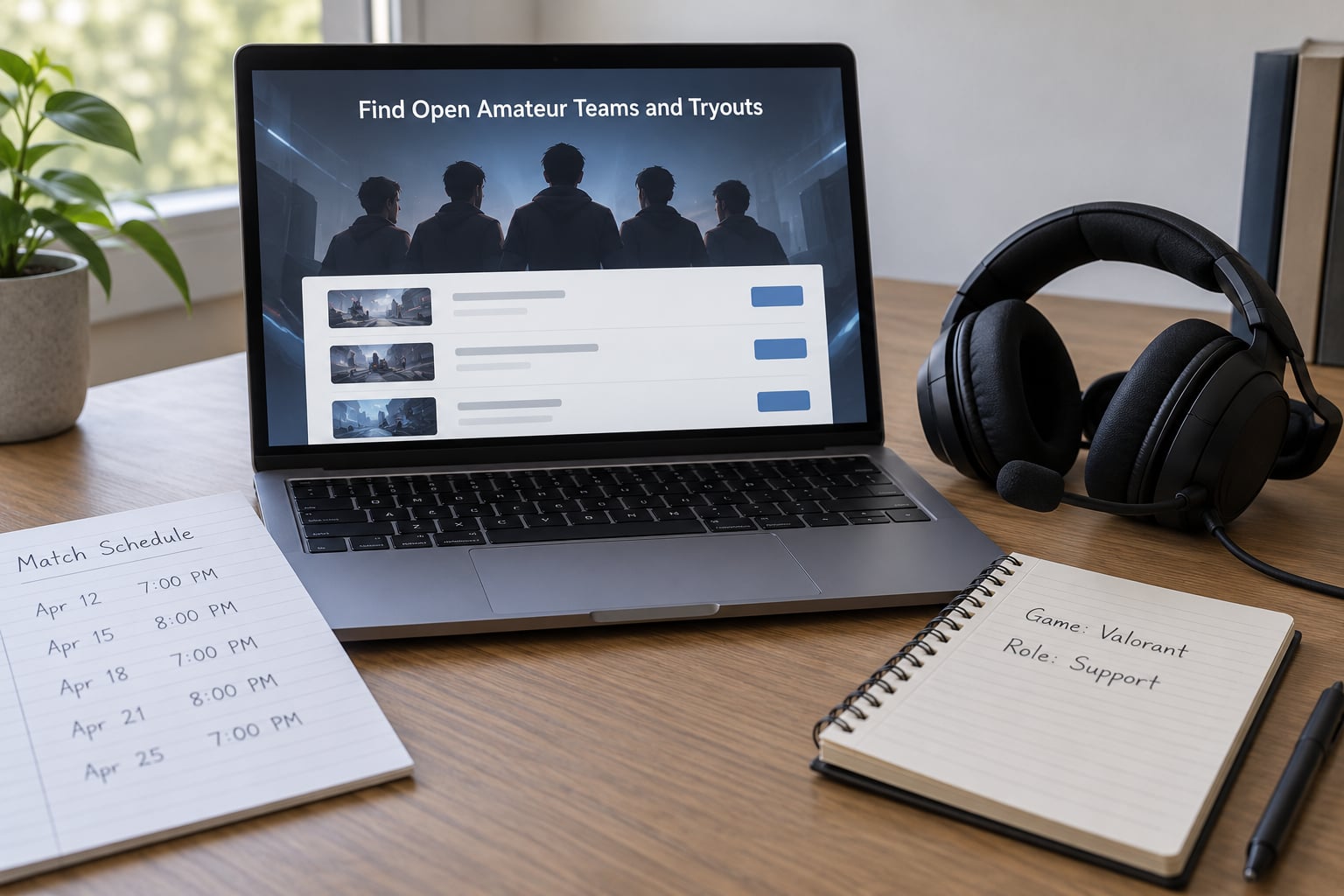
This is where most beginners stall, because they wait to be found. Teams rarely run a public inbox. They watch communities.
The order that works most often: the game’s official Discord and subreddit first, then the community LFG and looking-for-players channels, then recruiting platforms, then open tournaments, then local events.
| Where to look | Best for | How to post or apply |
|---|---|---|
| Game Discord and subreddit | Teams already playing your title, regional communities | Fill out the application channel and the LFG template, then be useful in chat for a week first |
| Recruiting platforms such as Seek Team, Curry.gg, Challengermode or Hitmarker | Structured profiles captains browse by game and rank | Complete every field, list roles and availability, attach a tracker link |
| Open online tournaments and community cups | Proving you can play under a schedule with strangers | Register, check the rules on age and eligibility, and finish your matches |
| School, college or university esports clubs | The most reliable real team environment, often with a coach | Contact the club advisor or club Discord near the start of term |
| Local venues, LAN organisers and convention halls | Offline play and a whole regional scene in one room | Follow local organiser accounts and ask about upcoming community nights |
| Facebook and Discord LFG groups | Quick scrims and casual stacks | Post with your game, rank, role, region and the exact time you are free |
On Reddit and in Discord communities, the most repeated advice from regulars is unglamorous: prove your rank before you promote yourself, and turn up in the server before you post. A username that has been active for a week gets replies. A brand-new account asking for a team usually does not.
You will know this step worked when a captain or player replies to your post, or when a platform shows recruiters viewing your profile. Silence is normal, volume is not. Twenty targeted applications beat two hundred copy-paste ones.
5. Check the Team Before You Apply
Interviews cut both ways. An amateur team that is actually organised will answer these questions without irritation; one that is not will go quiet.
- When exactly do you practise, and how many nights a week?
- Which game version or patch are you competing on?
- How many players are on the active roster, and is there a substitute list?
- Who makes calls, and how are tryouts decided?
- Is there an entry fee, a kit requirement, or a travel expectation for LAN events?
- How is any prize money split?
- What is the trial period, and what ends it?
Warning signs: a captain who refuses to discuss schedule, pressure to pay for a “roster spot”, a team that plays ranked only, an age requirement that is stated as vague or enormous, and any suggestion of deposit money to join. Community members repeatedly flag impersonation scams, so confirm any team’s existence through a second channel before you hand over personal details.
Positive signs read like the list above in reverse: a real practice calendar, published results, a roster page that matches what they tell you, and a willingness to say what they expect of you in the first month.
6. Contact the Team With a Strong Application
Managers read dozens of messages a week. Yours has to be short, specific and easy to answer.
Include five things: the game and role you play, your current rank and how long you have held it, a link to a tracker or match history, your weekly availability, and one line asking how to sign up for a trial scrim. Mention any team experience you have already had, even if it was a school club or a monthly community cup.
A template you can adapt:
Hi [name] — I play [game] as [role], currently [rank] and I have been at that level for about [time]. My match history is here: [link]. I am free [days and times] most weeks and I can commit to your practice schedule. I have played in [previous league, cup or club, if any]. I am looking for a roster that enters open qualifiers. How do I sign up for a trial scrim?
One message, no follow-up spam. If there is no reply after a week, move on rather than chasing. Your application should read like a player who has done this before, because that is what makes it click.
7. Prepare for and Pass the Tryout
A tryout is usually a few scrim blocks, not a final exam. Ask in advance which format you are walking into, how many games, and what the team is looking at.
Arrive early and be set up before the call starts. Warm up, test your mic, and know the current meta for your role. Play the assigned role rather than the one you prefer, and call out what you see: rotations, cooldowns, where the enemy is winning the map.
Treat the session as team play, not a performance. Take the coaching, repeat the correction next round, and show the change. Captains consistently describe scrim experience and coachability as more valuable than a tournament win, because a roster that has played structured practice together is genuinely harder to beat than five individually strong players.
Afterwards, send a short thank-you message with one thing you want to work on. That single sentence does more for your chances than a long recap of your stats.
8. Agree on Expectations and Join the Roster
Before you say yes, get the practical terms in writing somewhere, even if it is a Discord message you can scroll back to. Confirm practice times and match availability, who calls plays, how absences are reported, and how long the trial period runs.
Ask directly about money. Most amateur play is unpaid, entry fees are sometimes pooled for prize splits, and travel to events is usually self-funded. Knowing that in advance prevents the resentment that shows up in community threads about players feeling taken advantage of.
Know your status: starter, substitute, or academy player. And know the exit. A roster that cannot say what happens when someone wants to leave usually has not thought about it.
If Nobody Replies: Start Your Own Team
Plenty of successful amateur rosters began because five friends were tired of queuing alone. Registering your own team is a legitimate answer to “can you create your own esports team?”
The minimum viable version takes about a month. Pick a name, register with the tournament platform and any league that covers your game, open a Discord with channels for scheduling and VODs, agree a fixed practice time, and enter one small open cup to learn how brackets work. Publish your results honestly and post that you are recruiting; other solo players find you the same way you are looking now.
You can also take a non-player role in someone else’s org. Coaching, match analysis, team management, tournament administration and casting all have real entry points, and they are often easier to get into than a roster slot.
Common Mistakes That Cost People a Roster Spot
Almost every rejected application traces back to one of these.
- Applying without reading the role requirement. They wanted a controller, you mained a duelist. Read the whole post twice.
- Claiming a rank you cannot show. Unverifiable self-promotion is treated as a lie. Send a link instead.
- Ignoring the schedule. If their practice is Monday to Thursday and you can only play weekends, say so early and let them decide.
- Saying you are flexible in every way. Flexibility without a stated window reads as unreliable. Give concrete days and hours.
- Joining a team without asking about money or fees. Ask about entry fees, prize splits and travel costs before you commit, not after a dispute.
- Treating every loss as an individual failure. VOD review with the team is the job. Blaming teammates in the call ends trial periods early.
- Pushing only one game or one role. Teams need a second character option. A narrow pool is a real cost to them.
- Sending twenty identical applications. Volume from a template reads as spam. Personalise the first and second lines.
- Disappearing after the first scrim. Consistency is the trait captains remember. Keep the schedule for a full trial block before judging it.
Habits that help more than anything else: show up on time, post your availability early, review one match a week on your own, and be the person who is pleasant to queue with. A high rank with a bad reputation is a deal breaker in almost every community thread on this topic.
Frequently Asked Questions
Do I need to be a high-ranked gamer to join an amateur esports team?
Not usually. Amateur rosters span many skill levels, and the gap between local teams and the top of the ladder is enormous. What matters is consistency in a specific role, clear communication and a schedule you can keep. If you can hold a rank in a role and play structured practice without tilting, you are in range for most grassroots teams. The top-ranked players compete for limited spots on stronger rosters instead.
How old do I have to be to join an amateur esports team?
Amateur and school teams usually have no hard minimum, while professional leagues and some tournament platforms set their own age limits. School and university clubs commonly require student status and sometimes guardian consent for minors. Rules vary by league, platform and country, so check the entry terms of each tournament and community you join rather than assuming a single rule applies everywhere.
Where can I find amateur esports teams with open tryouts?
Start with your game’s official Discord and subreddit, then move to recruiting platforms, open tournaments, school or college esports clubs, and local LAN organisers. A table of these options appears earlier in this guide. Turn up in a community for a week before posting, and include your game, role, rank, region and the exact hours you are free so captains can sort messages quickly.
How much does it cost to join an amateur esports team?
Most amateur rosters are unpaid, and joining is usually free. Some leagues charge small entry fees that are pooled for prize money, and travel to offline events is normally self-funded. A few semi-professional teams offer stipends. Red flags include any request for a deposit, roster purchase or paid trial. Always ask about fees, prize splits and travel costs before you commit to a roster.
Can I join an amateur team if I am a complete beginner?
Yes, and beginner-friendly rosters exist for exactly this reason. Look for teams that describe themselves as community, academy, school or casual rather than competitive, and check that they run structured practice for newer players. Expect a longer trial period and simpler roles at first. The learning curve is communication and consistency rather than raw aim, and both are trainable.
What should I do if I do not pass my first tryout?
Ask for one specific piece of feedback, then apply it for two weeks before trying again. A short, gracious message asking what to improve gets replies more often than silence. Meanwhile keep playing ranked and stay active in the community, because most rosters turn over during a season. Starting a scrim block with the players you already met is another common route into the same scene.
Conclusion
Joining an amateur esports team is a visibility problem before it is a skill problem. Choose one game and one role, spend six to ten weeks building a rank and a match history you can link, then spend two weeks inside the game’s Discord and LFG channels before you send a single application.
Here is your first week. Write down your game, role and the hours you can give. Fix your setup and test your latency at practice time. Join the official Discord and one recruiting platform, and fill the profile out completely. Find five rosters at your level and read their recent posts, then send five personalised messages with a tracker link and a clear question about trial scrims.
That is the whole process. Everything after it, from open qualifiers to semi-pro rosters, is just the same loop run with a better team around you.