To practice tech skill in a platform fighter, pick one mechanic, drill it in training mode with the input display on until the sequence is clean, then add movement, then pressure, then test it in real matches and count how often it actually works. Most of the improvement happens in the last two steps, not the drilling.
That order matters because the common failure isn’t bad execution. A player on r/SSBM described having wavedashing, L-canceling and SHFFA down and still seeing no progress, because nobody had told them what to work on next or when to stop drilling. A tech skill moves through three stages: knowing the inputs, executing them on demand, and choosing when to commit. Beginners stall at stage one and call it improvement.
A focused session for one mechanic runs 20 to 30 minutes. Longer sessions work for players running several techniques, and those are better split into blocks than run as one long grind.
Table of Contents
- What You Need
- Step-by-Step
- 1. Choose One Tech Skill to Improve
- 2. Learn the Correct Timing and Input Sequence
- 3. Drill the Mechanic Without Opponent Pressure
- 4. Add Movement and Opponent Reactions
- 5. Practice the Skill in Short Realistic Scenarios
- 6. Use a Consistency and Spacing Test
- 7. Review, Adjust, and Retest
- Common Mistakes
- Frequently Asked Questions
- How long should I practice tech skill in a platform fighter each day?
- Is training mode enough to learn platform-fighting techniques?
- When should I practice a technique in real matches?
- How do I practice platform fighters without another player?
- Why does my combo work in training mode but fail in matches?
- Conclusion
What You Need
You need very little to run this plan, and almost all of it is already inside the game.
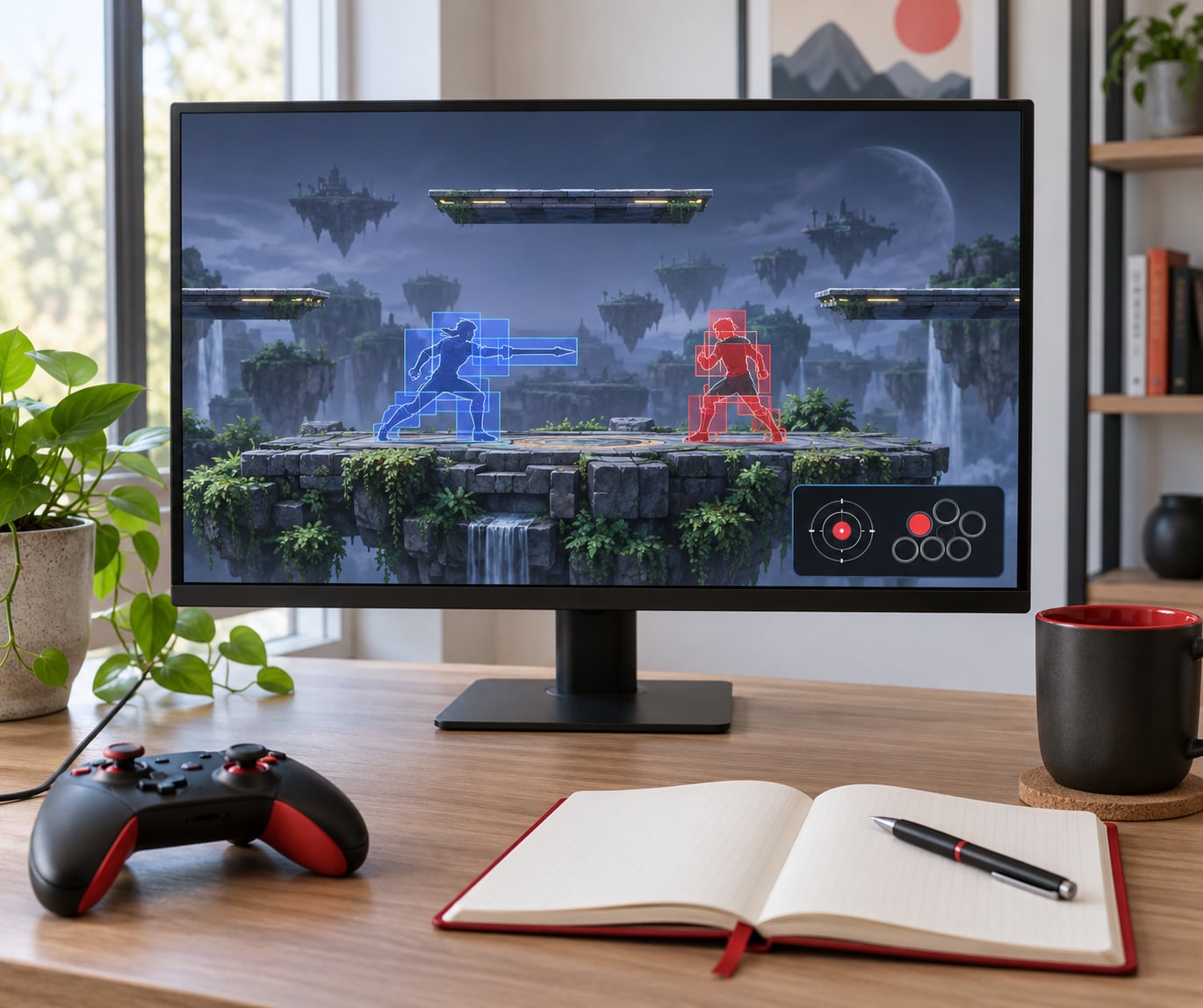
- Training mode with input display on. The input display shows your last inputs, which is the difference between drilling and guessing. Without it you are watching the animation and hoping.
- Hitbox visualization if the game has it. X-ray or hitbox view makes spacing measurable instead of a feeling.
- A written note of the exact sequence. Button and direction order, plus the frame or timing window, written down before you start.
- A way to count attempts. A tally on paper or a note app. Ten attempts is a test, fifty is a session.
- Replays or match history, when your game records them. A Rivals of Aether 2 player described solving tutorial mixup lessons by reading the AI’s fixed pattern instead of learning to react, which is exactly what watching your own footage exposes.
Set the dummy to a standing behaviour rather than an aggressive one for the first two steps. You want a still target while the input sequence is the only variable.
Step-by-Step
Seven steps, run in order. Each one has a clear exit condition, so you know when to move on instead of grinding on autopilot.
1. Choose One Tech Skill to Improve
Choose a single narrow mechanic for the session, and write down what success looks like before you start.
Good candidates are a short combo that starts from a jab, a wavedash that doesn’t drift, a knockdown conversion from a fixed distance, an edge guard after a whiffed recovery, or one recovery route off the ledge. Each has a visible pass or fail.
Find the mechanic by looking at your recent losses rather than your move list. Ask which situation repeats: the same mistake at the ledge, the same dropped string, the same whiffed reversal. Then set a number, like six clean conversions out of ten.
One technique per session. Running three at once is the fastest way to leave all three at the same mediocre level.
2. Learn the Correct Timing and Input Sequence
Break the mechanic into checkpoints: startup, active window, recovery, position, and the exact order of inputs.
Slow-motion footage or frame-by-frame replay of your own attempt shows where the sequence breaks. Watch ten attempts and the error usually repeats at the same place, usually the transition between two inputs rather than the whole thing.
Frame data helps if your game exposes it. Knowing a move is plus four on block tells you the input has to land inside a four-frame window, which is very different from a move that is plus twenty.
Repeat slowly until clean. Ten correct executions with the input display in front of you beats fifty blind reps, because blind reps train reaction to the animation rather than the inputs.
3. Drill the Mechanic Without Opponent Pressure
Drill the mechanic in isolation with repeatable setups, a fixed starting position, and short sets.
Set the dummy at one consistent distance and place yourself at a consistent spot every attempt. Change one variable at a time, or you won’t know which change fixed the problem.
Concrete setups: a knockdown string from a fixed range, the same recovery after a simulated KO, the same aerial out of a short hop from a fixed spot. Ten attempts, rest, ten more. Sets that are too long get sloppy, and the sloppy reps are the ones that get memorised.
Your exit condition for this step is simple: ten consecutive attempts with no visible error. Not nine out of ten. Ten.
4. Add Movement and Opponent Reactions
Add movement once the sequence is clean, so the technique works outside a fixed training-room setup.
Now vary the spacing, the approach direction, the platform you start on, and the defensive option you’re responding to. The same short-hop aerial that connects from standstill should connect while you’re drifting forward, and it should still work when the opponent is shielding instead of standing.
Make the dummy behave a little. A standing dummy proves your hands work; a mobile one proves you can do the thing while something else is happening. If your game lets you record dummy inputs, set a pattern that includes a whiffed attack and a jump, then run your response to both.
Ten attempts at each variation, not ten attempts total. A mechanic that only survives one variation is a memory, not a skill.
5. Practice the Skill in Short Realistic Scenarios
Connect the drill to actual match situations by setting a fixed number of attempts in a repeatable scenario.
Build the situation from something that just happened: after a whiffed move, near the ledge while disadvantaged, on wake-up, during a neutral reset. Each of these has a correct response and you can decide in under a second whether you recognised it.
Run ten attempts and score two things separately. Did you recognise the situation, and did you execute the response? Most players who fail this step fail recognition, not execution, and the two problems have completely different fixes.
This is also where the stock CPU fails you. Fixed AI mixup loops, the ABABAB pattern described on the Rivals of Aether 2 Steam hub, let you solve a lesson by memorising a pattern rather than learning to react. Recognise the pattern as a crutch, and get to real or online play before you move on.
6. Use a Consistency and Spacing Test
Measure the mechanic with a fixed number of attempts and a success rate, so reliability replaces luck as the standard.
Ten attempts, five in a row, three times across a session. Write down the number each time. If the first set is five out of ten and the last is eight out of ten, you are improving inside one session, which is the signal you are after.
Read the failure pattern. Missed entirely usually means spacing was wrong and the window never opened. Hit but late means execution. Hit but the wrong button means you chose a different option under pressure, which is a decision problem, not a hands problem.
Adjust one thing based on the pattern. If everything is landing late, the sequence is too rushed and needs slower reps. If nothing is landing, the spacing is off and you need to rebuild the setup before you touch the inputs again.
7. Review, Adjust, and Retest
Review the session, make one targeted change, and retest it in the next block.
Note the failure in one sentence. “Whiffed the second hit three times out of ten” is usable. “Combo felt bad” is not.
One change per session, then repeat the successful setup, test it under pressure, and record the goal for next time. That written goal is the whole difference between practice and drifting.
Then put it in matches. The step most people skip is the one that converts a technique into a result, and r/smashbros players consistently point at online play as the practice that actually builds adaptation, with arena-style modes named as the low-stakes place to start.
Common Mistakes
The failure modes below are all recoverable, and most are measurable once you look for them.
Practising only one easy spacing. Everything works from standstill at a fixed distance, so you conclude the technique is learned. Fix: run step four deliberately, three different distances per set.
Ignoring recovery and risk. You convert the knockdown every time in practice and then die on the way back. Fix: drill the full sequence, recovery included, and treat a safe finish as part of the pass condition.
Switching character or technique every session. Nothing accumulates. Fix: one technique for at least three sessions, or until the consistency test clears.
Treating one clean run as mastery. A single perfect string means the setup was repeatable that once. Fix: the ten-consecutive standard in step three, and the percentage in step six.
Skipping notes. The same failure shows up in five sessions in a row and nobody noticed. Fix: one line per session, no exceptions.
Moving to ranked matches before the skill is consistent. You learn nothing except that losing feels bad. Fix: hold ranked until step six passes three times.
Three habits worth keeping: fix the setup before changing inputs, test at the speed you’ll actually face, and treat the CPU as a mechanics trainer rather than a decisions trainer. Everything it can teach you about execution it teaches well. Nothing it teaches you about reading a person transfers.
Frequently Asked Questions
How long should I practice tech skill in a platform fighter each day?
Twenty to thirty focused minutes on one mechanic beats two hours of unstructured play. The number of repetitions matters more than the clock, so a short session with ten deliberate sets and a written result outperforms a long one you cannot recall. If you run several techniques, split the session into blocks of twenty minutes each rather than one long block, and stop a block the moment the repetitions stop being deliberate.
Is training mode enough to learn platform-fighting techniques?
Training mode is enough for input execution, timing, spacing, and frame advantage, and it is where the first four steps belong. It is not enough on its own for decision-making. Stock CPU behaviour runs fixed mixup loops, so a pattern you memorise from a dummy will not transfer to a person who mixes up. Treat the lab as a mechanics trainer and real or online matches as the decisions trainer, and alternate them.
When should I practice a technique in real matches?
Move to real matches once the technique is clean in training, survives more than one spacing, and passes your consistency test in separate sets. Before that, matches only give you noise. After that, they give you the one thing the lab cannot, which is a read on a human opponent. If you have no partner, online play with arena-style modes is the closest available substitute.
How do I practice platform fighters without another player?
Training mode covers execution work on its own: set a custom dummy behaviour, run a fixed setup, count attempts, and record the result. For matchup work without a partner, use replays of your own recent games, study a character’s option list, and rehearse the response rather than the execution. Community discords and locals exist for sparring, but they are not required to make steady progress on mechanics.
Why does my combo work in training mode but fail in matches?
Almost always one of three things: the spacing was fixed in the lab and varies in a match, the opponent’s response was predictable because the dummy behaves the same way every time, or you knew the string was coming and were not choosing under pressure. Test the string from three different distances, from a random start position, and against a dummy with varied behaviour. If it only works in one of those, you have a memory, not a match skill.
Conclusion
The seven steps run as one loop: choose one mechanic, find the timing, drill it clean, add movement, run a realistic scenario, measure the success rate, then review and change one thing. The loop matters far more than the tech you picked, because it is what turns a technique you can perform into one you can use.
Start today with the mechanic you keep missing in your losses, not the one on the easy tech list. Write the pass condition, run ten isolated attempts, ten with movement, ten under a realistic scenario, and note the number. That is one full session, and it tells you exactly what to change tomorrow.