Warm up before a ranked session by giving yourself ten minutes of low-intensity work: settle your settings, breathe and move your hands, then do a short aim block, a movement block, and one calm practice round. Most players skip it, queue immediately, and spend the first three rounds of the match fighting a cold crosshair instead of their opponent.
Ten minutes is enough. The routine below is built for the gap between sitting down and hitting find match, and it works whether you queue Valorant, CS2, or anything else with a gun in it.
Table of Contents
- What You Need
- Step-by-Step: How to Warm Up Before a Ranked Session in 10 Minutes
- How to Warm Up Before a Ranked Session: Minute 1
- Step 2: Breathe and Mobilize for 2 Minutes
- Step 3: Smooth Your Aim for 3 Minutes
- Step 4: Practice Movement and Peeking for 2 Minutes
- Step 5: Recreate a Calm First Round for 1 Minute
- Step 6: Check In and Queue for 1 Minute
- Common Mistakes
- Quick Warm-Up Tips for Competitive Players
- Frequently Asked Questions
- How long should I warm up before a ranked game?
- Should I stretch before playing competitive video games?
- What is the best warm-up routine for Valorant or CS2?
- How can I warm up when I only have five minutes?
- Should I change my mouse sensitivity before a ranked session?
- When should I skip ranked play instead of warming up?
- Conclusion
What You Need
You need very little: the game you are about to play (or an aim training routine if you use one), a timer, water, and the practice space you already sit in. That is the whole equipment list.
Optional extras help but are not required. A foam roller or a lacrosse ball for forearm work, a resistance band for shoulder circles, and a small notebook for tracking how the routine went are all nice to have.
One safety note before you start. Every movement in this routine should be comfortable. Stop immediately if you feel sharp pain, numbness, tingling, dizziness, or anything unusual in a joint, and talk to a doctor or physiotherapist about persistent discomfort rather than pushing through it. Warm-ups prepare you for gaming positions. They are not a treatment for an injury you already have.
Step-by-Step: How to Warm Up Before a Ranked Session in 10 Minutes
How to Warm Up Before a Ranked Session: Minute 1
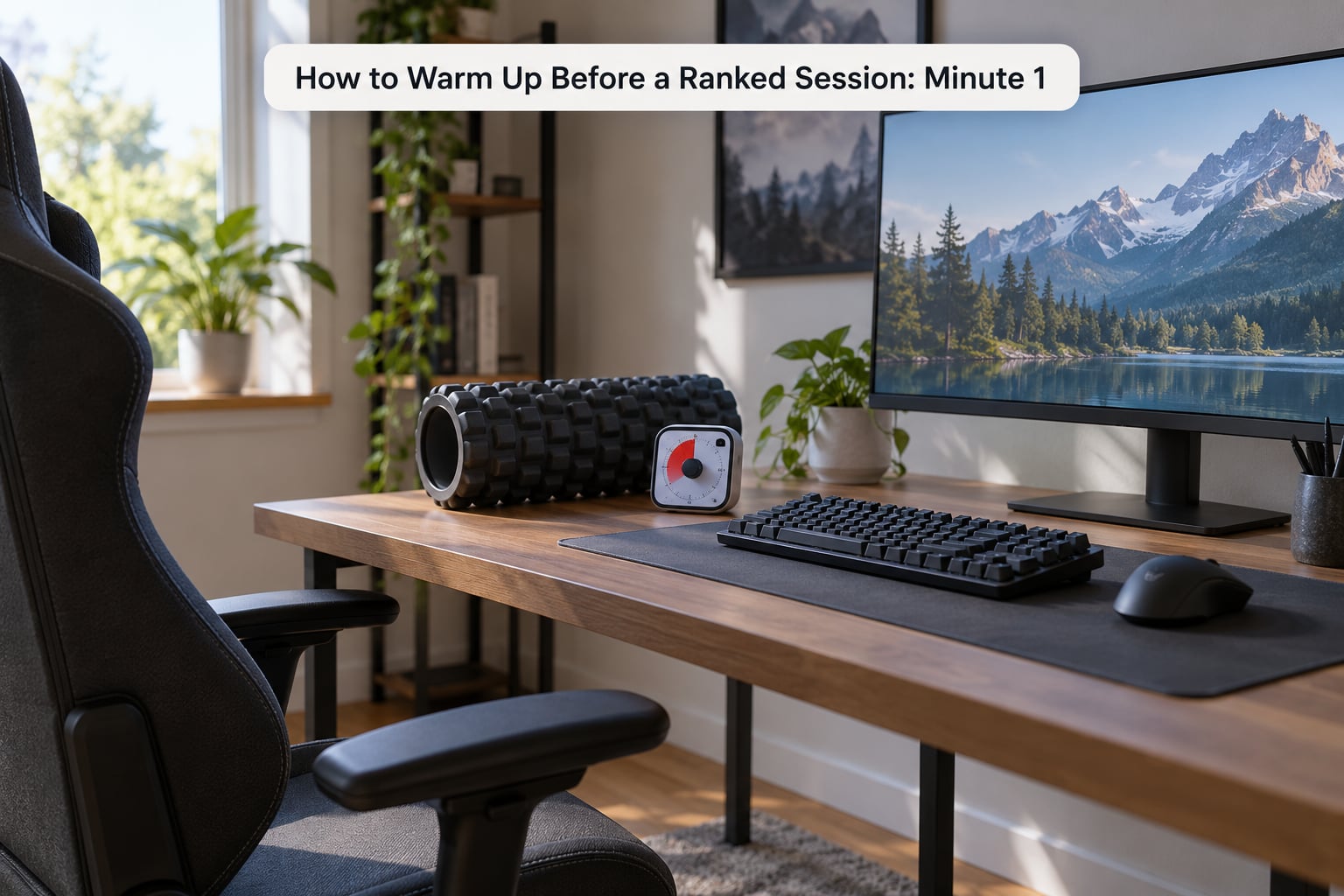
Start by confirming the conditions you will play under. Load the game, check that your sensitivity is the one you actually use, and make sure your crosshair and graphics settings match your ranked configuration.
Clear notifications, silence chat, and put your phone out of reach. The goal of this minute is to arrive at the queue already focused, not to install new plugins you have never tested in a match.
One rule matters more than the others here: do not change sensitivity, crosshair, or keybinds right before ranked. Anything new resets the muscle memory you spent the last nine minutes rebuilding. You worked it out this week, so play it this week.
You will know this minute worked when the game is loaded and you have not had a single thought about your mouse.
Step 2: Breathe and Mobilize for 2 Minutes
Take six slow breaths where the exhale is longer than the inhale. That single change drops the buzzy feeling you get after a stressful game faster than any amount of aim work.
Then move through the joints, staying inside a range that feels easy. Roll your shoulders backward and forward ten times each way, turn your head gently side to side, open and close your hands, and circle your wrists in both directions. Extend one arm with the palm up and gently draw the fingers down toward the floor, then flip the palm down and repeat on the other arm. Hold each for about fifteen seconds.
Keep every motion smooth and pain-free. The purpose is blood flow and range of motion for the positions you hold while gaming, not flexibility records. Straining into a stretch on cold muscles is how people talk themselves out of warming up for a month.
It has worked when your hands feel warm and loose and your shoulders sit lower than they did a minute ago.
Step 3: Smooth Your Aim for 3 Minutes
Work from easy to hard. Start with large, slow targets and take the time to land each one cleanly. After about a minute, move into tracking a moving target at your normal sensitivity. Finish with flick-and-follow sequences: flick to a target, hit it, and continue tracking without a second correction.
Use your real sensitivity and your real crosshair the whole time. If you are in an aim trainer, stay at roughly 60 to 70 percent effort, which is where r/VALORANT and r/FPSAimTrainer regulars tend to land, and never at maximum effort.
Resist two things: frantic clicking, and firing more bullets than the target needs. Both feel productive and both make your first shots worse. Slow and deliberate beats fast and sloppy every time at this stage.
It has worked when your clicks are landing without correction and your breathing is still steady. If you are breathing hard, slow down.
Step 4: Practice Movement and Peeking for 2 Minutes
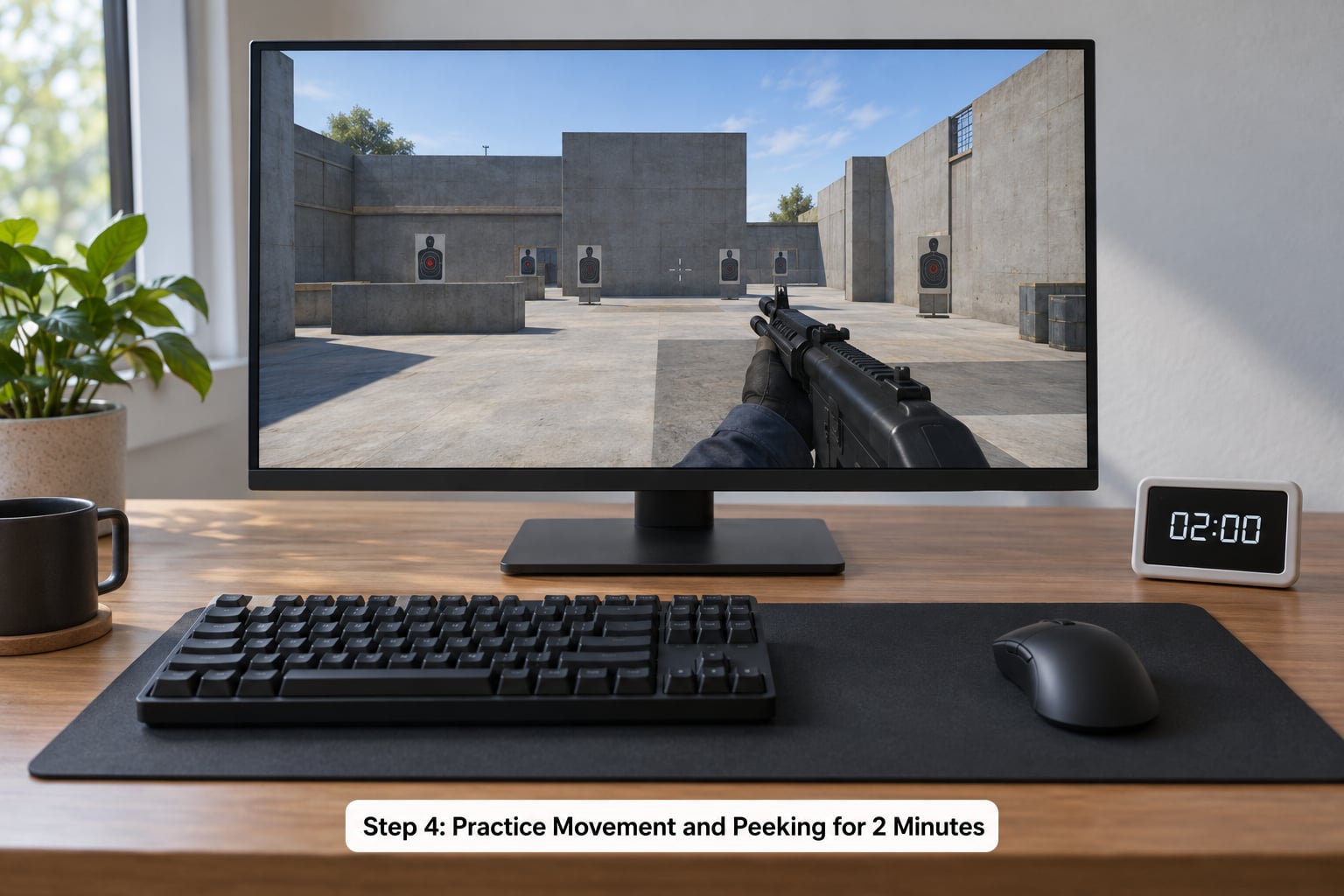
Switch to the game’s practice range and rehearse the movement skills you will need in the match, not the aim skills you just did. Counter-strafe and stop before you fire. Strafe sideways while keeping your crosshair where the enemy will appear. Lift the mouse for tight angles, then set it down and settle back into your normal position.
Peek the same corner several times from the same distance, checking that you clear it at the same speed each time. In Valorant and Overwatch 2, add a few jumpshots or a wall peek or two. In CS2, work movement shots and a short spray pattern at a wall. In Fortnite, practice the build-and-edit timings you rely on.
Consistency beats novelty here. The point is to make the timing automatic so you can think about the round instead of your footwork.
Step 5: Recreate a Calm First Round for 1 Minute
Play one low-intensity round that mimics ranked conditions. Make the buy decisions you would normally make, use your routine timings, and call only the information a teammate actually needs.
Keep the pressure off. You are rehearsing the rhythm of a match, not trying to win a scrim, so there is no reason to rush a rotate or force a duel. If the practice range has an AI option, use a low difficulty and treat it as a real round.
It has worked when you finished without frustration. If you ended the minute annoyed, your next game would have started annoyed too.
Step 6: Check In and Queue for 1 Minute
Run a quick readiness check before you queue. Are your hands comfortable and warm? Do you have full control of your mouse? Is your breathing normal? Do you know what the plan is for the first two rounds?
If any answer is no, shorten the routine rather than forcing it. A four-minute version of this routine is more useful than a rushed ten-minute one, and it is a better night for your hands too. Skip ranked entirely if you are deeply fatigued, wired from a bad loss, or already feeling the discomfort from earlier.
Use the last of this minute for water and a deliberate queue decision. Choose the mode, region, and party on purpose instead of accepting whatever pops first. Players who pick their queue on purpose lose fewer rating points than players who take whatever appears.
Common Mistakes
Stretching hard and long before queueing. Intense static stretching on cold muscles slows you down instead of speeding you up. Keep the mobility block short, keep it moving, and keep it comfortable.
Too much aim drilling. Thirty minutes of target clicking before ranked leaves you peaked in the range and flat by round five. Ten focused minutes will beat thirty scattered ones.
Changing sensitivity mid-session. The panic tweak before a match is the most common self-inflicted problem on this list. Your sensitivity is not the reason your aim feels off. Fix the aim, not the settings.
Warming up with one weapon only. If you main a rifle, add a short handgun or tracking block. Warm up the mechanics you will actually use, not just the one that feels good.
Queueing straight after a bad game. Tilt carries into the next match and the warm-up rarely fixes it. Take a real break first. The five-minute version below is for a settled player, not a furious one.
Ignoring persistent discomfort. Wrist tightness and shoulder tension that repeats every session are a signal to stop and get it assessed, not to stretch harder. No warm-up routine is worth training through pain.
Quick Warm-Up Tips for Competitive Players
Short on time? Run the five-minute version: one minute settling settings, one minute of breathing and wrist mobility, two minutes of aim at moderate effort, one minute of a calm practice round. Then queue.
Playing a non-shooter? The shape of the routine holds. League of Legends, Rocket League, and fighting games need the same settings check, the same breathing reset, and the same short mechanics block, just with your own game’s practice tool instead of a range.
Playing late or tired? Cut everything to about 60 percent effort and keep the movement block. A gentle ten minutes beats a punishing one when you are running on four hours of sleep.
Just came back from a break? Give it the full ten minutes for the first few sessions. Coming back cold is exactly the situation this routine exists for.
New to competitive play? Keep the aim block to two minutes and spend the extra time on the calm practice round. Learning to play a full match without panicking is worth more than micro-flick practice right now.
Low frame rates or rough connection? Drop the aim block and add time to the movement block instead. Precision drills need stable frames to be worth anything, and positioning practice does not.
Frequently Asked Questions
How long should I warm up before a ranked game?
Ten to fifteen minutes is the useful range for most players. Under five minutes usually leaves your hands and eyes cold, and past twenty-five you start peaking before the match begins. If you only have a few minutes, a focused five-minute version still beats queueing cold. The right length is the one you can repeat every session without dreading it.
Should I stretch before playing competitive video games?
Light mobility work helps, but long intense stretching does not. Gentle shoulder rolls, wrist circles, neck turns, and a short forearm reach prepare you for the positions you hold while gaming. Keep every movement comfortable and keep it brief. If you feel sharp pain, numbness, or tingling, stop and speak to a doctor or physiotherapist about it.
What is the best warm-up routine for Valorant or CS2?
Settle your settings, breathe and mobilize for two minutes, run three minutes of aim at moderate effort, then spend two minutes in the practice range on counter-strafing, stopping before firing, and peeking angles. Finish with one calm low-intensity round. In Valorant, add micro-flicks and burst control in the range. In CS2, add movement shots and a short spray pattern.
How can I warm up when I only have five minutes?
Do one minute of settings and focus, one minute of breathing and wrist and shoulder mobility, two minutes of aim on large targets at moderate effort, and one calm practice round at low difficulty. Skip the extended aim block and the long movement rehearsal. The short version exists to take the edge off a cold start, not to build skill, and that goal takes five minutes.
Should I change my mouse sensitivity before a ranked session?
No. Changing sensitivity right before a match resets the muscle memory you spent the last ten minutes rebuilding, and the new setting has never been tested under pressure. Pick the sensitivity you have used for the past week and commit to it for the session. If a setting genuinely needs to change, change it during a casual game several days earlier, not before a queue.
When should I skip ranked play instead of warming up?
Skip it when you are deeply fatigued, still angry from a previous match, dealing with wrist or shoulder pain, or have had almost no sleep. None of those improve with ten minutes of practice. Play a few casual rounds or stop for the night. Warming up works best on a player who is already settled, and it cannot fix a state you are not in.
Conclusion
Set a ten-minute timer the next time you sit down to queue. Start with a minute of settings and focus, then two minutes of breathing and pain-free mobility, three minutes of smooth aim, two minutes of movement and peeking, and one calm practice round before you decide to queue.
Run it the same way for two weeks. You will find out quickly whether your first three rounds stop feeling like a cold start, and which block is the one you actually need.