A glitchless speedrun is a category in which a runner finishes the whole game as fast as possible without using any glitches, sequence breaks, skips, or exploits. Movement tricks, combat optimisation and routing are all still fair game, but the run has to work the way the game was built to work.
If you have landed on this page wondering why a clean run is slower than the record you keep seeing, the short version is that the fastest time and the honest time are usually not the same run. This guide covers what the category actually bans, what it quietly allows, and how a run gets onto the leaderboard in the first place.
Table of Contents
- What Glitchless Speedrun Means
- What a glitchless speedrun still allows
- Why the category exists at all
- Glitchless is not always a separate category
- How Does a Glitchless Speedrun Work?
- Read the category rules page first
- What the clock is doing
- What Counts as a Glitch in Speedrunning?
- Glitchless is not the same as cheat-free
- How Do Speedrunners Verify a Glitchless Run?
- Glitchless Speedrun vs. Glitch-Assisted Speedrun
- Why Do Gamers Choose Glitchless Categories?
- Frequently Asked Questions
- Is every speedrun supposed to be glitchless?
- What is the difference between a glitchless run and a no-glitch run?
- Can a speedrunner use an exploit and still set a record?
- Why do speedrunning categories have different glitch rules?
- How can viewers tell whether a speedrun is glitchless?
- Conclusion
What Glitchless Speedrun Means
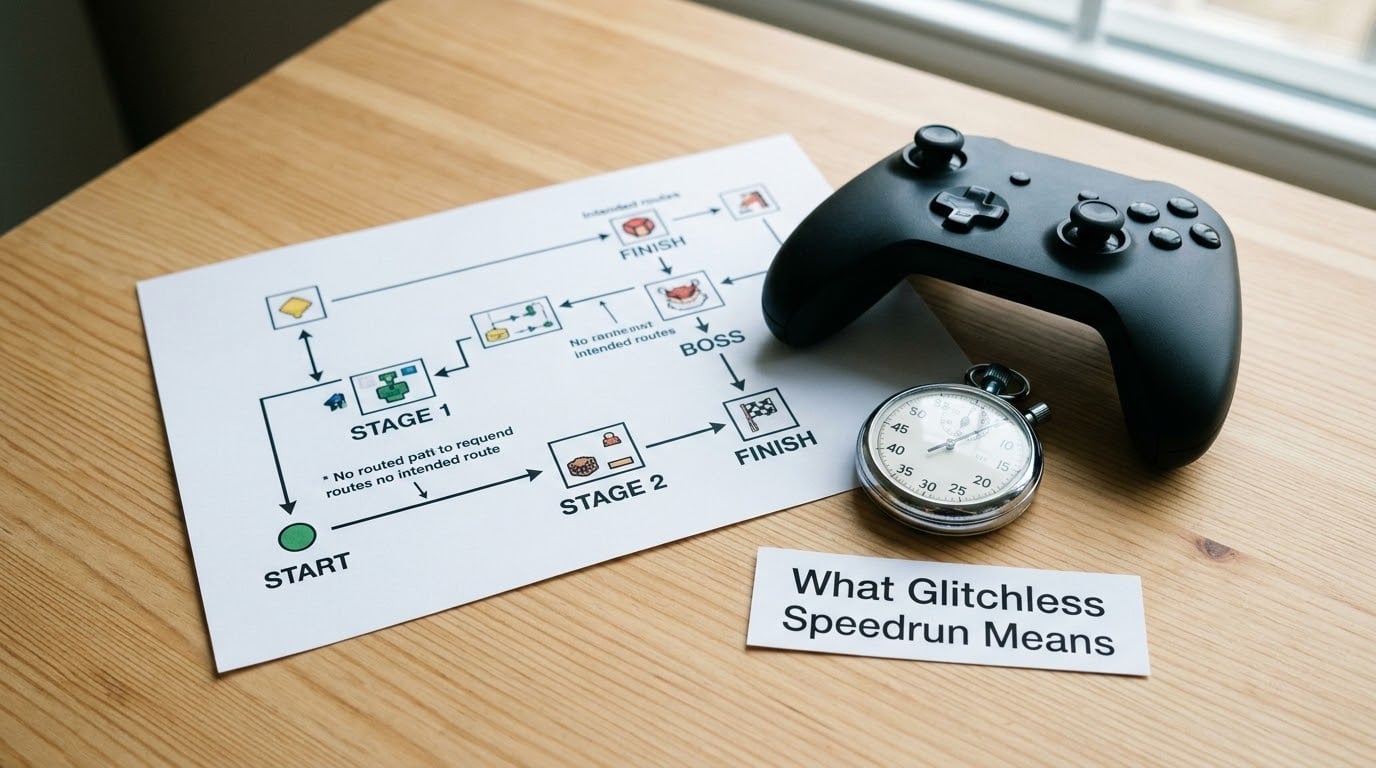
The category name is a contraction of glitch-free. It bans glitches, not speed, and it does not ban the runner from being very good at the game. A skilled route through every zone, fast menu handling and clean boss kills all count, because none of them break the game.
- Fastest legal finish. The clock still runs. Glitchless runners optimise as hard as anyone, they just cannot use anything the community has classified as a glitch.
- No exploits, no shortcuts past content. Sequence breaks, out-of-bounds routes, skip techniques and crash-based tricks are out.
- A real competition category. It has its own leaderboard, its own rules page and its own moderators, usually on speedrun.com.
What a glitchless speedrun still allows
This is the part that trips people up. The category is not a no-tricks category. In the Eternal Towers of Hell rules discussion on speedrun.com, community members spelled out that ladder flicking, regular high-jumping and two-stud pull-ups are not glitches, while wallhopping, emote glitching and lag high-jumping are. Same game, same community, two lists.
Bunny hopping, subpixel movement, frame-perfect input and route optimisation are almost always legal, because they push the engine harder without giving the player access to anything the developers never put in.
Why the category exists at all
A moderator on the A Short Hike forum thread framed the whole thing as two conflicting objectives. Objective 1 is to beat the game as fast as possible by any method. Objective 2 is to beat the game the way it was intended to be played. Any% chases the first, glitchless chases the second, and the same runner may care about both.
Communities also add a glitchless category when a single dominant trick changes how a game is played. The Mewgenics newcomer thread makes that prediction explicit: when something new reshapes routing, expect a glitchless category and a separate exploit category. Until then, most boards do not have one, which is why people on Reddit asking for Tears of the Kingdom or Elden Ring glitchless runs so often get pointed at nothing.
Glitchless is not always a separate category
Here is a nuance almost nobody covers. Glitchless is sometimes a standalone ranking, and sometimes a verification tag attached to a run submitted to the main Any% board. In Sonic 3 and Knuckles, runners noted on speedrun.com that a glitchless time can always be submitted to the main leaderboard, since the people there do not all use the same set of tricks. On TASVideos, a Standard ruleset can carry several goals at once, with No Major Skips and Glitchless stacking as modifiers.
So when someone asks whether glitchless is its own category, the honest answer is: sometimes, and it depends entirely on how that game’s community set it up.
How Does a Glitchless Speedrun Work?
A glitchless run is one continuous real-time attempt from the moment the game starts to the moment the final objective is complete, using only mechanics the game’s own rules support. The runner still plans an optimal route, still fights bosses quickly and still avoids deaths where dying costs seconds.
Where it differs is the route itself. Any% runners route around encounters entirely, skip entire zones and break collision so a door opens from the wrong side. A glitchless runner routes through all of that content in the order the game expects it, which is why the times are so much higher. One Secrets of Grindea player described finishing a full clean run in roughly three hours and seventeen minutes and called it comfortably doable for a competent player. That is a very different shape from an Any% time.
Read the category rules page first
Every serious glitchless community has a written rules page on the game’s leaderboard, and that page is the authority. Not a blog, not a forum opinion, not a video. The rules page lists the banned techniques by name, notes the platform and version required, and usually states the frame-rate cap and whether mods or patches are allowed. Runners consistently say the same thing: precise written rules matter more than anything else, and the top request on those forums is a clearer list of what is and is not a glitch.
A Short Hike moderator reply noted that glitchless has always been hard to moderate precisely because the definition of a glitch is subjective. That is why the community has to write the boundary down.
What the clock is doing
Runs are timed with a split timer, almost always LiveSplit, which breaks the run into named segments. The timer also acts as evidence: a moderator can compare the splits against the video and see instantly if a segment looks impossible without a glitch. A run that starts on a save file state instead of a fresh boot will not match, and neither will a run that was paused, loaded, or started mid-level.
What Counts as a Glitch in Speedrunning?
A glitch is an unintended behaviour in the game that gives the player an advantage the developers never meant to allow, usually by breaking collision, physics, level boundaries or the rules of progression. The key phrase is advantage through malfunction. A move the game supports, however strange it looks, is not a glitch.
The most-cited rule of thumb comes from a Legacy of Kain: Soul Reaver thread on speedrun.com. Doing something in a way the developers did not intend does not automatically make it a glitch, as long as the runner is not expanding on the game’s abilities to reach content or states that were never meant to be reachable that way.
Here is how the boundary usually falls, using the techniques runners actually argue about. A Steam Community routing thread for a 2018 title gave a clean plain-language version: no clips or zips, no skips, no momentum abuse.
| Usually counts as a glitch | Usually still legal in glitchless |
|---|---|
| Out-of-bounds routes into unloaded areas | Regular high-jumping and long jumps |
| Wallhopping through solid geometry | Ladder and truss flicking |
| Lag-based clips and lag high-jumping | Two-stud pull-ups and two-stud walls |
| Emote glitching to move or skip content | Bunny hopping and subpixel movement |
| Damage boosting far past intended values | Frame-perfect inputs and menu manipulation |
| Arbitrary code execution and credits warps | Skipping optional dialogue or cutscenes |
| Sequence breaks that skip required progression | Taking fights in any order the game allows |
Game rules change this list. A 3D game with a physics engine will have tricks a 2D platformer cannot have, and communities reclassify as they go. One Reddit commenter described the usual pattern for beginners: learn the clean route, then add skips one at a time as you move to faster categories.
Glitchless is not the same as cheat-free
This is the most common confusion for newcomers. Glitchless is a routing rule, not an anti-cheating system. It does nothing about splicing a run together from separate attempts, running it on a tool-assisted emulator, editing the timer or save file, or faking a time. Those are separate problems handled by a different part of the community, and a run can be entirely glitchless and still invalid for reasons that have nothing to do with glitches.
Moderators catch that side of things with handcam footage, forensic audio checks, console verification on the original hardware, and statistical comparison against previous runs. Knowing a run is clean tells you nothing about whether it is honest.
How Do Speedrunners Verify a Glitchless Run?
Verification for a glitchless run is a five-step pipeline, and it starts the moment the runner presses start. Most of the work happens after the run is over, not during it.
- Record the attempt in real time. Full capture of the screen, with the timer running, starting at the same moment the game loads. Tools that automate inputs are not eligible for real-time leaderboards.
- Submit the video to the game’s leaderboard on speedrun.com, with the run notes explaining anything a moderator would not immediately recognise as clean.
- Moderator review. A moderator watches the run against the category rules and checks the segments most likely to hide a skip. This is where the subjective part of the definition does its damage.
- Verification and placement. Once approved, the time goes on the glitchless board. If a moderator is unsure, the run can sit in a verification queue, or get posted to the forum for a second opinion.
- Post-run audit for edge cases. Rarely, a run is approved and then later pulled when someone spots an unintended technique. That is why runners read the rules carefully instead of finding out the hard way.
The split file is submitted alongside the video and is genuinely useful evidence, because a run with impossible splits is a red flag. Handcam video is requested when a technique is unusual but not obviously banned, and original-hardware verification matters because many exploits only exist on emulators.
Real examples of what survives this process are easy to find. Pokemon Yellow has a glitchless Any% record of 1:55, where Nidoking is the key technique. Shadow of the Erdtree has an Any% Glitchless world record of 1:08:01. Ocarina of Time glitchless Any% runs have a community record around 3:49:43, and there is a long-form video essay tracking how that category changed as tricks were reclassified over the years. That last example is the best illustration of why glitchless is a moving target rather than a fixed rule set.
Glitchless Speedrun vs. Glitch-Assisted Speedrun
The two run types use the same game and often the same starting point, but they measure different skills and produce different leaderboards. Here is the practical comparison.
| Point of comparison | Glitchless | Glitch-assisted |
|---|---|---|
| Goal | Fastest finish using only intended mechanics | Fastest finish allowed by the category rules |
| Glitches | Banned entirely | Expected and central to the route |
| Routing | Every required piece of content, in order | Skips, sequence breaks and out-of-bounds routes are normal |
| Equipment | Real-time on console or permitted emulator, timer started by hand | Same, but exploits drive most of the routing |
| Typical time | Considerably longer, often several times Any% | The headline record everyone shares |
| Record eligibility | Own category or a tag on the main board | Any% and lower categories |
| What viewers see | A clean, fast playthrough of the whole game | A stunt run through a broken game |
Neither is more legitimate than the other. Glitch-assisted running is where most of the community’s famous records live, and breaking a game cleanly is a genuine skill of its own. Glitchless is simply the version that keeps the game intact.
Why Do Gamers Choose Glitchless Categories?
It measures the game instead of the bug. A runner cannot fall back on finding an exploit, so the time reflects routing knowledge, execution and consistency. That is why one Zelda community member said Any% glitchless was their favourite category, because you had to play the game as intended while still using a few cool tricks and finishing as fast as possible.
It gives beginners something that transfers. Advice that circulates on Reddit r/speedrun is consistent: start with glitchless, then move up. Everything you learn about routing, splitting and boss order works in every other category later, so the skills are not wasted. A clean route is the foundation a faster route is built on.
It preserves the game for viewers. Watch an Any% run and you may see three percent of the game. Watch a glitchless record and you see a genuinely fast playthrough that makes the game look like a game people would recognise. That is the appeal for a stream audience that has no interest in a sequence break through the entire credits roll.
It solves a real leaderboard problem. When one trick makes a category trivial, the game stops having a competition. A glitchless board restores it, and communities add one precisely for that reason.
It is honest about the cost. Glitchless is not easier. Sub-three-hour Elden Ring clean runs come up regularly on Reddit, and the reply there is blunt: if you are attempting that, you are not a casual player. Anyone starting out should pick a game with an active community and a rules page, not a FromSoftware catalogue entry.
Marathons have their own take. Events like Games Done Quick rarely feature a pure glitchless run, because the format rewards spectacle, and a clean playthrough is the opposite of a spectacle. Glitchless lives mostly on individual leaderboards, small races, and personal goals, where the audience is people who care about the time more than the entertainment.
Frequently Asked Questions
Is every speedrun supposed to be glitchless?
No. Most speedrunning categories actively depend on glitches. Any% is built around exploits, skips and sequence breaks, and that is where most famous records live. Glitchless is one optional category among many, chosen by runners who want to compete without breaking the game.
What is the difference between a glitchless run and a no-glitch run?
There usually is not one. No-glitch and glitch-free are just other names for the same idea, and so is the modifier Intended Route that some communities prefer. The name varies by game, but the rule underneath is the same: finish as fast as possible using only mechanics the game supports.
Can a speedrunner use an exploit and still set a record?
Yes, as long as the category they are running allows it. Any% and No Major Glitches both permit exploits, with No Major Glitches banning only game-breaking ones. Only a glitchless run is judged on using nothing unintended, so a record there requires a clean playthrough.
Why do speedrunning categories have different glitch rules?
Because each community decides independently what belongs in its own ruleset, and games differ. A physics-based 3D title produces tricks a 2D platformer cannot have, and communities reclassify techniques as they learn more. Always read the specific category rules page on the leaderboard rather than assuming another game’s rules apply.
How can viewers tell whether a speedrun is glitchless?
You cannot always tell just by watching, which is why submitted videos are reviewed by moderators against the written rules. Signs of a clean run include an obviously complete playthrough, a split file whose times match what the video shows, and start-to-finish recording with no cuts. Verification is a human judgement call, not an automatic check.
Conclusion
A glitchless speedrun is simply a run where nothing unintended is used. The runner still pushes for speed, still routes smartly and still executes cleanly, but every shortcut the developers did not build is off the table, which is why the times are longer than the ones you see shared online.
When you watch or attempt one, check three things in this order: the category’s written rules, the video evidence, and whether the route follows the intended order of the game. That is the whole category, and nothing about it is secret.