Good economy management is what lets you win rounds you are outgunned in, and it is the reason two evenly matched teams end a map with different scores. If you are wondering how to manage economy in round based shooters, the whole system comes down to one habit: decide as a team what you are buying this round and what you are keeping for the next one, before anybody spends anything. That takes about ten seconds of thought per round and it is worth more than most aim drills.
Two evenly matched teams usually lose streaks of rounds for one reason. One side spends its money on a loadout that cannot win the round, then starts the following round with nothing. The whole discipline is about not being that side.
Table of Contents
- What You Need to Manage Economy in Round-Based Shooters
- Step-by-Step: Managing Your Economy Round by Round
- 1. Set a Team Economy Plan Before the Buy Phase
- 2. Buy Weapons Around a Clear Role
- 3. Use Utility Without Wasting Credits
- 4. Know When to Save, Eco, or Force
- 5. Track Income and Reset Your Plan
- 6. Make Smart Mid-Round Adjustments
- Common Mistakes
- Tips for Building a Consistent Economy
- Frequently Asked Questions
- What is a round-based shooter economy?
- How does the CS2 economy work?
- How does eco work in Valorant?
- When should you force buy?
- Is high economy good in Valorant?
- How do I track economy in solo queue?
- Conclusion
What You Need to Manage Economy in Round-Based Shooters
Before any buy phase, you need six pieces of information. Without them you are guessing, and guessing with real in-game currency is how teams end up broke at match point.
- Your team’s total credits. Not your own number. Add up what everyone is carrying, because a buy only works when the whole team can afford it.
- The buy-round status. Is this the pistol round, the round after a pistol win, or a mid-half round where a loss streak is climbing?
- Weapon and utility costs. Know roughly what a rifle plus armor plus a two-utility stack costs in the game you play, and what a cheaper alternative costs.
- Expected income this round. Winning pays, losing in a row pays more each time, and some weapons pay far better for kills than others.
- Current loadouts. Who already has a rifle, who has only a pistol, who picked up a weapon off a dead teammate.
- The likely next round. If you spend everything now, what can you buy on the round after?
That last item is the one people skip, and it is the one that decides matches. A buy is never just about this round. It is about what it leaves you with for the next four.
Step-by-Step: Managing Your Economy Round by Round
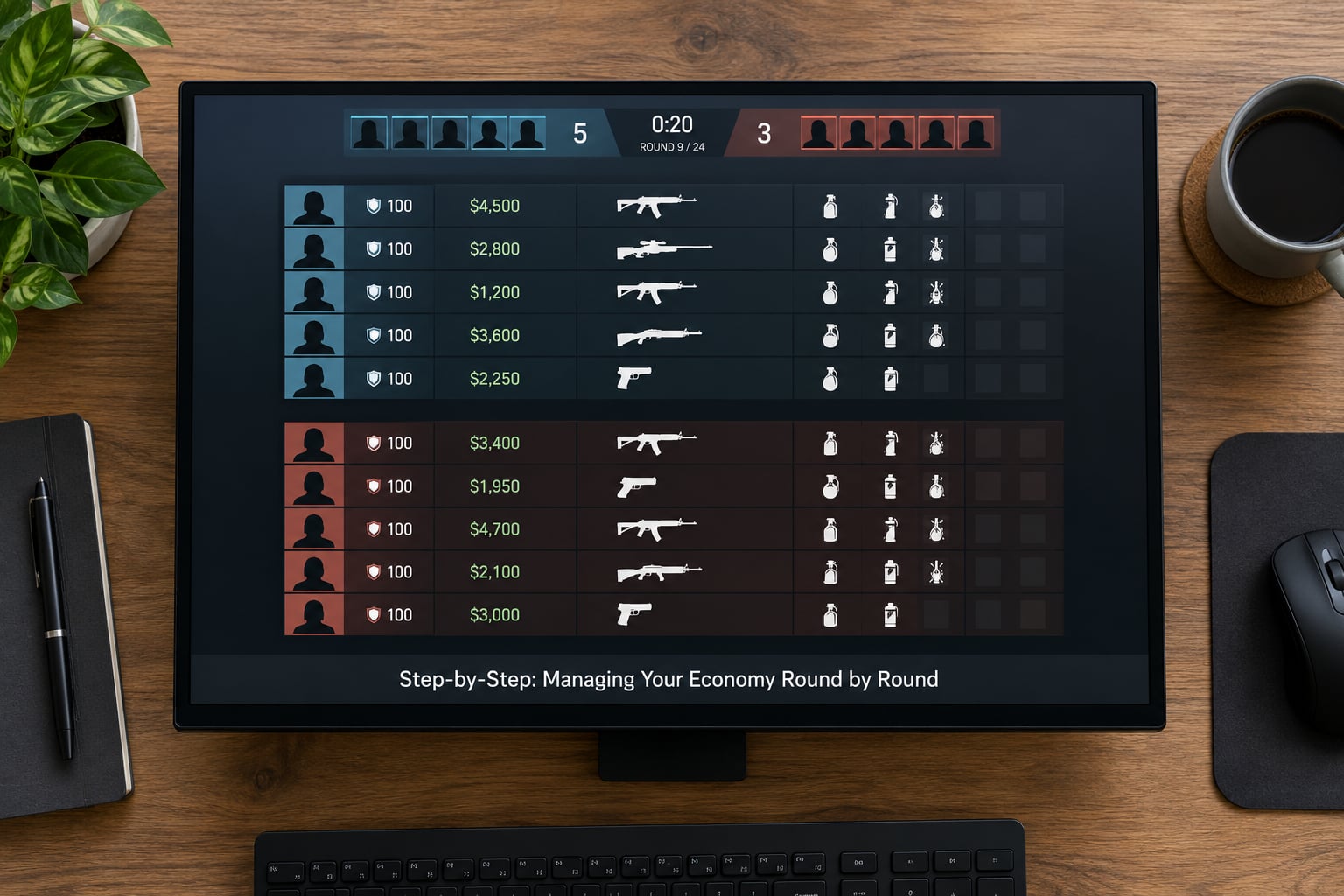
1. Set a Team Economy Plan Before the Buy Phase
Talk in the buy phase, not after the round starts. The call should be one of four words, and everyone should hear it.
| Buy call | What it means | Typical situation |
|---|---|---|
| Full buy | Everyone gets a proper loadout | You have enough credits for rifles, armor and utility across the whole team |
| Half buy | Cheaper or partial loadouts | You can afford some rifles but not the full stack for everyone |
| Eco | Spend very little, bank the rest | A loss streak is climbing and next round matters more |
| Force | Spend anyway, no plan for after | Last rounds of a half or a match, or no realistic full buy coming |
The rule most communities land on is simple: eco when your money plus the credits you are about to receive for losing are still short of a full buy, and only when at least half the team agrees. Individual math does not override the team. One player deciding on their own is how you get a squad where one person has a rifle and four have pistols, which loses more often than a full eco would.
If only one teammate is short, the fix is a drop, not a split. Buy your rifle and hand it over, or let them buy and take their weapon yourself. One grenade is worth less than a teammate holding a real gun.
2. Buy Weapons Around a Clear Role
The most common wasted-credit mistake is five players buying the same expensive item. Assign roles out loud and buy to them.
Entry players take the weapon they will use first, on the first contact. Support players buy utility and the secondary weapons that let them trade for an entry. Snipers buy the scoped weapon and little else, because that is already their whole budget. Lurkers on the rotation need a weapon they can use in a different part of the map, not the one they just abandoned.
Two economics notes here. First, an operator or sniper rifle is a poor choice on a force buy in many games, because the kill reward is tiny and you hand the enemy team very little income. Mechanically strong, economically expensive. Second, cheap submachine guns are strong on an anti-eco round precisely because they are cheap and kill rewards are predictable. Buy what the round rewards, not what your favorite player uses.
3. Use Utility Without Wasting Credits
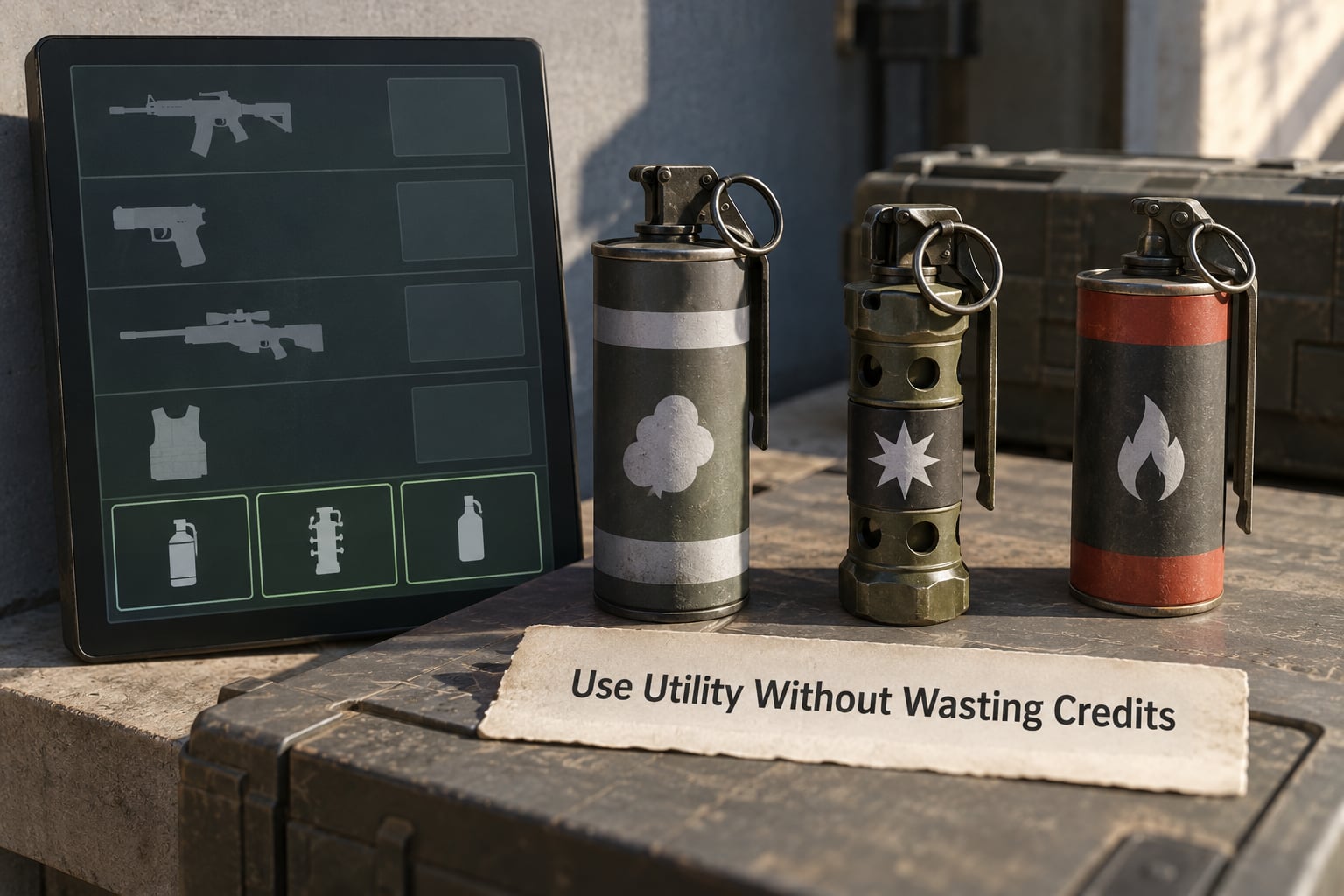
Utility is the first thing to cut when money is short, and the first thing to buy with leftover credits. The order when funds are tight is simple: armor before utility, and within utility, area denial beats raw damage.
A smoke that stops an opponent seeing your execute is usually worth more than an extra flash, because it changes the fight instead of adding to it. Incendiary utility is next. Flashes are the most tempting thing for a low-credit player to buy and the easiest to waste, especially utility nobody will use in the actual round plan.
Ask one question before every purchase: will this item be used in the next thirty seconds of the plan we agreed on? If the answer is unclear, the credits are better kept for next round.
4. Know When to Save, Eco, or Force
Saving, eco and force are three different decisions that players constantly mix up. Saving means keeping your weapon and losing the round on purpose. Eco means buying cheap gear with part of your credits while banking the rest. Force means spending regardless, accepting that the following round will be hard.
Save whenever the round is already lost. A weapon you walk away with is worth more next round than a meaningless kill that hands the enemy team income. This is community consensus with almost no dissent, and it is the single cheapest habit in the game.
Eco when the loss bonus is climbing and a full buy is still out of reach. Eco when your team cannot field a loadout that wins fights, since a bad buy with rifles loses and earns nothing. Eco when the round is a loss but the next one is a full-buy round you can actually afford.
Force in three situations only: the final round of a half, where the bonus economy reset on the other side makes holding credits worthless; the final round of a match; or when the odds of reaching a better buy later are worse than the odds of winning this round now.
The awkward middle case is real and worth naming. A fourth-round eco that gets you to a full buy next round is correct. A fourth-round eco that leaves you at four-fifths of a buy is the worst of both worlds, and in that situation a force is usually the better call.
5. Track Income and Reset Your Plan
Income comes from four places, and knowing which one is paying right now tells you what your next buy looks like.
| Income source | Typical effect |
|---|---|
| Round win | Largest reliable payout, paid every round you win |
| Loss streak step | Increases with each consecutive loss, resets on a win, and is the single biggest driver of mid-half buys |
| Objective play | Planting or holding the objective pays a bonus, and defusing pays one too |
| Kill rewards | Varies enormously by weapon. Budget rifles and pistols pay well, high-power sniper rifles pay poorly |
A worked example. Your team loses the pistol round, so you are all slightly short. Round two is an eco on both sides. You lose again, and now the loss reward has stepped up, so the credits you are about to receive are larger than the credits you already have. Round three is a full buy on paper, and both teams lose it, but your loss streak is now longer, so the payout steps up again. Round four is the round the fight actually turns, because the teams disciplined enough to eco twice arrive with rifles and utility while the teams that forced buys arrive with pistols.
Two resets matter and almost nobody mentions them. At half time the loss streak clears, so the round right after a side swap is a fresh economic start. The same is true going into overtime, where a forced extra round can make holding credits pointless. Check your game for the exact reset rules, since they differ between titles.
Solo queue makes this harder because no one is talking. Fall back to one habit: buy the cheapest thing that still wins fights, and never buy an expensive item you cannot replace by the round after.
6. Make Smart Mid-Round Adjustments
The round rarely goes to plan, and mid-round decisions are part of economy management rather than a break from it.
When a teammate dies with a rifle you wanted, pick it up if the position is safe. When you are the last player alive and the round is gone, do not trade the round for a kill with your best gun. When a strategy fails, reset to the plan that matches your loadout instead of improvising with what you happen to hold.
When your team unexpectedly has spare credits, buy utility for the next player who needs it rather than upgrading your own rifle for one round. Spare credits are worth more as a donation than as a marginal upgrade.
And when your team has less than the opponent, stop trying to out-buy them. Play for the round they cannot afford to lose, stay alive to keep the loss streak climbing, and take the free credits.
Common Mistakes
These eight mistakes show up in almost every match, and each one has a simple correction.
- Buying alone. Your credits are your team’s credits. If a teammate is short, drop them your weapon before you buy utility.
- Splitting the buy. One rifle and four pistols is weaker than a full team eco because you fight the round at full disadvantage with nothing banked. Go all-in or all-cheap.
- Buying an expensive scoped weapon on a force buy. The kill reward is poor, so a lost round leaves the enemy team poorer than you. Buy it when you can afford the round after.
- Over-investing in utility. Grenades you never use are the most common waste in the game. One or two with a purpose beats a full stack of speculation.
- Forcing every round. Winning nothing and banking nothing for two rounds is how a deficit becomes unrecoverable. Force is a decision, not a default.
- Ignoring the loss streak. The step on your next payout is often larger than anything on the scoreboard. Track it before the buy, not after the round.
- Saying nothing in voice comms. The best economy play in the game is a two-second call before the timer starts.
- Dying with a stolen weapon on a lost round. You just converted your savings into enemy income. Save the gun.
Tips for Building a Consistent Economy
Set credit thresholds before you queue. Decide in advance what your team does at each money band, so the call is a lookup rather than an argument in the buy phase.
Call the buy early and call it once. Write the round plan in one sentence during the buy phase and make sure the purchases match it.
Review your losses after the match. Half of the rounds you lost on an anti-eco round were rounds where the money was right and the decisions were not. Note the round number and the call you made, and look for a pattern across a few matches rather than one.
Adjust for the opponent, not for your habits. Track what their last two buys looked like. A team that full bought and lost is likely to be poor next round, and that is your cue to slow the game down and take the free credits instead of trading into their rifles.
Use a calculator or spreadsheet if your game has one. Entering your total, the round and the loss streak and getting a buy, force or save call takes seconds and takes the emotion out of the decision.
Frequently Asked Questions
What is a round-based shooter economy?
It is the in-game money system that decides what weapons, armor and utility you can afford each round. You start each half with a small fixed amount, earn more from winning rounds, losing in a row, playing the objective and scoring kills, then spend it in a buy phase. Loadouts are never fixed: the same player has a rifle one round and a pistol the next.
How does the CS2 economy work?
In CS2 you start with 800 dollars each half, win a round for a larger payout, and lose consecutive rounds for a payout that steps up each time before resetting on a win. Plant and defuse pay bonuses, and kill rewards vary by weapon. Money is capped, and half time clears the loss streak so the round after the swap is a fresh economic start.
How does eco work in Valorant?
An eco round in Valorant is a round where you spend very little of your credits, usually on armor and a cheap sidearm, and bank the rest. Because the loss reward steps up each time you lose, an early hard eco is often correct so that you can afford a full rifle plus armor on the round after. Your weapon is credits, but the ladder behind it works the same way as in CS2.
When should you force buy?
Force when there is no better buy coming: the final round of a half or a match, or when a loss streak is already maxed and you are still short of a full buy, so banking gains you nothing. A fourth-round eco that reaches a full buy next round is correct, but a fourth-round eco that leaves you short of a full buy forever is not. Decide as a team, never alone.
Is high economy good in Valorant?
High economy is good, but only if you convert it. Credits that produce a won round are worth more than credits you sit on. A team that full buys every round and loses often ends up poorer than a team that ecoed twice and then won its first full-buy fight, because a loss at a maxed loss streak pays less than a win does.
How do I track economy in solo queue?
Watch the loss round number on the scoreboard rather than trying to count every credit. You are really tracking two things: whether the last round was a win or a loss, and whether the opponent bought well. If their last round was a full buy that they lost, they are probably poor next round, and the smart play is to survive and take the credits.
Conclusion
Economy management is a short decision made once per round: pick full buy, half buy, eco or force, say it out loud, and buy only gear that serves both this round and the next one. Start with the three habits that pay off fastest. Add up team credits instead of tracking your own, drop your rifle to a teammate who is short, and save your weapon whenever the round is already lost. Those three, done consistently, will fix more rounds than anything else you change this season.