You win more one versus one fights by controlling the terms of the exchange before anyone fires a shot: where the fight happens, at what range, who moves first, and what you are willing to trade. That is the short answer to how to win more 1v1 fights, and it holds whether you queue into a battle royale, a tactical shooter, or a one-on-one fighter. Raw reflex matters far less than most losing players assume, and the eight habits below are ordered so you can work through them one at a time instead of changing everything at once.
I have watched a lot of people improve and a lot stall, and the pattern is stubbornly consistent. The ones who climb are not usually the ones with the fastest clicks. They are the ones who set a narrow target for a session, control distance, and are honest in review about which decision cost them the round. Everything here comes back to that loop: decide, execute, review, adjust.
The advice below is deliberately game-agnostic. Where a mechanic matters, I will name it in a few titles so you can translate it tonight, but the underlying habits are shared. A shooter and a fighting game feel nothing alike in the inputs and behave the same way in the decision layer: which position is favourable, which moment is safe, and when walking away is the correct play.
Table of Contents
- What You Need Before You Start
- Step-by-Step: How to Win More One Versus One Fights
- Step 1: Set a Specific Win-Rate Goal
- Step 2: Learn the Three Most Common Matchup Patterns
- Step 3: Prioritize Spacing Over Panic Button Presses
- Step 4: Build a Small Repertoire of Reliable Options
- Step 5: Make One Better Decision Per Match
- Step 6: Learn When Not to Engage
- Step 7: Review Losses Instead of Blaming Matchmaking
- Step 8: Protect Focus and Emotional Control
- Common Mistakes
- Common Mistakes Checklist
- Frequently Asked Questions
- How long does it take to get better at one-versus-one games?
- Should I focus on practicing one character or learn multiple?
- How do I improve when I keep losing the same way?
- Is watching stronger players useful if I lose most of my matches?
- How many matches should I play to know if I am improving?
- Can these habits improve my win rate across different PvP games?
- Conclusion
What You Need Before You Start
Before changing anything about how you play, you need five things in place. Skipping this stage is why most improvement attempts evaporate after a week.
A main mode to measure. Pick one mode or one character and treat it as your baseline for a couple of months. Progress you measure across five different games is not progress, it is noise.
One limited practice objective. Not “get better at duels” but “hold my crosshair at head level through every corner clear” or “win the opening exchange without taking damage below half”. A narrow target is the only thing you can actually verify.
Access to replays or match history. Every major competitive title stores a replay or stat line. If yours does not, screen-record a handful of matches instead. Review is where the actual gain lives, and it is the step everyone skips.
A control settings baseline. Know your sensitivity, your look speed, your response curve, and your button layout, and write them down. Chasing new settings mid-grind feels productive and mostly just adds variance to your results.
A notebook or a tracking sheet. Three columns is enough: the situation, the decision, the correction. A phone note works. The format does not matter, the habit does.
Step-by-Step: How to Win More One Versus One Fights
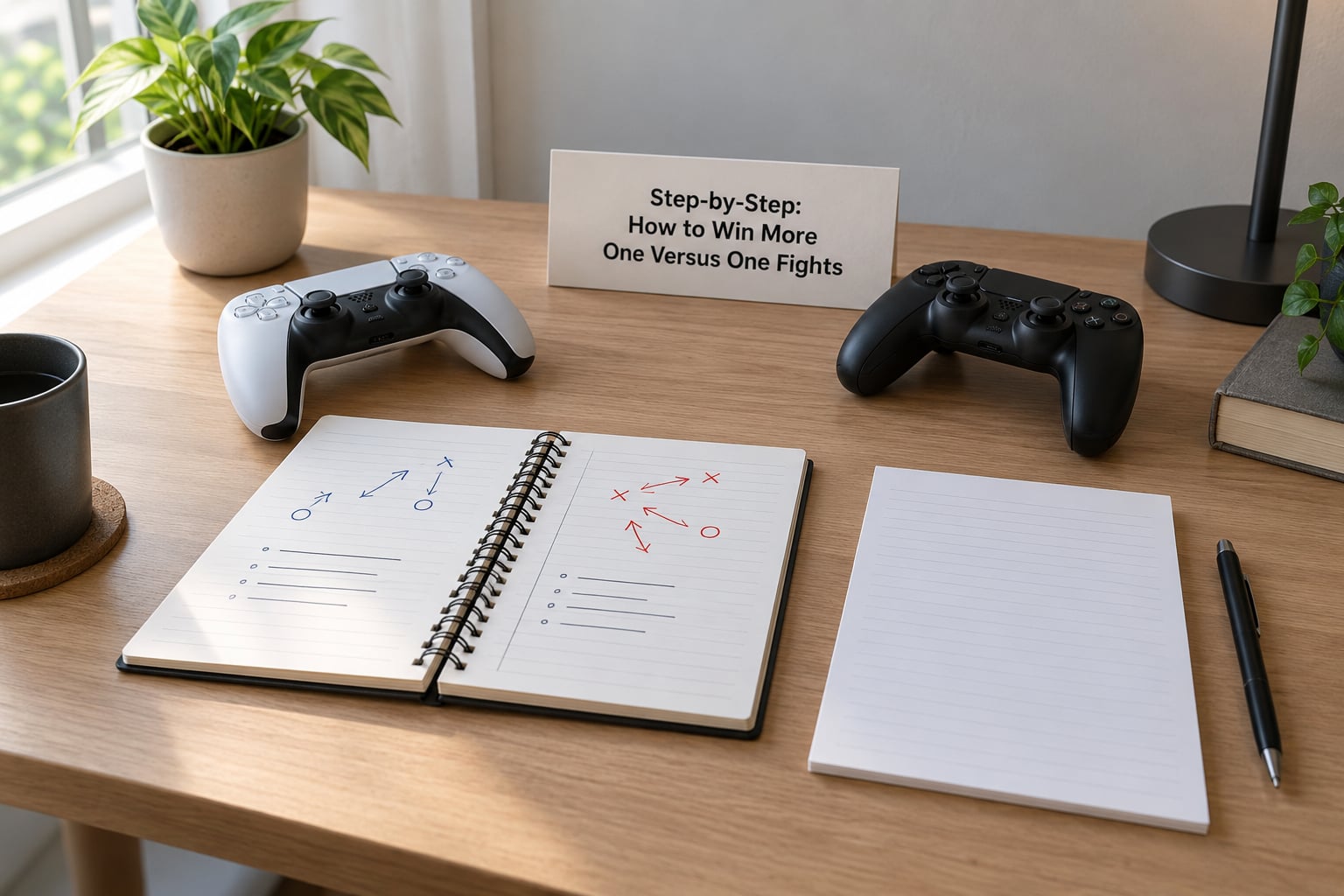
This is a system rather than a tip list. Each step assumes the one before it is in place, and each one tells you what to do, how to do it, and how you can tell it is working.
Step 1: Set a Specific Win-Rate Goal
Turn the vague goal of winning more into a number you can check. Pull your recent win rate and your expected win rate from the same mode over a defined period, write both down, and pick a review window of two to four weeks.
Sample size matters more than people expect. Twenty matches can swing either direction through pure variance, so do not react to a single session. If you average 45 percent across a hundred matches, that is your baseline, and the only meaningful reading is where you sit after another hundred.
How do you know it worked? After two review periods your number moves by three to five points in the direction you wanted. If it does not, the diagnosis in Step 7 is telling you which part of the system is weak, and you fix that instead of grinding wider.
Step 2: Learn the Three Most Common Matchup Patterns
Group opponents by behaviour rather than by rank. Four patterns cover the overwhelming majority of duels: the aggressive rushdown who closes distance on a timer, the defensive zoner who holds space and waits for an approach, the patient neutral player who takes no risk until forced, and the counter-attacker who sits on a response until you commit.
Here is the payoff. Once you can name the pattern in the first ten seconds, your preferred response is already decided: hold the long angle and pre-aim against a rushdown, close the gap and deny the long sightline against a zoner, refuse to be the first aggressor against a patient player, and never commit a recovery option against a counter-attacker.
How do you know it works? In review, you find yourself naming the opponent type before the fight starts rather than reacting halfway through. That single habit is the difference between fighting a person and fighting a situation.
Step 3: Prioritize Spacing Over Panic Button Presses
Distance is the cheapest advantage in any versus game. When you are inside someone else’s optimal range, every exchange is a coin flip that goes slightly against you. When you are in yours, you can afford to be patient.
Working the same principle across genres looks like this. In a tactical shooter it is holding a known sightline at a range where your weapon wins. In a battle royale it is breaking line of sight behind hard cover before you heal or reload. In a fighting game it is the gap that stops a throw from connecting, so you control when contact happens at all.
| Where the fight is happening | What the pattern looks like | The better response |
|---|---|---|
| Inside their effective range | You are pressured, forced to guess, reacting to their rhythm | Disengage, re-enter at a range you win, or reset to cover |
| At your effective range | You can take your time, watch, and choose the moment | Hold the angle, pre-aim, let them enter the trap |
| Neither side has an advantage yet | Both players are gathering information | Break first, take a favourable angle, then engage |
| On even footing with no cover nearby | Raw reaction decides it | Do not accept it; find cover before the exchange |
How do you know it is working? Your damage taken per engagement drops while your win rate holds steady. If win rate is flat but you are surviving longer, spacing is improving and the follow-up decision-making is the next gap.
Step 4: Build a Small Repertoire of Reliable Options
Most players lose duels because they attempt options they have never practised under pressure. A small set of movements, setups, and responses you own cold beats a large set you have only read about.
Pick three or four. Practise each one in a scenario, not in isolation: the movement used specifically to break a line of sight, the response to a whiffed attack, the reposition after losing ground. Confirm the basic version works before you add a single variation, because a variation built on an unstable base is worse than useless.
How do you know it works? You can execute the set on demand in a real match without thinking, and your deaths stop coming from options you chose under pressure rather than options you never intended to use.
Step 5: Make One Better Decision Per Match
Set a single decision goal before each match. One clean opening exchange with no damage taken, or not contesting a single round where the position is bad, or retreating once instead of fighting to the end every time. The goal is not a performance target you berate yourself over, it is a thing to notice.
Narrow objectives work because attention is finite. Trying to fix positioning, aim, and timing simultaneously means you are actively tracking three things, and the one you drop under pressure is always the one you most needed. One decision per match means you arrive at the finish able to say whether you did the thing you set out to do.
How do you know it works? At the end of a session you can honestly rate how many matches you followed your own goal. Even a low number is useful information, because it tells you the goal was realistic.
Step 6: Learn When Not to Engage
Declining a fight is a winning tactic, not a surrender. Most lost duels were already lost at the moment they were accepted: wrong range, no cover, low resources, an opponent with a fresh loadout and a visible reload timer.
Take a concrete case. You have taken damage, your opponent is still healthy and knows where you are, and the only route forward is a corridor they control. Contesting means you are fighting on their terms with less on the clock. Resetting means breaking contact, using the recovery to rebuild, and returning on a condition you choose rather than one they impose. Same situation in a fighter: being cornered or pushed to the edge with no reversal available, the correct play is often the safe escape and a reset to neutral.
How do you know it works? Your average survival time in lost positions goes up, and the number of fights you lose by a single small margin drops. Walking away more often makes your win rate look better without changing your mechanics at all.
Step 7: Review Losses Instead of Blaming Matchmaking
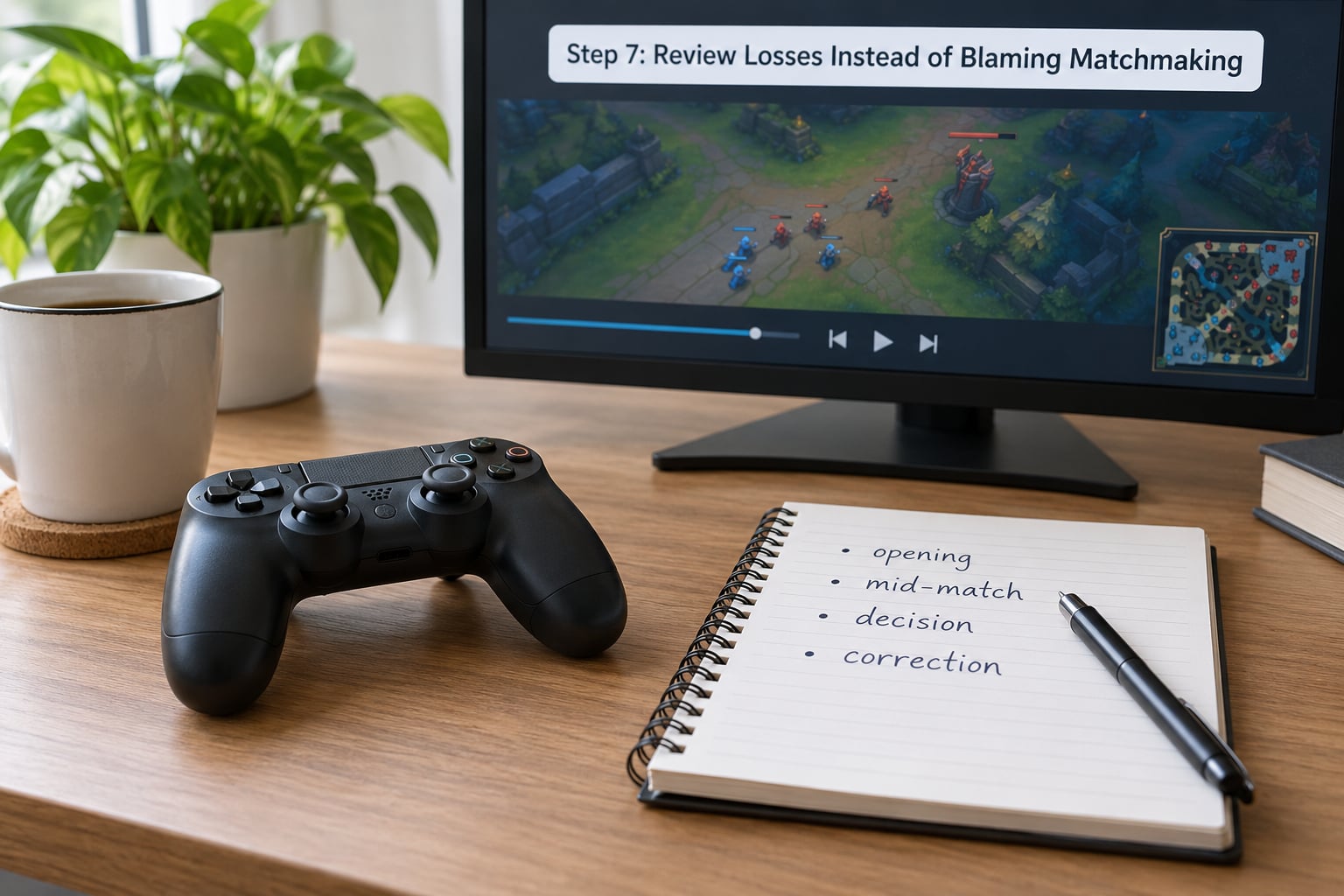
Matchmaking is a real factor sometimes, but it is the least useful explanation available to you, because it changes nothing. The review pass below takes about ten minutes and it is where most of the gain lives.
Run it in three passes. First, watch the opening: what information did you have, and what did you do with it? Second, find the single moment the fight turned: the health trade you lost, the angle you gave up, the cooldown you misjudged, the whiff you did not punish. Third, write one correction in the notebook, phrased as an instruction to yourself in the next match.
The discipline is in what you discard. A loss that felt bad is not evidence. Evidence is a specific, repeatable event you can describe without emotional language. If you cannot write the correction as an instruction, you have not finished the review.
How do you know it works? After three review sessions, the same correction shows up more than once, which means it is a real pattern in your play. Fixing one repeated error is worth more than fixing five rare ones.
Step 8: Protect Focus and Emotional Control
The final habit is about the state you are in when the other seven are applied. Most bad decisions happen while tilted, and tilt is not a moral failure, it is a predictable response to a losing run that needs a physical interruption.
Build a short pre-match routine you actually use: one specific warm-up drill, one reminder of your decision goal, one physical reset such as a short walk or a drink of water. During pauses between rounds, slow your breathing deliberately, four counts in and six counts out, for three cycles. And drop performance expectations entirely, because the moment you need to win a round rather than to learn from it, your attention narrows in exactly the wrong place.
Have a defined stop rule for the session. Two or three consecutive bad matches in a row ends the run, records the correction, and comes back tomorrow. How do you know it is working? Your decision quality in the second half of a session stays close to the first half, which is the clearest sign focus is holding.
| What the loss looked like | What it usually means | Where to spend practice time |
|---|---|---|
| You lost the first clean shot every time | Positioning and pre-aim, not raw aim | Corner clears and angle holds at your effective range |
| You win most trades but lose most exchanges | Starting the fight from an unfavourable range | Spacing drills and deliberate disengages |
| You win duels but lose the round after | Decisions after the fight, including recovery and commitment | Reset timing, punish windows, and threat tracking |
| Mechanics fall apart under pressure | Tilt and attention narrowing | Pre-match routine, breathing, and session stop rules |
Common Mistakes
Changing five things at once. You end the week with no idea which change helped. Fix one habit, hold it for a full review period, then move on.
Copying advanced players without their fundamentals. Someone flicking at high speed is not a lesson by itself. Ask what positioning makes that flick safe, and practise that position instead.
Over-adjusting after a single loss. One bad round is variance. The correction comes from a pattern across matches, not from the match that annoyed you most.
Practising without an objective. Time in a practice range or deathmatch with no target is entertainment. Give every block one thing to measure.
Studying highlights only. Highlights show the wins you already understand. Your losses contain the information you are missing, and they are less fun to watch, which is exactly why they are worth more.
Common Mistakes Checklist
Run this after a session, not during a match. It takes about a minute and it keeps you honest about whether you actually followed a process or just played.
Did I pick one decision goal before the session and know at the end whether I hit it? Did I record a win rate over a large enough sample that a single result did not change my plan? Did I name the opponent’s pattern early instead of reacting to it halfway through the fight? Did I take fights at ranges I win, and leave the ones I was forced to accept?
Did I identify one repeated error in review, write it as an instruction, and carry it into the next session? Did I stop the session on my own rule rather than on frustration? And most importantly: is there exactly one thing I am changing next time? If there are three, you have no plan, you have a wish list.
Frequently Asked Questions
How long does it take to get better at one-versus-one games?
Expect to notice a change in your results within four to six weeks of consistent, targeted practice, and a meaningful change in your fundamentals within three to six months. The speed depends almost entirely on the quality of your review, not on hours played. Players who practise deliberately and correct one repeated error at a time improve steadily; players who simply play more usually plateau at the same point.
Should I focus on practicing one character or learn multiple?
Pick one character or one mode for your main improvement block, ideally two to three months. Depth in a single option is what makes spacing and responses automatic under pressure, and automatic responses are where most duels are decided. Once your habits are solid there, adding a second character is faster than it looks, because the decision layer carries over.
How do I improve when I keep losing the same way?
A repeated loss usually points to one specific decision, not to a general skill problem. Review three to five of those losses and write down the exact moment each fight turned: the health trade you lost, the angle you gave away, or the cooldown you misread. Fix that single behaviour in your next sessions, and treat the repetition as normal progress rather than as evidence that you are bad.
Is watching stronger players useful if I lose most of my matches?
Yes, provided you watch with a question rather than for inspiration. Pick one habit to study, such as how they hold an angle or when they disengage, and look specifically for that. Watching without a specific question tends to produce admiration and no change. Reviewing your own losses is the higher-value activity, so alternate the two rather than replacing one with the other.
How many matches should I play to know if I am improving?
Treat a hundred matches as your minimum meaningful sample and check in every two to four weeks. Smaller batches swing on variance alone, so a twenty-match swing proves very little. If you cannot or do not want to log that many, screen-record a smaller set and review the same situations each time, which is slower but still far better than judging progress from memory.
Can these habits improve my win rate across different PvP games?
The habits transfer, the mechanics do not, and that is the point. Goal setting, pattern recognition, spacing, selective engagement, structured review, and focus control apply in shooters, battle royales, and one-on-one fighters alike. You will need to relearn the inputs and the timing in a new title, but the decision layer is the same one you are already training.
Conclusion
Start tonight, with no new gear and no new settings. Pull up your last five matches and write down the single most repeated decision error, ignoring anything you cannot describe as a specific action. Then pick one correction from that, keep it small enough to actually remember under pressure, and take it into your next session. One habit, held for a full review period, is worth more than eight habits abandoned on Tuesday.