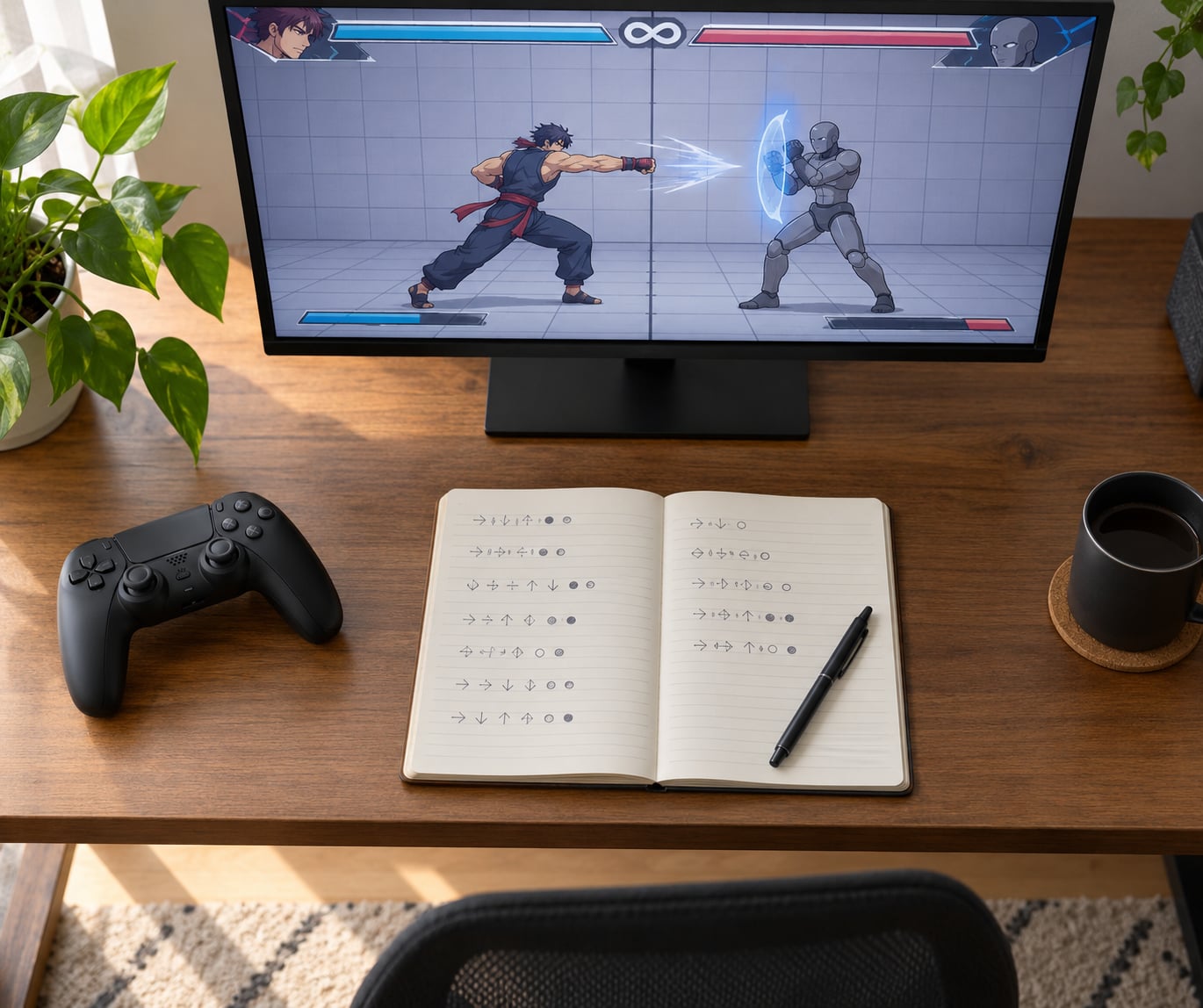
Training mode is only useful when you arrive with one specific thing to fix and a way to measure whether you fixed it. Players who wander into practice, mash buttons at an idle dummy for forty minutes and quit have practised nothing. The method that works is boring and repeatable: set the dummy to match the situation you want to learn, drill five to ten clean reps, record the attempt, then move on.
A focused session takes twenty to thirty minutes and covers movement, decisions, pressure and one matchup-specific detail, in that order. You do not need a new character or a new game to start, and you do not need to understand every piece of jargon before the first session, though this guide explains the terms as they come up.
Table of Contents
- What You Need
- Step-by-Step: Build a Focused Practice Session
- Set the Training Scenario Before You Practice
- Drill Movement, Buttons, and Confirms
- Practice Neutral Decisions and Punishes
- Test Combos Under Realistic Conditions
- Review Your Results and Record Progress
- Common Mistakes
- Frequently Asked Questions
- How long should I use training mode each day?
- Is training mode useful if I practice alone?
- What training mode settings should I use for realistic practice?
- Should I focus on combos or fighting in training mode?
- How do I know whether I am improving at a fighting game?
- When should I stop training mode and play real matches?
- Conclusion
What You Need
You need four things before practice is worth your time: the game itself with its training mode, a written record of your goal, a way to see what the game is telling you, and a rule for when to stop. That last one is the one most players skip.
Most training modes ship with the tools already in. The menu names differ between games, but the four functions are the same everywhere, and knowing them by function lets you find them in whatever game you bought this month.
- A controllable dummy. Idle, block everything, block randomly, and record-and-playback behaviours cover nearly every drill you will run.
- Infinite health and infinite meter. Turn both on so a failed attempt costs you nothing and a long sequence never runs out of resources mid-route.
- Instant recovery. Set the dummy to get up as fast as the game allows, so your resets are immediate and you spend the session practising instead of waiting.
- Input display and frame data. Turn on the input history and, where it exists, the frame meter. This is how you see that your dragon punch came out as a forward instead of a quarter circle forward.
- Frame-by-frame stepping or slow motion. Essential for frame traps, safe jumps and anything you are reading off the frame meter.
- A reset position button. Binds your dummy reset so your hands never leave the controls.
- Stage hazards turned off. Fire, poison and stage breaks add nothing to a solo session and cost you attention.
- One written goal for the session. One sentence, written down before you load the dummy.
Set those eight things once and save them. Most training modes remember your last settings between sessions, so after the first session the setup takes under a minute and you can go straight to the drill.
Step-by-Step: Build a Focused Practice Session
A session that works moves from the fundamentals you can still get wrong under pressure, up to neutral decisions, then pressure, then one thing specific to the character or the matchup. Skipping straight to step three is why so many players can land a six-hit combo and still lose.
Set the Training Scenario Before You Practice
Before pressing a button, write down one situation and one success condition. “Punish a whiffed medium punch” and “land the route three times in a row without a dropped input” both work. “Get better” is not a situation.
Then pick the dummy behaviour that produces that situation, because an idle dummy teaches you almost nothing on its own. It stands there, which means spacing, whiff punishing and anti-airing never get rehearsed.
| Drill goal | Dummy behaviour | Also turn on |
|---|---|---|
| Combo routes | Guard all after the first hit | Infinite meter, instant recovery |
| Blockstrings and mixups | Block everything | Input display to confirm the follow-up came out |
| Hitconfirming | Block randomly | Frame meter, slow motion |
| Reaction and punish practice | Record two dummy strings, play back at random | Random playback, reset positions |
| Pokes and spacing | Idle, no input | Frame data display, distance measurement where available |
| Anti-air practice | Jump forward, then jump backward | Frame data, input display |
| Execution under pressure | CPU opponent at the lowest level | Nothing extra, keep it realistic |
The random-behaviour settings are the ones beginners never touch, and they are the difference between practising and performing. A dummy that blocks everything lets you mash and hit nothing. A dummy that blocks randomly forces you to see the hit before you commit, which is the actual skill.
Drill Movement, Buttons, and Confirms
Chunk the sequence and repeat it in small blocks. Five to ten clean reps in a row, then reset and go again, is the number the community keeps coming back to, because muscle memory forms in clean reps rather than in attempts. Two hundred attempts with drops teach you nothing except frustration.
Start with movement: your dash, double dash, back dash, short hop, full jump and your throw. Then move to your fastest normal and your crouching medium. Keep each block small enough that you are not relying on memory of the whole string, which is how motion inputs get fudged.
Motion inputs use number notation, and 236 means down, down-forward, forward while 623 means down, down-forward, forward, up. Six-two-three is the classic dragon punch motion. Practise every motion on both sides of the screen, because forward always means toward the opponent no matter which side you are standing on, and that one detail explains most of the inputs you drop online.
When a move keeps coming out wrong, slow it down before you change anything else. Turn on the input display, watch which part of the motion was missed, and cut the motion out of the string temporarily so you are drilling only the failing link. Putting it back in once it is clean is faster than repeating a whole combo and hoping.
Once the buttons land, add hitconfirming. Watch the hit spark or the animation tell before you press the follow-up, and stop hitting the button early. Blocking randomly is the setting that makes this real, because you cannot confirm what you cannot predict.
Practice Neutral Decisions and Punishes
Neutral is where matches are actually won, and it is the part training mode handles worst. Set the dummy to idle, walk your character to different ranges, and check where your poke plus or minus on block is using the frame meter. A move that leaves you minus three has to be spaced far enough that the opponent cannot reach you after blocking.
Frame data only matters if you act on it. Safe jump means jumping only when the opponent’s move is plus on block, so that you are not being hit out of the jump. A frame trap is a move plus on block that visually looks like it should be punishable, so the opponent guesses wrong. A whiff punish is punishing a move that recovers slowly enough to hit you after it misses. Each of those is a two-minute drill once the setting is right.
There is an honest limit here. The idle dummy and the low-level CPU both behave in fixed ways that no human opponent will, so neutral drilled this way transfers only partially. Treat training mode neutral as spacing practice, then go to real matches for actual matchup reads.
Test Combos Under Realistic Conditions
A combo that works against a guard-all dummy can fall apart the moment the opponent blocks, counters or starts throwing. Test routes under conditions closer to a real match: set the dummy to block all after the first hit and confirm the route still converts, then check whether it does real damage rather than just looking long.
Watch what happens as the sequence gets longer. Damage scaling means later hits do less, stun or stun decay means the combo can end early once the opponent cannot block any more, and resource cost means an expensive route leaves you with nothing. Turn on the combo counter and the damage display if the game has them so you can see the number fall.
Practise the route twice: once from a hit confirm, and once from neutral with no opening given. The second version is harder and far more useful, because most of your real combo opportunities begin with a normal you had to land yourself.
Review Your Results and Record Progress
Record your best attempt and your typical attempt, then watch both with the slow motion off. Most mistakes are obvious on playback and invisible in the moment: a late jump, a follow-up pressed before the hit, a dash that ended you out of range.
Separate execution errors from decision errors, because they need different fixes. A dropped input is execution and responds to more reps. Walking into a range where your poke is minus is a decision and needs spacing practice, not repetition.
Keep a small log with three lines per session: the goal, the number of clean reps, and one sentence on what failed. A twenty-minute beginner session looks like this:
- Minutes 1 to 3: dashing and jumping, ten clean reps each.
- Minutes 4 to 7: your two best normals and the cancel route between them.
- Minutes 8 to 11: motion inputs on both sides, ten clean reps per motion.
- Minutes 12 to 15: hitconfirming against a random-blocking dummy.
- Minutes 16 to 18: the session goal written down at the start.
- Minutes 19 to 20: record one attempt and write the log line.
A thirty-minute session for tournament prep adds ten minutes of matchup work on a recorded dummy string, and ten minutes against the lowest-level CPU so your execution survives some pressure. Warm-ups before a tournament match use the first fifteen minutes of this structure and nothing else.
Common Mistakes
Almost every wasted session comes from one of a handful of habits. Each has a straight fix, and the fix is usually about narrowing your focus rather than adding more time.
| Mistake | Fix |
|---|---|
| Drilling only the flashiest combo | Practise your fastest safe normal and one confirm before touching the long route |
| Leaving the dummy on block everything | Switch to random block for confirms, record-and-playback for reactions |
| Chasing long routes that never hit | Reset on the first dropped link and rebuild the string one link at a time |
| Never reviewing what went wrong | Record every attempt, watch one, name the mistake, then drill only that |
| Changing three settings between attempts | Hold settings constant for the whole session so results are comparable |
| Treating the CPU as a real opponent | Use it for execution only, and take neutral and matchups into real matches |
| Choosing a new character every session | Stick with one character until its basic confirms are second nature |
There is one more mistake worth naming because it is the one players argue about most: practising for four hours and never playing anyone. Training mode builds clean execution, and clean execution without decision-making under pressure does not win matches on its own. The consensus routine from the community is to play a limited number of matches, review the replays, find the single worst problem, fix that one in training, then re-queue.
Frequently Asked Questions
How long should I use training mode each day?
Twenty to thirty focused minutes beats two unfocused hours. Long sessions tend to drift into drilling combos you can already do, which feels productive and improves nothing. Keep one written goal, stop when the clean-rep count stops climbing, and log the result. If you want more, do a second short session later rather than extending the first.
Is training mode useful if I practice alone?
Yes, and it is where most of your improvement will come from. Solo practice lets you repeat one situation hundreds of times with instant resets and no timer pressure. What it cannot teach you is matchup reads, adapting to a human opponent, or performing while anxious. Treat it as the place to build clean habits, then test them against other people.
What training mode settings should I use for realistic practice?
Turn on infinite health and meter, set instant dummy recovery, enable input display and frame data, and disable stage hazards. Then change only the dummy behaviour to match your drill: block all for blockstrings, random block for hitconfirms, recorded strings on random playback for reactions, and idle for spacing. Menus differ by game, but the function you need is always there.
Should I focus on combos or fighting in training mode?
Do execution first, then fighting. Combos and motion inputs are where input errors live, and they transfer to every match you play. Blockstrings, hitconfirms and punishes come next, because that is where rounds are won. Save matchup-specific and neutral work for after your fundamentals stop dropping, or you will spend the session drilling routes that were never the problem.
How do I know whether I am improving at a fighting game?
Track clean reps per drill rather than hours practised. Record the same ten attempts of a combo every week and compare the best run and the average run. If the average climbs, your execution is improving even when the best run does not. Add a second measure from real matches: count how often you got hit during the first ten seconds, which usually drops well before your combo damage goes up.
When should I stop training mode and play real matches?
Stop when your drill stops producing clean reps, or when you have held one skill for several sessions and it feels automatic. Both are signs you have hit the ceiling of what the dummy can teach you. Play real matches when you want matchup experience or decision-making under pressure, and use the replay review loop to decide what to bring back to training next.
Conclusion
Start with one weakness today. Write it down, pick the dummy behaviour that recreates the situation, set infinite meter and instant recovery, and run ten clean reps of a single short sequence. Record the attempt, watch it back once, and write down whether the failure was an input error or a bad decision, because those two need completely different fixes.
That loop is the whole method. Knowing how to use training mode effectively in fighting games is not about the settings you toggle or the combo you can land at the tenth attempt; it is about running short, measurable sessions with a single purpose, then proving the result in real matches before you move on to the next skill.