
Organizers almost never pay players directly. The placement award goes to the team, then the organization takes its cut, sets aside a pool for coaches and support staff, sometimes adds a performance bonus, and divides the rest among the players on that event’s roster.
That chain of allocations is what people mean when they ask how esports prize pools are split between players and coaches. No league rule dictates the internal split, so the same tournament can pay two teams with completely different per-head amounts. All figures below are in US dollars and illustrative unless a source is named.
Table of Contents
- How Are Esports Prize Pools Split?
- Who Decides the Player-and-Coach Split?
- What Is the Typical Prize-Pool Split?
- Do Players Split Their Share Equally?
- How Are Coaches Compensated From Prize Money?
- What Happens to Money Before Players and Coaches Receive It?
- Which Arrangement Is Best for a Player or Coach?
- How to Check a Team’s Prize-Pool Agreement
- Frequently Asked Questions
- Do all esports teams split prize money in the same way?
- How is prize money divided among five starting players?
- Are substitute players entitled to tournament prize money?
- Are esports coaches usually paid only from prize pools?
- Where can players find their team’s prize-money split?
- Conclusion
How Are Esports Prize Pools Split?
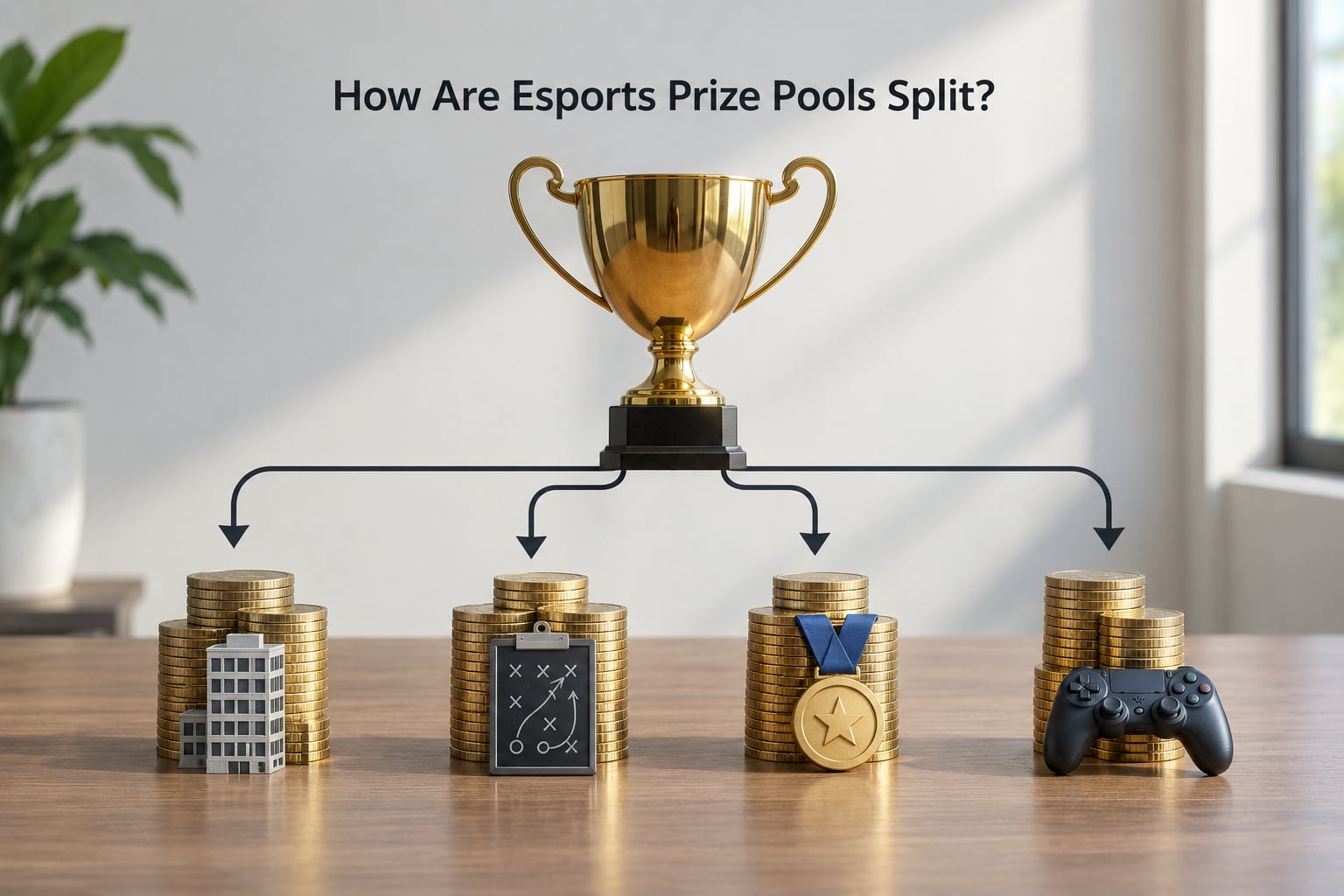
An esports prize pool is split in four stages: the organizer pays a placement award to the team, the organization deducts its own percentage, the remainder of that deduction funds coaches and support staff, and the balance is distributed across the roster.
Start with the placement award. A published payout curve tells you what first place pays against what fifth place pays, and those curves are steeply top-heavy. First place typically takes several times what second place earns, and a team finishing outside the top eight may collect nothing at all.
The winner’s check is a team total. Dignitas notes that a 200,000 first-place cheque gets divided between five players, a coach or manager, and the organization itself.
From there the money moves in four steps:
- The organizer pays the placement award for that finishing position to the team’s registered entity.
- The organization retains its cut, which the Reddit r/DotA2 community puts at roughly 10% as a common figure.
- A staff pool is carved out for coaches, analysts and managers, then any agreed performance bonus is funded.
- The balance is split across players, substitutes and coaches on the roster for that specific event.
Tax is not part of any of those four steps. It comes later, and it comes out of the individual’s share rather than the team’s.
Who Decides the Player-and-Coach Split?
Nobody outside the contract does. The tournament organizer controls the placement award and who receives it, and the league sets any minimum requirements. Everything after that is negotiated between the organization and the people on its books.
Player contracts set the split for players. A clause typically assigns a percentage of gross tournament winnings to the organization and states how the remainder is distributed, sometimes as an equal per-head figure and sometimes weighted by role or playing time.
Coach pay sits in its own document. Employment terms, contractor agreements and freelance invoices each produce a different result, and the coach’s share of prize money may be written into a separate agreement from the players’ contracts.
Owner decisions fill whatever the contracts leave open. Some organizations publish a written split policy because the alternative is arguing about it after every tournament win.
What Is the Typical Prize-Pool Split?
The ranges below are the working numbers community members and contract commentary actually use. They are benchmarks, not standards, and a single org can sit outside every one of them.
| Recipient | Typical share of gross winnings | Notes |
|---|---|---|
| Organization | 10% to 20% | Community consensus on r/DotA2 sits near 10%; some pro-league contracts reportedly reach 80% to the organization in aggregate, counting staff |
| Coaches and support staff | 5% to 15% of the total | CS2Pulse estimates a coach takes about 10% when each player takes about 18% |
| Performance bonus pool | 0% to 10% | Only some organizations fund a bonus on top of salary for meeting a placement target |
| Players | 60% to 85% | Some rule sets cap the organization at 20%, others let players keep everything on small amateur events |
Here is the same split applied to a first-place award of 1,000,000 across a five-player roster with one head coach. It is a worked illustration, not a real contract.
| Stage | Amount | Running total |
|---|---|---|
| Placement award paid to the organization | 1,000,000 | 1,000,000 |
| Organization retains 20% | -200,000 | 800,000 |
| Coaching and support staff pool, 10% | -100,000 | 700,000 |
| Performance bonus pool, 5% | -50,000 | 650,000 |
| Five players, equal split | 130,000 each | 0 |
Run the same 1,000,000 through an equal-per-head event instead, where every person on the roster receives an identical amount, and six people take home roughly 166,666 each with no organization deduction at all. Both structures are real and they produce very different careers.
Do Players Split Their Share Equally?
Sometimes. Five models show up in practice, and a team can mix more than one of them in the same season.
Equal per head. Every starting player takes the same amount. Simple, and common in team titles where the roster is treated as one unit. A Dota 2 community member describing an amateur league put it plainly: we did prize pool split 6 ways.
Starter weighted. Players who actually played the tournament take the full share, and anyone benched takes a reduced one or nothing. This is where substitute status matters most.
Role weighted. Star roles or designated carry positions negotiate a larger percentage than support roles. The numbers are private and rarely published.
Individual achievement bonus. A separate payment tied to personal statistics, such as tournament MVP awards or a rating leaderboard, sits on top of the team share.
Salary plus share. The most common tier-one arrangement. Prize money is a bonus on top of a guaranteed salary, and contracts increasingly treat championship payouts as a category eligible for most-favored-nation treatment, so a player can demand the better rate another player on the roster negotiated.
For five starters sharing 650,000, equal splitting gives 130,000 each. A 30/20/20/15/15 weighting gives 195,000, 130,000, 130,000, 97,500 and 97,500, and nobody outside the contract can tell you which arrangement a given team uses.
How Are Coaches Compensated From Prize Money?
Most coaches are salaried, and prize money is the bonus on top. What varies is how much of the tournament payout the contract routes into the staff pool.
CS2Pulse gives the clearest public benchmark: a coach takes roughly 10% of the prize money while each player takes roughly 18%, alongside a reported average coach salary of about 5,000 per month. Against a single 130,000 player share, a 10% staff pool is a meaningful second income rather than a rounding error.
Not every event works that way. The Esports Nations Cup publishes per-person placement tables where players and coaches earn the same per-head amount: 50,000 per person for first place, 30,000 for second and 15,000 for third across its Apex Legends tables, with equivalent tables for other titles.
That structure changes the coaching math. In its worked first-place example for a five-plus-one roster, 300,000 goes to the team with the coach taking the same 50,000 as each player, and a separate club incentive pays the organization 40% of what each player earns once a team reaches the top 16, adding 120,000 on top.
Assistant coaches, analysts and performance staff rarely have prize money written into their agreements. They are usually covered by a staff pool the head coach controls, which is why the head coach’s contract matters more to a support staffer than the player’s does.
Freelance and personal coaches are the exception that proves the rule. At amateur and open events there is often no organization taking a cut, so the players keep 100% and a paid personal coach is simply invoiced separately, if they are paid at all.
What Happens to Money Before Players and Coaches Receive It?
Three things sit between the placement award and a bank account, and none of them are the split itself.
Withholding tax. Prize winnings are typically treated as income where the player or coach is resident, and the rate depends on the country, the residency position and whether the player has an established tax base. The community summary that keeps coming up is blunt about this: taxed based on where you win. Amounts vary widely by jurisdiction and change over time, so treat any figure you read as a starting point for a conversation with a tax professional rather than an answer.
Fees and conversion. Payment platforms, banking intermediaries and currency conversion between the tournament’s paying country and the recipient’s home country each take a slice. Nobody publishes a standard figure for this.
Delay. This is the complaint players raise most often. Winnings arrive late, in instalments, or not at all, and a contract that says nothing about payment timing leaves the player with little leverage. A written payment deadline and an audit right are the two clauses worth having.
Not every prize is cash either. Hardware, merchandise and sponsor benefits often pad an advertised pot, and those items rarely convert cleanly into a shareable figure for the roster.
Which Arrangement Is Best for a Player or Coach?
Each model trades security against upside, and the right answer changes with career stage.
Guaranteed salary, small prize share. Best for players building a name, where predictable income matters more than a percentage.
Percentage-based prize share, low salary. Best for established tier-one players with leverage. Higher risk, much larger ceiling.
Salary with tournament bonuses. The most common professional compromise, and the easiest to budget around.
Revenue participation. Streams beyond prize money. Odin Law highlights in-game item revenue, merchandise and streaming income as parallel streams that can carry the same contractual protections, including most-favored-nation treatment.
For coaches, a written percentage tied to a defined set of eligible team members beats a discretionary staff pool, because a pool can shrink quietly when the org has a bad year.
How to Check a Team’s Prize-Pool Agreement
Most splits are private, so checking means assembling the public pieces around them.
- Read the organizer’s published payout table to learn the placement award before any internal split applies.
- Confirm who the named recipient is, the team entity or an individual. It changes who owes the money.
- Check whether the event uses an equal payout per placement model, where the per-head figure is published and the internal negotiation does not apply.
- Search for published rules. One gaming subreddit post cites a rule set where players keep 100% of a prize pool of 10,000 or less and 80% at 10,001 or more.
- Establish roster eligibility. Ask whether substitutes who played in the event count toward the roster and whether a benched player receives anything.
- Confirm the payment deadline in the contract, plus audit rights and who remits withholding tax.
- Compare against published salary reporting for the region, such as the roughly 5,000 per month average coach salary figure, to sanity-check a percentage against the rest of the compensation.
When an organization withholds or delays payment, the practical route is a written demand to the named team entity, then whatever dispute process the contract names, then the governing body’s rules for unresolved prize disputes. Labor and contract lawyers handle this routinely.
Frequently Asked Questions
Do all esports teams split prize money in the same way?
No. There is no league-wide formula for the internal split. The organizer publishes the placement award, and everything after that comes from the organization’s own policy and the individual contracts. That is why two teams finishing in the same place can leave their players with very different per-head amounts. Public benchmarks put the organization cut at roughly 10% to 20% of gross winnings, but real contracts run outside that range.
How is prize money divided among five starting players?
It depends on the clause. An equal per-head split gives every starter the same figure, so 650,000 across five starters is 130,000 each. Starter-weighted contracts cut or eliminate the share for anyone benched during the event, and role-weighted contracts favour star positions. Some contracts also stack an individual achievement bonus on top of the team share. Ask for the written clause rather than assuming an equal split, because the default is not universal.
Are substitute players entitled to tournament prize money?
Sometimes, and it is one of the most common points of confusion. Substitutes who are listed on the official roster and played in the event are often treated as full members of the split. A substitute who was registered but never played may receive a reduced share or nothing, depending on the contract wording. The definition of an eligible team member is exactly the clause to check, since it decides who counts on a roster of six.
Are esports coaches usually paid only from prize pools?
Rarely. Most coaches draw a fixed salary, reported at roughly 5,000 per month on average, with prize money as a bonus layered on top. A commonly cited estimate puts a coach share near 10% against roughly 18% per player. Some events pay coaches an identical per-head amount to players instead. Freelance coaches working with amateur rosters are the exception, and at those events there is often no organization cut at all.
Where can players find their team’s prize-money split?
Start with the organizer’s published payout table and the event rules, since those fix the placement award and sometimes the per-head figure. Beyond that, the split lives in the player’s own contract and the organization’s written split policy, which are rarely public. Inside a team, ask management for the prize-money clause, the definition of an eligible team member and the payment deadline. Agents and contract lawyers read these clauses for a living.
Conclusion
The headline number is a team total, not a personal one, and the gap between the two is the split. Start with the organizer’s payment recipient and published payout table, then look at the team’s agreement, then read the individual contract or compensation plan.
Anyone working out a real number should treat the percentages here as ranges that change with the game title, the event and the country involved, and should confirm the specifics with a qualified tax or contract professional before acting on them.