To counter campers in multiplayer games, you take away the thing that makes camping work: the safe sightline. That means pre-aiming the angles they favour, reading sound cues before you commit, controlling the approach lane instead of walking straight into it, and using utility or numbers to force them off the spot. Most of the time the camper never has to fight fairly again.
Camping is not actually strong play. It is a way of converting patience into kills, and patience stops paying the moment someone refuses to walk into the lane. The eight steps below work in shooters, battle royales, extraction shooters, asymmetric horror games and even 1v1 mobile fighters, though the specific tools change.
Whole guide in one line: identify the likely position, gather information, control an approach lane, then execute a pressure plan.
Table of Contents
- What You Need Before You Counter a Camper
- Step-by-Step: Countering a Camper From Approach to Cleanup
- 1. Learn the Camper’s Common Positions
- 2. Use Audio and Visual Information First
- 3. Control the Area Instead of Charging Directly
- 4. Break the Camp With a Pressure Plan
- 5. Choose the Right Entry for the Game You’re In
- 6. Equip for a Direct Fight
- 7. Avoid Predictable Duels
- 8. Practice the Counterplay Loop
- How to Counter Campers in Multiplayer Games: Common Mistakes
- Frequently Asked Questions
- What does camper mean in gaming?
- What is the 3-3-3 rule when camping?
- How do I counter a camping sniper?
- Should I fight the camper or just ignore them?
- Why do people camp in multiplayer games?
- How do I deal with camper conflict with teammates or opponents?
- Conclusion
What You Need Before You Counter a Camper
Countering campers is less about reflexes and more about preparation. You want four things in place before you ever walk into a contested area.
Knowledge of the common angles. Almost every map has the same five or six spots where players sit. Learn which ones on the maps you play, and half the work is already done before you move.
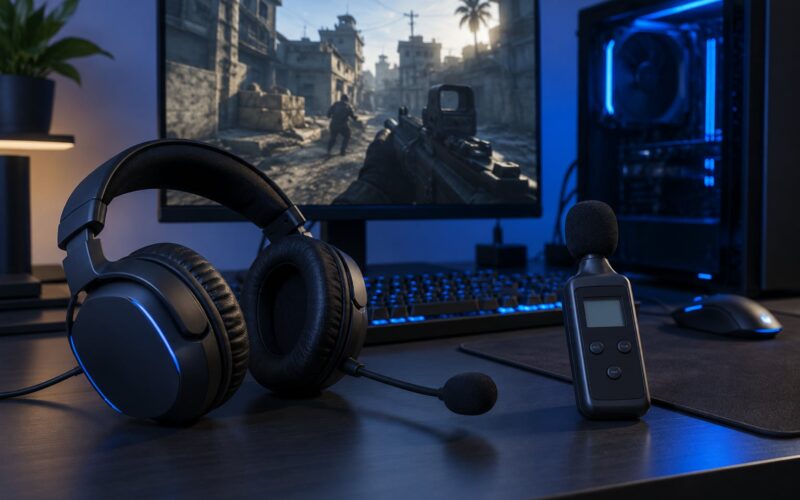
Working audio. If your headphones are on and your sound is set right, you can hear a reload, an ability activation, or a scope settling before you can see anyone. Players on mobile and console often skip this step entirely, and it shows.
At least one tool that opens space. A flashbang, a smoke, a recon scan, a heartbeat sensor, a ping, a motion trap. Even in games with no grenades, most have some form of recon or marking tool that replaces one.
A reason to be there. The single best anti-camping habit is having somewhere else to be. A camper with an objective to defend is a problem. A camper holding a corridor nobody needs is a distraction.
Step-by-Step: Countering a Camper From Approach to Cleanup
1. Learn the Camper’s Common Positions
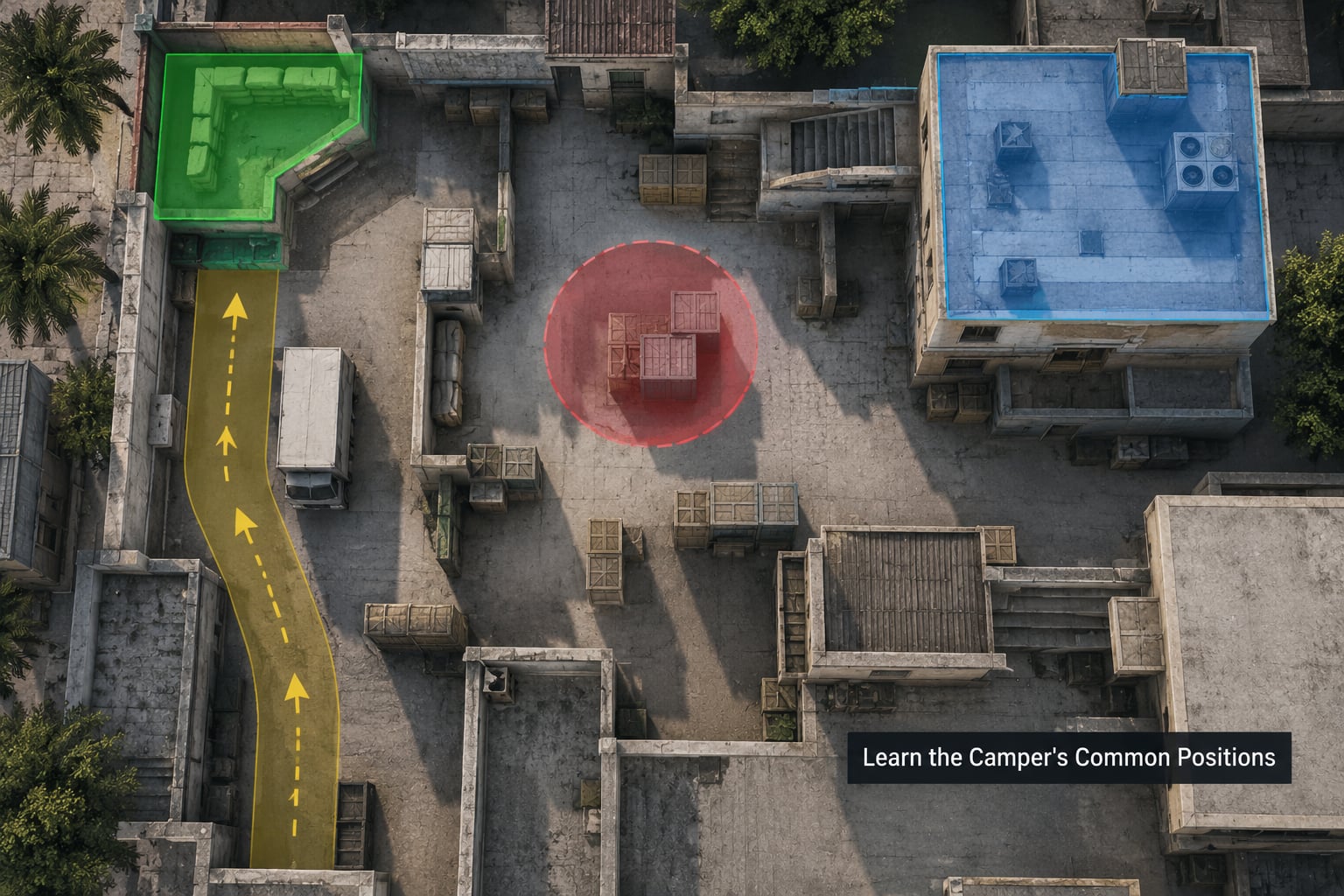
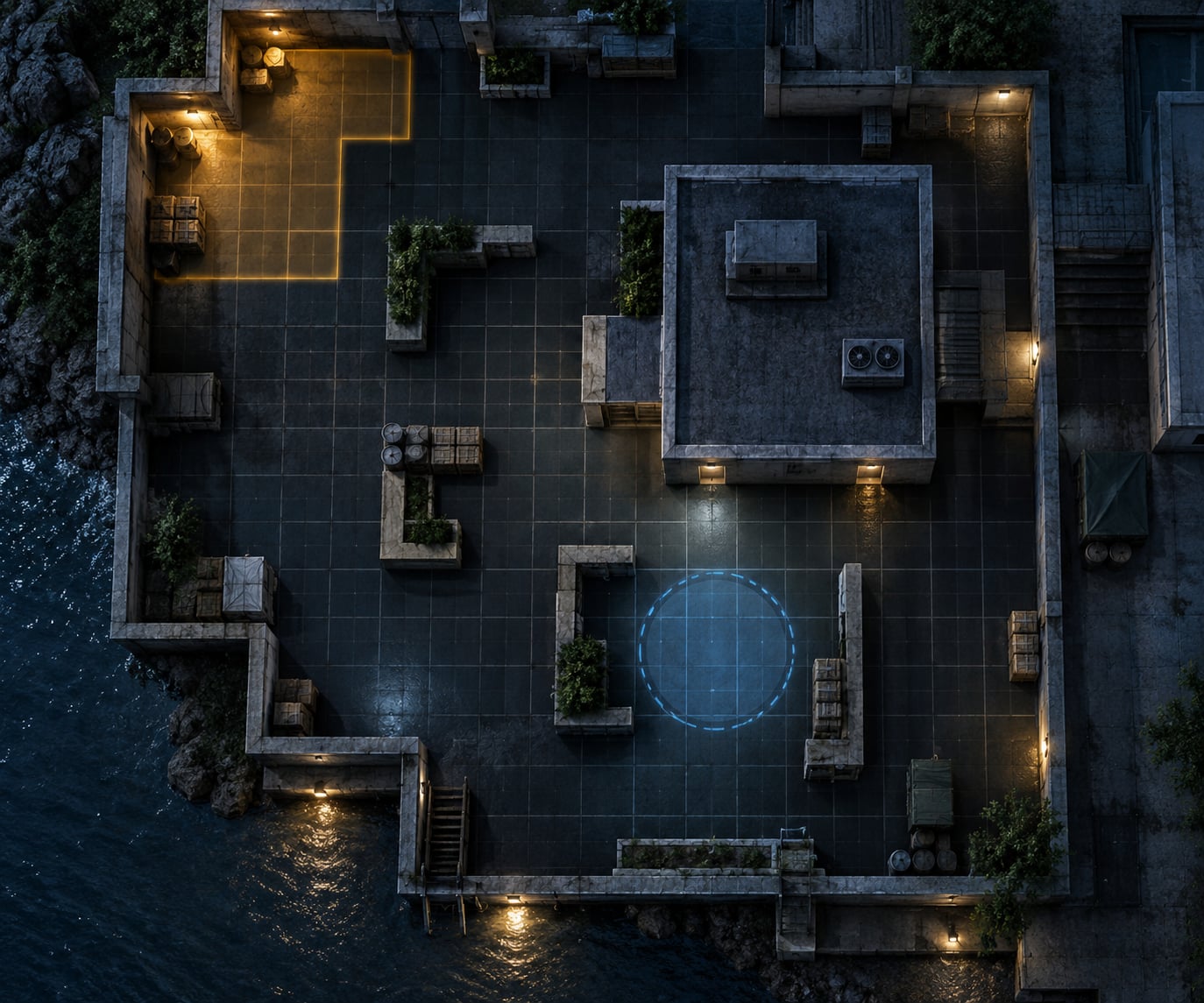
Campers are not random. They pick from a short list: the dark corner, the off-angle, the elevated perch, the doorway, and the objective-adjacent spot.
The corner gives a camper a wall at their back, so you can only challenge from one side. The off-angle is the nastier version: a sightline nobody is pre-aiming, usually from a room you are not expecting someone to hold.
Why do players choose them? Because each one has an escape route that favours them. A corner holder knows you have to come around the corner into their crosshair. A rooftop player can drop behind you after the first shot. An off-angle player is already pointed at the doorway before you clear the room next to it.
Once you can name the position, you can name the counter. Corner means utility or a wide swing. Off-angle means clearing the room first. Rooftop means not being under it at all.
One community rule that circulates for campers is the 3-3-3 rule: move roughly every three seconds, check three angles, and re-position every three kills or so. Treat it as folklore rather than an official mechanic, but the logic is sound for your own play. If you hold the same spot for long, you are camping too.
2. Use Audio and Visual Information First
Before you push anything, listen. A camper who has been still for thirty seconds will eventually move, reload, or use an ability, and each of those makes noise.
The specific cues worth learning are footstep direction and surface, reload clicks, equipment and ability activation sounds, and the silence itself. A spot that is completely silent when four of your teammates just walked past is a spot somebody is holding.
Then check the information you are given for free: the kill feed showing where fights are happening, the minimap for ping or contact markers, and your teammates’ callouts. In most games, someone on your team already knows a camper exists and has simply not said it out loud.
You can also make yourself a worse target by improving your visual habits. Keep your crosshair at head height on the level, not pointed at the floor, and scan the room behind you as you clear it. The camper who is already aiming where you are standing has had far more time to prepare than you have.
3. Control the Area Instead of Charging Directly
The single change that fixes most camper deaths is refusing to take the lane they prepared for. If the corridor has a clear sightline down its length, you do not walk the corridor.
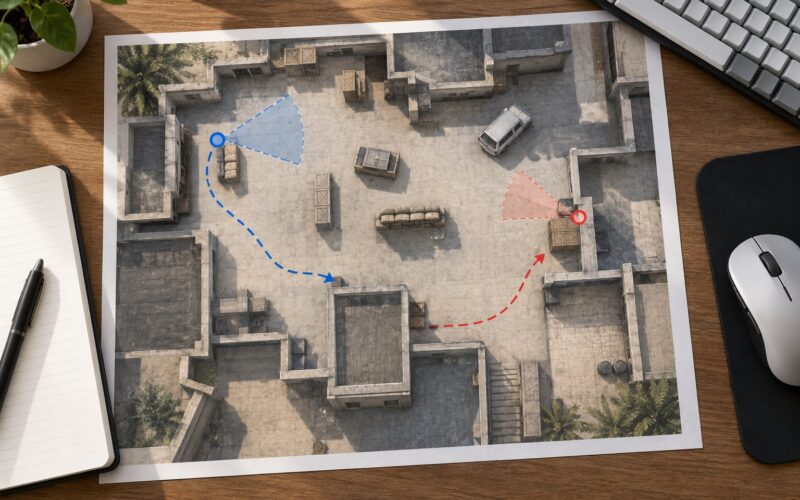
Approach from more than one direction, even if that means going around and coming back. Use cover and cover-to-cover movement so that the camper has to break their pre-aim each time you shift position. And take the fight somewhere the camper did not choose, because their advantage is entirely location-based.
In objective modes, control the area around the spot too. A camper in a good corner still has to rotate, reload, and eventually leave. Rotating means facing your crosshair somewhere new, and that is where prepared players catch them.
4. Break the Camp With a Pressure Plan
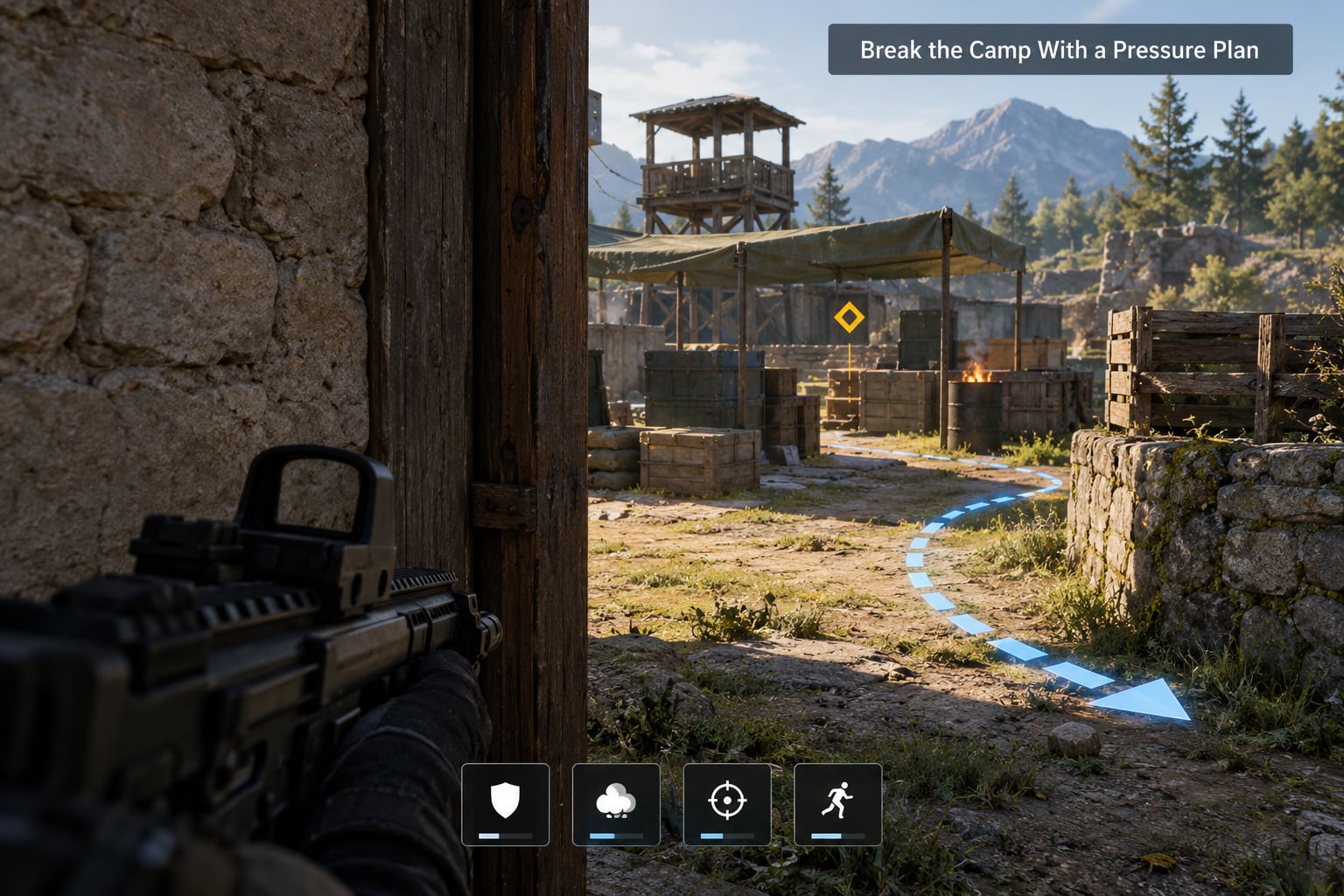
A pressure plan is three moves, in this order: isolate, force, punish.
Isolate means removing help. Take the angle with a teammate so the camper is not winning a two-on-one trade, or clear the area so nobody can arrive to cover them.
Force means making them react. Throw a grenade into the corner, make noise on a second lane, or simply step into a different sightline than the one they are watching. A camper who reacts has lost the benefit of patience, because reacting means exposing themselves.
Punish means finishing it. The reaction is the moment the camper moves, re-peeks, or uses an ability, and that is when their aim moves off the pre-set point. If a camper is hit with utility, they are effectively stunned rather than ready, and the fight is already won before it starts.
This is the same idea that comes up constantly in competitive shooters advice. The goal when challenging a camper is not always to win the straight trade. It is to make the camper unable to play the game they prepared for.
5. Choose the Right Entry for the Game You’re In
Not every tactic transfers between genres, so match your approach to what the game rewards.
In a tactical shooter or an objective map, slow clears and trades win. You move as a unit, someone makes contact, and someone else takes the free kill. Solo pushes into a held angle are how people lose entire matches.
In a battle royale, the smart answer is often to not engage at all. Rotating to a better fight is not losing. Camping players in a battle royale usually hold a spot that several squads will walk past, and the counter is arriving from an angle nobody rotated toward.
In an extraction shooter, extraction points with multiple entrances are the camper’s favourite ground, because one player can watch two lanes at once. Carry something that breaks line of sight so you can reach an exit and leave instead of dying in the doorway.
In an asymmetric horror game, a camper holding a hook spot is a different problem entirely. There, looping, pallets, windows and perks built around decisiveness matter more than any aim, because the whole point is to avoid the fight.
In a 1v1 mobile fighter, camping can genuinely be strong when blocking and grabs are automatic. There, the counter is range management and aggression timing, not positioning.
6. Equip for a Direct Fight
When you do have to win the fight, bring things that make a prepared camper uncomfortable.
Mobility beats static aim more reliably than raw accuracy. A player who can stop, change direction and reposition is much harder to hit than one walking a straight line.
Utility is the cheapest answer and the most underrated. A flash, a smoke, a gas, an incendiary or a scanning tool all cost nothing in the fight itself and everything in the approach.
Recon options turn a guess into information. Heartbeat sensors, motion traps, ping systems, survivor senses, and similar tools all exist for the same reason.
Sustain matters more than players expect. Shields, healing and armour let you take two hits and still be the one shooting back, which changes a bad trade into an even one.
Loadouts built around anti-camping play also tend to be built around mobility perks and decisiveness perks rather than damage bonuses. Players in asymmetric horror games have discussed this at length: perks that speed you up or let you bail out of a bad position beat perks that add a few percent damage, because camping is a patience problem and you win by refusing the pace.
7. Avoid Predictable Duels
Once a camper knows how you approach, they win the next one for free. That is the whole reason they stay in the spot, and it is why you have to be inconsistent.
Vary your timing, so the same lane does not get taken at the same moment twice. Vary your route, so you do not always enter from the same door. Vary your crosshair placement, because the camper is pre-aiming at a fixed point and every pixel of difference helps.
When you duel a sniper camper specifically, the goal is often not a clean headshot. Stun them, or force them to reposition, then take the fight from a different angle while their aim is reset. Players have built entire community strategies around that single idea for one-shot rifles in competitive shooters.
Roof campers have their own counter. Rather than challenging the sightline, players have used the geometry of railings and ledges to reach a position outside the angle entirely, which is the general principle applied: do not fight a camper on the camper’s terrain.
8. Practice the Counterplay Loop
Treating this as a drill is what separates players who fix the problem from players who keep dying to it.
The loop is short: identify where the camper was, choose the pressure plan you used, and if it failed, work out which of the three stages broke. Isolate failed because you were alone. Force failed because you never made the camper react. Punish failed because they recovered faster than you expected.
After a few matches you will see the same stage failing over and over, and that is the thing to fix. It is usually something small, like approaching on the same route every time or entering without any utility.
Rotating away is a valid answer, not a surrender. The oldest piece of community advice on this topic is simply to ignore the camper when you can and keep moving to other targets. That works until your team needs the space the camper is holding, and at that point the pressure plan is the only option you have.
How to Counter Campers in Multiplayer Games: Common Mistakes
Pushing alone. The most common way to lose to a camper is a solo entry into a held angle with no trade available. If you are going to take the fight, take it with someone.
Standing in the open to look for them. Looking for a camper by walking into open ground is exactly what the camper is waiting for. Move behind cover between checks.
Chasing the last kill. A camper who killed you once is now holding a better angle, because they know your tendency. Take a different route.
Ignoring sound information. If your audio is off, you are choosing to fight with one eye closed. This is the least glamorous fix and probably the biggest one.
Using utility with no plan. A grenade thrown to make noise is wasted if nobody is watching the angle when it pops. Line it up, then commit.
Letting your team feed the same angle repeatedly. When three teammates die to one player in the same spot, the answer is to stop going there, not to try harder.
Tilting into the fourth push. The angrier you get, the more predictable you become, and predictability is what campers feed on. Walking away from one map is often the strongest decision available.
Frequently Asked Questions
What does camper mean in gaming?
A camper is a player who holds one defensive position for an extended period instead of actively contesting space. Usually that means a corner, an off-angle, a rooftop, a doorway, or a spot near an objective, with the crosshair pointed at the entrance. Camping sits between legitimate holding and active play: holding an objective is fine, staying still to farm kills is camping. The word gets used loosely, but the behaviour people complain about is always the same: they wait for you to walk into a prepared sightline.
What is the 3-3-3 rule when camping?
The 3-3-3 rule is a community heuristic rather than an official mechanic in any major title. The idea is that a player should move roughly every three seconds, check three different angles before settling, and re-position after about three kills so opponents cannot learn a predictable pattern. It is folklore built on real tactical logic, which is why it keeps circulating. Even if you never follow it as a camper, the habit helps you notice when someone else is holding far too still for too long.
How do I counter a camping sniper?
Do not take the straight duel, because the sniper is ready and you are not. Make them react first with a flash, a piece of utility, or by entering from a lane they are not watching. Once they reposition or lose their pre-aim, take the fight from a different angle. If they are holding a doorway or window, approach off-axis so their scope is pointed at nothing. Repeatedly entering the same sightline on a predictable timer is what feeds them.
Should I fight the camper or just ignore them?
Ignore them when the spot is not holding anything you need, when you have a better fight available, or when you are alone with no utility. Fight when your team needs the space, when they are camping a point you must take, or when you have the numbers and the tools to make them move. The old community rule holds up: keep rotating to other targets until the camper becomes genuinely relevant to your objective. At that point it is no longer a distraction, it is a problem with a price.
Why do people camp in multiplayer games?
Because it works more often than players expect. Camping trades movement for information, positioning and patience, and it converts every cautious peek into a free kill. It is strongest in games with long sightlines, one-way approaches, limited utility and few entrances, where a prepared defender controls the approach completely. In games with strong mobility and abundant information tools it is much weaker. Some games also balance it deliberately, which is why you will see players defend camping as legitimate play rather than admitting it is bad.
How do I deal with camper conflict with teammates or opponents?
Keep it tactical rather than personal. Call out the spot and the plan instead of calling out the player: saying a name through voice chat usually ends with either mute or rage-quitting. When a teammate keeps feeding the same angle, say it once clearly, then change your own route so you are not contesting the same lane. If it keeps happening, mute and play around them. Leaving the queue is a legitimate response when a match has become nothing but feeding one player.
Conclusion
Start with the position, not the fight. Identify the most likely camping spot, gather whatever sound and visual information you can, control an approach lane the camper is not pre-aiming, and run the pressure plan: isolate, force, punish.
How to counter campers in multiplayer games comes down to refusing their game. Do not walk the corridor, do not take the same sightline twice, and rotate away when the spot is not worth the cost.