
Speedrun world records keep falling because the three things that make a run fast are all still improving at once. Players get cleaner at executing the same route, communities keep finding tricks and shortcuts nobody had spotted, and the gear and emulators used to time and replay the game remove more wasted frames every year. Add the money and rivalry that push a handful of people to grind the hardest categories, and a time that stood for years becomes reachable.
That is the short version. The rest of this guide breaks the pattern apart, because the interesting part is not that records fall. It is why some fall by a minute and others by four frames, why a record can survive twenty years and then die in a week, and why so many old records were never close to the true limit in the first place.
Table of Contents
- What Does It Mean When a Speedrun World Record Falls?
- Why Do Speedrunners Find Faster Routes?
- How Does New Technology Make Speedruns Faster?
- Load removal and emulator accuracy
- Frame advance and frame data
- Timing software
- Capture and latency
- What Role Do Training and Practice Play?
- How Practice Changes Why Speedrun World Records Keep Falling
- How Do New Game Versions and Rule Changes Affect Records?
- Why Do Verification and Technology Push Records Down Faster?
- Frequently Asked Questions
- Are newer speedrun world records always better than old ones?
- Can a game patch make old speedrun records impossible?
- Does luck cause speedrun world records to keep falling?
- Why do speedrunners change routes after a record falls?
- How much do controllers and monitors affect speedrun times?
- What Should Players Do to Set a New Record?
What Does It Mean When a Speedrun World Record Falls?
A speedrun world record falls when a run completes a category faster than any run submitted before it, and a reviewer confirms the run is legal under the rules the leaderboard is currently using. Time is only one part of it. A claim also has to match the right category, the right game version, the right platform and the right ruleset.
Because of that, a “new record” can mean several different things. Sometimes the same route simply got executed faster. Sometimes someone found a different route. Sometimes a new category opened up and the first entry sets a record that has no predecessor at all. Occasionally a rules change, a patch or a corrected verification decision changes what counts as the old record at all.
Here are the five drivers behind most of the progress, in the order they usually show up.
- Better execution of a known route. Fewer wasted frames on movement, cleaner menu navigation, fewer deaths. Same plan, faster hands.
- New tricks and sequence breaks. A skip, a misdirection, a movement interaction that saves a whole segment.
- Better tools. Frame advance, frame data, more accurate emulators, load removal, better timing splits.
- Time and money spent narrowly. A bounty, a rivalry, a marathon slot, or a few obsessive people pooling hundreds of hours into one category.
- Better verification. Frame-by-frame review and shared research make the fastest legitimate technique visible to everyone, so it gets copied fast.
One more thing worth naming early: speedrunning is not the same thing as tool-assisted play. RTA means real-time attack, where the game runs on a timer and the runner plays it themselves. IGT is in-game time, a slightly more forgiving clock. A TAS is a tool-assisted speedrun, recorded frame by frame with inputs played back rather than pressed. Records fall differently in each of those worlds, and mixing them up is the fastest way to argue online.
Why Do Speedrunners Find Faster Routes?
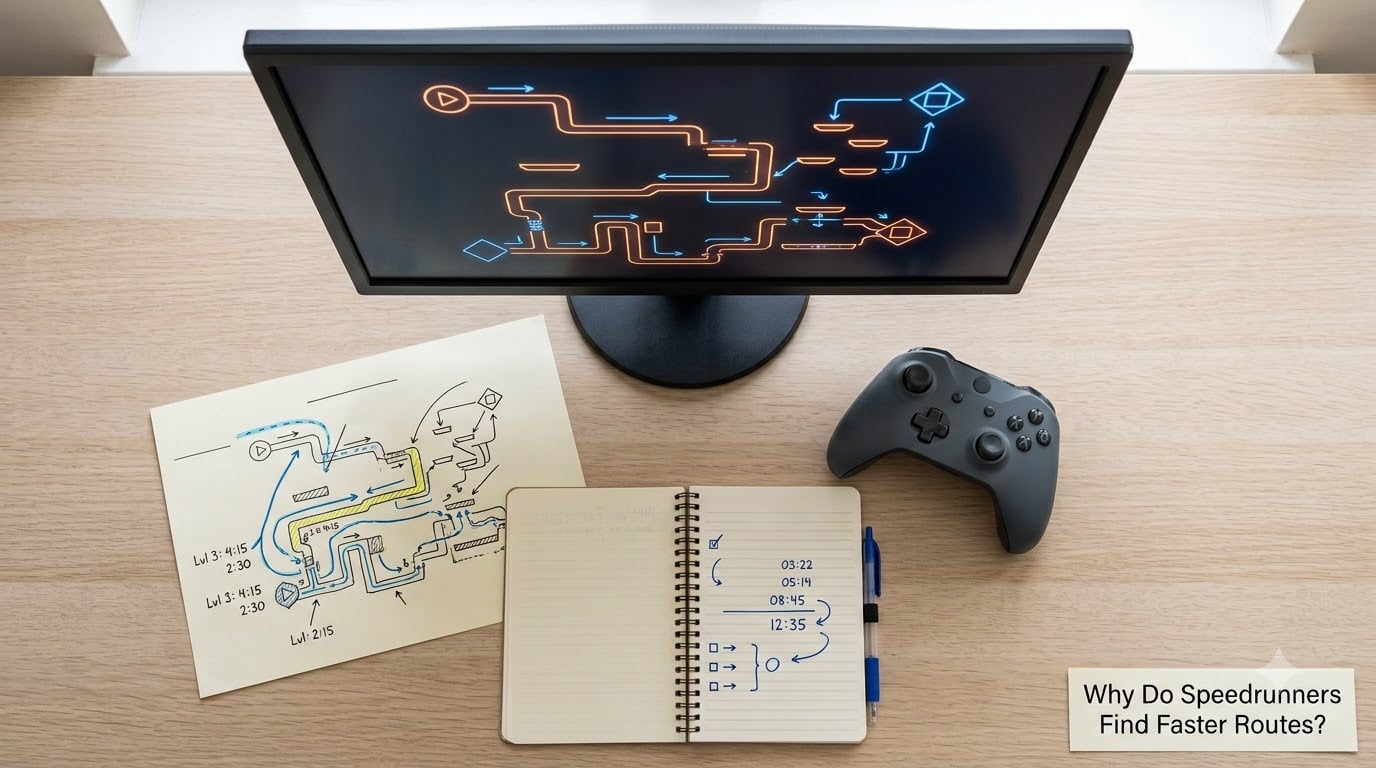
Routes get faster because a route is a hypothesis, not a rule. A runner publishes one, other people watch it looking for the moment where the character slows down for no good reason, and someone eventually asks why.
That question has produced most of the famous tricks. A sequence break skips intended content entirely. A misc skip is a shorter, unintended path that avoids a loading screen or a mandatory detour. Sub-pixel movement, hitbox quirks, spawn positions and frame-perfect inputs all fall into the same family: the game never promised you had to do it the slow way.
Take a hypothetical corridor. The accepted route runs through a hallway, opens a door, collects a key, unlocks the second door and takes a lift. Suppose a runner notices the key spawns on the far side of the first door in some rooms, so the unlock is unnecessary there. If nobody had ever run that room without dying, the detour would look mandatory. The discovery is not a flash of genius in the moment. It is a line-by-line check of a game that was fully understood, except for this.
Discovery tends to come from four places, and they mix constantly:
- Frame-by-frame study. Pausing a run, stepping through inputs and comparing a tool-assisted route against a real-time one shows exactly where the seconds leak out.
- Community argument. Two runners who disagree about whether a save is possible will test it for a weekend, and one of them will be wrong in a useful way.
- TAS crossover. Tool-assisted runners find interactions years before anyone tries them live, then real-time runners chase them down.
- Luck with a repeatable result. The lucky run matters only if someone can show it was consistent rather than a one-off.
Old scenes produce long-tail finds for the same reason. A Metal Gear Solid virtual reality glitch record that sat for roughly two decades was eventually broken after a newly found trick turned up. A Trackmania shortcut surfaced about a decade after the category had settled. A Doom 2 UV-Speed TAS demonstration went more than fifteen years without being completed before a new one landed. None of those games were newly discovered. They were newly understood.
How Does New Technology Make Speedruns Faster?
Tools matter here more than in most gaming hobbies, and not mainly because they make you press buttons faster. They remove time that used to be unavoidable.
Load removal and emulator accuracy
Old games load slowly, and slow loading is dead time you cannot optimise away on the original hardware. More accurate emulators, savestate-friendly practice and file-based loading cut into that. The category of a run has not changed, but the clock no longer sits still while a disc spins up, so the same route produces a lower time.
Frame advance and frame data
Stepping through a run one frame at a time turns a vague feeling about timing into a number. If the character’s turn takes 24 frames rather than 26, you now know 2 frames exist and you can go get all of them. This is the single most common source of small, permanent gains.
Timing software
LiveSplit and its equivalents give per-segment comparisons, so a runner can see that the third room is costing a tenth more than it did last week instead of guessing. Segment timers also make the painfully slow process of fixing one part of a run tractable.
Capture and latency
Video evidence, frame-accurate capture and better streaming pipelines reduce the number of runs that die in review because of a dropped stream or a missing segment. That does not make a run faster, but it stops a legitimate one from being thrown away, which has the same effect over a season.
There is a line, though. Turbo buttons, programmable controllers that queue inputs, external hardware that reads memory and modified firmware can all shave real time, and most leaderboards ban them outright. The usual rule is that the game runs at its intended speed on hardware the leaderboard accepts, and anything automating the player’s hands falls outside real-time categories. A banned device is not a faster run, it is a rejected one.
Hardware variance is a genuine source of confusion between scenes. Two regional versions of the same game can have different physics, and runners regularly compare times across versions without checking. That is why you will see arguments about a Super Mario 64 70 Star run looking faster than a comparable Japanese-version run. The leaderboard rules, not the runner’s opinion, decide which time counts.
What Role Do Training and Practice Play?
Practice is the least cinematic driver and probably the largest one. A route may be fully known and still lose time for months, because the runner is not yet physically capable of executing it at full speed every time.
The gains show up in unglamorous places. Menu navigation gets faster because the sequence stops being a thought. Movement becomes consistent, so the run does not depend on whether today is a good day. Resource management, from ammunition to health, stops being a mid-run decision and becomes part of the route. Deaths drop, and in most categories a death costs a meaningful fraction of a second no matter how small it looks on screen.
The practical version: a runner who can hit a segment at 3.10 and 3.14 with equal ease has just made a large improvement to their odds, even though the average improved by only two hundredths. Record progress tracks the best run, but the best run only rises when the bad outcomes shrink.
How Practice Changes Why Speedrun World Records Keep Falling
There is a clear boundary between what practice can do and what it cannot. Practice makes an existing route faster, safer and more repeatable. It cannot create a shortcut that nobody has found, and it cannot fix a route that is actually a couple of seconds longer than the theoretical best.
That boundary is why the last big drops in a mature category usually are not practice drops. A big drop means a new idea. A small, repeated drop of a few frames across months is a runner slowly converting a known route into muscle memory, and it is the reason a stalled leaderboard is not the same as a finished one.
It is also why beginners sometimes set records in old categories. Someone arriving fresh has no route inertia, no sunk cost in a plan that almost works, and often asks the basic question that veterans stopped asking: does this step have to happen at all?
How Do New Game Versions and Rule Changes Affect Records?
Every record sits on top of a version number and a rulebook. When either changes, what a record means can move even though nobody played any better.
Patches can remove a glitch that a whole category relied on, which forces a reset or a category split. Emulator updates can shift timing by a frame or two, which is noise to a normal player and a headline to a record chaser. Regional version differences change physics and route length. Leaderboards get reorganised, hardware rules get tightened, and a disputed verification can retroactively void a run and hand the record back to the previous holder.
Runners worry about this constantly, and the fear is not irrational. A developer patching out a beloved skip can kill a category’s record history, which is why some scenes keep both an old-version leaderboard and a current one.
| Situation | What changed | Effect on the old record | What a runner should do |
|---|---|---|---|
| Legitimate category improvement | Same version, same rules, faster execution or a new route | Superseded outright | Submit the run with full video evidence and in-game timer |
| Patched game or new version | Glitch removed, timing shifted, region rules changed | Stays valid on its own version, frozen elsewhere | Check which version the leaderboard accepts before grinding |
| Hardware-assisted run | Turbo, macros, memory reading, modified firmware | Usually not accepted at all | Read the leaderboard’s hardware rules and stick to them |
The honest answer to a “the record was patched out” complaint is usually that the record still exists, on a different page. Progress gets complicated when the ground rules move, and that complication is not a reason progress stops.
Why Do Verification and Technology Push Records Down Faster?
Verification does not make a run physically faster. It makes good technique visible, and visible technique gets copied within weeks.
When a run is checked frame by frame, the exact input that saved three frames is documented. When a community shares the timing data behind a segment, every runner in the category now knows that three frames were available and where they were. The first person to find it gets a record; everyone else gets a shorter list of things left to try.
Crowd-sourced route research works the same way. A lone runner grinding a category for years can only test what they think to test. A scene with fifty runners testing everything generates far more experiments per month, and the results are shared whether or not they help.
Good verification also removes fake barriers. Some records are treated as unbreakable because nobody has examined them closely. A careful review of a ten-year-old time often turns up an assumption nobody ever tested, and the “impossible” gap turns out to be a shortcut that was always there.
Luck deserves an honest mention too, because it cuts both ways. A single lucky frame sequence can win a run outright, which is why categories with heavy random behaviour produce dramatic records. It also destroys runs. Runners on r/speedrun describe losing a good time to a fraction of a second of bad luck, including a Super Mario 64 attempt that ended seconds before the finish and a Minecraft run lost to fifteen frames of hesitation. Luck does not raise the ceiling. It decides how often the ceiling is actually touched.
So progress is not one factor multiplying another. It is a loop: technique improves, the improvement gets shared, the shared knowledge reveals what is left, and the new record resets the target for everyone.
Frequently Asked Questions
Are newer speedrun world records always better than old ones?
Not always. A new time is only better if it was set on the same version, the same platform and the same rules as the one it replaced. A record set on a patched version or a hardware rule the old leaderboard rejected may not be directly comparable. Check the version and ruleset before treating one time as an improvement on another.
Can a game patch make old speedrun records impossible?
It can remove a technique a record depended on, which makes the record unreachable on the new version. Most scenes handle this by splitting the leaderboard, keeping the old version’s times and the new version’s times separate rather than deleting history. Some categories do get retired, but the old times usually remain visible somewhere.
Does luck cause speedrun world records to keep falling?
Luck decides how often a runner touches the ceiling, not where the ceiling sits. A single lucky sequence can produce a record in a random-heavy category, and bad luck can destroy an otherwise excellent run seconds before the finish. Over a long enough sample, the fastest legitimate times come from the best technique, not the luckiest rolls.
Why do speedrunners change routes after a record falls?
Because a new record is proof the old route was not optimal. The runner who set the new time usually shows what the previous route was costing, and the rest of the scene rebuilds around the faster line. Over a few years that is why speedrun world records keep falling rather than settling: every record resets the plan the whole category is built on.
How much do controllers and monitors affect speedrun times?
Modern controllers and monitors are usually not a meaningful factor. Latency of a few milliseconds is a rounding error next to the seconds runners fight for, and any device that automates inputs is banned by most leaderboards. Display settings can change how a game presents itself on modern screens, but the real hardware gains come from removing load times and measuring frames accurately.
What Should Players Do to Set a New Record?
Start by fixing the ground rules. Pick a version, a platform and a category and confirm the leaderboard accepts what you intend to use, because a record on the wrong ruleset is a record that does not exist.
Then learn the current route properly. Watch the best run, note every split, and write down where the time goes before you start grinding. Practice one segment at a time until it is reliable rather than occasional, then link the segments together.
Use the tools the scene already uses. Timing software with segment comparisons, frame advance for anything that feels slightly wrong, and a practice setup that saves and reloads quickly will shorten every session.
Document the attempt properly, with uninterrupted video, an in-game timer where the rules require one, and no unexplained edits. Most rejected runs are rejected for evidence problems, not for being slow.
That is the loop. The reason why speedrun world records keep falling is that each of those steps is easier for the tenth person in a category than it was for the first, and the shared version of that knowledge is what pulls the number down.