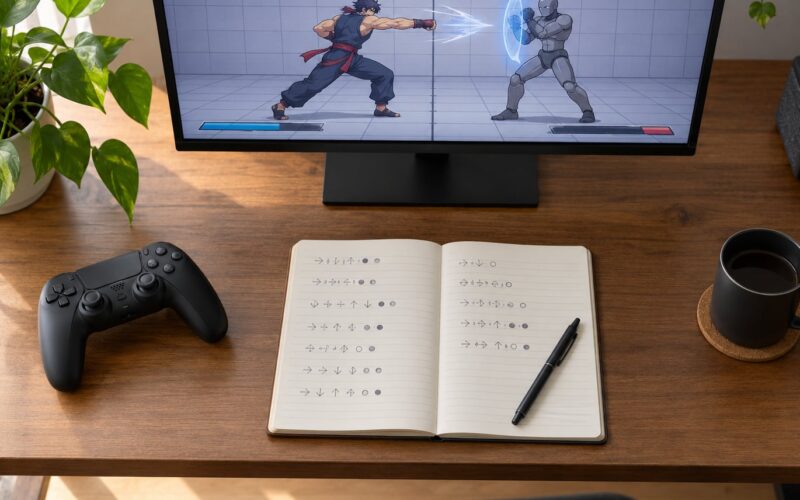
If you are looking for how to block and punish in fighting games, the whole thing comes down to one loop: block the direction the attack is coming from, then press a fast button before your opponent finishes recovering. Most attacks are negative on block, so the defender gets a small head start, and that head start is where the punish lives. Fifteen minutes of training mode a day and you will notice it in ranked within a few weeks.
It matters because blocking by itself never wins a match. It keeps you alive, and that is all it does. Punishing is what turns defense into offense, shuts down the same pressure string over and over, and stops you from losing the exact same round eight times in a row.
This guide covers the inputs first, then frame advantage, then the punish itself, then the situations where punishing is the wrong call. New to the genre? Read it in order. If you already block comfortably and just freeze after a blocked heavy, jump to step 3.
Table of Contents
- What You Need for How to Block and Punish in Fighting Games
- Which button blocks what
- Step-by-Step
- 1. Learn Which Moves Are Safe to Block
- 2. Block with the Smallest Commitment Needed
- 3. Check Whether the Move Is Plus on Block
- 4. Choose the Right Punish for the Situation
- 5. Respect Wake-Up and Counterattack Risk
- 6. Practice Punishes in Training Mode
- Common Mistakes
- Frequently Asked Questions
- How do you block in fighting games?
- What does minus on block mean?
- What is frame advantage in fighting games?
- What is parrying versus blocking?
- What should I press after blocking?
- How do I practice punishing in training mode?
- Conclusion
What You Need for How to Block and Punish in Fighting Games
A block punish is what you do after you block an attack that leaves your opponent at a frame disadvantage. Blockstun ends, but they cannot act for a few extra frames while you can, so you press an attack of your own and it connects before they can block or move. That window is the punish.
Three things have to line up before a punish works, and beginners usually fail on the third one. You have to block the correct direction, the move you blocked has to be punishable, and the button you press has to come out fast enough to fit inside the window. Miss the first and you eat the hit. Miss the second and there is no punish. Miss the third and your punish whiffs and the pressure restarts.
What you need from the game’s training mode is modest. Frame data display, so the game tells you the numbers instead of making you guess. A dummy whose behaviour you can set, so you can make a move come out over and over on demand. Recording and playback, so you can save a pressure string and drill the same three seconds fifty times without re-entering it by hand. Every major game has all three, usually buried a couple of menus into the training options.
Which button blocks what
Blocking is directional, and this is where most new players first get stuck. Holding straight back works against some attacks and then fails against the very next one, which is why people conclude that blocking does not work in their game.
| Attack type | Direction to hold | What it looks like |
|---|---|---|
| Mid-height | Back | Standing jabs, standing kicks, most special moves |
| Low or sweep | Down-back | Crouching attacks, sweepers, many low pokes |
| Overhead | Down | The move that hits you when you hold down-back, so you have to adjust |
| Throw or grab | Guard plus throw button together | Cannot be blocked with a direction at all |
| Projectile | Block, jump, or backdash | Some projectiles pass through crouch block, so check the move |
| Unblockable | Nothing blocks it | Super moves and unblockable grapples; jump or leave the area |
Because attacks come at different heights, the opponent guessing your guard is called block priority. In its simplest form it is a game of rock paper scissors: they may show a crouching animation that could be a low, so you guard down-back, and then it turns out to be an overhead. You blocked correctly and still got hit, which feels broken the first few dozen times and then becomes readable.
Two games in particular need the caveat. Street Fighter 6 and Guilty Gear -Strive- both run on 2D planes, so the table above applies almost exactly. Street Fighter 6 adds Drive Parry on the punch and kick buttons for absorbing a single hit. Guilty Gear -Strive- has Faultless Guard, which costs meter but gives you a reversal on a perfect block. Tekken has no dedicated block button at all, so defense there is built from spacing, backdashing and punishing whiffs, and Mortal Kombat 1 has no blocking, only evading and punishing.
Finally, the vocabulary. These words show up in every forum answer you will read, so it is cheaper to learn them once:
Blockstun is the frozen animation you get when a move hits your guard. Plus frames means you recover before your opponent does. Minus frames means the reverse. Startup is how many frames a move takes to become active. Recovery is the tail end where nothing else can come out. Frame trap is a gap in a block string baiting you into a bad counter-attack. Tick throw is a throw thrown into the start of a blocked string, before you can act. Meaty means blocking a move on the very first active frame so you get a tighter window. Jail is when one move’s animation forces a follow-up that the guard does not cover. Neutral is the state where neither player has the advantage and has to earn it.
Step-by-Step
Here is how to block and punish in fighting games as a fixed loop rather than a pile of memorized answers: see the move, read its properties, choose the cheapest response, press it inside the window, then confirm. Every step below is one turn of that loop, and the loop is the same whether you just blocked a jab or survived a full block string.
1. Learn Which Moves Are Safe to Block
Not every attack can be blocked, and knowing which ones cannot is the first half of defense. Directional attacks and most command grabs can be blocked with the right height. Throws cannot, and neither can unblockable attacks, which exist specifically to punish players who assume every incoming hit is blockable.
Start by separating your character’s moves into two buckets in training mode. The bucket of things you block with back, down-back or down, and the bucket of things that ignore your guard: throws, command grabs, unblockables, and moves with armor that walk through your block and hit you anyway. Almost all of the panic on the block screen comes from the second bucket.
For the throw bucket, the answer is never to mash. Press the guard and throw buttons on the same beat, and you tech it. In some games that is a single button, in others it is a simultaneous press, and Street Fighter 6 additionally lets you throw an opponent out of air recovery on a six-frame window. Learn the tech before you learn anything else about defense, because a blocked string that ends in a throw beats a perfect guard every time.
What you do not need yet is the whole movelist. Pick the five attacks your opponents use most and learn those five first. r/Tekken veterans put block priority second on the fundamentals list for exactly this reason, ahead of frame data, and it is good advice: you cannot punish a move you never blocked in the first place.
2. Block with the Smallest Commitment Needed
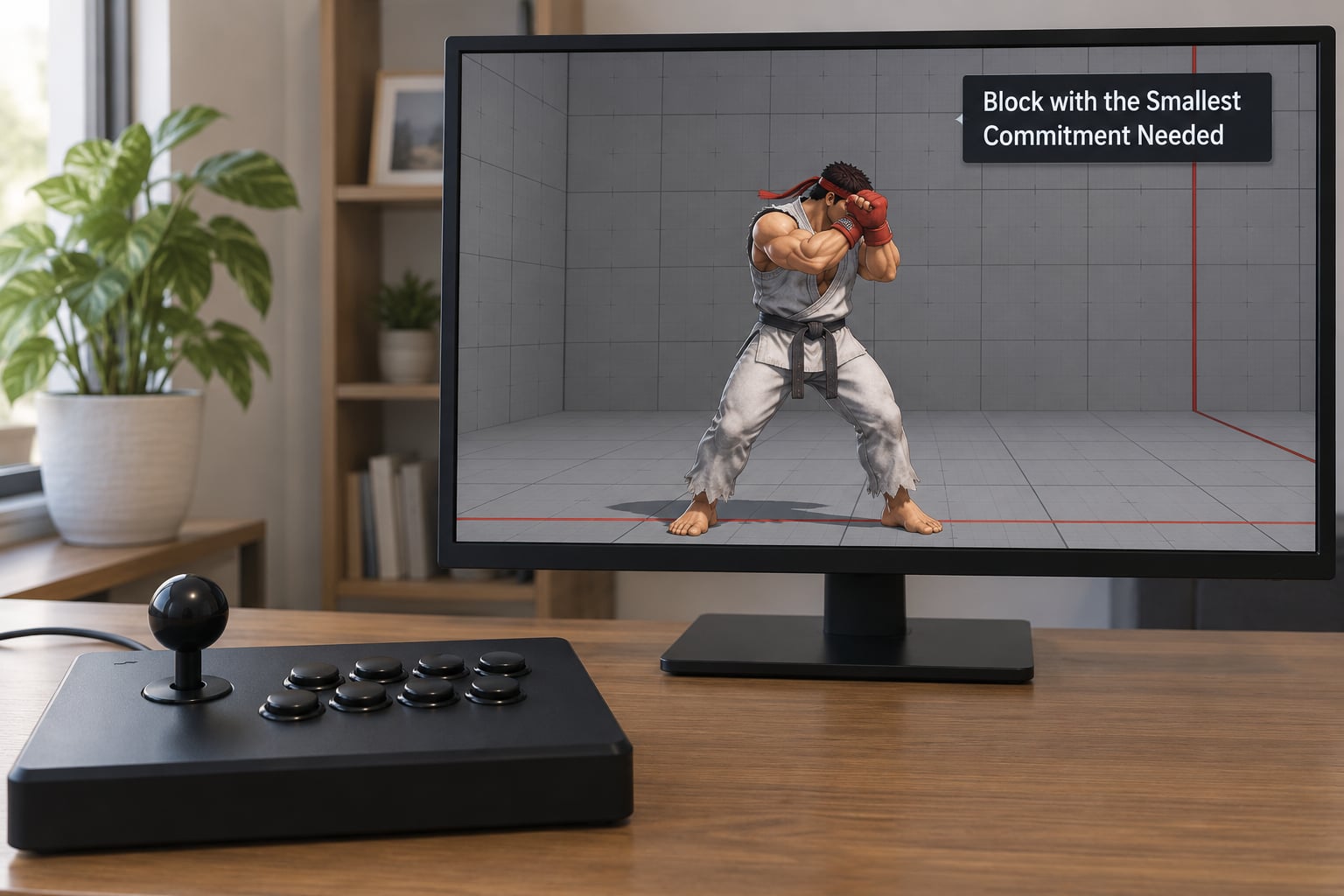
Hold back only as long as the string needs, then let go. Beginners tend to lock a direction for a whole round out of fear, and that is a losing habit even when nothing is hitting you, because permanently holding back means you can never dash, walk forward, anti-air or throw.
Tap blocking is the default. Press and release the guard as the move connects, and you come out of blockstun neutral. The risk is dropping a guard on a slow multi-hit string, which is exactly why guard cancel exists: press forward during blockstun in Street Fighter 6, or use the dedicated guard button, to keep holding block through the rest of the string. If your game has that button, the rule is simple. Use the button.
Backdashing is the escape valve. It makes you unblockable for its startup frames, so it beats throws, it beats pressure, and it creates the distance you need to think. In Street Fighter 6 and Guilty Gear -Strive- it is a back double-tap; in Dragon Ball FighterZ backdashing is how you handle half the defensive game, because assists cover what your guard does not.
The habit to build is: block, then immediately look for one of three outs. The string ends, so act. A throw comes, so tech it or backdash. It is not ending, so backdash out. Deciding between those three takes a second, and it is a far better second than mashing.
3. Check Whether the Move Is Plus on Block
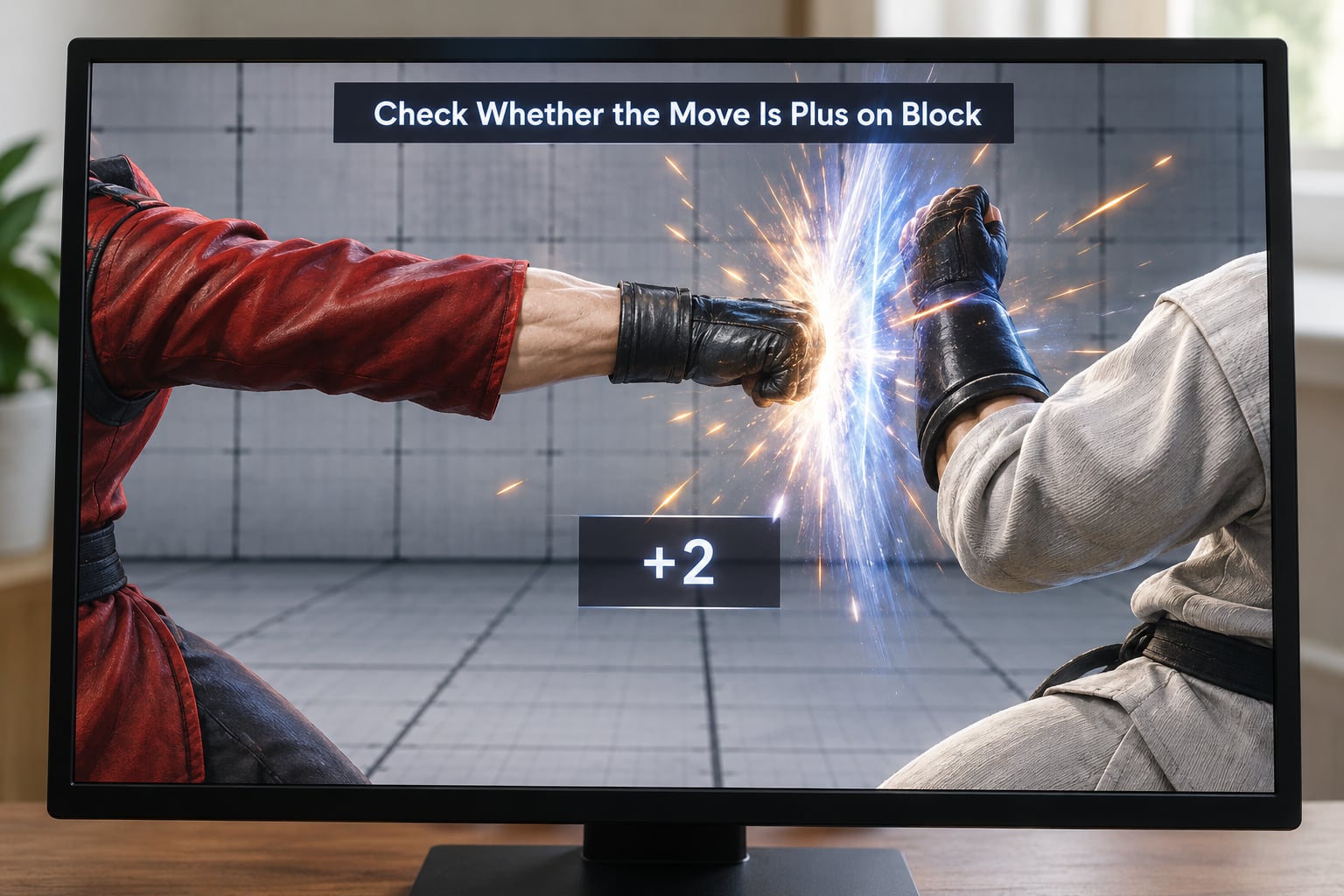
Frame advantage is a comparison, and the comparison is between how long your opponent’s move takes to finish and how long you stay frozen. Add the move’s startup and active frames to its recovery, subtract the number of frames of blockstun your guard gives you, and whatever is left is the advantage. A move with 5 frames of startup, 3 active and 20 of recovery gives 28 frames; if blocking it locks you for 12, the attacker is 16 frames minus and you are plus.
In practice you never do that arithmetic during a match. Training mode does it for you. Turn on frame data and every move will show you its value on block, so the only job left is to know your own side of the number, which is the frame count of your fastest normal attack. Most characters have a 4 or 5 frame button, and that number is your budget for every punish decision in the game.
| Frame advantage | What it means | What you can do |
|---|---|---|
| +6 or more | They are still recovering long after you can act | Dash in, jump, or take a full combo |
| +2 to +5 | A small head start for you | Fast button, short confirm, keep the pressure |
| 0, even | You both act on the same frame | Neither side is punishable; respect their turn |
| -2 to -3 | A tiny recovery gap for them | Fast button only, and confirm it |
| -4 to -6 | A real punish window | Your fastest button, then the full combo |
| -7 or worse | A huge punish window | Anything, including jumps and special pokes |
Two practical shortcuts beat memorising every number. First, long-reaching pokes and big lunging normals are usually heavily minus, because the designer paid for that reach in recovery frames. Second, in most games almost every button is negative on block, which is the single insight that flips a beginner from passive to aggressive. r/dragonballfighterz users say it plainly in their punish threads: if everything were safe, blocking would already be winning.
On top of frame value, check two more properties. Is the move jump-in cancellable, so a safe jump beats it? Is it a knockdown, so it has to be hard-knocked down before you can punish? Sweepers and launchers in Tekken and Virtua Fighter are typically launch punishable, which means the punish is a full combo, not one button.
4. Choose the Right Punish for the Situation
The punish is not one button, it is a decision. Run these five steps every time and the decision takes about the same shape whether the situation is simple or messy.
1. See it. Watch which height the animation is at and whether the recovery looks long. You cannot process what you never saw, and forum advice on this point is consistent: punishing starts with seeing something happen on screen, not with pressing a button.
2. Process it. Frame advantage, jump-in cancellable or not, knockdown or not, and does your opponent have meter.
3. Choose the cheapest answer that works. A fast button is the default. A sweep needs a stand-up or get-up action. A jump-in wants a normal, an anti-air, or a backdash. A deep negative move deserves your fastest special if it is safe.
4. Press it inside the window. Late is the same as not pressing it.
5. Confirm. Watch whether it connected, then decide again from there. Confirming is what separates a punish from a hopeful swing.
The single most common punish error is reaching for the heavy button. It looks more impressive and it whiffs, because the heavy usually has 10 or 12 frames of startup and the window was six. Press light, confirm, then take the combo. Mashing is a legitimate shortcut when the window is large and you only need the hit, but a deliberate press with a plan converts into far more damage.
Throws work as punishes in their own right. A blocked move with a long recovery is often followed by a throw attempt, and if they whiff a throw into your throw they eat a full punish animation. This is the tick throw idea, and it is also why backdashing on reaction beats a player who ends every string with a throw.
Once blocking is reliable, the next level is whiff punishing, which is hitting moves that miss. The beginner version is simple: set the dummy to whiff the move, then press your fast button into the recovery. The better version is the option select, where you use the blockstun of the incoming attack to decide whether to punish before you know whether it will hit. An eventhubs writeup on the technique credits a four-time Capcom Cup competitor with it, and reports the same second-order effect other players describe: with whiff punishes handled, you stop panicking and start watching for jump-ins.
5. Respect Wake-Up and Counterattack Risk
Some blocked moves are not punishable, or not safely. The difference is almost always what your opponent can do on the first frame they act, and a few move types decide the whole question.
Invincible attacks are the big one. Reversals and invincible specials come out on wake-up and beat a normal unless they are beaten back, so a knockdown into a blocked high that leaves them minus can still be dangerous. Armored moves do something similar in games that have armor, since they absorb one hit and hit you anyway. Long-reaching normals tend to be safe on block by design, because the recovery pays for the range.
Frame traps work the same way in reverse. If your opponent throws a move out during the gap in a block string, they are baiting your natural counter-attack into a faster move, and the punish you thought you had becomes their combo. The correction is to stop mashing and check the gap before you press.
Throws set the other limit. If a string ends in a throw you cannot tech, and they are plus after the last blocked hit, throwing is a coin flip rather than a punish. The two safe answers are to backdash out and reset, or to block the whole string and take nothing.
The honest summary of this step: negative on block means an opening exists, not that you must take it every time. When in doubt, especially in the corner or against a character you do not know, blocking and resetting is a correct answer rather than a failure.
6. Practice Punishes in Training Mode
Training mode is where punishes are actually built, and the difference between reading frame data and memorizing it is one setting. Turn on frame data display first. Do it before anything else, because numbers shown in the corner teach faster than any video.
Here is the drill sequence I would run, in order.
Drill one, single move. Pick one attack the dummy will do on demand. Block it ten times and read the frame number each time until you would have bet on it before the dummy moved. Then press your fast button ten times and check the frame advantage the punish gives you. If it is plus, you have your combo. Repeat with a second move until the first few are automatic.
Drill two, height recognition. Have the dummy alternate a mid-height poke, a low and an overhead. Block with the correct direction each time, and note how often you guessed wrong. That number is your real block priority, and it drops fast over a week.
Drill three, the punish loop. Now punish instead of just blocking. The goal is not damage, it is hitting a press on the first attempt with your light button, every time, without mashing. Add mashing only after the deliberate version is reliable.
Drill four, whiff punishes. Set the dummy to whiff on purpose and hit the recovery. Five minutes, and this is where most of your neutral improvement shows up in actual matches.
Drill five, the recorded string. Record a real pressure string from a match, save it, and drill the whole sequence. This is where frame traps and tick throws get found, because you can replay the same three seconds until you see the tell.
A four-week routine fits that into something you will actually keep doing. Week one is drill one on five of your character’s most-used pokes, fifteen minutes a day. Week two adds drill two and puts block priority to the test on live matches. Week three is drill three plus the deliberate light-button punish, and you stop mashing entirely. Week four is drills four and five, with recorded strings from your own losses.
One last habit: keep a list of the moves you have confirmed as punishable, with their numbers. Players who do this climb faster, because they stop guessing. A short written list of ten confirmed punishes is worth more than a hundred remembered opinions.
Common Mistakes
Holding back all the time. It feels safe and it quietly loses you the round, because you cannot anti-air, walk forward, or escape. Fix: tap the guard, and let go the frame the string ends.
Blocking only one way. If you hold back and lose to every overhead and low, the problem is guard direction, not the guard. Fix: one five-minute session on the direction table, nothing else.
Mashing after every blocked move. It connects sometimes, so it feels like progress while producing no damage and no plan. Fix: press the light button once, watch the hit, then decide.
Punishing with the heavy button. It is slower than the window and you get counter-hit for trying. Fix: always start the punish with your fastest normal.
Throwing on negative frames. If their move was heavily minus, the throw is usually fine, and if it was only minus by two, you are trading a real punish for a coin flip. Fix: check the number before you choose the throw.
Punishing without checking wake-up options. The blocked move was punishable, but the character has a safe jump, an invincible reversal, or a command grab. Fix: ask what they can do on their first actionable frame, not just what you can do on yours.
Using unsafe jumps as a punish. A full jump is a big commitment and many characters get punished for it. Fix: use a short hop or a normal, and save full jumps for confirmed plus frames.
Drilling against random dummy behaviour. A dummy that acts randomly teaches you to react but never lets you drill a specific punish. Fix: set behaviour to a recorded sequence or a repeating action, and turn on frame data.
Two habits are worth adding on top of the corrections. First, learn combos second, not first: a player who can convert a confirmed punish into a combo doubles the reward for the same block, and the r/Tekken beginners who rush to combos before defense are the ones who end up guessing their way through pressure. Second, keep one safe way out of every situation. A backdash that always works is worth more than a risky pressure route you only use on a good day.
Frequently Asked Questions
How do you block in fighting games?
Hold back to block mid-height attacks, hold down-back to block lows and sweeps, and hold down to block overheads. Throws cannot be blocked with a direction at all, so you press your guard and throw buttons together to tech them. Practice each direction on its own in training mode before you try to combine them.
What does minus on block mean?
Minus on block means the attacker’s move is still in recovery after blockstun ends, so they cannot act for a few frames after you can. That gap is your punish window: a move that starts in 4 to 6 frames will land, while a heavy button will whiff. A bigger negative means a bigger window and more combo options after it.
What is frame advantage in fighting games?
Frame advantage compares how many frames of recovery each side has after a move trades. If the attacker’s recovery is longer than the defender’s blockstun, the defender is plus and acts first. If it is shorter, the defender is minus and can punish. Zero means even, where neither side gets a free action.
What is parrying versus blocking?
Blocking is a passive stance that reduces damage and pushes the attacker away. Parrying is a timed button press that stops a single hit and punishes the attacker, but it has a tight timing window and spends a resource. Street Fighter 6 uses Drive Parry on the punch and kick buttons, and Guilty Gear -Strive- has Faultless Guard for a similar effect.
What should I press after blocking?
Press your character’s fastest normal attack, usually a light punch or kick, then decide what to do with the advantage you just won. A heavy or special is usually too slow to connect and hands the initiative straight back. If the move was deeply negative, that fast button starts a full combo instead of ending the exchange.
How do I practice punishing in training mode?
Turn on frame data display, set the dummy to a recorded sequence or a repeating action, and block the move until the frame meter confirms its value. Then press your fastest button and check the advantage the punish gives you. Repeat ten times until it lands without thinking, then move to the next move in the set.
Conclusion
Do one thing this week: pick the attack you lose to most often, block it ten times in training mode with frame data on, and write down its number. Then drill the fast-button punish until it lands without mashing. Repeat for the next four moves, and blocking will stop being something you survive and start being something you attack out of.