
If you want a straight answer: speedrun categories are decided by volunteers, specifically the moderators assigned to each game on platforms like speedrun.com. They read community requests, judge whether a proposed goal produces comparable times, write the rules, and decide where that category sits on the leaderboard. No algorithm picks them, and no central governing body approves them.
That sounds informal until you look at how much rides on it. A category defines what counts as a record, which routes are legal, and who a runner is competing against. Get the definition wrong and a leaderboard fills up with runs that nobody can compare to each other.
Table of Contents
- Key takeaways
- How Speedrun Categories Are Decided
- What Makes a Good Speedrun Category?
- Who Decides the Official Rules?
- How Communities Propose a New Category
- How Rules Define a Fair Route
- How Speedrun Categories Are Decided Step by Step
- Do players have a clear and comparable goal?
- Is the route stable enough to reproduce?
- Does the category create a meaningful skill challenge?
- Can the rules be verified objectively?
- How speedrun categories are decided when the community is split
- What Happens When Categories Are Changed?
- Examples of Popular Category Types
- Frequently Asked Questions
- What are the different categories in speedrunning?
- What does NMG mean in speedrunning?
- Who decides which categories a game gets?
- Should this be a new category or a subcategory?
- Why do speedrun categories get moved to miscellaneous?
- Can anyone add a category to a speedrun leaderboard?
- Conclusion
Key takeaways
- A category is a goal, not a method. The method is the ruleset underneath it.
- Game moderators make the call, guided by community consensus and the runners already on the board.
- Comparability, reproducibility, skill expression and verifiable rules decide whether a proposal survives.
- Categories that stop attracting runners get parked in miscellaneous, and can be promoted back.
- Norms differ per game and per community, so there is no universal rulebook to appeal to.
This guide covers how the process actually works, both for runners picking a board to submit to and for moderators designing one. If you have ever wondered why a game you love has five categories while another has fifty, the answer is usually about attention, not philosophy.
How Speedrun Categories Are Decided
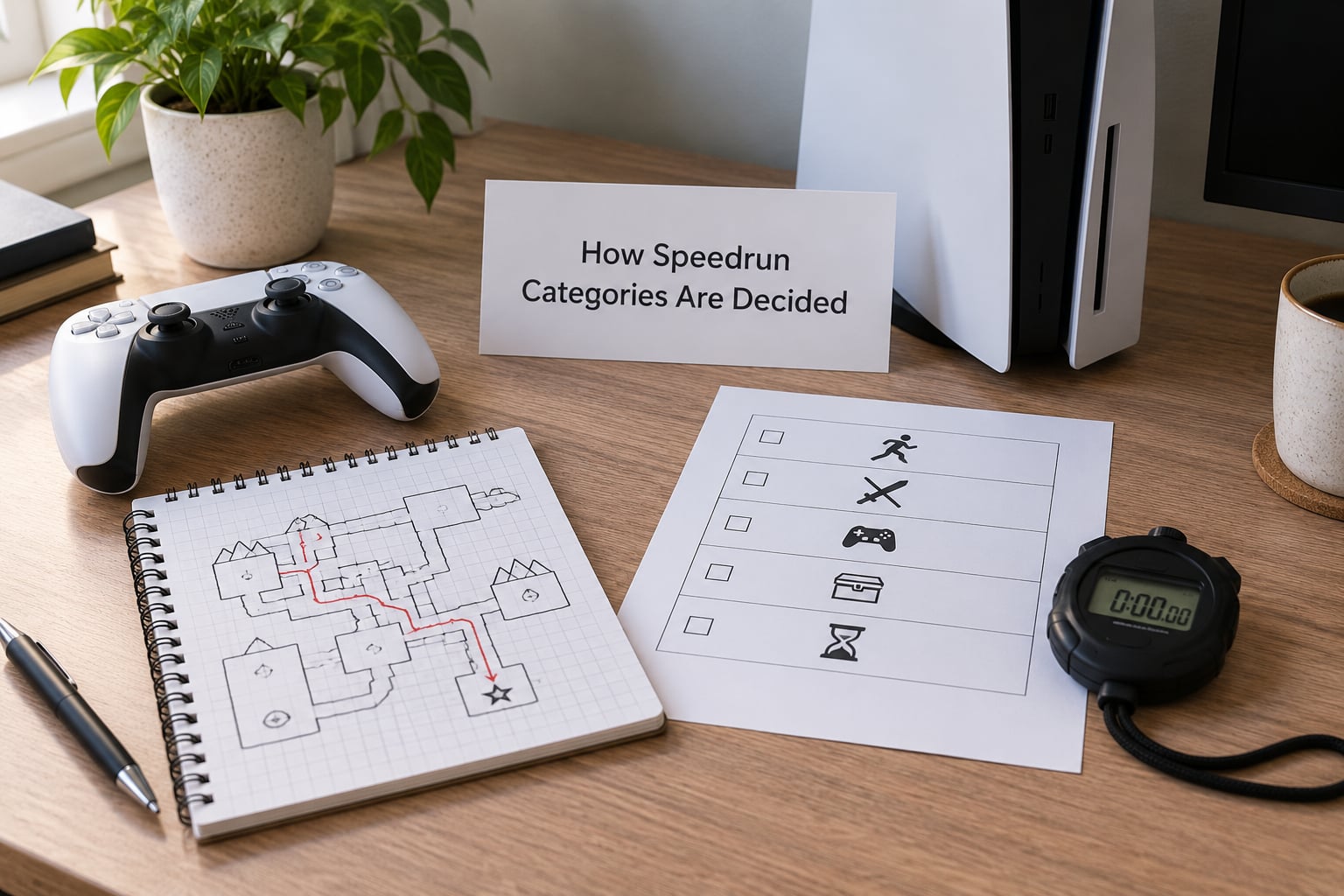
Four people or groups shape a category decision: the game moderators who own the leaderboard, the runners who run the game, the tournament organizers who set event rules, and occasionally the platform holder when a version difference makes runs incomparable. In practice the moderators hold the final say on speedrun.com, and they almost always do it after listening to the runners.
The single most useful thing to understand is the hierarchy, because most category arguments are really arguments about which tier a rule belongs on.
| Level | What it sets | Example |
|---|---|---|
| Game | Which title the leaderboard belongs to | Elden Ring |
| Category | The goal the run has to achieve | Any% |
| Subcategory | The ruleset allowed while chasing that goal | Glitchless |
| Annotation | Extra context that is not a rule | Game Version: 1.16 |
Categories say what you finish. Subcategories say how you are allowed to finish it. Annotations record information that changes how a run should be read without restricting anything. Get that separation right and most disputes shrink dramatically, because people stop arguing about the wrong field.
What Makes a Good Speedrun Category?
A category has to survive five tests before a moderator is comfortable adding it, and they overlap more than you would expect.
- A distinct objective. If a runner cannot say in one sentence what the category asks for, the rules will be ambiguous forever. Ends when the final boss falls is clear. Ends when the game is done somehow is not.
- A repeatable route. The route has to hold up across input latency, patch notes and player skill. A route that only one person can execute is a stunt, not a category.
- A measurable end condition. The finish has to be observable in the video. Communities write conditions like a run ending when Red is defeated because a viewer can spot that frame instantly.
- Balanced competitive value. The category needs to be hard enough that improvement is interesting and open enough that a first-time submitter is not hopeless.
- Enough players to populate it. This is the filter most people underestimate. A leaderboard with four runs and a two-year gap between first and second tells nobody anything.
There is a sixth, quieter consideration: moderation work. Every category is a verification queue, a rules page to maintain, and a dispute waiting to happen. Solo moderators on small games feel this one hardest, which is why plenty of reasonable proposals sit unapproved for years simply because nobody has the evening free.
Who Decides the Official Rules?
Authority depends on where you are running. On speedrun.com it sits with the volunteer moderators assigned to each game, with site-wide moderators handling disputes that cross game boundaries. Nobody is paid, and many small games are run by a single person.
That person can be strict or permissive. A community with a loud argument culture will produce narrow, tightly specified rules, while a quiet game might run on one line of text and a lot of good faith. Neither is wrong, but the difference matters when you compare times across games or platforms.
Tournament organizers set their own rules too, and they will not always match the community board. A speedrunning event might ban emulator runs, lock to an original console release, or require a full uncut video when the leaderboard does not. Platform holders influence things indirectly, since a new release or a patch can force a version decision overnight.
There is no appeals court. When two communities disagree, the outcome depends on who has the time to argue it, which is why so many decisions get documented in forum threads rather than in a formal policy.
How Communities Propose a New Category
The mechanics differ per platform, but the social process follows a recognizable pattern. Newcomers usually expect a submission form. What actually happens is closer to a public argument that ends in a forum thread.
- State the goal in one sentence. If you cannot, moderators will ask you to go back and try again.
- Check the existing board. Half of all requests are answered by an existing category plus a subcategory, which is cheaper to run and easier to compare against.
- Post it in the game’s forum with evidence. Show a completed run, or at least a route someone believes is possible, and say roughly how many runners would submit.
- Take the criticism. Expect a wall of route-breaking discoveries in the first few replies. That is normal and useful.
- Write the rules the moderator asked for. Precise start and end conditions, allowed and banned techniques, and version assumptions.
- Wait for a ruling. A moderator approves it, folds it into an existing category as a subcategory, or parks it with an explanation.
Forum threads about category suggestions make one thing obvious: naming is treated as a real requirement. A community moderator on one game put it plainly when arguing that categories need to be named so people will understand what the goal means from the title alone.
How Rules Define a Fair Route
Once a category is approved, the rules page becomes the actual referee. Runs get submitted, moderators compare them against the wording, and the wording wins every argument.
Good rules usually cover the same ground: where timing starts and stops, which milestones are mandatory, which skips and glitches are legal, whether save states and load removal are permitted, how cutscenes and boss order are handled, and whether any action outside the counted timer is allowed at all. Every one of those lines exists because somebody did the thing that the rule now forbids.
Timing method is part of this, and it is a common source of confusion. Real Time Attack counts wall-clock time including loads. Loadless Real Time ignores loading screens. In-Game Time uses the game’s own counter, which is fast but often easier to manipulate. Communities pick the method that produces the most honest comparison, and they rarely change it once records exist.
Emulator policy is the other big lever. Allowing emulators opens the field to anyone with the game file, but introduces questions about version authenticity and frame timing. Restricting to original hardware shrinks the pool and raises the barrier. Platforms usually do not get separate categories unless the mechanics differ meaningfully, which is the general consensus runners reach when the question comes up.
The goal-versus-method rule keeps coming back. If a change alters what must be accomplished, it is a new category. If it alters how it may be accomplished, it is a subcategory under the same category.
How Speedrun Categories Are Decided Step by Step
Moderators rarely formalize this, but the questions below come up in almost every review. A proposal that answers all of them clearly usually gets approved on the first pass.
Do players have a clear and comparable goal?
Say the finish line out loud. If two reasonable readers would disagree about when the run ends, the rules need another paragraph. Clarity here also cuts down verification time, since a moderator should be able to pause a video and see the ending without a debate.
Is the route stable enough to reproduce?
The route has to work for players other than the person who found it, on hardware and input setups they did not choose, after the patch that may land next month. Routes get cut, wall clips get fixed, and a category built on a single discovery is a category with a short life.
Does the category create a meaningful skill challenge?
Ask what the leaderboard is actually ranking. If the top ten times are decided by who has the best routing knowledge, that is a legitimate category. If they are decided by one lucky skip, it is not, and the community will say so.
Can the rules be verified objectively?
A moderator has to watch the run and reach the same verdict another moderator would. If the answer depends on taste, arguing or trusting the runner, the wording needs tightening. This is also where the moderation workload bites, because every unclear rule becomes a queue of appeals.
How speedrun categories are decided when the community is split
Disputes get resolved in public, usually in a forum thread, and moderators use a few predictable moves. They ask for video evidence, they ask whether the objection is about the rules or about a single run, and they distinguish between a rules problem and a routing problem.
When a rule genuinely cannot serve both camps, the usual fix is to split rather than pick a winner. Any% and Any% Glitchless sitting side by side is the classic outcome: two goals, two boards, no argument. When a moderator insists on one answer anyway, the community remembers, and that shapes the next request.
What Happens When Categories Are Changed?
Categories are not permanent. Routes break, patches land, and goals that once looked interesting stop attracting runners. The way that is handled decides whether a community keeps its history intact.
Revision usually shows up as documentation. The rules page notes the effective date, existing records stay valid unless the change breaks comparability, and anything genuinely incomparable gets marked obsolete so runners know why their time vanished from the ranking. Obsoletion on speedrun.com can also chain: a newer platform obsoletes an older one, and an older platform obsoletes its predecessor.
The miscellaneous category is the pressure valve. A veteran user on the site forum described why it exists: showing every leaderboard on a game’s main page is not very productive and useful, so categories that do not earn a permanent slot get filed away instead. Typical residents are old routes from before skips were discovered, joke categories, and add-on or DLC content runs.
The nice part is that misc is reversible. Categories can move back out to the main page when the community majority wants them back, because the decision is made by mods and runners rather than by software. Treat a demotion as a question about current interest, not a judgement about the category’s legitimacy.
Examples of Popular Category Types
The names on a leaderboard are shorthand, and they follow fairly consistent conventions. Once you can read them, browsing almost any game’s board becomes obvious.
| Category name | What it requires | What it measures |
|---|---|---|
| Any% | Reach the ending as fast as possible | Routing knowledge and execution speed |
| 100% | Complete every collectible in the game | Thoroughness and long-game consistency |
| All Achievements | Finish every achievement or trophy | Completion, usually on the most accessible platform |
| All Bosses | Defeat every boss, order often fixed | Fight execution and boss-specific routing |
| Low% | Complete the game using the smallest possible percentage gain | Constraint solving and routing creativity |
| NMG | Finish without major glitches, minor ones allowed | Clean play with a grey area that needs defined boundaries |
| Glitchless | No glitches at all, as defined by the community | Raw execution and input precision |
| IL | Finish one level rather than the whole game | Per-level routing, often the busiest entry point for newcomers |
Any% and 100% are the two poles most people picture. Any% rewards the shortest path, which makes it competitive and fast-moving as new skips surface. 100% asks you to touch everything, which turns it into a long grind where a single late-game mistake costs hours.
All Bosses and All Achievements sit in between. They exist because a lot of players love the fights but not the collectible hunt, and a category lets that crowd compete without diluting Any%. Low% does the opposite: it takes a familiar goal and removes an option, so the same game plays differently.
NMG and Glitchless are really rulesets, not goals, which is why they usually appear as subcategories. That distinction is where a lot of new-runner confusion starts, so it is worth learning to read before you assume a board is missing something.
Individual level categories come from the same logic applied to scope. If a game has ten clearly separated levels, giving each its own board makes the competition meaningful, even though it multiplies the moderation load. Whether they are worth it is a local judgement about how many runners each level realistically has.
Frequently Asked Questions
What are the different categories in speedrunning?
The common ones are Any%, which reaches the ending as fast as possible, 100%, which collects everything, All Achievements, All Bosses, Low%, which restricts the percentage you can gain, and individual level categories that cover one level at a time. Variants like NMG and Glitchless are usually rulesets listed under a category rather than separate goals.
What does NMG mean in speedrunning?
NMG stands for No Major Glitches. The community has to define which techniques count as major and which do not, because the line moves between games. It normally sits as a subcategory under Any% so that glitchless-style and unrestricted runs can be compared side by side on the same board.
Who decides which categories a game gets?
The volunteer moderators assigned to that game on the platform, working from community consensus in the game’s forum threads. On speedrun.com, game moderators create, rename, split and retire categories for their own games, while site moderators step in when a dispute crosses game boundaries. Tournament organizers can set separate rules for their events.
Should this be a new category or a subcategory?
If the change alters what the run has to accomplish, make it a new category. If it only changes how that goal may be achieved, make it a subcategory. Any% and Any% Glitchless is the standard example: the finish line is identical, so the split belongs underneath the category, not beside it.
Why do speedrun categories get moved to miscellaneous?
Miscellaneous is a visibility tool. A game’s main page only has room for the categories with real activity, and everything else is filed away so the board stays readable. Residents typically include superseded routes, joke categories and add-on runs. The move can be reversed when runners want the category back on the main page.
Can anyone add a category to a speedrun leaderboard?
Anyone can propose one, but nobody can add one alone. Post the idea in the game’s forum with a clear one-sentence goal, evidence that the route works, and an estimate of how many runners would submit. A game moderator reviews it and approves, folds it into an existing category as a subcategory, or explains why it was declined.
Conclusion
Speedrun categories are decided by people, in public, using one test: does this proposal give runners a goal they can compare, a route they can repeat, and rules a moderator can apply without arguing. Everything else is detail.
Start by reading the existing board and learning the goal-versus-method distinction. If you want to run, pick the category whose end condition matches how you actually want to play. If you want to moderate, post one clear sentence and bring evidence, and expect the community to break your route before they break your rules. That is not gatekeeping, it is the same process that keeps every record on the site worth something.
Rules and standards shift as games and communities change, so check the game’s own rules page and forum before submitting in 2026.