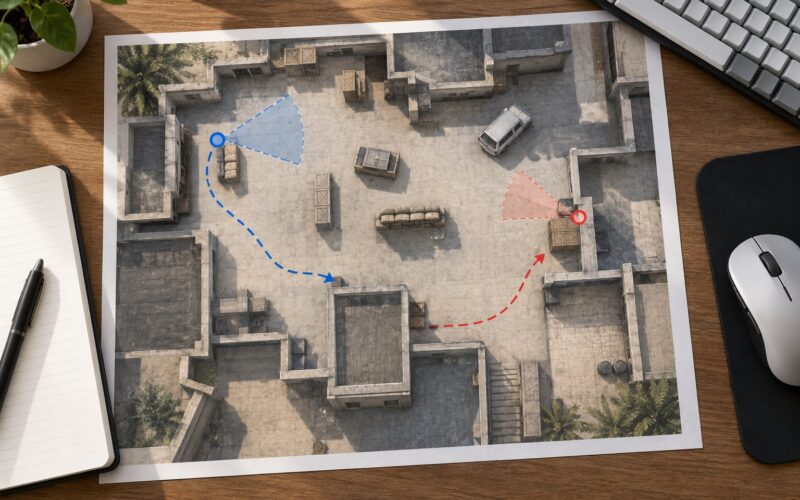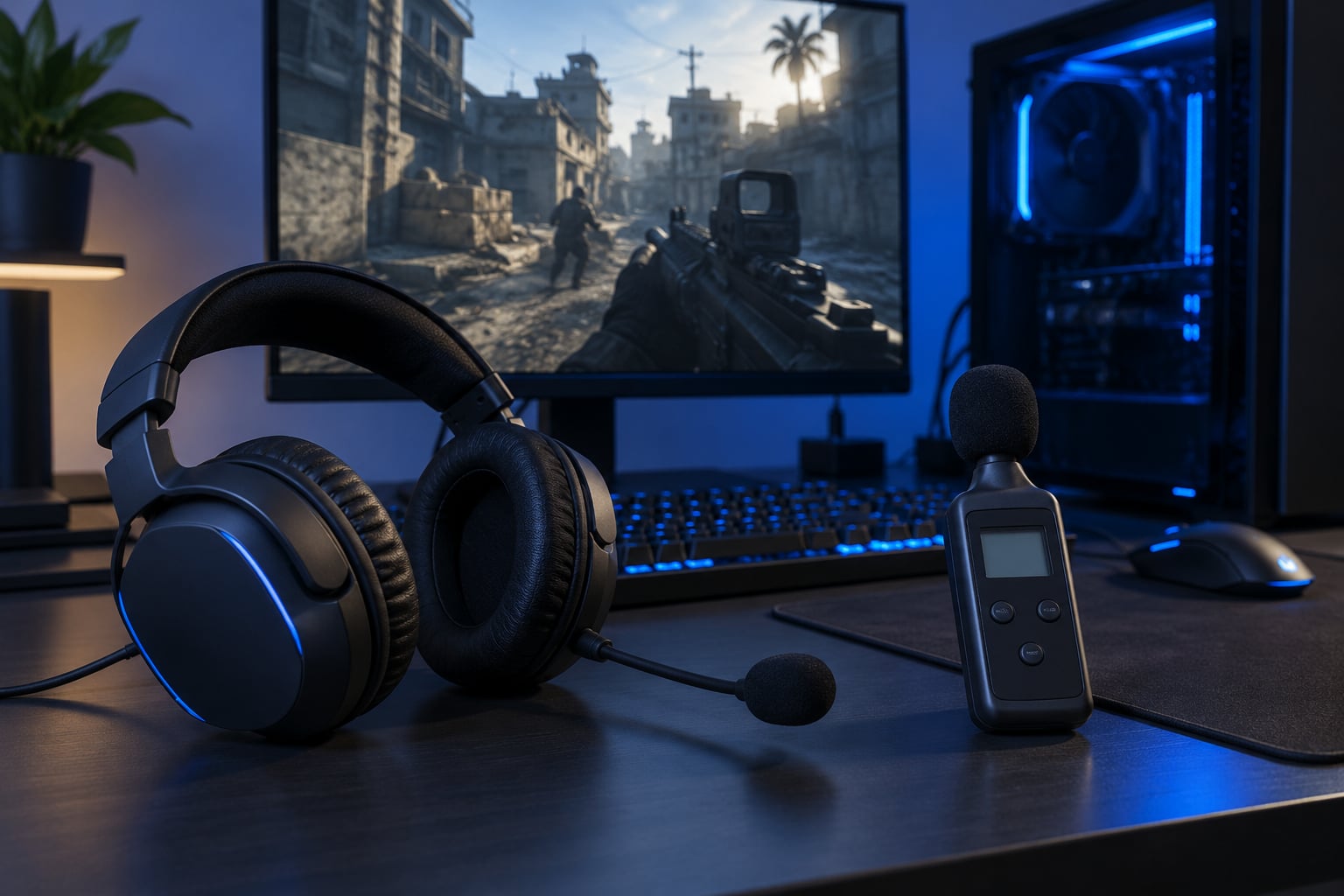
To play off sound cues in a shooter, you use what you hear as decision-making information rather than background noise. You identify the cue, estimate where it came from, decide on a move, then confirm before you commit. It works in every shooter, and it is the difference between winning a fight you never saw starting and losing one you did not hear coming.
The most useful thing I can tell you up front is that cue-reading is a loop, not a talent. Hear it, identify what it is, decide what it means, move accordingly, tell your team. Most players stall at the second step: they hear something, they know something happened, and they have no idea what to do about it.
Audio also arrives before visuals, every time. That timing is the whole reason this skill pays off. The rest of this guide breaks the loop into seven steps, plus the setup work you need before any of it registers.
Table of Contents
- What You Need Before You Start: Headphones, Settings and Quiet
- Headphones, and which kind
- The settings that matter, in the order you should change them
- The equalizer, if your headset has one
- The room
- How to Play Off Sound Cues in Shooters: The Step-by-Step Loop
- 1. Learn the main sound cues first
- 2. Separate useful cues from distractions
- 3. Position your attention correctly
- 4. Turn the cue into a prediction
- 5. Confirm the cue before committing
- 6. Communicate the information clearly
- 7. Practice with a deliberate routine
- Common Mistakes and the Fix for Each
- Frequently Asked Questions
- How do I know where an enemy is by sound in a shooter?
- What headphones do pros use for shooter sound cues?
- Should I turn on surround sound for a competitive shooter?
- Can you hear footsteps through walls in shooters?
- What EQ settings help me hear enemy footsteps better?
- How do I get better at reading sound cues with a team?
- Conclusion: Pick One Map and One Cue to Start
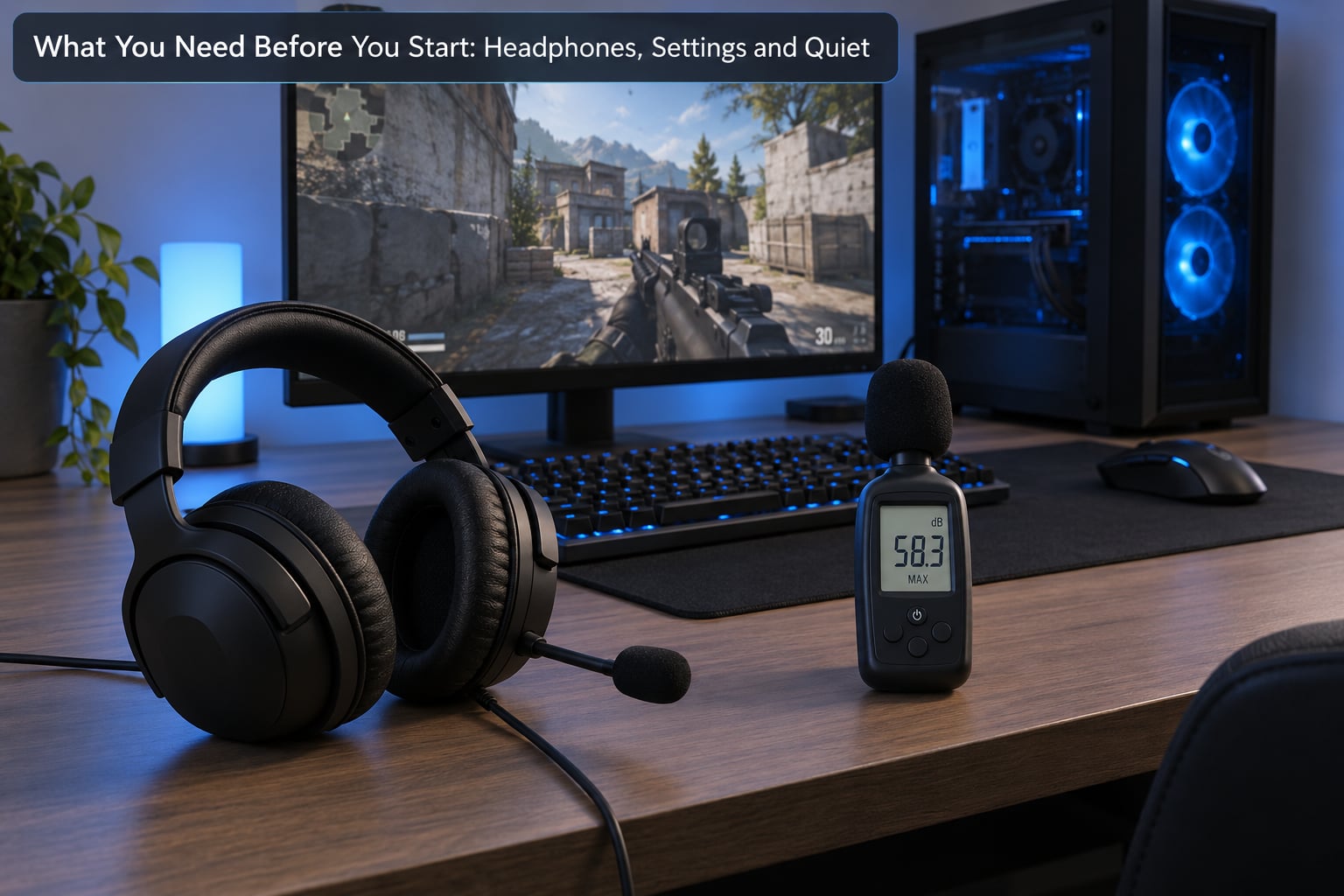
What You Need Before You Start: Headphones, Settings and Quiet
You need three things working together: a way to hear direction clearly, settings that stop the game from burying that direction, and a room quiet enough that your own fans are not louder than an enemy’s footsteps. Miss any one of the three and the loop breaks at the first step.
Headphones, and which kind
Over-ear, closed-back headphones are the default for a reason. The ear cups block outside sound, so your desk fan and the room behind you stop competing with the game. Open-back headphones leak in room noise and leak your game audio out where a friend can hear it, which is its own problem.
Wireless is fine, with one caveat. A 2.4GHz dongle wants a clear line to the receiver, so plug it into a front USB port rather than tucking it behind a tower, and keep the dongle away from the receiver end of the keyboard cable. Packet loss in a wireless headset shows up as a footstep that vanishes, and you will misread that as a player who stopped moving.
The settings that matter, in the order you should change them
Set music and dialogue volume to zero first. It is the highest-value change on the list and the one people skip. Players on r/Competitiveoverwatch describe the same experience repeatedly: effects and master at maximum, music and dialogue at zero, and footsteps suddenly sounding like they are in the same room as you. Research on competitive FPS players backs this up, documenting deliberate in-game muting as a way to maximise awareness of movement cues.
Next, turn off mono audio if the game offers it. Mono collapses the stereo field to a single channel, and left-right information is the part your brain uses most. You are trading the most useful dimension for nothing.
Then deal with surround. This is where players get stuck, and the Tom’s Guide forum threads on this topic are full of people who cannot tell which combination is correct. The consensus that keeps repeating from competitive players is to disable the headset’s own surround button entirely, because the virtual surround processing muddies direction. If your game offers Dolby Atmos for Headphones, treat it as a second layer: switch it on after a few days of clean stereo play, and give it time to recalibrate your sense of where sounds come from.
Players coming back to Hunt: Showdown after the 1896 audio overhaul described losing above-and-below resolution almost overnight, going from precise direction-finding to footsteps all around. That recalibration is normal and it passes, but it passes faster if you play with one audio configuration instead of swapping between them every session.
The equalizer, if your headset has one
A gentle presence boost does more for footstep clarity than any hardware swap. High-pass around 80 to 100Hz to clear out desk rumble, then add roughly 3 to 6dB in the 2kHz to 4kHz range where footsteps and fabric rustle live. Do not push the 8kHz and above bands hard; that is where footstep detail sits, and boosting it heavily creates harshness that makes you turn the whole signal down afterwards.
The room
Measure your noise floor honestly. Sit in silence and note what is loudest: a fan, a fridge, traffic, a wall clock. If you cannot identify a single footstep pattern in that room during a quiet match, the problem is the room, not your ears. Dorms and shared flats are the worst case, and the realistic fix is a decent closed-back pair plus a room where you can mute the world for a few hours.
How to Play Off Sound Cues in Shooters: The Step-by-Step Loop
1. Learn the main sound cues first
Every shooter has its own audio vocabulary, so start by learning the categories that show up in all of them: footsteps and the surface they land on, weapon handling sounds, firing, movement events like jumps and landings, and ability or utility audio. The specific mix changes per game, but the categories do not.
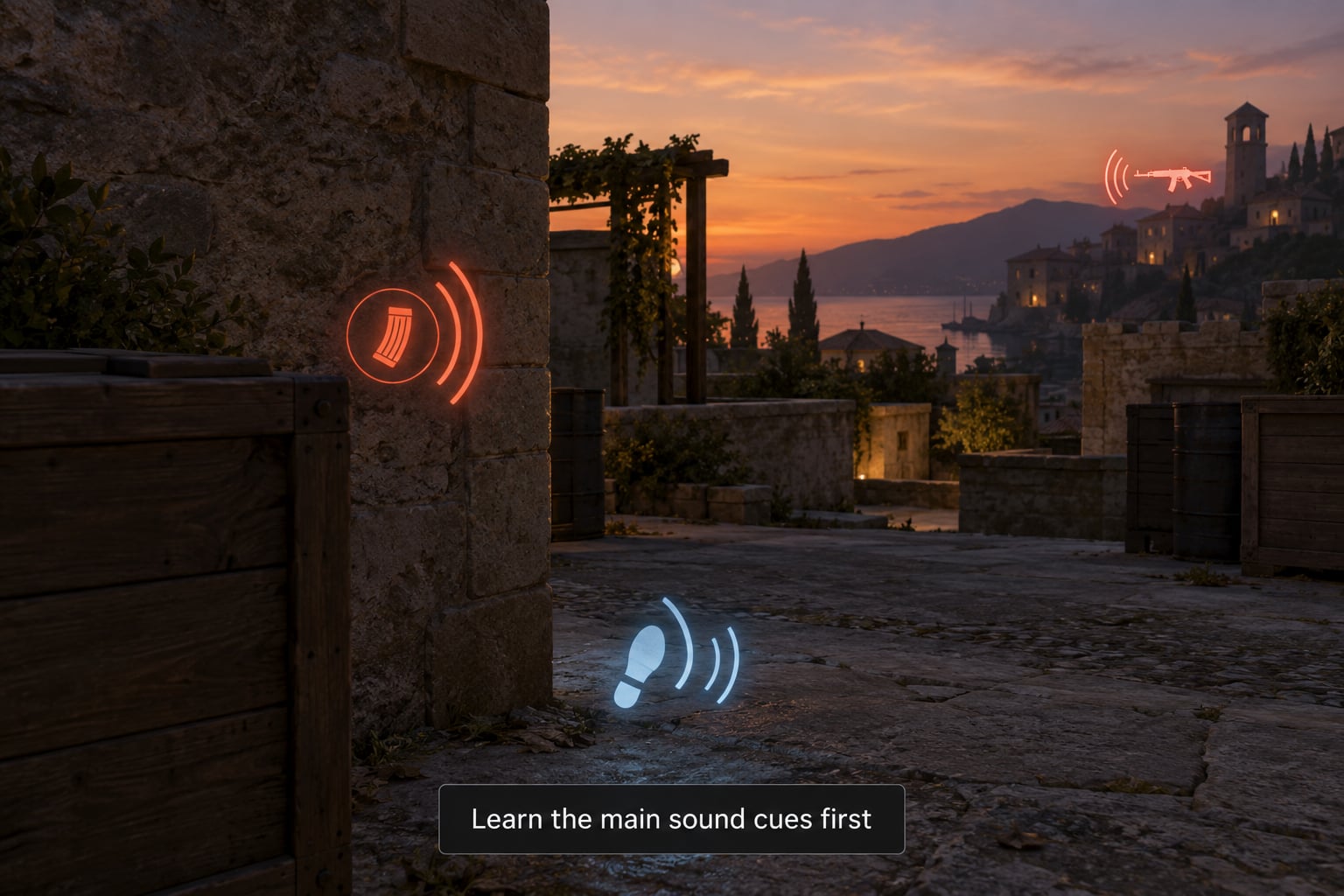
Within those categories, surface material is the most underused channel. In Hunt: Showdown the community treats environmental audio as a standout feature: stepping on twigs is extremely loud, and glass bottles produce a consistent, learnable sound. That is a map-reading skill, not a gimmick. Once you know that a given corridor is gravel and the next one is wood, an enemy’s surface tells you which route they took even when you cannot hear the direction clearly.
Weapon handling deserves its own attention because it is the loudest thing an enemy does at the wrong moment. A reload, a weapon swap, and a scope zoom all produce distinct sounds that carry a long way and tell you the enemy is committed to something for the next second or two. Learning to recognise those three by ear is the fastest return on practice time.
2. Separate useful cues from distractions
You are not listening for sound. You are listening for sound that changes your next decision. Sort every noise into those two buckets, using five filters: volume relative to the rest of the mix, direction, distance, rhythm, and whether the sound belongs to someone who should be alive where you think they are.
Rhythm is the filter most people skip. A single footstep is a player moving carefully or landing from a jump. Several in even rhythm is someone walking a corridor. A burst of them that stops abruptly is a player who heard something and stopped.
Your own team is the biggest source of noise you have to filter. Learn your teammates’ footsteps as well as your enemies’, and once you can tell them apart in a noisy room, the mental workload of sorting cues drops noticeably.
There is a physical reason loud sounds hide quiet ones. Spectral masking is what happens when a gunshot sits in the same frequency range as the footstep that follows it, and the gunshot wins. If you are duelling at close range, expect to lose audio information for a second afterwards, and plan your next move around what you already knew rather than what you think you heard.
3. Position your attention correctly
Your camera orientation and your movement both shape what reaches your ears. Walk while listening and the noise of your own steps masks theirs, so stop before you commit to a read. Crouching and holding still is the cheapest way to raise your own signal-to-noise ratio during a listen.
Attention has a direction of its own. Players who report being able to tell that someone moved but never where usually have their focus locked on the crosshair and their centre lane. Sweep attention through the surrounding audio space deliberately, one sector at a time, then come back to your aim point. It feels strange for a few sessions and then it stops feeling strange.
Where you stand in a room changes what you hear, too. A position with hard surfaces on two sides will return more reflected audio and muddier direction than a spot in open space. When a map allows it, take angles that keep one ear facing the likely approach rather than standing square to it.
4. Turn the cue into a prediction
A sound tells you a location and an action. It does not tell you a plan. Convert it into what the enemy is most likely doing next, and keep the conversion loose enough that you can revise it.
One distant footstep followed by silence is someone who stopped. A reload sound is a commitment: they are out of the fight for a moment. A shotgun blast in a game like Hunt or Hunt-like modes means someone just showed themselves. Grenade bounces tell you a throw just landed near you, which is a cue to move rather than a cue to look.
Never treat one sound as a precise position marker. If you have heard a single footstep, you know a person is somewhere in that direction. You do not know which corner, and assuming you do is how players die peeking into an empty hallway because they heard someone leave it.
5. Confirm the cue before committing
Every cue deserves a cheap check before you spend a life on it. Place your crosshair on the likely corner and look without exposing your body. Check what your teammates are doing, because a teammate holding that lane already told you. Wait for a second sound to agree with the first, or for a visual to confirm it.
The habit to kill is repeated peeking on an unconfirmed read. If you peek, get nothing, and peek again from the same angle, you have just broadcast your position twice for one piece of information. Change angle, change speed, or wait.
Map knowledge does most of the confirming work for you. If you know the only path from that sound to your position runs past a specific opening, your prediction just got much sharper, and you can hold that opening instead of searching.
6. Communicate the information clearly
A callout only helps if it carries four things: direction, distance, action, and confidence. The shorthand works and takes a second to say.
Short and specific beats long and vague. Say steps, one set, close, above you, two contacts, or they are reloading. Notice that confidence is part of the callout: if you are guessing, say that you are guessing, so a teammate does not rotate on a read you are not sure of.
There is a discipline here worth stating plainly. Do not give away what you have just learned in order to sound useful. If a teammate is rotating to a suspect spot you are not in a position to help with, you can hand the enemy a free flank. Some information is worth holding for five more seconds until somebody can act on it.
And if a teammate cannot hear clearly, or is playing without voice at all, simplify. A callout system that assumes a full headset works is a callout system that breaks on the night it matters.
7. Practice with a deliberate routine
Improvement here comes from focused repetition, not from playing more matches. Most of my own progress came from cutting the volume of the game down and listening on purpose.
A workable routine runs in stages. Start in a training range or private match with one cue as your only target, such as reloads, and react by stopping and facing the sound. Then add a second cue and make yourself track both. After that, play a full match and call every cue you hear out loud, including the ones you got wrong.
Review your deaths with the replay or kill cam afterward. This is where the real learning sits: every death where the opponent heard you is a sound-discipline failure, and every death where you did not hear them is a cue-reading failure. Those are different problems with different fixes.
Progress from one cue to several only once the single-cue stage feels boring. A bot match where you only care about footsteps is a legitimate training mode, and it is faster than fighting real players for the same repetitions. Set a survival or accuracy goal so the session has an outcome rather than just an hour.
Common Mistakes and the Fix for Each
Running volume too high. It feels like more awareness and it is actually less. Sustained loud levels tire your ear muscles, and detail drops first. Most players land lower than they think they should once they stop being startled by their own gunfire.
Relying on a single cue. One footstep, one assumption, one peek. Use at least two inputs whenever the situation allows: sound plus map knowledge, or sound plus a teammate’s callout.
Turning too fast on a read. The instinct to swing at a sound is how players trade a 1v1 for a loss. Stop, listen again, then move. The half-second costs less than the death.
Ignoring your own noise. Every sound you make hands your opponent the same information you are trying to extract. Sprinting onto metal, dropping from a height, and reloading in the open are all broadcasts. This is the half of audio most players never practice.
Mistaking ambience for enemies. Map audio, gunfire from a distant fight, and your own weapon’s report all sound like something worth investigating. Learn the map’s ambient floor so a real cue stands out against it.
Never changing your audio settings after an update. When a game overhauls its sound model, your calibration is wrong until you redo it. The Hunt: Showdown 1896 change is a good example: it did not remove positional audio, it removed above-and-below resolution, and the reaction was confusion rather than recalibration.
Reacting without confirmation. Committing to a read you have not verified is the most expensive habit on this list, because it also teaches your enemy where you are watching.
Two habits cover most of it. Keep one audio configuration and do not touch it between sessions, so your ears stay calibrated. And play a few minutes of passive listening each day on a map you know well, with no objective, just to notice sounds you would normally walk past.
Frequently Asked Questions
How do I know where an enemy is by sound in a shooter?
You rarely know exactly, and any guide that suggests otherwise is overselling it. You estimate a direction, estimate a distance from how loud and how filtered the sound is, and then check that estimate against the map. A single footstep gives you a direction, not a corner. Confirm before you commit, usually by pre-aiming the likely entry with your crosshair and peeking with your body still covered.
What headphones do pros use for shooter sound cues?
Mostly closed-back over-ear headphones chosen for isolation rather than for a specific brand. The details that matter are a sealed ear cup, comfortable weight for long sessions, and a detachable or reliable wireless connection. Free virtual surround on the headset itself is widely skipped by competitive players, who report it muddies left-right direction. Set the hardware flat, then tune the equalizer for footstep clarity in the 2kHz to 4kHz range.
Should I turn on surround sound for a competitive shooter?
Usually not on the headset itself. Start with plain stereo, because left-right is the dimension your brain uses most for locating movement, and virtual surround processing tends to blur it. If your game offers Dolby Atmos for Headphones, treat that as a separate layer you add later rather than an upgrade, then give yourself several days before judging it. Swap one setting at a time, never two, or you will not know which change helped.
Can you hear footsteps through walls in shooters?
Yes, in most competitive shooters, and that is by design. Footsteps, reloads, and weapon swaps are mixed so they carry through cover with direction and relative volume intact, which is why a player behind a wall is still a threat. What changes between games is attenuation and how clearly surfaces are separated. What does not change: if you want to be harder to hear, walk less, crouch, and avoid hard surfaces like metal and gravel.
What EQ settings help me hear enemy footsteps better?
Set a high-pass filter around 80 to 100Hz to strip desk rumble and room noise, then add a modest 3 to 6dB boost in the 2kHz to 4kHz presence band where footstep transients live. Be careful above 8kHz, because pushing that range hard sounds sharper at first and then makes you turn everything down. Keep the boost gentle enough that you can still pick out distant gunfire underneath it.
How do I get better at reading sound cues with a team?
Agree on a shared vocabulary before you need it, and keep it to direction, distance, action, and confidence. Short calls work: steps, one set, close, reloading, or two contacts. Say when you are unsure, so nobody rotates on a guess. Agree on what to hold back when the information would only hand the enemy a free flank. Ten minutes of comms practice in a warmup match does more than a week of everyone saying something different.
Conclusion: Pick One Map and One Cue to Start
If you do one thing after reading this, pick a single map you already know well and spend a few sessions listening for one cue. Learning how to play off sound cues in shooters starts with reloads, because they are loud, unmistakable, and impossible to confuse with anything else.
From there, build outward. Add a second cue, add a confirmation habit, add the callout vocabulary your team has never agreed on. Two weeks of that is worth more than two months of changing your EQ sliders, and it is the part of the game that opponents cannot out-aim you on.