A meta in competitive gaming is the collection of strategies, characters, weapons, maps and styles that are currently the most effective and most widely used at the highest level of a game. It is not a rulebook. It is a snapshot of what works right now, and it moves every time a patch lands or somebody finds something better.
If you have ever read patch notes, watched a tournament broadcast, or scrolled a guide and hit the word without knowing what it meant, you are not alone. The term shows up in every genre and means slightly different things depending on who is saying it.
This guide covers what a meta actually is, how one forms, how to read it, and how to use it without turning yourself into a copy of everybody else. Short answer: a meta is a description of the current competitive environment, not a set of orders.
Table of Contents
- What a Meta Is in Competitive Gaming
- What a Meta Is in Competitive Gaming: A Match Example
- How a Competitive Gaming Meta Forms
- Common Types of Meta in Competitive Games
- Meta Examples Across Competitive Game Genres
- Team shooters: the map decides the loadout
- Fighting games: matchup charts and tier lists
- Strategy games: openings and compositions
- Battle royales and MOBAs: the pick and ban phase
- How to Tell Whether a Meta Is Actually Dominant
- Why Metas Change Between Patches and Seasons
- Meta vs. Strategy: What Is the Difference?
- How to Use the Current Meta Without Copying Everyone
- Frequently Asked Questions
- What does meta mean in gaming?
- Is a meta the same as the best strategy?
- What makes a character, weapon, or strategy part of the meta?
- Should beginners copy the current meta?
- How often does a competitive gaming meta change?
- Can a meta be good for one player but bad for another?
- Conclusion: Start With the Current Competitive Environment
What a Meta Is in Competitive Gaming
The word is usually expanded as “most effective tactics available,” and while nobody serious claims that exact acronym came from a committee, it is a useful shorthand. A meta is whatever a large share of serious players are doing because it works better than the alternatives.
Two things make it a meta rather than just a good idea. First, other people are doing it too, at scale, in enough games that you will run into it. Second, it is measurably strong, whether that strength shows up in win rate, pick rate, tournament results, or a hundred hours of someone explaining why it is broken.
As for the word itself, the prefix means “beyond” or “after,” so “metagame” literally means the game that exists around and underneath the match you are playing. That older sense is still correct. The scoreboard is not the whole game; the patterns around it are.
Not every competitive game has a meaningful meta. A game with a long, well-documented competitive history usually does, because every choice has been studied to exhaustion. A game with constant roster additions and no ranked scene may not have one worth naming yet, because nobody has had time to agree on what works. If a game has no clear consensus choice, what you are looking at is not a settled meta.
A meta is also broader than any single strategy. One guide might say a specific opening is strong. That is a strategy. When the whole ladder shifts toward a style of play built around those openings, that is a meta.
People use the word to mean slightly different things in practice. Some say “that agent is meta,” meaning strong and commonly used. Others say “the meta is stale,” meaning nothing has changed in months. Both usages are fine as long as you know which one you are hearing.
What a Meta Is in Competitive Gaming: A Match Example
Picture a fictional five-on-five shooter. No real game, no real weapons, just the pattern. Across the last few hundred matches on the stream, most strong teams take the same central area first, use the same two fast characters to pressure it, and save their burst ability for the same thirty-second window.
Why does that become a meta? Because it works. Teams that take the centre more often win more rounds. New players copy what they see winning, which makes it even more common, which makes it easier for teams to plan against it.
Now watch what happens next. A team notices that everyone is funnelling into the same centre, so they take the quieter flank instead and beat the pattern. That counterplay works for a while. Then the developers change the numbers, and the centre becomes worth taking again. That back-and-forth is the meta moving.
How a Competitive Gaming Meta Forms
Metas are not designed by a committee. They emerge from a repeatable cycle, and once you can name the steps, you can usually guess where a game sits in them.
- An option exists with a clear strength. A new character, a reworked ability, a map layout, or a rebalance leaves something standing out.
- Somebody finds it early. Usually a skilled player or a small team with more hours than the average person, sometimes a theory that turns out to be right for the wrong reason.
- The discovery spreads. Guides, videos, scrims and tournament play carry it to thousands of players who would not have found it alone.
- The community copies it at scale. Win rates climb, pick rates climb, and the option stops being clever and starts being default.
- The developers respond. A nerf, a buff to the counters, or a map change pushes the meta somewhere new, and the cycle starts again.
Step four is where beginners usually get stuck. A strategy can be strong without being meta, but once most people are doing it, it is meta by definition of how the word gets used in conversation.
The interesting part is the lag. Developers balance the version that existed three months ago, not the one players just discovered. That gap is why the first week after a patch always feels strange, and why an option that looks broken now often was not the answer last patch.
Common Types of Meta in Competitive Games
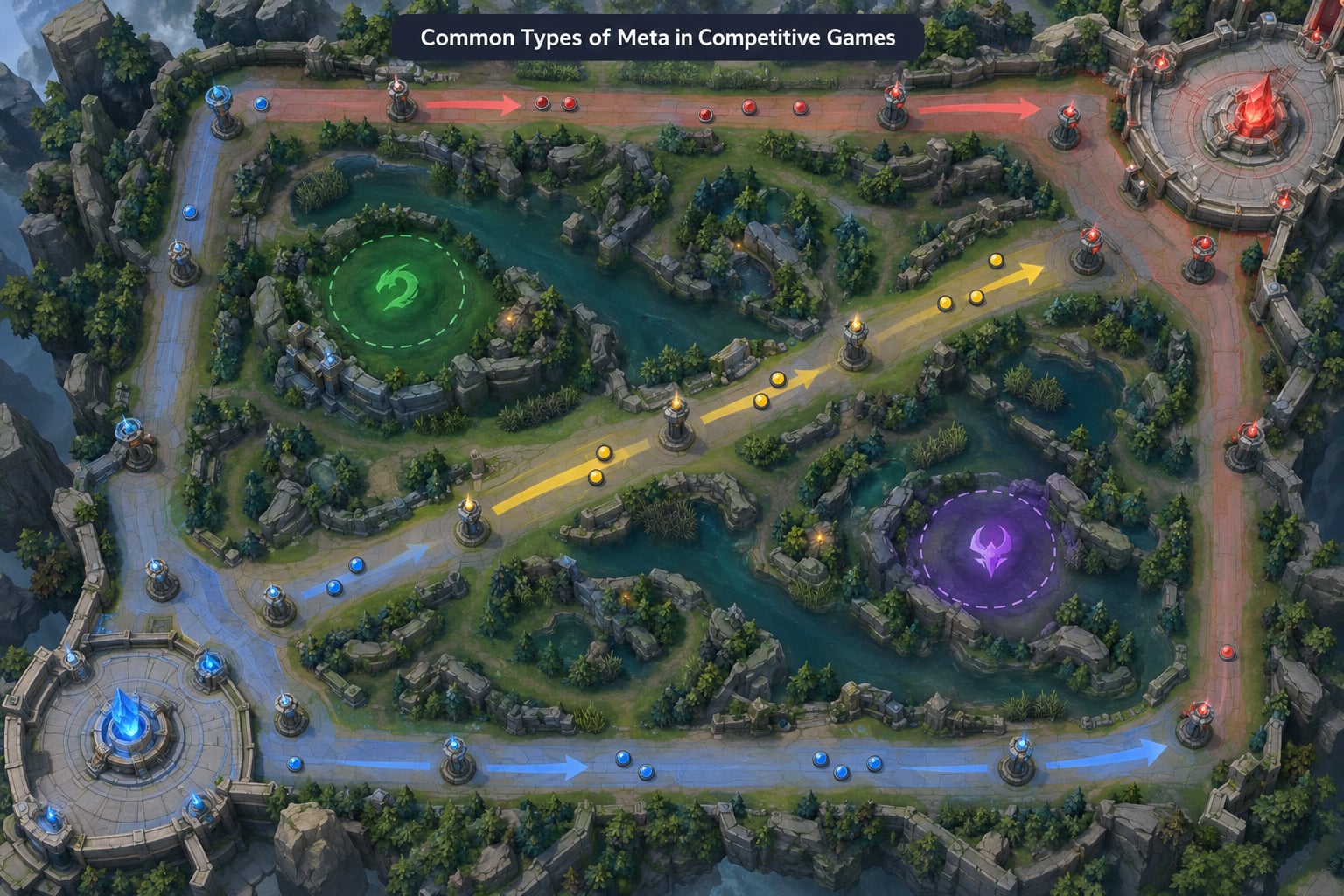
Genres produce different kinds of meta, and knowing which kind you are looking at makes everything else easier to judge.
- Character or agent meta. A handful of characters sit at high pick and win rates. Most common in multiplayer online battle arenas and hero shooters, where the choice happens before the match starts.
- Weapon or loadout meta. A small set of guns, loadouts, or equipment packages dominate. Typical in tactical shooters and battle royales, where the numbers on the gun matter more than the person holding it.
- Strategy meta. A way of winning the match sits on top: a specific economy plan, a siege strategy, an aggressive rush timing. This is the version that gets described in broadcast analysis.
- Team composition meta. Certain combinations of roles keep appearing together. Two tanks and three damage characters, a dive lineup, a backline protect comp. Common in MOBAs and raid content.
- Map or objective meta. Certain areas or objectives get contested disproportionately, and control of them decides matches. This is the oldest form, going back to board games.
- Style meta. A broad approach to how the game is played, such as hyper-aggressive or defensive, takes over the scene. Hardest to see because it is never written in the patch notes.
These overlap constantly. A character meta usually exists because of a strategy meta, and a map meta often produces a loadout meta as a response. Treating them as separate boxes is useful mainly so you know which conversation you are in.
Meta Examples Across Competitive Game Genres
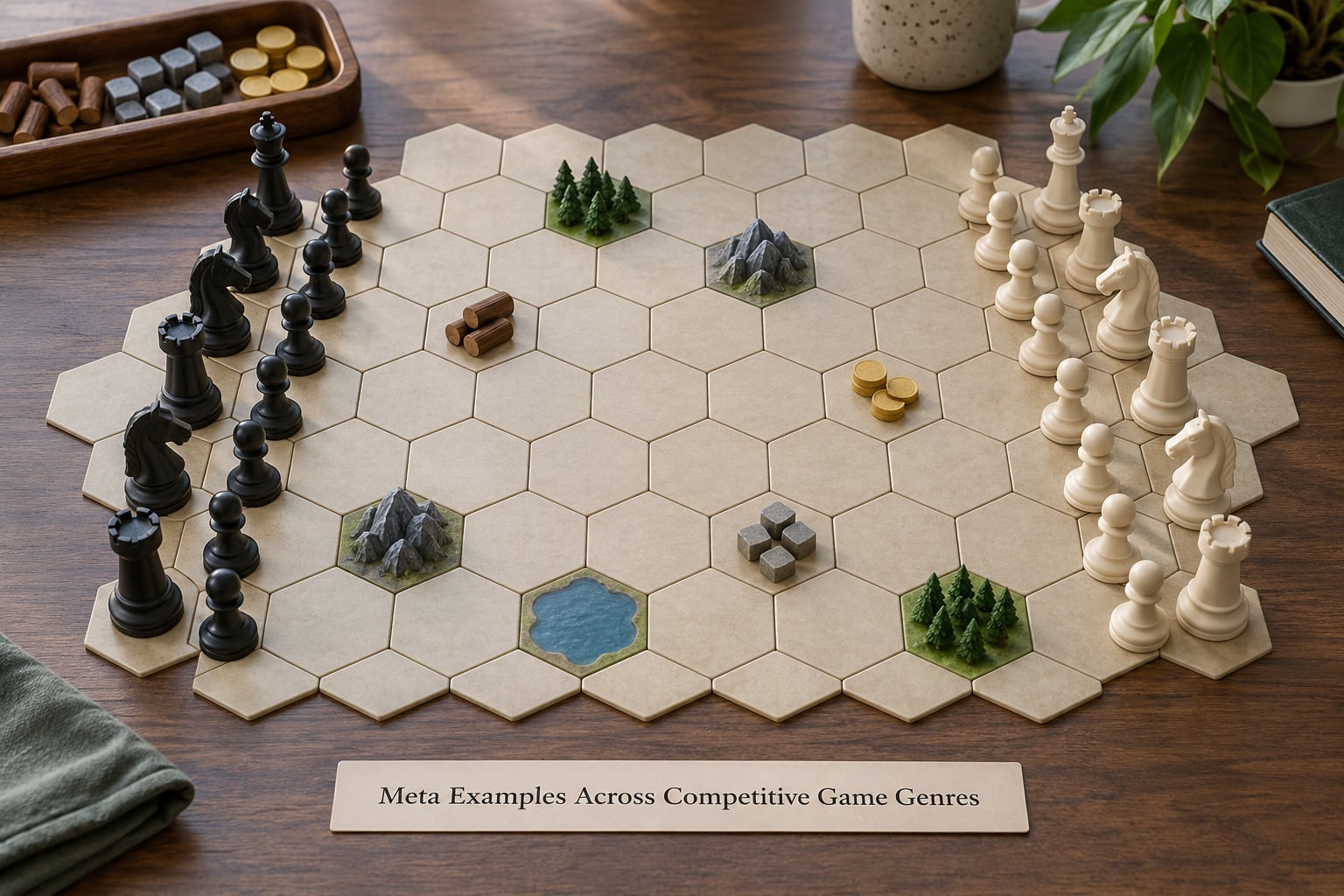
Examples age fast, so treat these as shapes rather than answers. What matters is the pattern, not the specific names, because by the time you read about any of it the patch will likely have moved.
Team shooters: the map decides the loadout
In tactical shooters, a meta tends to form around one map first. A defensive position with good angles pulls teams toward a slow default, which pulls them toward specific weapons that hold those angles. When the map rotates or the site changes, the whole loadout picture can flip with it.
Fighting games: matchup charts and tier lists
Fighting games lean on matchups. A tier list ranks characters by how favourable their best and worst matchups are, and communities argue about the exact order constantly. A pro player who can win a losing matchup is the reason the tier list keeps producing arguments at all.
Strategy games: openings and compositions
In real-time and turn-based strategy, the meta is often an opening or an economy plan. A build order that is slightly more efficient becomes standard, gets studied, gets punished, and gets replaced by something that looks more inefficient but survives the counter.
Battle royales and MOBAs: the pick and ban phase
When a draft sits in front of you, the meta becomes a negotiation. Strong picks get contested, contested picks get banned, and the resulting ban rate is one of the clearest signals a player can read. A character with a high ban rate but low pick rate is usually strong but not comfortable in practice.
How to Tell Whether a Meta Is Actually Dominant
Every patch produces a loud claim that something is broken. Most are not. Here is the checklist I use before I change anything about how I play.
- Check the win rate against the pick rate. A high win rate on a small pick rate means strong in the right hands. A high pick rate on an average win rate means popular, not dominant. You want both numbers before you conclude anything.
- Check the sample size. Stats from fifty games are noise. A character sitting at fifty-eight percent across tens of thousands of ranked games is telling you something real.
- Ask who the data is from. Pro play, high-ranked ladder, and casual queue are three different games with three different metas. A strategy that wins at the top of the ladder can be terrible in your matches.
- Check the patch age. Statistics from before the last update may describe a game that no longer exists. Most “broken” claims turn out to be statistics nobody refreshed.
- Look at the map or matchup split. An option that is dominant on one map and weak everywhere else is a situational pick, not a meta pick.
- Look for real counters. If one cheap, obvious counter reliably beats it, it is not dominant. It is strong. Those get used in scrims within a day.
- Ask what happens after two weeks. Options that survive a full patch cycle without a response usually are not actually dominant, no matter what the guide said on day one.
If you cannot answer most of those quickly, you are reading opinion rather than analysis. That is fine, but know which one you are reading.
Why Metas Change Between Patches and Seasons
Metas move for a short list of reasons, and most of them are visible if you know what to look for in the notes.
- Balance patches. Numbers change, so outcomes change. A small percentage on a heavily used ability can remove an entire playstyle from the game.
- New characters, weapons, or items. Fresh options get discovered first by the committed players, then spread outward, then get tuned down.
- Map and mode changes. Rotating objectives or a new spawn layout can make last month’s priorities worthless.
- Rule updates and tournament formats. When a format rewards a different style, professional play shifts quickly and ranked play follows more slowly.
- Player behaviour. Sometimes the developers do nothing and the meta still moves, because a well-known counter gets solved and the old answer stops working.
Patch notes are written in developer shorthand, and that shorthand is a real barrier for beginners. A nerf is a deliberate weakening, a buff is a strengthening, a rework is a bigger change to how something works, and a win rate adjustment is usually a quiet adjustment in either direction. Once you know those four words, patch notes become readable in about a minute.
Season resets matter too, because they change who is playing. A fresh ladder pulls in returning players at different ranks, and the strategies that dominate month three are not always the ones that dominate week one.
Meta vs. Strategy: What Is the Difference?
Most arguments about meta are really arguments about strategy. They are not the same thing, and once the difference is clear, most online debates get a lot shorter.
| Question | Meta | Strategy |
|---|---|---|
| What is it? | The prevailing competitive environment at a given time | One plan for winning a match |
| Scope | Everyone playing the game right now | Your team in this series of matches |
| Changes when | A patch lands or the scene shifts | You adapt mid-series, or get countered |
| Example | Teams prioritising early map control this season | Your team taking the same approach every round |
| Can you refuse it? | Yes, deliberately | Yes, if you can execute it |
The metaphor that works for me is weather. The meta is the season’s prevailing weather, and a strategy is the jacket you wear today. Wearing the wrong jacket is a bad afternoon. Ignoring the season entirely is a bad year.
A related confusion is metagaming, which is a different word with a different meaning. Metagaming is playing to win rather than playing the game as intended, or using knowledge from outside the match, like checking an opponent’s stream before a fight. People use it as an insult because they think copying the strongest available option is somehow cheating. It is not, but the argument is worth having honestly, and most players land on the same place: a guide, not a rulebook.
How to Use the Current Meta Without Copying Everyone
The goal is not to be original for its own sake. The goal is to win matches you were losing while keeping the parts of your game that will still work next patch.
Start with your role. A meta pick that requires mechanical precision you do not have yet will underperform a solid pick you understand completely. The strongest option in the game is not the strongest option for you.
Then look at why it works, not just what it is. Every meta option has a cost: a slower win condition, a fragile timing window, a composition that falls apart if one piece is removed. If you know the cost, you can take the option and know when to abandon it.
Keep one off-meta option in your pocket. Not because it is secretly better, but because if everybody plays one strategy, being the team that plays something else gives you information theirs do not have. This is where counter-meta thinking starts, and it is a real skill rather than a meme.
Finally, protect your fundamentals. Positioning, communication, decision-making under pressure. Those survive every patch, and they are the reason a team with average drafts sometimes wins a series against a team with great ones.
One honest caveat from the community side of this debate: a lot of players are tired of constant churn, and they are not wrong that forced meta rotation is a business decision as much as a design one. You do not have to like the pace to benefit from knowing the environment you are playing in.
Frequently Asked Questions
What does meta mean in gaming?
In gaming, the meta is the set of characters, weapons, strategies and styles that are currently the most effective and most widely used at the highest level of play. The word is usually expanded as most effective tactics available. It is a description of the current competitive environment rather than a fixed rule, and it changes whenever developers patch the game or players find something stronger.
Is a meta the same as the best strategy?
No. A strategy is one plan for winning a match, and a meta is the wider environment that makes certain strategies popular. A single opening can be strong without being the meta, and a meta can contain several strategies that all work well. Think of the meta as the season and the strategy as today’s outfit.
What makes a character, weapon, or strategy part of the meta?
Two things usually. Other strong players are choosing it in large numbers, and it produces better results than the alternatives. In practice that shows up as a high pick rate alongside a high win rate, or a high ban rate for options nobody wants to face. One number on its own proves very little, so look at both.
Should beginners copy the current meta?
Use the meta as a starting point, not a shopping list. Pick what fits your role and your mechanical level, and understand why the strong option works before committing to it. Copying a strategy you cannot execute will lose you matches that a solid, well-understood pick would have won.
How often does a competitive gaming meta change?
It depends on the genre and the game’s patch schedule. Tactical shooters and MOBAs often shift within days of an update, while strategy games and card games can hold a stable meta for weeks or months. The rate usually tracks how aggressively the developers balance, so check how often the game you play actually patches.
Can a meta be good for one player but bad for another?
Yes, and this is the most common reason meta advice fails. A strategy built on fast, confident decisions can be excellent for an experienced player and unplayable for a beginner, while a slower, safer approach can be the opposite. Rank, role, team coordination and personal mechanics all change which version of the current meta works for you.
Conclusion: Start With the Current Competitive Environment
A meta is the current answer to the question: what is working right now in this game, at my level, among players like me. It changes, it disagrees with itself across regions and skill levels, and it will never be a rulebook.
So start simple. Find out which patch you are on, look at statistics from your own rank rather than from pro broadcasts, watch a few matches at the level you play, and pick the approach that fits the role you already have. When the next update lands, repeat it. That is the whole job, and it is genuinely easier than it sounds from the outside.