
Damage types and resistances are the labels a game uses to decide what a hit does. Every attack carries a type, every target has a reaction to that type, and the reaction is usually a multiplier: resistance halves the damage, vulnerability doubles it, immunity removes it, and true damage skips the whole system.
The confusing part is that no two games express it the same way. One halves, one applies a percentage, one uses a signed number where a positive value means something better than the baseline. Once you read the scale correctly, a lot of “my build is weak” complaints turn into “I was using the wrong element.”
Table of Contents
- What Are Damage Types and Resistances?
- Dealing damage versus reducing it
- The words that show up everywhere
- Why the concept exists
- How to Understand Damage Types and Resistances Step by Step
- Step 1: Confirm the hit landed
- Step 2: Find the type of the attack
- Step 3: Establish the base damage
- Step 4: Check the target’s reaction to that type
- Step 5: Apply the modifier
- Step 6: Fold in shields, buffs and status effects
- Step 7: Compare against what the formula promised
- Common Damage Types and What They Represent
- Category-based typing
- Why the exact number of types is not a fixed fact
- How Resistances, Weaknesses, and Immunities Work
- Resistance is not always a percentage
- How it stacks
- Armor, blocking and damage reduction are separate systems
- How to Read a Damage Formula or Combat Screen
- What players say versus what actually happens
- Why your number disagrees with your expectation
- How to Use Damage Types and Resistances When Building a Character
- Read the tooltip before the stat screen
- Spread resistances instead of stacking one
- Do not trade all survivability for one damage type
- Keep a fallback weapon
- Watch the breakpoints, not the totals
- Game-Specific Examples and Formula Variations
- Percentage halving
- Fixed armor plus capped resistance
- Signed scales where neutral is not zero
- Alternating weaknesses
- Damage over time as its own channel
- Damage that ignores the system entirely
- Frequently Asked Questions
- What does damage resistance mean?
- What are the most common damage types?
- Does double resistance mean immunity?
- Does resistance cancel out vulnerability?
- Is zero resistance neutral?
- Why does my damage number not match the formula?
- Conclusion: Start With the Combat Panel
What Are Damage Types and Resistances?
A damage type is the category label attached to an attack, such as physical, fire, poison or energy. A resistance is the target’s modifier against one of those categories, and it changes the damage after the attack has been rolled but before it lands.
So there are two separate halves to the system. The attacking side deals damage of a type, and the defending side decides what happens to it. Understanding damage types and resistances means knowing which side you are looking at before you change any gear.
Dealing damage versus reducing it
Dealing damage is an output problem. If your fire sword hits for 40 in an area where nothing resists fire, you will keep seeing 40. If the target takes half damage from fire, you will see 20, and no amount of upgrading the sword fixes that number on its own.
Reducing incoming damage is an input problem. Armor, shields, resistances and blocking all sit on the receiving side, and they interact differently. A hit can be blocked, cut by a percentage, cut by a flat number, negated entirely, or pass through untouched.
The words that show up everywhere
Weakness and vulnerability are the mirror of resistance: they increase incoming damage of a type. Immunity removes a type entirely, usually with a stated cause such as a race or an environment. True damage, sometimes called pure damage, skips the mitigation layer and applies to the target’s health directly.
Why the concept exists
Damage types are not decoration. Designers add them to create matchups, to keep a defensive stat from being a universal answer, and to make different weapons feel different in the hand. Threads on r/RPGdesign and the RPG Maker forums keep circling the same debate: how many types a system should have before complexity stops paying for itself. The honest answer from those discussions is that every type needs a reason to exist in the fiction, not just a place in the formula.
How to Understand Damage Types and Resistances Step by Step
When a number on screen does not match your expectation, work through the hit in the order the game resolves it. Here is the sequence that covers most systems.
Step 1: Confirm the hit landed
Accuracy, evasion and cover checks happen before any math. A whiff produces a zero that has nothing to do with your damage type, and a guarded target may take a fraction before any modifier runs.
Step 2: Find the type of the attack
Read the weapon tooltip or spell description and find the type field. In most games an attack carries exactly one type, and hybrids either split the damage or pick a single type with a bonus. Games such as Starfield split into physical, energy, electromagnetic, thermal, airborne, corrosive and radiation, so the same gun can be a different answer depending on the target.
Step 3: Establish the base damage
Find the unmodified roll, usually a weapon range multiplied by an attack stat. Check whether the attack is a critical hit and whether the critical multiplier applies to the whole hit or only part of it.
Step 4: Check the target’s reaction to that type
This is the step most players skip. Look for a resistance value, a weakness marker, or a colour cue on the health bar. Borderlands 4 uses shield and flesh colours to telegraph elemental weaknesses, which is the fastest read in the genre.
Step 5: Apply the modifier
Resistance and vulnerability are applied after most other calculations, not before. In D&D 5e the halving or doubling happens after all other modifiers to damage, which is why a resisted hit can still be a large hit.
Step 6: Fold in shields, buffs and status effects
Guard, dodge, damage reduction buffs and shields can sit either side of the resistance step depending on the game. If your result is off by a small constant amount, that is usually a flat reduction rather than a percentage.
Step 7: Compare against what the formula promised
If the difference is a fixed fraction, the type modifier is the cause. If the difference scales with the size of the hit, look at percentage reduction or armor. If the number is wildly off, check for a cap, a floor, or a level penalty.
Common Damage Types and What They Represent
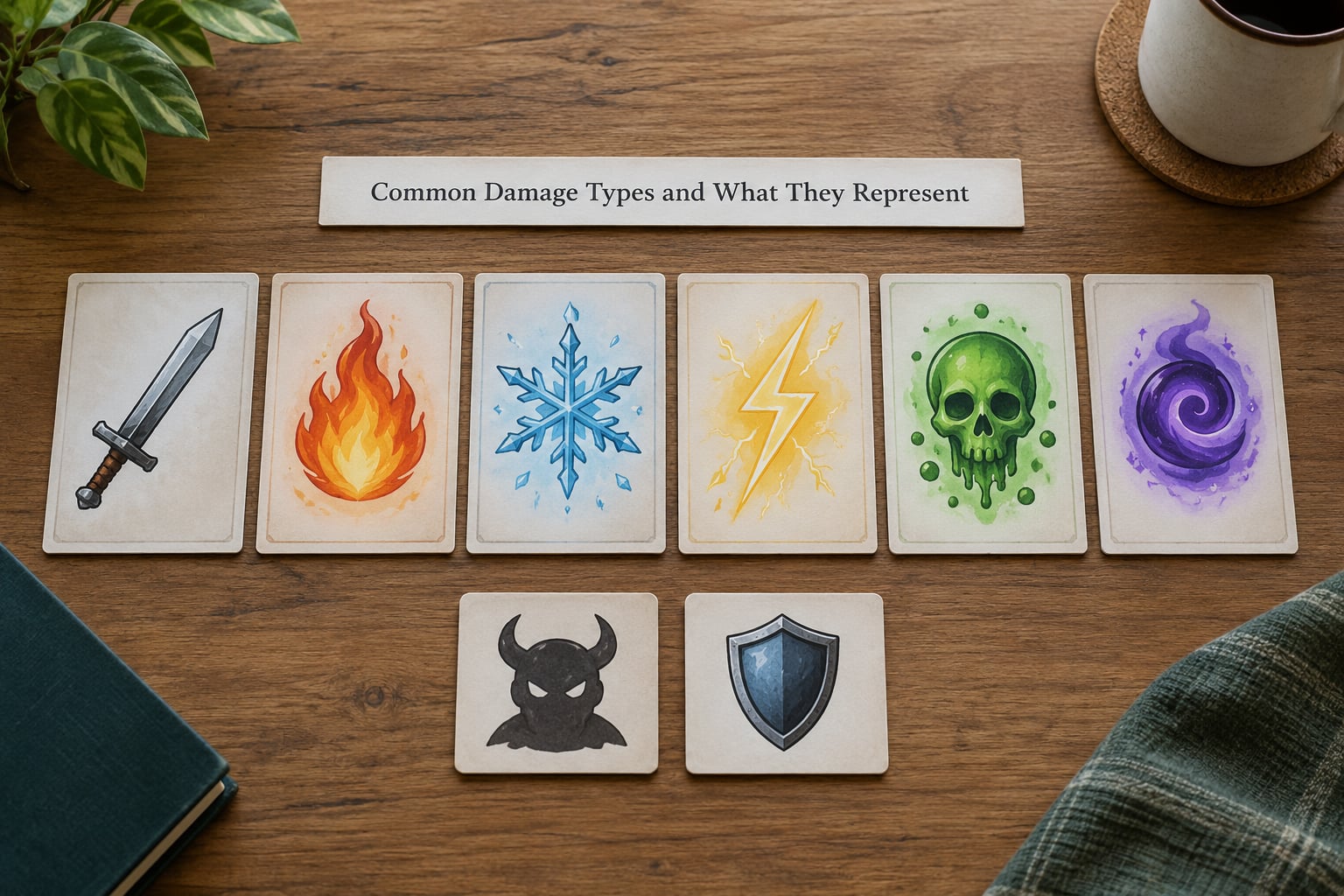
Labels vary between games, so match the concept rather than the word. What matters is whether the game treats the category as physical and mitigated by armor, as elemental and modified by a resistance chart, or as true damage that bypasses both.
| Damage type | Typical source | What to watch for |
|---|---|---|
| Physical | Swords, arrows, fists, thrown weapons | Usually the only type armor reduces well |
| Blunt, slashing and piercing | Table-top systems that split physical damage further | D&D 5e treats these as separate physical types |
| Fire, cold and lightning | Spells, elemental weapons, elemental reactions | Most games cap elemental resistance near a ceiling |
| Poison and corrosion | Poison weapons, acid spells, environmental hazards | Often arrives as a damage-over-time channel rather than a hit |
| Magical or arcane | Spell damage that is not elemental | Some systems resist all magic with one value |
| Energy, radiant, necrotic | Beams, holy and undead damage, sci-fi weapons | Often a separate resistance track from elemental |
| True or pure damage | Executioner abilities, percent-health damage | Bypasses shields, armor and resistances |
| Damage over time | Burning, bleeding, poison ticks, corrosion | May be calculated per tick, so resistance changes the total not just the hit |
Category-based typing
Some games type damage by where it came from rather than by what it is. Starfield separates physical from energy, and further splits energy into electromagnetic, thermal, airborne, corrosive and radiation. Fallout-style systems add radiation and an energy category on top of ballistic weapons. Same idea, different labels.
Why the exact number of types is not a fixed fact
Players search for lists like “what are the damage types” or “what are the 13 damage types in D&D” because they want a definitive count. There isn’t one across games. D&D splits physical into bludgeoning, piercing and slashing and adds acid, cold, fire, lightning, necrotic, radiant and thunder, plus poison and psychic, force and psychic-type effects that come from the same rules family. Borderlands 4 runs five elemental types. League of Legends treats resistance subtypes as a secondary typing system designed to promote champion classes and diversify item matchups, which is a design goal in plain sight.
How Resistances, Weaknesses, and Immunities Work
Resistance, weakness and immunity sit on one scale. Understanding where a game puts neutral is the part that trips people up.
| State | Typical effect | Common representation |
|---|---|---|
| Vulnerability | Damage doubled | Marker on the health bar, or a “weak to” label |
| Normal | No change | Nothing shown |
| Resistance | Damage halved | A resistance percentage or a coloured icon |
| Immunity | Damage removed | Explicit immunity text, usually with a stated cause |
Resistance is not always a percentage
Baldur’s Gate 3 expresses resistance on a signed scale running from -128 to 127, and the wiki notes that at 50% resistance a creature takes 50% damage, rounded up. Beginners read that scale as a percentage and miscalculate constantly. Check the tooltip wording before doing the arithmetic yourself.
Some systems use a neutral value other than zero. One widely cited MMO guide points out that 50 is the neutral resistance figure, so a value below 50 is a reduction and a value above it is an increase. That single detail flips the meaning of the whole character sheet, and it is the kind of thing no general guide can assume.
How it stacks
Two separate resistance effects do not normally cancel the damage. Players often read “resisted twice” as “immune”, and rules sources consistently distinguish between damage reduced to zero and true immunity. In D&D, resistance applied twice still only halves the damage, because halving is a switch rather than a second multiplication.
Resistances and vulnerabilities apply after other modifiers rather than cancelling each other, which means a creature can be both resistant and vulnerable to the same type. A long-running thread on the D&D Beyond forums raises exactly this: the answer there is that the sequence is well defined but the wording invites confusion. Check the specific rules text rather than assuming one cancels the other.
Armor, blocking and damage reduction are separate systems
Flat defense subtracts a fixed number from a hit. Percentage resistance scales with the size of the hit. Blocking, guarding and dodging usually reduce by a fraction or prevent the hit entirely. When choosing between them, flat defense protects better against small hits, and percentage resistance protects better against large ones. A game that mixes both leaves you with a choice rather than a single correct stat.
How to Read a Damage Formula or Combat Screen
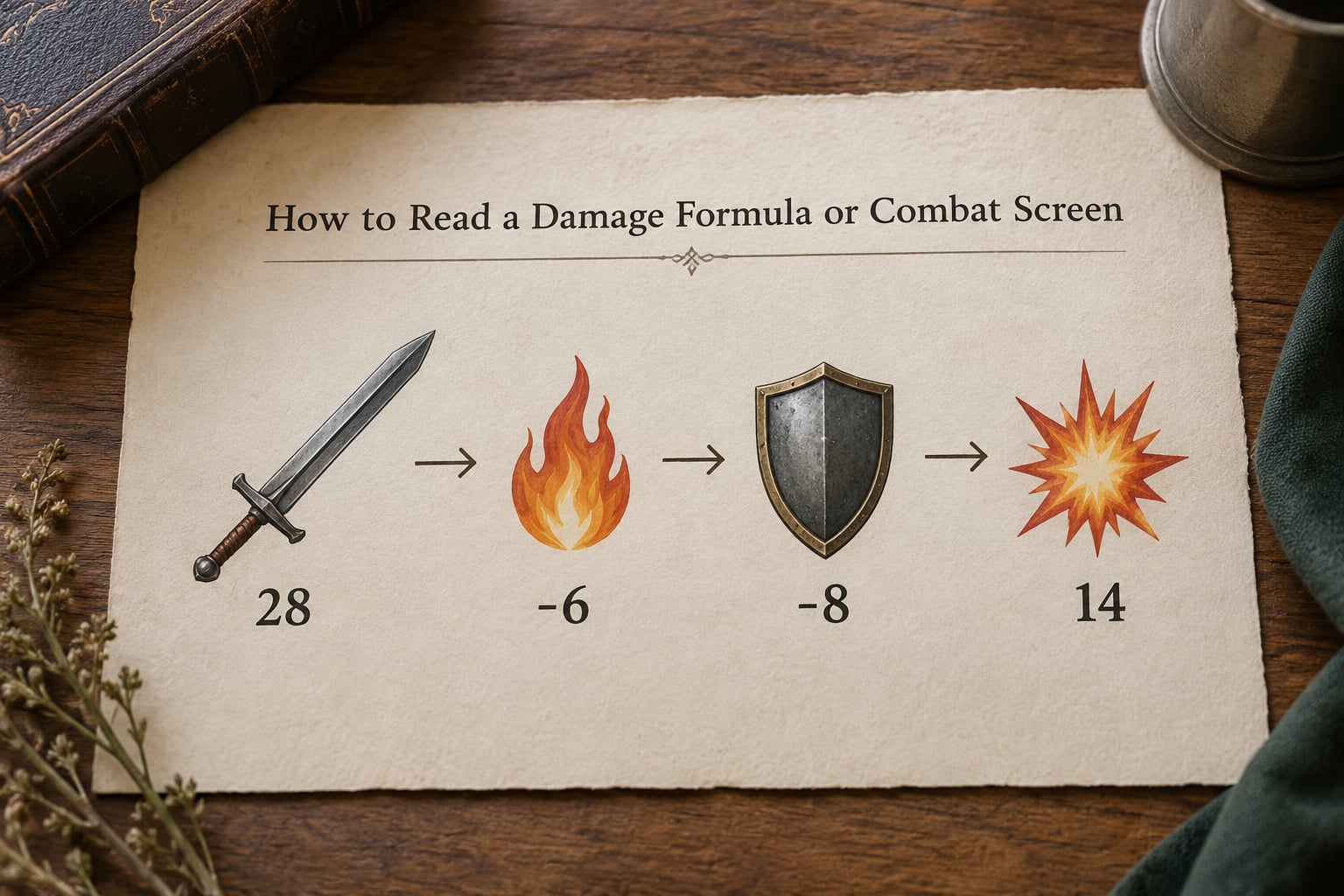
Most formulas are the same six steps wearing different names. Here is a representative one you can map onto almost any game.
- The hit lands, or it does not. A miss ends the process.
- Base damage is rolled from the weapon or spell.
- Attacker bonuses apply, such as attack power, skill scaling or a critical multiplier.
- The target subtracts flat defense such as armor.
- The resistance or vulnerability modifier applies to what remains.
- The result is compared against caps, floors and any leftover health.
Worked example. A weapon rolls 120 base damage, the attacker has a 20% damage bonus, the target has 45 flat defense and 30% fire resistance, and the weapon deals fire damage. Base becomes 144, defense brings it to 99, and resistance takes it to 69.3, which the game would show as 69 or 70 depending on rounding. The fire resistance cut 30 of 99 points. If the same hit had been physical instead, the resistance step would not have applied at all.
| Symbol or label | What it usually represents |
|---|---|
| Atk / attack rating | The attacker’s offensive stat that scales base damage |
| Def / defense rating | The defender’s stat, usually a flat subtraction |
| Res / resistance % | Percentage reduction for a named type |
| Weak / vulnerability | Incoming damage multiplier above one |
| Immune | Incoming damage set to zero for that type |
| Crit / critical hit | A multiplier that may apply to only part of the roll |
| DMG/s or DoT % | Damage over time rate or percentage of base per tick |
| Ignore resistance | A modifier that skips the type check entirely |
What players say versus what actually happens
| What players say | What actually happens |
|---|---|
| Zero resistance is always neutral | In several systems the neutral value is not zero. Read the tooltip before assuming |
| Two resistances make you immune | Halving is usually a switch, so two applications still only halve the damage |
| Resistance cancels vulnerability | The two apply in sequence after other modifiers rather than cancelling |
| The floating number is the damage taken | It is usually the post-mitigation roll, which can exceed the target’s remaining health |
| A critical hit doubles everything | Many systems apply the crit multiplier only to part of the hit, so DoT or secondary components stay unscaled |
| Damage over time always ignores defense | Some systems skip mitigation on ticks, others apply it per tick. Check the game |
Why your number disagrees with your expectation
Usually it is one of four things: the wrong type was matched, a percentage was applied where you expected a flat cut, a cap or floor clamped the result, or a level penalty scaled the hit. Turn on floating combat text and read the colour, since many games colour the number by the largest contributing damage type.
How to Use Damage Types and Resistances When Building a Character
Once the mechanic is clear, the practical question is what to do with it. The answer is coverage, not one big number.
Read the tooltip before the stat screen
Most games tell you what damage type a weapon deals, and some tell you what the target is weak to. Check the weapon first, then the enemy. Players report consistently that finding an enemy’s weakness without leaving the game is the hardest part, which is why a colour-coded health bar is worth more than a raw number.
Spread resistances instead of stacking one
Two resistances rarely beat one resistance plus one immunity across the content you will face. A set that covers the elements you actually meet is more useful than a set tuned for a boss you have not reached.
Do not trade all survivability for one damage type
Elemental damage that a third of enemies resist can be worse than a smaller bonus that always lands. Compare the weakness multiplier against the share of the zone where that weakness is active before you commit.
Keep a fallback weapon
A neutral or physical option matters more than players expect. It is the answer to immune enemies, to unknown resistances, and to the damage-over-time ticks that resist your chosen element.
Watch the breakpoints, not the totals
A resistance that takes an enemy from immune to normal is worth more than a large number in a stat you never use. Build around the thresholds where behaviour changes.
Game-Specific Examples and Formula Variations
The same principle shows up in very different shapes. These examples are illustrative rather than quoted rules, so confirm the specifics in your own game’s documentation.
Percentage halving
A table-top system where resistance halves and vulnerability doubles is the simplest case. Damage rolls stay exact, and the order of operations matters more than the numbers.
Fixed armor plus capped resistance
An action RPG where armor subtracts a flat value and elemental resistance applies as a percentage usually caps resistance near a ceiling. Past the cap, extra points do nothing, so a build should stop investing there.
Signed scales where neutral is not zero
A system where the neutral value sits at 50 rather than 0 rewards reading the tooltip. Numbers below the midpoint reduce damage, numbers above it increase it, and a player who assumes zero is neutral will misjudge every item.
Alternating weaknesses
Enemies that rotate their weakness every hit or every few seconds punish single-element builds. In that environment, coverage beats specialization, and swapping targets mid-fight is the correct play rather than a mistake.
Damage over time as its own channel
Where burning, bleeding and poison tick separately from the hit, resistance may apply per tick. The total reduction then compounds over time, so a DoT resisted at 50% is halved in aggregate even though each tick looks small.
Damage that ignores the system entirely
True damage exists as a deliberate escape hatch. It removes the puzzle rather than solving it, which is why it appears sparingly and usually carries a drawback or a cooldown.
Frequently Asked Questions
What does damage resistance mean?
Damage resistance is a modifier that reduces incoming damage of one named type, most often by half. It applies to your character or an enemy, not to the attack itself, and it usually runs after other calculations rather than before them. Immunities are the extreme end of the same scale, removing the damage entirely.
What are the most common damage types?
Physical, elemental such as fire, cold, lightning and poison, magical or energy, and true damage cover most systems. Action RPGs split elemental into several named elements, while some games type damage by source instead, separating physical from energy and subdividing energy further. The count varies per game rather than following a fixed standard.
Does double resistance mean immunity?
No, in most systems it does not. Halving damage is a switch rather than a repeated multiplication, so applying resistance twice still only halves the damage. Rules sources consistently separate damage that is reduced to zero from a true immunity, which usually carries its own stated cause and is far rarer.
Does resistance cancel out vulnerability?
Generally no. In common rulesets resistance and vulnerability are applied in sequence after other modifiers, so a creature can carry both against the same type and the vulnerability simply wins. The ordering is well defined, but the wording in some rules is loose, so check the exact text for the system you are playing.
Is zero resistance neutral?
In many games yes, but not in all of them. Several systems place the neutral value elsewhere on the scale, so a resistance figure below the midpoint reduces damage and one above it increases damage. Always read the tooltip wording instead of assuming zero means no effect.
Why does my damage number not match the formula?
The usual causes are a mismatched damage type, a percentage applied where you expected a flat reduction, a cap or floor clamping the result, or a level penalty scaling the hit. Floating numbers also show the post-mitigation roll rather than health actually removed, so a big number against a nearly dead enemy is normal.
Conclusion: Start With the Combat Panel
Do one thing before touching your gear. Open the target’s health bar or tooltip, name the damage type your weapon deals, read the modifier that target applies to that type, and compare the resulting hit against the formula the game states out loud. Once you can do that quickly, damage types and resistances stop being mysterious and start being a checklist you run in combat.