Most resource waste in the first hours of a survival game comes from doing too much, not too little. Players craft upgrades before a problem exists, empty every container they walk past, and haul stacks they never use. Knowing how to avoid wasting resources early in survival games means running a fixed order: survey the ground, name the single most urgent need, craft only what solves it, and leave before the clock turns expensive. It takes about ten minutes of setup, and it applies whether you are in Valheim, Subnautica, Project Zomboid, DayZ or Resident Evil.
The short version:
- Walk the starting area first, and pick a route before you pick up anything.
- Rank needs in order: water, warmth, shelter, food, tools, defence, then everything else.
- Craft the cheapest item that solves the problem in front of you, not the best item you could eventually build.
- Leave easily replaced supplies behind. If a resource is abundant near base, carrying it is a waste of slots.
- Set a reserve cap, then spend the moment a real need shows up.
Table of Contents
- What You Need
- Step-by-Step: How to Avoid Wasting Resources Early in Survival Games
- 1. Survey the Starting Area Before You Collect
- 2. Separate Immediate Needs From Optional Resources
- 3. Craft Only What the Current Problem Requires
- 4. Preserve Food and Water Instead of Hoarding It
- 5. Collect Materials in Planned Loops
- 6. Carry a Lean, Replaceable Inventory
- 7. Reassess After Every Major Milestone
- Common Mistakes
- Mistake 1: Collecting Every Nearby Resource
- Mistake 2: Crafting Upgrades Too Early
- Mistake 3: Overpacking Food and Water
- Mistake 4: Gathering Without a Route
- Mistake 5: Ignoring the Clock
- Quick Resource-Control Tips
- Frequently Asked Questions
- Should I gather every resource I see at the start of a survival game?
- How many items should I carry before finding a base?
- Is crafting tools early usually worth the resource cost?
- What should I do if my inventory fills up before I have shelter?
- How can I tell whether I am overcollecting instead of progressing?
- Should I follow the same opening strategy in every survival game?
- Conclusion
What You Need
The prep for this kind of run takes no money and no rare starting gear. It takes information, and the most useful information is the boring kind that most players never gather before their first ten minutes of collecting.
You need to know which need is most urgent right now, and the honest answer changes with the hour, the weather and what is circling nearby. In The Long Dark the opening problem is fire, shelter and water, not a hunting rifle. In Project Zomboid players who base beside a river tell you plainly that you stop looting for food altogether, because fishing and farming cover it.
You also need the real recipe costs before you start crafting. Most survival games hide ingredient counts behind a menu you have not opened yet, and the difference between a twenty-minute first tool and a two-hour one is where the whole opening goes wrong. Read the requirements for the first three items on your priority list, then write down what they cost in total.
Next, know your limits. How many inventory slots do you have, what does encumbrance slow down, and what degrades or spoils while it sits in your pack. A stack that eats four slots is a real cost even when the item itself was free to pick up.
Finally, shortlist two possible shelter sites and one fast route out of the starting area. Two sites matter because the first one you find in daylight sometimes turns out to be exposed at night, or a hundred steps from water when you did not want the walk.
Step-by-Step: How to Avoid Wasting Resources Early in Survival Games
1. Survey the Starting Area Before You Collect
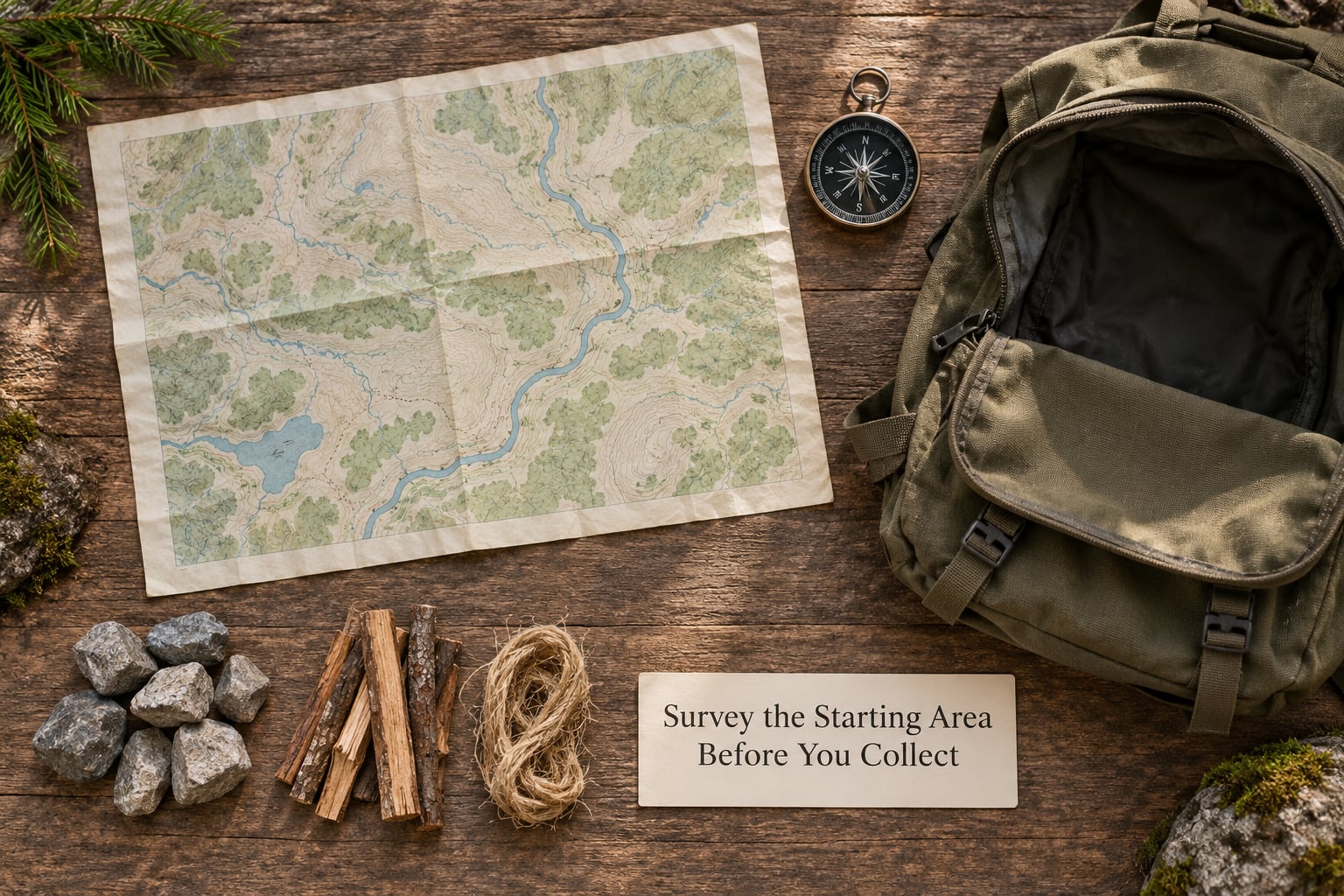
Spend the first few minutes walking rather than picking up. Note the landmarks you can find again, the water sources, the tree and stone clusters, and the places that look safe from a distance but are not.
You finish this step with two things: a short route through the area, and two candidate shelter sites. Everything after this is faster because every trip has a destination.
2. Separate Immediate Needs From Optional Resources
Write your needs as an ordered list and treat anything outside it as optional until the list is empty. The usual order is water, warmth, shelter, food, tools, defence, and only then exploration gear, upgrades and rare materials.
That order is not universal, and swapping two entries is sometimes the correct play. A player who is far from any water source puts water first no matter what; a player caught out at dusk puts warmth first. The rule is that the list must exist before you start, so the choice is made once under pressure rather than ten times while running.
Roughly half the materials you pass in the first hour belong to a category you will not need for days. They are not wrong to collect later, when a storage crate is free. They are wrong to collect now, when every slot is a decision.
3. Craft Only What the Current Problem Requires
Craft the item that closes the gap you have right now, using the cheapest recipe that does it. A stone axe lets you fell trees; a better axe does not make the first tree any faster.
Delay anything that unlocks a later tier until you have met three conditions: the current problem is solved, the recipe needs materials you can gather nearby, and you can afford it without dipping into the reserve that covers water and food. Upgrade recipes are designed to feel tempting at the exact moment you cannot spare the inputs.
You know the step worked when your next action is a gathering trip rather than another crafting session. Progress in the opening is measured in what you can reach, not in what you can build.
4. Preserve Food and Water Instead of Hoarding It
Carrying a week’s food on day two solves a problem you do not have yet, and it costs you speed, slots and, in games that model spoilage, freshness. Cook or preserve what you gather, store it at the base, and carry one or two days of rations for an outing.
The same logic applies to water. If your base sits near a reliable source, hauling bottles home is repeated work for no gain. On Oxygen Not Included, long-time players put a cool water supply ahead of almost everything else in the first base, because the whole setup lives or dies by it; that is a priority decision, not a carrying decision.
Plan return trips around what you actually can protect. A stack you cannot defend at your current gear level is not a reserve, it is an invitation.
5. Collect Materials in Planned Loops
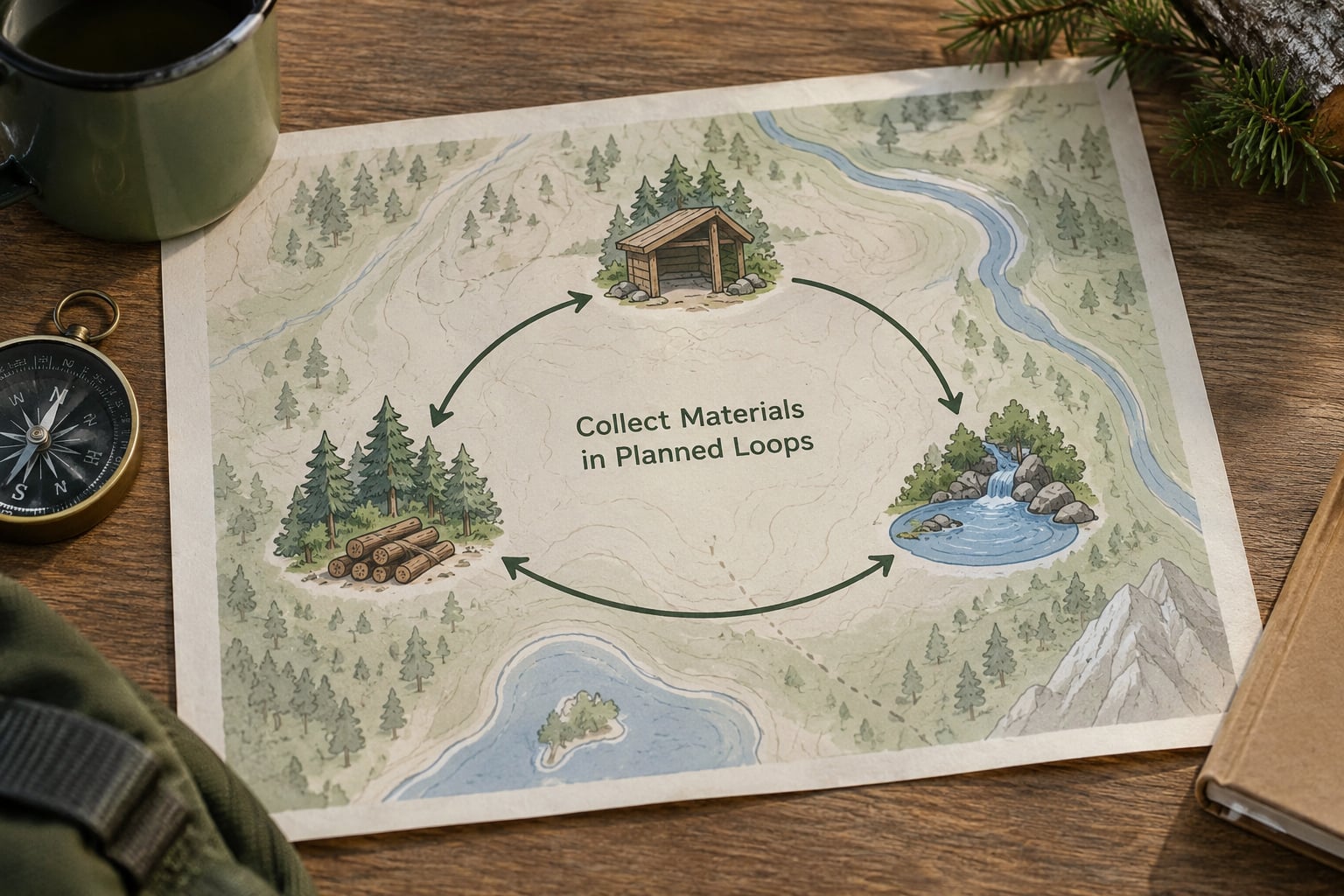
Group nearby resource types into a route instead of wandering. Wood cluster, then stone outcrop, then water, then back to base, is a loop. Walking north until something interesting appears is not.
Mark the detours you take as you go, and name a return point you can reach quickly. Most backtracking in the opening hour comes from missing that one habit: you dropped a material in a cave mouth forty minutes ago and have no note telling you where.
Loops also cut down on bad encounters, because the same route gets walked at the same time of day. Players on Hinterland forums put it more bluntly about The Long Dark, skipping loot beyond the bare necessities and trusting that tools will still be there when you come back.
6. Carry a Lean, Replaceable Inventory
Ask of every item: could I get this again within an hour of losing it? If yes, drop it. Fiber, small stone, common wood and scrap are replaceable in almost every survival game, and hauling extra copies only slows you down and fills the slots you need for something that cannot be replaced.
Keep your emergency essentials in the first two slots so a panic moment does not cost you a full inventory sweep. Use field storage when the game offers it, but treat a temporary cache as a place to drop a mid-run load, not a second base to stock.
Players on r/SurvivalGaming describe the opposite habit clearly: filling a pack with ammunition and consumables for guns they never equip, then finishing the run with the stack untouched. That is the version of hoarding that actually costs you the run.
7. Reassess After Every Major Milestone
After you have water, shelter, food and a basic tool, stop and check the clock, your inventory, your health and what is moving around nearby. That checkpoint takes a minute and it is where the plan changes instead of hardening into habit.
Write the new priority list at the checkpoint. Often the honest new priority is not more materials; it is a tool upgrade, a farm, or moving base closer to a better resource cluster. Early routines that nobody revisits are how players end day five still gathering as if they were day one.
Common Mistakes
Mistake 1: Collecting Every Nearby Resource
Unlimited gathering is the loudest waste in the genre because it feels productive. Every tree, stone and loose object you pick up occupies a slot, slows your movement and pulls your attention away from the one task that mattered.
Fix it by collecting against the current priority list only. If an item has no near-term purpose, walk past it. On r/SurvivingMars, the same instinct shows up as a new player laying cable and pipe networks across a map with no stable food source yet; the resource was spent, and the problem it was meant to solve was never solved.
Mistake 2: Crafting Upgrades Too Early
Advanced recipes are the most expensive way to spend basic materials, and they are usually unlocked in the menu before you are ready for them. Crafting a higher tier tool at the start often consumes the exact wood, stone and cloth that shelter, water collection or a weapon needed.
Fix it by crafting the cheapest item that solves the problem in front of you, and by checking what the upgrade actually changes. A r/Fallout survival-mode thread makes the same point about perks: spending early points on extra ammo, caps or materials sounds efficient and leaves you short when the difficulty spike lands.
Mistake 3: Overpacking Food and Water
Carrying oversized supplies makes every step slower, fills your pack, and in games that model spoilage means part of the load is bad by the time you need it. The trip also gets riskier, because more time outside means more chances to be caught out.
Fix it with realistic carry targets, a reliable local source, and a planned return. If your base can produce or refill the resource, your reserve should be a couple of days of rations, not the whole pantry.
Mistake 4: Gathering Without a Route
Aimless wandering wastes time, which is the real currency of the genre, and it turns you into an unpredictable target for anything hostile. You also retrace the same ground three times without noticing.
Fix it with short loops and landmarks, plus one rule: pick a return point before you leave it. If you are lost, head back to the last landmark rather than forward to the next idea.
Mistake 5: Ignoring the Clock
Day-night cycles, hunger, thirst, temperature, storms and raids all change what a resource is worth. The wood you cannot carry in daylight may be unreachable during a storm, and the food you skipped in the afternoon was the safe option.
Fix it by reserving enough time and supplies to get home before the danger window. Decide your return time when you leave, not when the light starts going.
Quick Resource-Control Tips
- Use a discard rule: if a stack does not serve the current priority list, it leaves the pack.
- Deposit temporary caches at your base instead of carrying a mid-run load back and forth.
- Craft at the point of need, so the inputs never sit in storage waiting for a need that got cancelled.
- Set a stop condition for each trip, such as a stack count or a time, and obey it.
- Keep a short note of why you carry each item. If the reason is gone, the item goes too.
Frequently Asked Questions
Should I gather every resource I see at the start of a survival game?
No. Gather only what your current priority list asks for, and treat everything else as a later trip once storage is free. Early inventory is the scarcest resource you have, and slots spent on material you cannot use yet slow every journey that follows. Walk past the ore, the extra fibre and the rare parts. The map is not going anywhere, and the resource is usually replaceable.
How many items should I carry before finding a base?
Carry what the first night and the first gathering loop require, and nothing more. That is usually one or two days of food, a water source or the tool to reach one, a basic tool set, and medical or defensive items for the threats you actually met. Keep essentials in your first two slots so a panic moment does not cost you a full inventory sweep.
Is crafting tools early usually worth the resource cost?
Usually yes for the first tier, rarely for anything above it. A basic axe, pickaxe or knife pays for itself immediately because it speeds the gathering you are already doing. Higher tiers are locked behind a long material chain and rarely save time in the first hours. Read the recipe cost first, and only build the upgrade when the problem it solves is the one in front of you.
What should I do if my inventory fills up before I have shelter?
Sort the pack by immediate use, not by value. Drop anything you can gather again within an hour, keep water, warmth, a tool and a weapon you can actually use, and head for the nearer of your two candidate shelter sites. Building a rough shelter from what you are already carrying clears slots faster than clearing the pack and going back for building materials.
How can I tell whether I am overcollecting instead of progressing?
Ask one question at each milestone: can I now do something I could not do before? If your last few trips did not unlock water, shelter, food, a tool tier or a safer route, you were gathering rather than progressing. A second sign is a pack that fills on the way out and empties at the base with nothing built. That loop looks busy and changes nothing.
Should I follow the same opening strategy in every survival game?
Keep the structure, change the priority list. The survey first, craft the cheapest fix, carry lean, reassess at milestones rule transfers to almost any title. The order inside it does not: The Long Dark opens with fire and water, Oxygen Not Included with a cool water supply, and a survival horror title with ammo and healing items rather than crafting chains.
Conclusion
Start with the survey, not the axe. Walk the area, name the one need that will hurt you soonest, and collect only what answers it before you set off on a gathering loop with a fixed return point. The whole method comes down to three habits: a priority list written before you loot, a lean pack of things you cannot replace, and a fresh list at every milestone. Players who run the opening this way usually end week one with a working shelter, a tool tier and a base near renewable resources, instead of a full inventory and nothing built.