A side quest earns its place when what it gives you is unique and the time it takes is proportionate. Learning how to tell when a side quest is worth doing takes about 30 seconds of reading the quest prompt, checking the reward and measuring the travel distance. Most players lose hours to filler they never needed.
This guide is for players with limited hours, huge quest logs and a growing suspicion that not every errand matters. We’ll cover the signals worth your time, the cost of accepting one, the red flags that mean walk away, and how completionists and story-first players should read the same quest differently.
Table of Contents
- How to Tell When a Side Quest Is Worth Doing: A Quick Test
- What Makes a Side Quest Worth Your Time?
- Unique rewards beat bigger rewards
- Time cost has to be proportionate
- Story value survives a small reward
- Risk has to be worth taking
- Lasting usefulness beats one-shot value
- How to Estimate the Real Cost of a Side Quest
- What Rewards Should You Look For?
- When Is a Side Quest Worth Completing for Story or Lore?
- Worldbuilding that a map cannot carry
- Relationships that pay off much later
- Lore behind hidden objectives
- Consequences you cannot get back
- When Should You Skip or Abandon a Side Quest?
- How Player Choice and Completion Tracking Change the Decision
- Frequently Asked Questions
- How do I know if a side quest is worth doing?
- Are side quests always better than main quests?
- Should I complete side quests before finishing the main story?
- Is it worth doing a side quest with a small reward?
- How do I prioritize side quests for 100% completion?
- Conclusion: Decide What to Do First
How to Tell When a Side Quest Is Worth Doing: A Quick Test
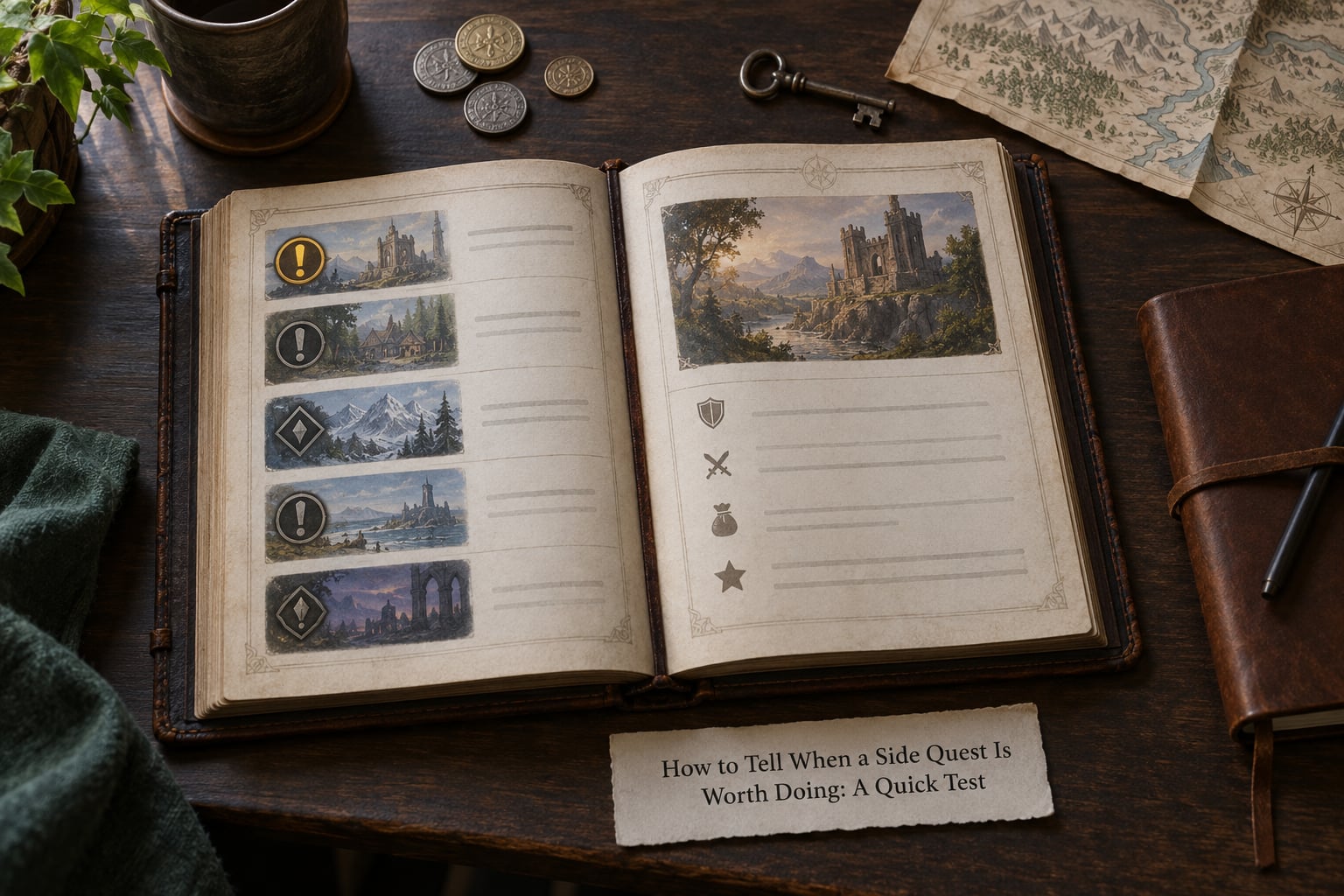
Run these seven questions before you accept. If you get three or more yes answers, do it. If you get one or fewer, close the journal.
- Is the reward unique? A named item, a new ability, a map region, a permanent discount. Common materials and small change are not rewards.
- Does it take you somewhere new? If the destination is an area you have not opened yet, the travel pays for itself.
- How far is the walk? Under two minutes of travel is a side quest. Ten minutes of riding to hand in one item is padding.
- Does it change something? A village that empties, a boss that appears, a shop that opens, a character who changes sides.
- Is the quest itself readable? You can usually tell within two paragraphs whether the writing is doing anything.
- Is there a deadline? Quests that expire or that block another quest should be cleared early, before they cause a problem.
- Does it feed a need you have right now? Crafting materials for a build you are actually playing count. Materials for a build you abandoned do not.
That is the whole test. Everything below is just the reasoning behind it.
What Makes a Side Quest Worth Your Time?
Side quests pay off in five categories, and a quest only needs to hit one of them well to justify itself.
Unique rewards beat bigger rewards
A modest item that nothing else gives you is worth more than a strong weapon you can buy from any merchant. Unique means you cannot get it elsewhere: the Armorer in Mass Effect 1, the recipe from a Xenoblade Chronicles 3 Hero Quest, a costume that changes a character’s look for the rest of the run.
Scale matters too. Twenty percent more damage is nothing. A new ability, a new fast-travel point or a new region changes how the rest of the game plays.
Time cost has to be proportionate
Players on the r/ffxiv boards point out that clearing every side quest can roughly double your time in a game compared with the main storyline alone. That is the real number to reason with, not the reward size.
Story value survives a small reward
A quest that hands you 40 experience and four lines of dialogue about a character you will meet in hour 40 is still good value. The Bloody Baron quest in The Witcher 3 runs long and pays modestly, and it is one of the reasons that game is remembered. The Anju and Kafei side quests in Majora’s Mask build two characters across a time loop you will miss entirely if you speed through.
Risk has to be worth taking
Difficulty is a cost like any other. A fight you are not built for costs respecs, deaths or a walk back to a checkpoint. A superboss is worth that price when you want the challenge or the drop. It is not worth it when you are three levels under and hoping.
Lasting usefulness beats one-shot value
Reputation, discount unlocks, faster travel, a mount, a crafting perk, a character who fights beside you later. These keep paying for the whole playthrough, which no single item of loot does.
One quick note from the data. In a 588-vote reader poll run by Nintendo Life, players picked worldbuilding and lore as the number one reason a side quest is worth doing at 35 percent, with character development at 22 percent. Exploration and world change took 13 percent each, main story ties 8 percent, and tough enemies only 5 percent. Loot barely registered as its own category, which is roughly the opposite of how people talk about side quests in game chat.
How to Estimate the Real Cost of a Side Quest
The reward screen lies about how long a quest takes. It shows you what you get, never the walk, the puzzle or the three follow-up errands that unlock afterward. So estimate the cost yourself before you accept.
- Read the whole quest text, not the title. The description usually names the destination and the complication. “Retrieve from the merchant three valleys away” tells you everything.
- Check the distance on the map. Look at both legs, including the return trip. Most bad side quests are bad because of a round trip you did not price in.
- Look for chain indicators. A quest that spawns another quest costs double the listed time. A three-link chain is a side story wearing a costume.
- Check the wiki before you start. A one-minute lookup tells you the length, the missable conditions and whether it ties into the main plot. Do this for anything you suspect is missable.
- Check scaling. In MMOs and many action RPGs, side quests level with you or with the zone. A level 30 quest you are failing at level 30 is not a challenge, it is a wall.
A workable formula: total minutes equals travel, plus combat encounters, plus puzzle attempts, plus collectibles, plus the follow-ups. A fetch quest runs ten to fifteen minutes. A proper side story runs thirty to ninety. Anything above two hours deserves a wiki check.
Some quests also carry conditions that fail permanently. Those belong at the front of your list, not the back.
What Rewards Should You Look For?
Compare the reward against what your character actually needs this week, not against how big the number looks.
- Equipment you will use. Check your build. A heavy axe for a spellcaster is worthless regardless of its stats.
- Experience, when you need levels. Leveling quests are worth doing in games where the main path gives thin experience, including most MMOs during the level cap run.
- Money, when you are gated on money. Early shop and fast-travel unlocks make every rupee quest valuable for a while.
- Crafting materials for your current build. Narrowly useful beats broadly useless.
- Access. New regions, new vendors, new fast travel. This is the strongest category because it changes the map, not the character.
- Reputation and story consequences. These rarely show a number and are the reason narrative side quests are worth a first playthrough.
Rare is not the same as valuable. A rare item for a build you abandoned, a weapon two tiers below what you already found, or a cosmetic in a game with no visual combat are all cheap. The 5-rupee fetch quests in Breath of the Wild get criticised for exactly this reason, not because the work is hard but because the return is insulting.
When Is a Side Quest Worth Completing for Story or Lore?
A side quest is worth finishing for story when it explains a place, changes a relationship, or answers a question the main story raised and dropped.
Worldbuilding that a map cannot carry
Tarrey Town in Tears of the Kingdom is a settlement quest chain with almost no combat. It is worth doing because the village itself is the point, and because what happens there feeds the rest of the region.
Relationships that pay off much later
Disco Elysium’s Morell chain and the loyalty missions in Mass Effect 1 are the two clearest cases. The Morell investigation is the story. The loyalty missions change who stands with you at the end and what choices stay open.
Lore behind hidden objectives
Some lore is optional and easy to miss. Notes in safe houses, statues you have to activate in Chrono Trigger’s later acts, optional bosses in Octopath Traveler II. If you care about the world, these are the reason to clear the log rather than rush it.
Consequences you cannot get back
Some quests change who lives, which vendor stays open, or how a district looks later. Find out before you finish the game, not after.
None of this requires a guide spoilering the plot. Watch for a quest that mentions a person twice, or one whose reward is a conversation rather than an object. That is the tell.
When Should You Skip or Abandon a Side Quest?
Skip it when the cost signals outweigh the reward signals. These are the warning signs I use.
- Map-wide travel for one item. If the objective is a single common material and the marker is across the map, abandon it.
- A third identical quest in the same village. Repetition padding tells you the developer is filling space, not writing something.
- A long chain for a small payout. Three quests deep for a modest upgrade is a bad trade of hours.
- A fight you cannot win without a build change. Check your gear. If the fight needs a different weapon type or a summon you have never used, the cost is higher than it looks.
- Consequences you do not understand. If you cannot find out what a choice does, do not pick it blind. Save and look it up.
- A quest competing with something time-limited. If another objective expires, do that one first.
- It is your fifth side quest before the second main quest. This is how a 60-hour RPG becomes 120.
A widely used compromise on the Witcher 3 boards: do the side quests in the area you are already standing in, and skip anything that sends you across the map. It cuts the filler and keeps most of the good ones.
Abandoning is free in most games. The journal entry stays until you delete it, so you can always come back.
How Player Choice and Completion Tracking Change the Decision
Chasing a trophy or a 100 percent map flips the rule. Once completion is the goal, most of the skip advice inverts.
Completionists should work the log by area rather than by value. Start where you are, clear the village, clear the caves, then move. The risk is pacing, not boredom: indiscriminate completion turns some games into a slog, and players on r/patientgamers single out long assassination series as the worst case.
Trophy hunters have a narrower target. Optional bosses, one-per-location collectibles and missable-link quests matter because they gate the platinum, and nothing else does. Chests and crafting mats usually do not.
Story-first players should use side quests as a pacing tool instead. When the main story stalls or the writing turns sour, a well-rewarded side quest is the cure. That is also the strongest answer to the “do I have to do them” question. No, you do not, with rare genre exceptions such as MMOs where side quests carry the level progression.
Players on a schedule should sort by travel, not by reward. The rule is simple: if you cannot get back to the main path within your session, the quest was too far away.
New Game Plus planners should mostly leave it. Optional bosses and rare drops are often the only thing worth chasing on a second run, and story quests you have already read once rarely repay it.
Frequently Asked Questions
How do I know if a side quest is worth doing?
Check three things before accepting: whether the reward is unique, whether the destination is somewhere new, and how long the round trip takes. A quest that offers a named item, a new region or a permanent discount for under an hour of travel is usually worth it. One that sends you across the map for common materials is filler.
Are side quests always better than main quests?
No. Main quests drive the plot, the ending and the pacing. Side quests deliver optional rewards, lore and characters. In most RPGs the main path is the tighter experience and the side content is the richer one. In MMOs and life sims the balance flips, because leveling and crafting depend on optional quests.
Should I complete side quests before finishing the main story?
Usually no, unless the quest is missable or expires. Main story first keeps the narrative intact and stops you overlevelling past the point where the plot has any tension. The exceptions are quests that can fail permanently, quests that unlock a main path branch, and games where side quests supply the experience needed to survive the next boss.
Is it worth doing a side quest with a small reward?
Often yes, if the reward is experience, money or access rather than gear. Small rewards still keep a character levelled and equipped, and many of the best-written quests in games like The Witcher 3 and Majora’s Mask pay modestly. Judge the small reward against your current need, not against the size of the number.
How do I prioritize side quests for 100% completion?
Work by area rather than by value. Clear every quest in the village you are standing in, then the caves and ruins around it, then move on. That avoids constant map travel and stops you overlevelling in one corner of the world. Prioritise anything that can fail permanently, and anything listed as missable on the wiki, before anything optional.
Conclusion: Decide What to Do First
Start with the reward screen, then look at the map. That is the whole order of operations: check whether the reward is unique, measure the travel, read the quest text for a story hook or a world change, and estimate the risk of the fight.
If one major benefit clearly matches what you want right now, do the quest. If you are counting the yes answers on the seven-question test and landing on one or fewer, drop it and move on. The quest log will still be there, and in most games you can pick it up months later.