The short version of how to take breaks without losing focus: keep every break time-boxed and low-stimulation, and run the same small re-entry ritual the second it ends. Setup takes about five minutes. The routine works the same whether you are between ranked matches or between study blocks.
Focus usually leaks after a break for three reasons, and none of them are the break itself. The break ran long, the break was stimulating, or you came back without remembering what you were doing. Fix those three and a break becomes an investment instead of a leak.
The trick is treating the break and the return as one routine with two halves. Players who do this well are not the ones with more willpower. They are the ones who stop at a predictable point in the game, step away for a fixed few minutes, and come back to a note they already wrote.
Table of Contents
- What You Need
- Step-by-Step: How to Take Breaks Without Losing Focus
- Define a Clear Stopping Point
- Use a Short, Predictable Break
- Reset Your Body and Attention
- Leave a Mental Resume Note
- Re-enter Gradually
- Common Mistakes
- Frequently Asked Questions
- How long should a gaming break be?
- How do I stop losing focus after a break?
- Should I take breaks during a competitive match?
- What is the best way to remember where I was in a game?
- Is standing up during a break better than staying seated?
- How often should I take a longer break while gaming?
What You Need
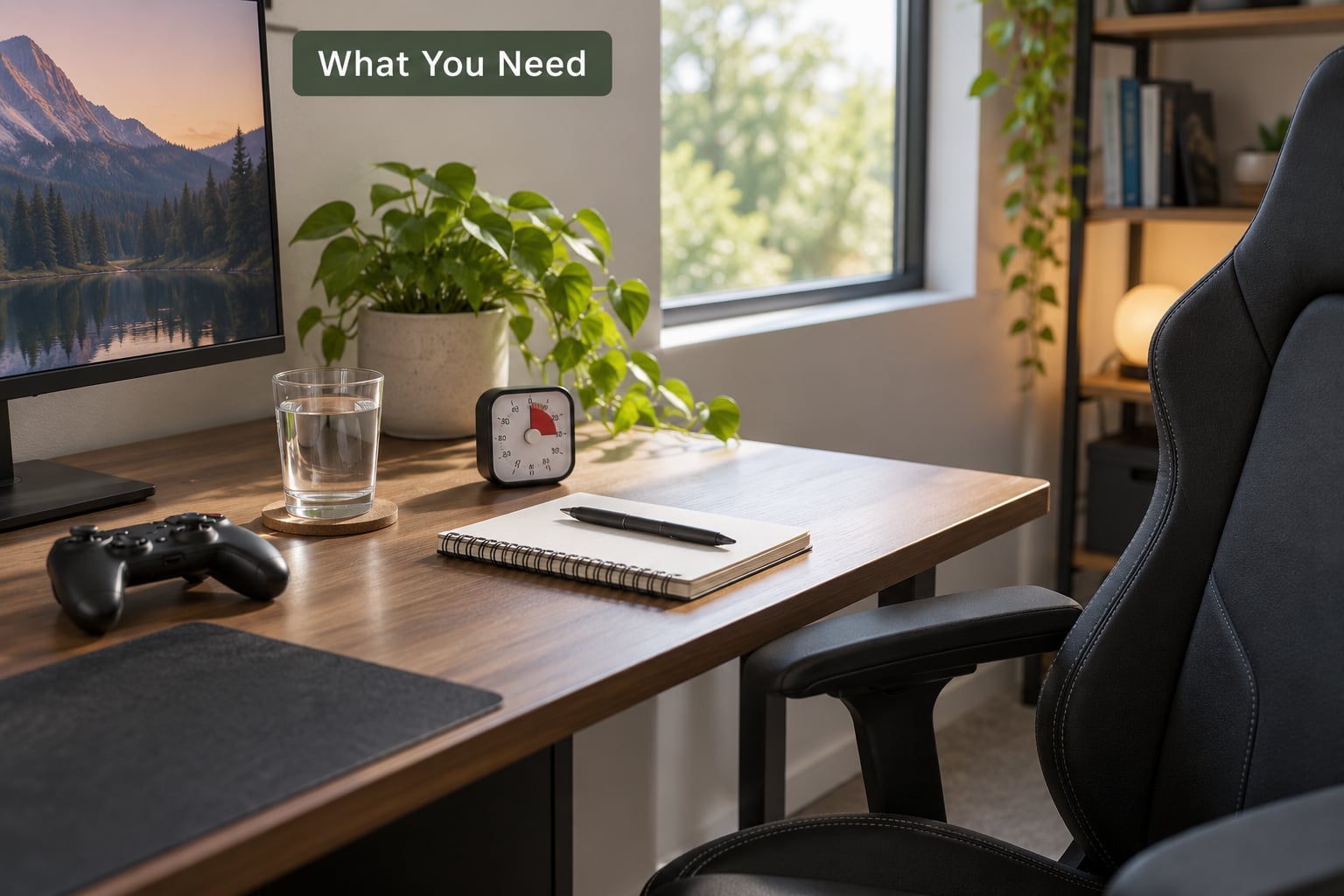
You need five things, and every one of them is free or already sitting in your room.
- A clear stopping point. Pick the moment in the session that ends your block, decided before you get tired of deciding. A finished round, a completed quest objective, or a save screen before a hard section all work.
- A timer you can hear across the room. A phone on the desk is fine as long as it stays face down and out of reach. The timer is a boundary, not a suggestion.
- Water within arm’s reach. Refilling a glass at a kitchen tap turns a five-minute break into a ten-minute errand, and that is how short breaks become long ones.
- Somewhere to stand or move. You do not need to leave the room. Standing up, a few steps down a hallway, or a stretch beside the chair is enough to change what your body is doing.
- A resume note. A notebook, a sticky note, or a single line in a phone notes app. One sentence is enough.
That last item is the one people skip, and it is the one that decides whether you lose focus. On the study side of this, people posting in r/GetStudying repeatedly say the same thing: they forget what they were doing after a break, not because the game or the textbook is hard but because nobody wrote the next step down.
Step-by-Step: How to Take Breaks Without Losing Focus
Five steps, in order. The whole cycle takes as long as your break does, and the first time you run it you should slow down and get used to it.
Define a Clear Stopping Point
End your block at a game boundary, not a moment boundary. The difference sounds small but it decides whether the break feels finished or stolen from you.
A hard boss attempt is a moment. The room after you clear it, with your health restored and the checkpoint saved, is a boundary. Same for a study session: finishing a practice set beats closing the page halfway down a problem.
If you cannot find a clean stop, you have a signal that the block was too long. Keep sessions at 45 to 90 minutes of focused work and the boundaries show up on their own.
Use a Short, Predictable Break
Pick the break length before you need it, and change it only when a task genuinely calls for it. A break you have to negotiate is a break that runs long.
| Break type | Length | Best for |
|---|---|---|
| Micro-break | 2 to 5 minutes | Queue time, a single death, a loading screen. In place, screen stays off. |
| Short break | 5 to 10 minutes | End of a match, a 25/5 or 50/10 Pomodoro cycle, the end of a study block. |
| Long break | 15 to 30 minutes | After two or three hours, or any block where you noticed your attention sliding. |
The Pomodoro Technique is the 25 and 5 version of this: 25 minutes on, 5 minutes off. For a gaming session, longer blocks work better because match boundaries are further apart, so 50 and 10 fits a ranked set of matches more naturally.
Clock the break instead of trusting it. Ten minutes without a timer reliably turns into twenty-five, and a 45-minute scroll at the end of a 5-minute break is the single most reported failure mode in study communities.
Reset Your Body and Attention
Stand up and move first, because a body that has been folded into a chair for an hour will drag attention down with it even when your mind is willing.
Then handle your eyes. Look at something across the room or out a window for about 20 seconds. Near-focus is the thing your eyes have been doing without a break, and distance focus is what resets it.
Drink some water, take five slow breaths, and count them in for one, out for one, up to ten. Breath counting is the most shared in-place reset in r/GetStudying because it needs no equipment and it stops the hands from reaching for a phone.
Naps fit here too, with one rule: keep them under 20 minutes. Past 30 you get groggy, and groggy plus a difficult game is how a break becomes a lost evening.
Leave a Mental Resume Note
Before you stand up, write one sentence describing exactly what you do first when you sit back down. Not a summary of the session, a next action.
Weak version: “continue the game.” Strong version: “farm the two drops I still need before the vendor, then push the second boss.” The second one costs you eight seconds and hands you a starting point instead of a blank screen.
If a decision was hanging when you stopped, write that down too, with your leaning. Resuming a half-made decision is more tiring than resuming a settled one, because you have to rebuild the whole argument from nothing.
Re-enter Gradually
The first ninety seconds back decide how the next hour feels. Start on an easy objective, not the hardest thing in the session.
Read the resume note first, take one sip of water, then pick up the game with the simplest available task. Warm-up activity in a session works the same way it does in sport: you would not open a match with your hardest route, and you should not open a session with your worst enemy encounter.
Give yourself a minute at low intensity and let your performance climb back to where it was. If the first minutes feel shaky, that is normal and it passes quickly once you stop judging it.
Give yourself a graded return for the harder objectives. You are not going to be sharp immediately, and a session built on punishing yourself for the first five minutes is how tilt starts. In competitive play, the first fight after a break is practice, not a test.
Common Mistakes
Every mistake below has a fix that takes the same amount of effort. The pattern is always the same, so pair them.
Stopping mid-fight. You break at the worst possible second, then spend the break stewing instead of resting. Fix: break only at a boundary you chose in advance. If no boundary is coming, take a micro-break where you are instead of ending the session badly.
Checking every notification. Each check is a small restart, and a restart is the exact thing you are trying to avoid. Fix: phone in another room during the break, or a blocker app if you need the help. That environmental fix comes up more than anything else in r/GetStudying, and it works for the same reason a closed door works.
Sitting completely still. A ten-minute break spent in the same chair is a partial break, and your eyes get none of it. Fix: stand for the whole break, even if you are only looking out the window.
Taking unplanned breaks. You stop when you feel bad instead of when the plan says, which means breaks get longer as the session gets worse. Fix: planned breaks are fixed in advance, and they do not depend on how the match is going.
Coming back to peak intensity. You sit down and immediately jump into the hardest content with no warm-up. Fix: one easy objective, about a minute, then escalate.
Going longer than you planned because the game is good. Finishing one more match is a fine choice, but only if it was a choice. Fix: if a session runs past its block, restart the block at the next boundary instead of pretending the schedule still applies.
One final focus tip. Treat a break as part of the session, not as time stolen from it. Players who plan the break in advance get more out of two hours than players who never stop, because they never spend the last twenty minutes drifting.
Frequently Asked Questions
How long should a gaming break be?
Five to ten minutes works for most players, taken at the end of a match or at a natural boundary rather than mid-fight. Two to five minutes is enough for a micro-break during queue time. Save the 15 to 30 minute break for after two or three hours, when attention has started sliding regardless of how the session is going.
How do I stop losing focus after a break?
Run a fixed re-entry ritual every time: read your resume note, drink a sip of water, then start one easy objective for about a minute before trying anything hard. The ritual matters more than the length of the break, because it removes the decision of what to do first. Warm-up content should be simple by design.
Should I take breaks during a competitive match?
No. A break is something you plan between matches, never inside one. Most competitive modes do not pause safely anyway, and stopping mid-round leaves you stewing instead of resting. Use queue time and loading screens for micro-breaks instead, and save the real break for the gap between matches or sets.
What is the best way to remember where I was in a game?
Write one sentence before you stop, naming your first objective when you return. A note that says continue the game forces you to rebuild the whole state from memory. A note that names the next objective hands you a starting point immediately. Keep it somewhere you will actually see it when you sit back down.
Is standing up during a break better than staying seated?
Yes, for most people. Standing changes your posture, gets blood moving, and gives your eyes a different distance to focus on, which seated screen time does not. You do not need to leave the room or exercise. Standing up, a few steps, and some water covers most of the benefit in five minutes.
How often should I take a longer break while gaming?
Every two to three hours of continuous play, and earlier if you notice your reaction time slowing, your mistakes climbing, or your patience thinning. A long break is 15 to 30 minutes of low-stimulation activity rather than a second game. Those are the same signals you would use to stop a study session, and they arrive on a similar schedule.
Start with one change: decide your stopping point and your break length before the next session begins, then write the resume note before you stand up. Everything else, the standing, the water, the five breaths, is easier to add once the routine is already there. Knowing how to take breaks without losing focus is a matter of ending them the same way every time.