To balance gaming and school, book your study blocks first, leave gaming a fixed window with a hard end time, and keep your study space separate from your play space. Most students do not have a willpower problem. They have no schedule, so gaming wins by default and eats the study hours.
That is the whole answer, and it takes about twenty minutes to set up properly. What follows is the system I would hand a student in week one: what to gather, six steps to build the schedule, the mistakes that break it, and what to do when the week already went sideways.
Gaming is not the enemy here. A four-hour session on Saturday with your friends is completely fine. The thing that damages schoolwork is a Tuesday night with no plan, where playtime quietly grows until it is 1 a.m. and the essay due Friday has three pages.
One more thing before we start. This guide works for a high school student with homework, a university student juggling coursework and a part-time job, and an adult studying after work. The system is the same; the hours move depending on where your energy peaks.
Table of Contents
- What You Need
- Step-by-Step
- 1. List Every School and Gaming Commitment
- 2. Set Non-Negotiable School and Rest Times
- 3. Assign Gaming to Specific Time Blocks
- 4. Use a Short Study Session and Focus Method
- 5. Leave Room for Deadlines and Unexpected Work
- 6. Review the Plan Every Week
- Common Mistakes
- Frequently Asked Questions
- How much gaming is too much while school is busy?
- Can I game on school nights if my homework is finished?
- What should I do when gaming makes it hard to start homework?
- How can I balance gaming and school during exam week?
- Is gaming a good way to relax after school?
- What if I already have a bad gaming and sleep schedule?
- Conclusion: Start With This Week
What You Need
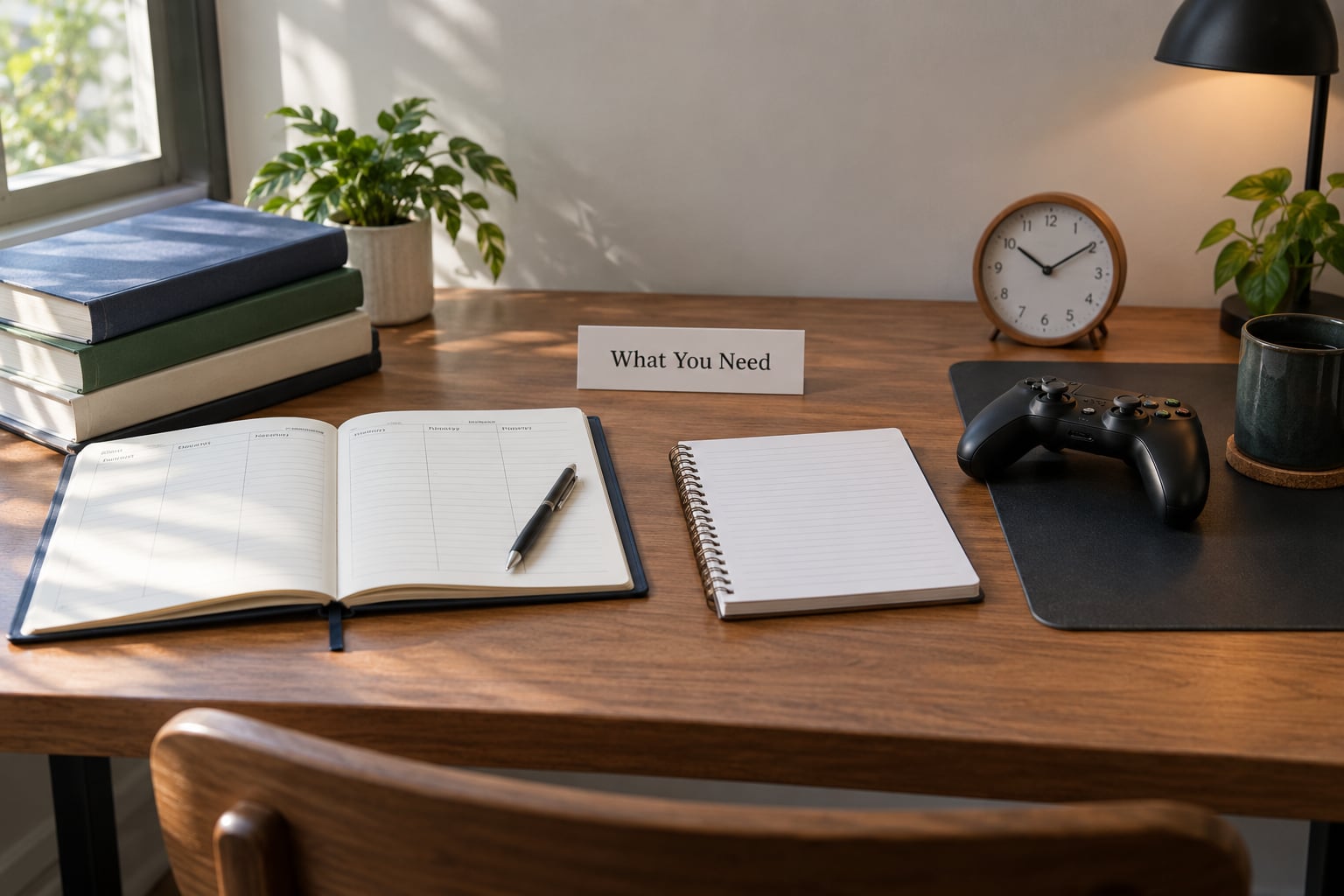
Six things, and you probably own all of them already:
- A full assignment list. Every class, every deadline, every exam date, in one place. If it lives in your head, it will lose to a game notification.
- A weekly calendar. Paper works fine. A phone calendar works better because it can send you an alarm at the end of a gaming block.
- A realistic gaming limit. A number of hours per week you can actually hit on your worst week, not your best one.
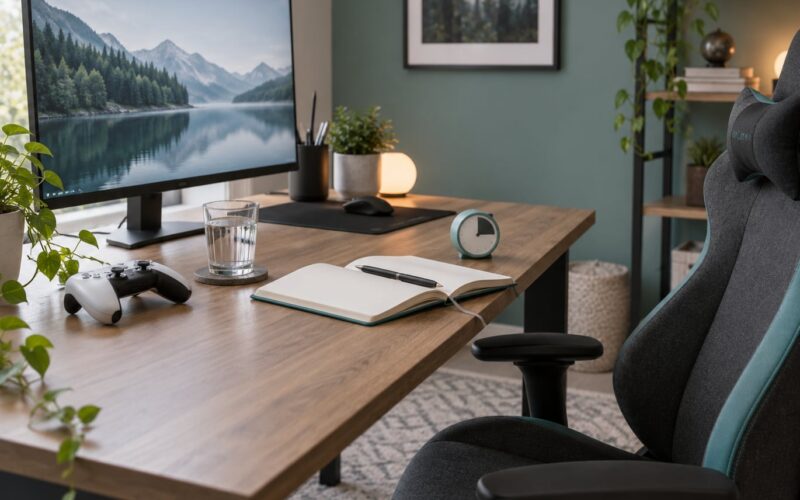
- A quiet study setup. One desk, one chair, no controller, ideally in a different part of the house from the TV or gaming monitor.
- A timer. For study blocks and, more importantly, for the end of your gaming sessions.
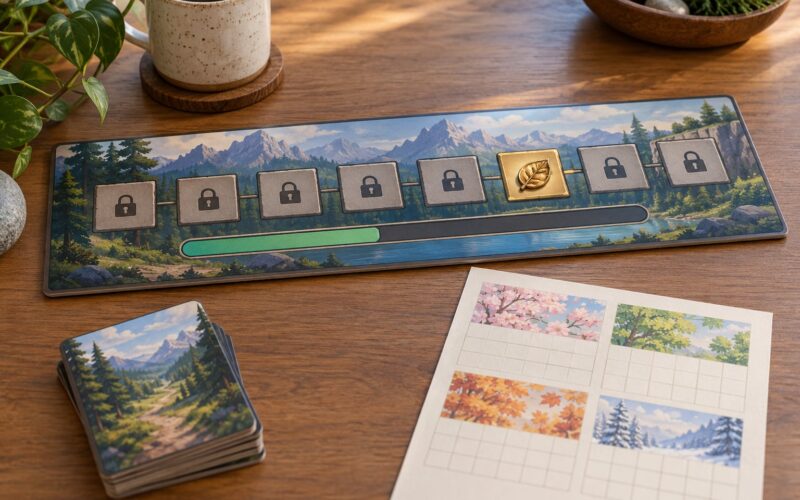
- A way to track it. A paper chart on the wall works. So does a habit tracker app. The point is that you can see the week.
The quiet study setup is the one students skip and regret. A controller in the same room as your homework is not a small thing. You are asking your brain to ignore a cue it is trained to respond to.
Step-by-Step
Six steps, done once on a Sunday, take about half an hour. The system only works if you set it up when you are not mid-session.
1. List Every School and Gaming Commitment
Write down every fixed commitment before you write down anything fun. Classes with start and end times. Assignments with due dates. Exams. Your job shifts if you have one. Practice, sport, music, church, family dinner, the walk home.
Then add sleep. Block seven to nine hours as a scheduled item, because a student who plans gaming until 1 a.m. and hopes to sleep has not planned anything.
Add your gaming next, but as the leftover: three or four sessions a week with a start time and an end time, not as “whenever I have time.” That last part is what turns two hours into five.
Your sign that this step worked: when you read the list out loud, the total of everything in it fits inside a real week. If it does not, something is going and it is not gaming. Usually it is the assumption that study time is infinite.
2. Set Non-Negotiable School and Rest Times
Now protect the parts of your day before you schedule the parts you want. Two or three school blocks a day, placed at the times you actually think clearly, become fixed. Meals become fixed. Bedtime becomes fixed.
The best study block is the one that matches your energy, not the one that fits neatly between other things. Plenty of students do their clearest thinking between 4 p.m. and 7 p.m. after school. Others do it first thing in the morning. Either works. What does not work is putting your hardest work in the 45 minutes before bed, when you will reread the same paragraph four times and remember none of it.
Meals and sleep are on this list for a reason. Students who skip dinner to buy gaming time end up raiding the fridge at 11 p.m. and then sleeping badly and studying worse the next day. Two anchors hold a week together: a bedtime and an evening meal.
3. Assign Gaming to Specific Time Blocks
This is where most plans break down, so keep it simple. A session has a start, a length, and an alarm.
A school-night example that works: 4:00 to 5:30 p.m. for homework, dinner around 6, one hour of study from 6:30 to 7:30, then gaming from 8:00 to 9:30 with an alarm at 9:30. Not “after homework.” A specific time.
A weekend example: two longer blocks, say 11 a.m. to 1 p.m. and 4 p.m. to 7 p.m., with the afternoon left for a longer study push or a part-time shift. Weekends are where plans get abandoned, so fewer and longer usually beats many and short.
Set the end alarm to something slightly annoying. A phone on the other side of the room works better than one sitting next to your mouse, because ending a session takes a small physical action and small physical actions are easy to skip.
How to balance gaming and school on a week with a party, a tournament, or a friend visiting: move that week’s gaming block, do not delete it. A schedule you abandon in one evening is not a schedule. Deleting is fine; drifting quietly back to nothing is not.
4. Use a Short Study Session and Focus Method
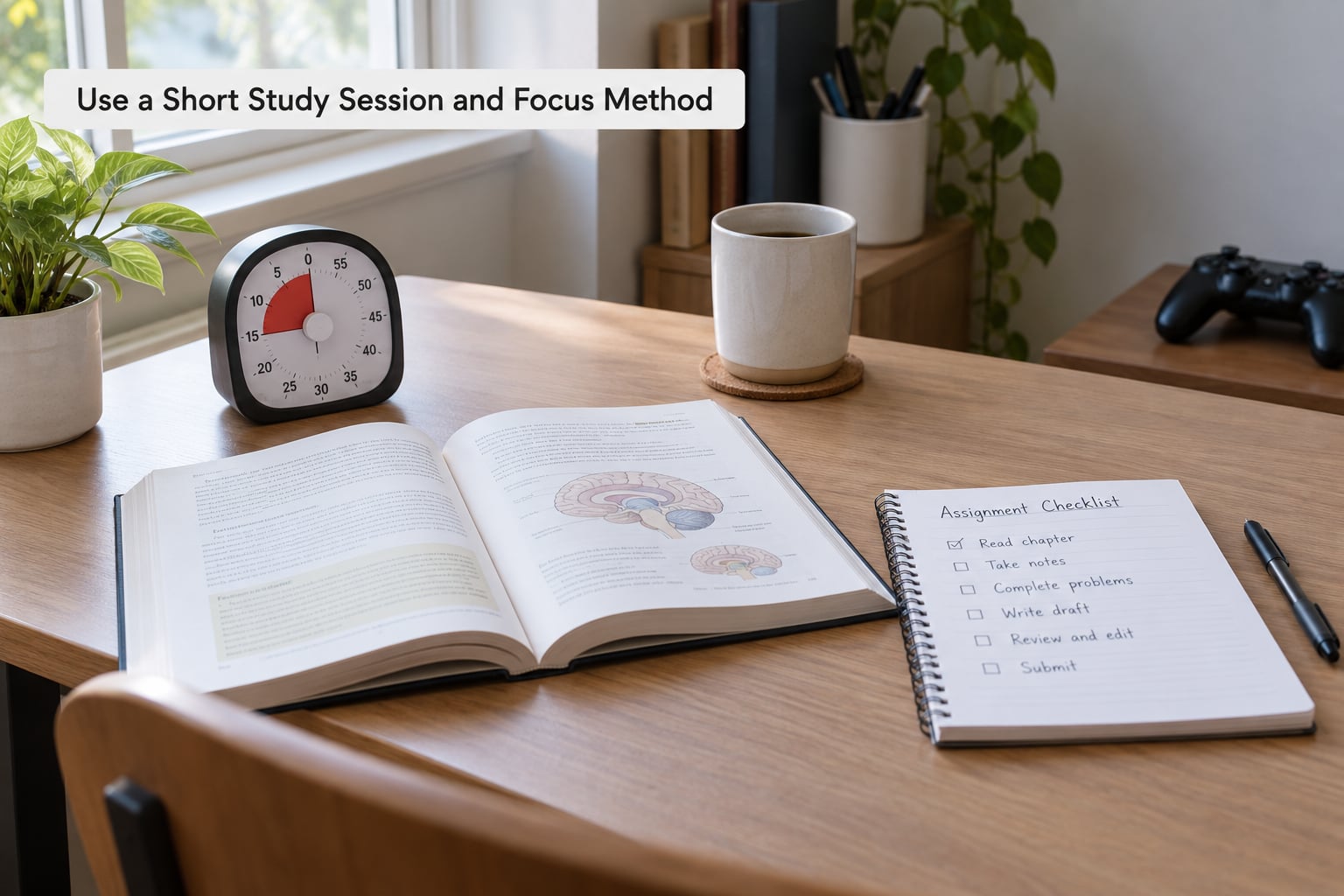
Long study sessions fail most students. Three options work, and you pick based on how much stamina you actually have:
- 25 minutes on, 5 minutes off (Pomodoro). Best when you are avoiding a task or when your attention drops fast.
- 50 minutes on, 10 minutes off. Best for reading, writing and problem sets that need continuity.
- Four blocks of 25, then a 30-minute break. Best when you have several small assignments rather than one big one.
The break rule matters more than the timer. A break spent on your phone or another game is not a break, because your attention never left the screen. Stand up, get water, look out a window for ten minutes. You will start the next block faster.
The number that catches people is four. If you plan nine focus blocks in a day, you will do three and feel like a failure. Plan three or four, finish them, and stop. A plan you complete teaches your brain that the schedule is real, and that is what makes next Sunday easier.
5. Leave Room for Deadlines and Unexpected Work
Every realistic week has surprises: a lab partner disappears, a teacher moves a deadline, a work shift gets swapped. Block one open slot a week, or a 30-minute buffer inside each evening, and use it for overflow instead of borrowing from sleep.
For exam weeks, drop gaming to one short session and put the freed hours into review. Front-loading homework to bank gaming time is the strategy most students who make it work actually use, because finishing early is the only thing that reliably creates free time.
When you cut gaming for a deadline, cut it yourself, in advance, on your own schedule. Doing it at the last minute turns a plan into a punishment and the next week into another negotiation.
6. Review the Plan Every Week
Sunday, fifteen minutes. Check what actually happened, not what you intended: assignments finished, sleep hours, gaming hours, and whether you felt stressed most of the week. Adjust next week’s blocks based on what happened, not what you wish had happened.
This is the step that makes it how to balance gaming and school rather than just read about it. A weekly review turns a good week into a repeatable system and a bad week into data. If you only changed one thing last week, keep that change and drop everything else.
Common Mistakes
Scheduling around gaming instead of school. Open the calendar, put your gaming in first, and then squeeze homework around whatever is left. The result is assignment time in the shape of gaps. Book school first.
Making gaming your only reward. If the only thing you look forward to is a match, motivation and dread get tangled together, and study starts to feel like punishment you are buying your way out of. Rewards work better when there is more than one: a walk, a friend, music, an hour of a show you actually like.
Trading sleep for gaming. This is the most expensive mistake on the list. Lost sleep costs focus the next day, which costs more study time, which tempts you into another late night. Keep a fixed bedtime even when a season launches.
Playing during homework. A game in the background or on a second monitor feels like balance. It is not. Your attention splits whether or not you notice, and the quality of both halves drops. If you want to game between sessions, close the game first and restart it after the break.
Making the plan too rigid. A schedule with no slack fails in week two and you throw it out. Leave one movable block a week and treat changing it as allowed rather than as cheating.
Counting hours instead of finished work. Four hours of study is not a result. Three assignments done, one review completed, one problem set finished is. Track outputs, and let the hours follow.
Breaking the one-more-game loop. This one deserves its own paragraph because it is the most common failure by far. One match turns into a queue, the queue turns into a friend asking you to play, and four hours disappear. The counters that work: end the session during a match rather than between matches, keep the controller somewhere you have to stand up to reach, and tell one person your end time so someone notices when you go past it. When willpower is not enough, people who post in study communities tend to use structure instead, co-presence in a study room or a call with the camera on.
Frequently Asked Questions
How much gaming is too much while school is busy?
There is no magic number, but there is a useful test. If gaming is the first thing you cut when an assignment is due, it is already too large for your current workload. During exam weeks, most students do best on one short session or none. On a normal week, pick a number you can hit on your worst week, write it down, and treat it as a limit rather than a target. Unstructured gaming is the real problem, not the total.
Can I game on school nights if my homework is finished?
Yes, as long as it sits in a fixed window and does not run past bedtime. Homework done does not mean the evening is free, because there is always the next day’s reading or a half-finished lab waiting. Pick a start and an end time, set an alarm for the end, and keep the session off your study desk. A student gaming from 8:00 to 9:30 every night with homework finished by 7:30 is doing this correctly.
What should I do when gaming makes it hard to start homework?
Shrink the first task until it is too small to refuse. Open the document, write one sentence, and set a timer for fifteen minutes. Starting is the hard part; the timer makes the rest automatic. If you still cannot start, change rooms and study alongside one person, even on a call with the camera on. Co-presence beats willpower more often than not.
How can I balance gaming and school during exam week?
Drop gaming to one short session and schedule it like any other block, so it does not become the thing you negotiate over every night. Front-load review across the days you have rather than cramming the night before. Keep your bedtime fixed, since exam weeks are when sleep loss does the most damage. When the exam is done, put the gaming hours back on the calendar the same week.
Is gaming a good way to relax after school?
It depends entirely on what comes after it. Gaming that follows a completed study session and ends at a set time usually reads as a reward, and that is fine. Gaming that starts because homework felt overwhelming tends to run long and ends with guilt. A rough test: after you stop, do you feel rested or annoyed? If annoyed, the session was avoidance rather than rest. Walking, food or a friend work better when you need to actually recover.
What if I already have a bad gaming and sleep schedule?
Fix the bedtime first, because it changes everything else within a week. Pick a realistic time, hold it for seven days, and accept less gaming for a while. Do not try to fix gaming hours and sleep at the same time; fix sleep, then rebuild the gaming blocks around the new evening. Expect the first two days to feel worse before they feel better, which is normal.
Conclusion: Start With This Week
Here is the only thing to do today: open a calendar, block your classes, your sleep and your gaming sessions, and fill in the blanks. Start with the smallest schedule you would genuinely keep, do three or four focus blocks a day, and review it next Sunday.
That is how to balance gaming and school. Not by playing less out of guilt, but by deciding in advance when the games happen. A week with a plan keeps the gaming you love and the grades you need, and it takes one afternoon to set up.