Battle passes changed game design by turning time-limited, tiered progression into the backbone of a game’s content cycle. Instead of a studio shipping a fixed product and moving on, a season now has a start date, a reward ladder, a challenge set, and an expiration clock. Everything else in the roadmap bends around that structure.
That single decision is the short answer to how battle passes changed game design, and it reshaped season lengths, on-boarding, reward economies, live-ops staffing, and the metrics designers are judged by. If you have ever wondered why nearly every competitive multiplayer release now ships with one, or why your favorite game is built around a quarterly reset, this is the explanation.
Table of Contents
- What Is a Battle Pass, and Why Did It Change Games?
- How Battle Passes Changed Game Design
- 1. Seasons became the unit of release
- 2. Progression split into two parallel tracks
- 3. Challenges became level design
- 4. Retention metrics became the design brief
- 5. Reward economies needed deliberate tuning
- 6. Defeat-heavy genres got sub-goals
- 7. Gameplay content ended up on the premium track
- Which Game Design Systems Were Reworked?
- How Did Progression and Player Expectations Change?
- What New Content Types Did Battle Passes Encourage?
- How Did Battle Passes Affect Monetization and Retention?
- What Are the Risks of Designing Around Battle Passes?
- How Can a Battle Pass Improve Player Experience?
- Frequently Asked Questions
- What game popularized the battle pass?
- Is a battle pass the same as a season pass or DLC?
- Do battle pass rewards expire?
- Why are battle passes controversial?
- Are battle passes better than loot boxes?
- How long does it take to finish a battle pass?
- Conclusion
What Is a Battle Pass, and Why Did It Change Games?
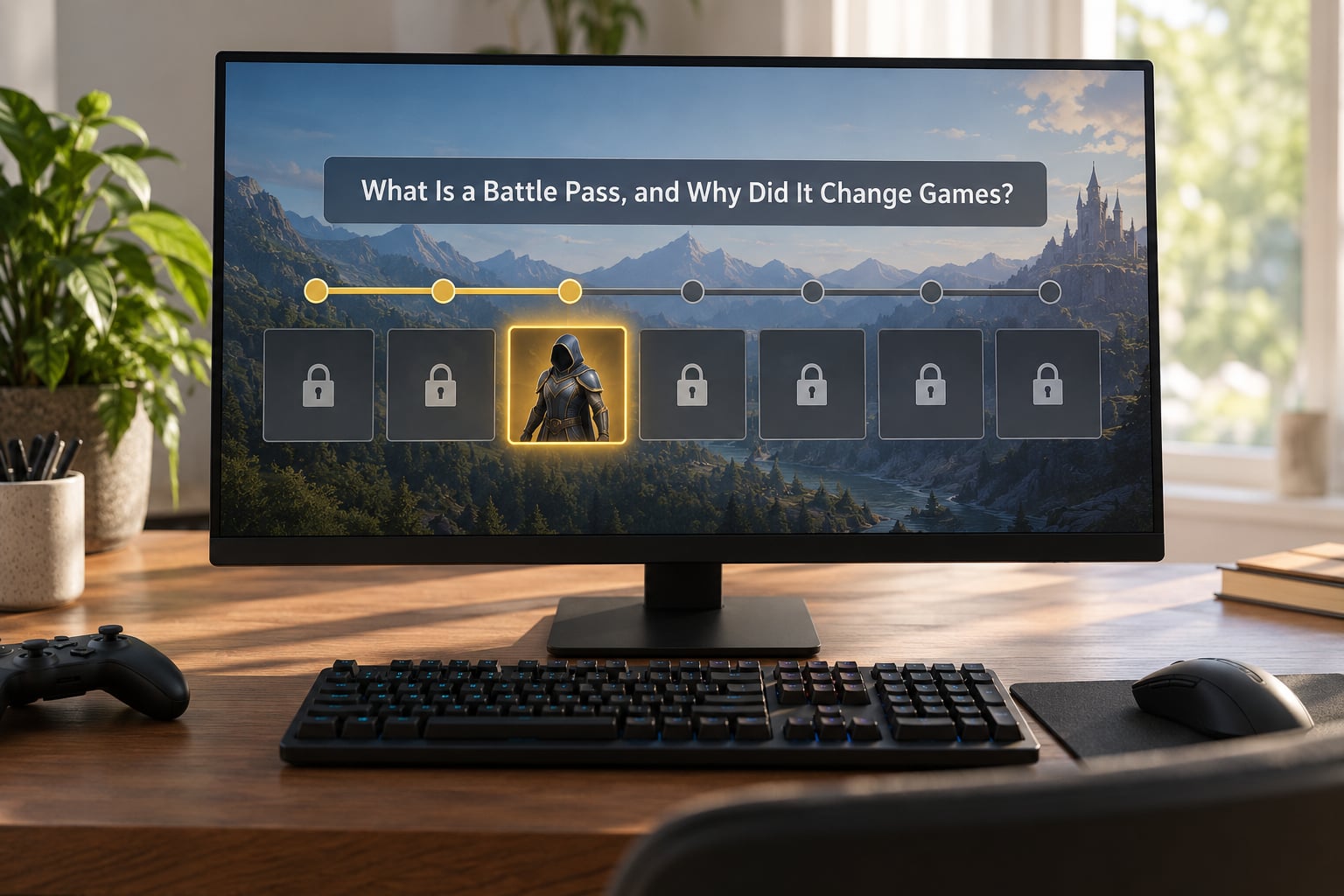
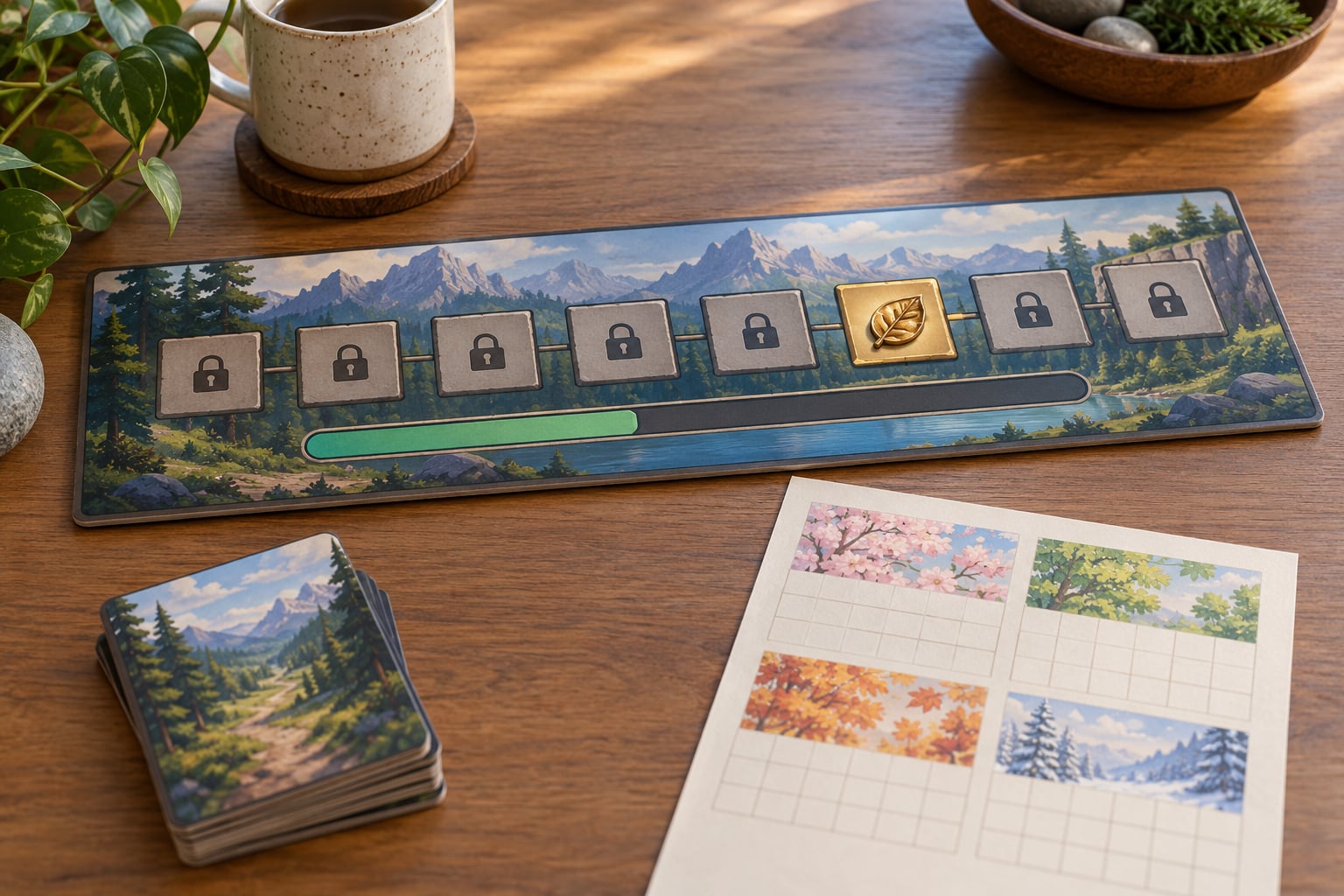
A battle pass is a time-limited reward track inside a video game that players climb by playing. You earn experience from matches and from daily or weekly challenges, each tier asks for more experience than the last, and every tier you reach hands you a reward. Most passes run two lines side by side: a free track everybody can earn, and a premium track with better items that costs a single flat purchase for the whole season.
What popularized it: Dota 2’s 2013 Compendium, which Valve renamed the Battle Pass in 2016, then Fortnite Season 2 in December 2017, which turned the format into a mass-market seasonal event.
The model solved two specific problems that single-purchase games had.
The first was the spending cliff. A game that cost money once had to keep earning from a player base that mostly played for free, and expansions were expensive to build and easy to skip. A pass turns that audience into a predictable monthly payer without asking anyone to pay twice in a year.
The second was the content treadmill. A competitive game that rewards winning gets thin fast when most matches are losses. A tier track gives the losing side a reason to keep logging in, because progress is measured in tiers rather than placements.
| Year | Milestone | Why it mattered for design |
|---|---|---|
| 2013 | Dota 2 Compendium, Valve | First widely copied tiered pass tied to a competitive event, with cosmetics and tournament entries as rewards. |
| 2016 | Renamed the Battle Pass | The name stuck and became the default label for the format. |
| 2017 | Fortnite Season 2, Epic Games | Made the pass a headline seasonal event and pushed it to a mass audience. |
| 2018 | PUBG and Rocket League add passes | The format spread beyond battle royale into sports and shooter genres. |
| 2019 | Apex Legends and Black Ops 4 | Passes became the default for major competitive launches, not an optional extra. |
| 2021-2022 | Overwatch 2, Call of Duty, Destiny 2, Deep Rock Galactic | Starter variants appeared, including free passes and choice-based rewards. |
| 2026 | Correction cycle | Non-expiring passes, free track redesigns, backlog unlocks and breather seasons as player fatigue pushed back. |
One more piece of background helps. Roughly 40% of Fortnite is owned by Tencent, the game’s largest outside shareholder, which is often the reason the question of who profits from Fortnite comes up in the same conversation as pass pricing.
How Battle Passes Changed Game Design
Seven shifts did most of the damage to the old way of building a multiplayer game. Taken together, they are the clearest set of answers to why battle passes reshaped progression, rewards, retention, and monetization rather than just the cosmetics players actually notice.
1. Seasons became the unit of release
Before passes, a live game shipped content whenever a team finished it, and the roadmap was a loose list. After passes, the season calendar became the plan. A new season has to land on a date announced months earlier, which means level art, balance changes, reward art, and marketing all get pulled onto a repeating metronome.
That single constraint explains a lot of odd-looking design. Modes appear and vanish on a schedule because the pass needs fresh weekly objectives. Maps rotate because rotating maps generate new challenge data. Characters get balance tweaks at season boundaries rather than whenever a designer finds an exploit.
2. Progression split into two parallel tracks
Older progression was one ladder with power at the top: earn resources, buy gear, get stronger. Pass design split that ladder. Cosmetic rewards sit on both tracks so a free player and a paying player move at similar speed through the same tier count, while anything that touches combat power stays off the pass entirely.
The split was mostly about fairness optics. It also created a new design problem, because a purely cosmetic ladder has to stay interesting across a hundred tiers without handing out anything that changes a match.
3. Challenges became level design
This is the shift most players never noticed. Before passes, objectives were a menu option or a tutorial. Now daily and weekly challenges are the main way a player learns a map, discovers a weapon, or tries a mode they would never open on their own.
A developer described Fortnite’s early challenges, things like landing at named locations or hunting specific items, as a way of teaching new players the map without a tutorial. The objective is the level design. It teaches you where the high ground is, which sightlines matter, and what each item is worth, then pays you for the lesson.
4. Retention metrics became the design brief
Design documents used to argue about fun, readability, and competitive fairness. Now they argue about DAU, MAU, CCU, and ARPU, the daily and monthly active counts, peak concurrent users, and average revenue per user. A design is approved when it lifts a retention number without hurting match quality.
That reordering has real consequences. Systems get added because they keep players logging in, and get cut when a season’s numbers slide, sometimes regardless of whether players enjoyed them.
5. Reward economies needed deliberate tuning
A pass is an economy with two currencies, a tier curve, an exchange rate for buying tiers outright, and a conversion rate between in-game currency and premium currency. When enough premium currency carried over to cover the next pass, players started treating passes as subscriptions rather than purchases, and studios adjusted the reward mix accordingly.
Designers talk openly about filler tiers, low-value currency drops early and the genuinely desirable cosmetics near the back half. The pacing curve is tuned so a player who finishes in week eight still has a reason to finish.
6. Defeat-heavy genres got sub-goals
Battle royale gives most players more losses than wins. A pass does not fix that, but it gives a losing player something that visibly moves. Teams that die in the first minute can still gain tiers, which keeps the session from feeling wasted and reduces the incentive to quit after a bad streak.
Players in r/apexlegends describe the same idea from the other side, arguing that the tier curve is tuned to stretch a season rather than to respect how much time someone actually has.
7. Gameplay content ended up on the premium track
This is the shift that causes the loudest arguments. Heroes, weapons, and characters have ended up on the premium track or inside pass-exclusive events, which turns a cosmetic system into something that looks like a power advantage.
Overwatch 2 is the clearest example players point to, since a pass-exclusive hero changes the counter-pick picture for everyone else in the match. The same criticism shows up whenever a new character arrives tied to a purchase rather than to play.
The design counter to that is a voucher. Instead of handing a player a skin locked to a legend they never pick, the pass gives them a token they spend later on something they actually use. Apex Legends is the case that gets named most, since its character-locked rewards left players grinding toward something with no use in their loadout.
Challenge design also differs sharply between two famous rivals. Fortnite’s objectives push players across the map into places they would not normally land, which teaches terrain and keeps matches varied. Apex Legends leans on narrower tasks that can be finished inside a single match, which suits its faster rotation. Neither is wrong, but the choice decides what players learn.
The naming and packaging around all of this got tangled too. Season pass, battle pass, level pass, starter pass, and battle pass level now mean different things at different studios, sometimes bundled together, and players on r/diablo4 described not being sure whether one purchase covered the pass, the season, or both. That confusion is a design failure, not a player failure. The other naming problem is the seasonal character lock, since naming a hero after the season it debuted in makes the temporary reward feel permanent and the later purchase feel like an unlock you were meant to miss.
Which Game Design Systems Were Reworked?
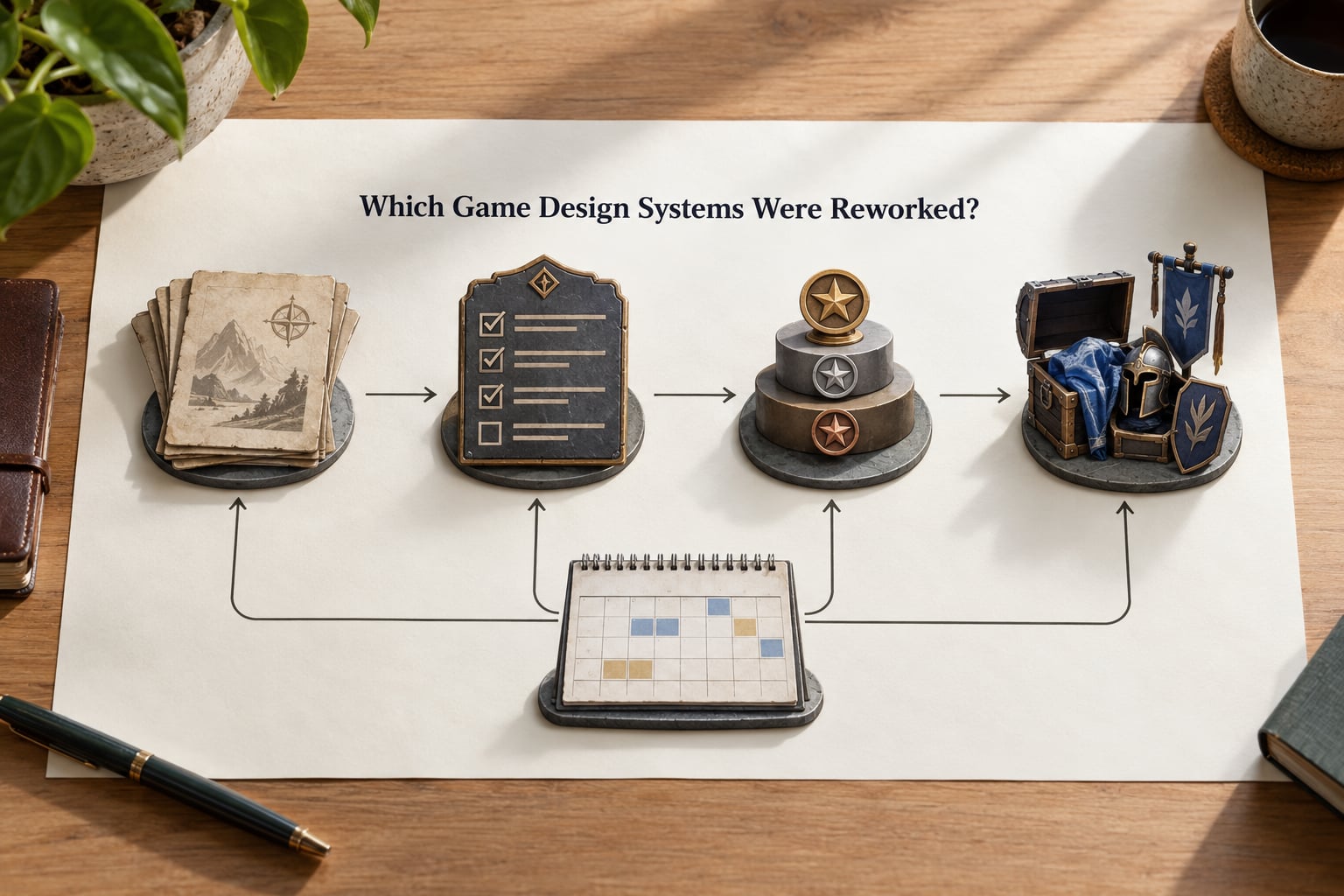
The pass did not stay in the store. It reached into almost every system a multiplayer game has.
On-boarding got quieter. Tutorials and unlock lines got shorter because the tier track supplies the first ten hours of guidance on its own.
The core loop absorbed a meta loop. A match still produces currency and experience, but now the match feeds a season, and the season feeds a reward ladder. Designers talk about the macro loop and the micro goals inside it.
Telemetry is what makes the cycle possible. A studio tracks when players log in and out, which mode, map, and loadout they pick, and where deaths happen. Pass design reads that data directly, which is why a challenge set can be tuned weekly instead of being locked into a build years ahead.
Content roadmaps became calendar-shaped. Instead of a feature list, a studio plans what arrives in season three and what arrives in season four, and server-side toggles let teams flip modes, rules, and rewards without a full certification cycle.
Live-ops teams grew. Keeping a season fed with weekly challenges and themed events means permanent staffing rather than a launch team that disbands after release. That stability has a cost, and it shows up as production pressure on the people doing the weekly work. Designers describe a treadmill where the same small team ships cosmetic variants, mission strings, and balance tweaks on a fixed clock, and layoffs at large publishers have made that pressure more visible than it used to be.
Even monetization menus were reorganized. Bundles, tier skips, and starter variants are laid out around the assumption that a player will buy something every season.
One external force is worth naming. Regulators in Belgium and the Netherlands ruled that paid loot boxes fall under gambling rules, which pushed studios toward systems where the full reward list is visible up front. A battle pass already fits that requirement, so transparency stopped being a concession and became the sales pitch.
How Did Progression and Player Expectations Change?
Old reward pacing was slow and quiet. Earn a fixed amount, wait for a timer, log in tomorrow. Pass progression is a curve with visible milestones, so players now judge a game by how fast the ladder moves.
Three expectations followed. First, that there is always a next thing, because a pass with nothing visible at tier 40 feels broken. Second, that missing a week is survivable, which is where catch-up systems, relaxed daily caps, and generous XP boosts came from. Players on r/Battlefield asked directly for the removal of daily limits so returning players could progress again.
Third, that rewards matter after the season ends. When they do not, players treat the whole ladder as temporary inventory. That expectation is now the main reason studios talk about backlog unlocks, letting earned cosmetics return to a shop later.
The flip side is an implied time contract. A pass says finish this in ten weeks, which is fine until you have a bad month. The player who missed three weeks now faces a wall of XP with a clock running.
That contract is also why progression curves stopped being invisible. A studio once could tune an XP formula and forget about it. Now the shape of the curve is the season’s main balancing problem, and players see it directly, because the next tier is always on screen with a number attached.
Experienced players have started shopping around on curve shape rather than on theme. A short track with generous early tiers can be finished in a long weekend. A hundred-tier track with a steep back half needs a schedule. The same content, priced identically, feels completely different depending on the maths underneath it.
What New Content Types Did Battle Passes Encourage?
Because a season has to justify itself every few months, studios produce content types they used to skip.
Mission chains came first, giving a weekly set of objectives that ends in a themed reward. Then came emotes, sprays, weapon skins, pickaxes, gliders, contrails, banners, and music packs, all cheap to produce in volume and reusable as pass filler.
Story episodes and short character vignettes rode the same wave, since a short video or a few lines of dialogue is cheap next to a new character model. Limited-time modes arrived to give weekly challenges something to point at, and seasonal events bundled new mechanics with themed rewards so the store had one clear destination.
Not all of it holds up. A cosmetic nobody uses is inventory clutter, and a mission that repeats forty times with a new number is filler with a progress bar. The test designers use is whether a reward changes how a player plays or only how their inventory looks.
Limited-time modes carry their own tension. They give the pass something fresh to point at, but a mode that only exists for two weeks produces no long-term attachment, and players who miss it get nothing. That is why the better examples reward something permanent at the end of the temporary event, usually a title, a banner, or an unlock that stays in the account.
How Did Battle Passes Affect Monetization and Retention?
The business loop is straightforward enough that it became the model for live-service games. Recurring seasons produce predictable revenue, the free track gives everyone a reason to engage, and the premium track converts a slice of that engagement into purchases.
The free and premium balance is the design lever that matters most. A generous free track lowers the barrier to entry, keeps new players in the game long enough to care, and makes the premium purchase feel like support rather than a toll. A stingy free track pushes more people toward the purchase and annoys the same people.
Tier skipping is the whale mechanism. Because the XP curve steepens toward the back half, buying levels directly becomes attractive to players who want a specific reward and have limited time. That is a deliberate conversion path, and players who use it often feel the pass was priced for them personally.
On retention, the effect is genuine but conditional. Seasons give players a reason to return on a schedule, and challenge sets create a daily appointment. Players in r/gaming put the blunt version: seasonal gaming tends to suit people with hours to spare, which is not everyone.
There is a quieter audience effect too. Because rewards are cosmetic and the ladder is universal, a pass gives non-committed players a reason to keep a game installed instead of quietly deleting it after two weeks. Retention is the metric the whole structure optimizes for, and the pass is the clearest lever most studios have.
The dark mirror of that is a player who stays and never pays, consuming weekly challenges, keeping a login streak alive, and getting nothing at the end. If the free track is stingy enough, that outcome becomes the plan rather than a side effect.
What Are the Risks of Designing Around Battle Passes?
Every one of these patterns has a failure mode, and most of them show up in the same season.
Shallow missions come first. When the goal is logging in rather than playing well, a task like win two matches gets padded until it is a checklist instead of a challenge.
Padded tiers are the next layer. Low-value rewards spread through the early track to make the pass look generous, while the items people actually want sit at the far end.
Grind that assumes unlimited time is the complaint players raise most often. A pass designed around a student with four free hours a week is a wall for an adult with a job and a family.
Unclear value comes from pricing a pass without publishing how long it takes to finish. Psyonix once quoted roughly 100 hours for Rocket Pass, a figure players said they wished more studios would provide.
Pay-to-win pressure appears when a hero, weapon, or gameplay event sits behind the purchase. Even a small power edge becomes the whole argument.
Content fatigue is the quiet one. When every game ships the same pass, the identical tier count, and the same weekly challenge shape, players stop reading the rewards and start treating the pass as a bill. The complaint that battle passes all feel the same is really a complaint about design departments copying each other.
Finally, the pass can outgrow the game. When the season structure drives every decision, the core game stops being the reason to play.
How Can a Battle Pass Improve Player Experience?
A pass built around player trust follows a few rules. Publish an honest hour estimate for finishing the track at a normal play session. Make the free track genuinely worth earning, not a consolation prize. Keep combat power off the pass entirely, and keep new gameplay content earnable through play. Space rewards so the interesting ones land across the whole season rather than only at the end.
Then add flexibility, because the pattern that works best is removing the deadline pressure instead of adding more rewards. Five approaches show up more often as the industry moves on.
Non-expiring passes remove the clock. Halo Infinite built its pass around rewards that stay in the account, which removes most of the fear from buying one.
Free passes set the floor. Deep Rock Galactic handed out a battle pass and folded rewards into the wider progression, which players treated as a genuine gift rather than a lesser product.
Choice tokens let a player pick one of several rewards, so a reward for a legend they never touch stops feeling like a wasted tier. Rainbow Six Siege and Call of Duty both moved toward vouchers for the same reason.
Season backlogs return earned cosmetics to a later shop window, so missing a season costs you the cosmetics but not everything you put in.
Breather seasons alternate a pass season with a content season that has no ladder, which gives players a chance to breathe. Players have asked for this pattern for years, and it remains rare.
The test is simple. After a season ends, does a player feel they got a fair deal, or do they feel they were on a timer? Everything else in pass design is a detail.
Frequently Asked Questions
What game popularized the battle pass?
Dota 2 introduced the format in 2013 with the Compendium, and Valve renamed it the Battle Pass in 2016. Fortnite Season 2 in December 2017 made it a mass-market seasonal event and the template studios copied for battle royale, shooters, and sports games.
Is a battle pass the same as a season pass or DLC?
Not exactly. A battle pass is a tiered reward track you climb by playing, with a free line and a premium line. A season pass often bundles permanent content such as a story expansion or character. DLC is a one-time purchase of specific content. Studios use the terms loosely, so check what a purchase actually includes.
Do battle pass rewards expire?
In most games the unclaimed rewards expire when the season ends, though cosmetics sometimes return to a shop later. A few titles use non-expiring passes where rewards stay in the account permanently, which removes most of the risk from buying one.
Why are battle passes controversial?
The complaints cluster around time pressure, padded tiers, and unclear value. Daily login requirements break for people with jobs, rewards tied to a character you never use feel wasted, and pass-exclusive heroes or weapons get called pay-to-win. Some players also object to paying for the same system across every multiplayer game.
Are battle passes better than loot boxes?
Battle passes are more transparent because you can see the entire reward list before buying and you earn it by playing. Loot boxes hide the odds and deliver rewards at random. That does not make a pass harmless, since expiration and tier skipping still create pressure, but the information is far clearer.
How long does it take to finish a battle pass?
It depends on track length, XP curve, and how many hours a week you play. Completing a full pass commonly takes anywhere from 30 to 100 hours, with shorter passes and generous XP boosts at the lower end. Day-one progress matters most, since the XP curve steepens toward the final tiers.
Conclusion
The lasting shift is bigger than cosmetics. Battle passes made a repeating, expiring season the unit of game design, and almost every system in a modern live-service game was rebuilt to feed that loop.
Judge any pass you are considering on four things. Does the progression feel fair for someone playing a few hours a week? Are the rewards useful after the season ends? Does the free track respect players who never pay? And does the game underneath still stand up without the pass? If a pass fails any of those, the design has drifted away from the player and toward the season clock.