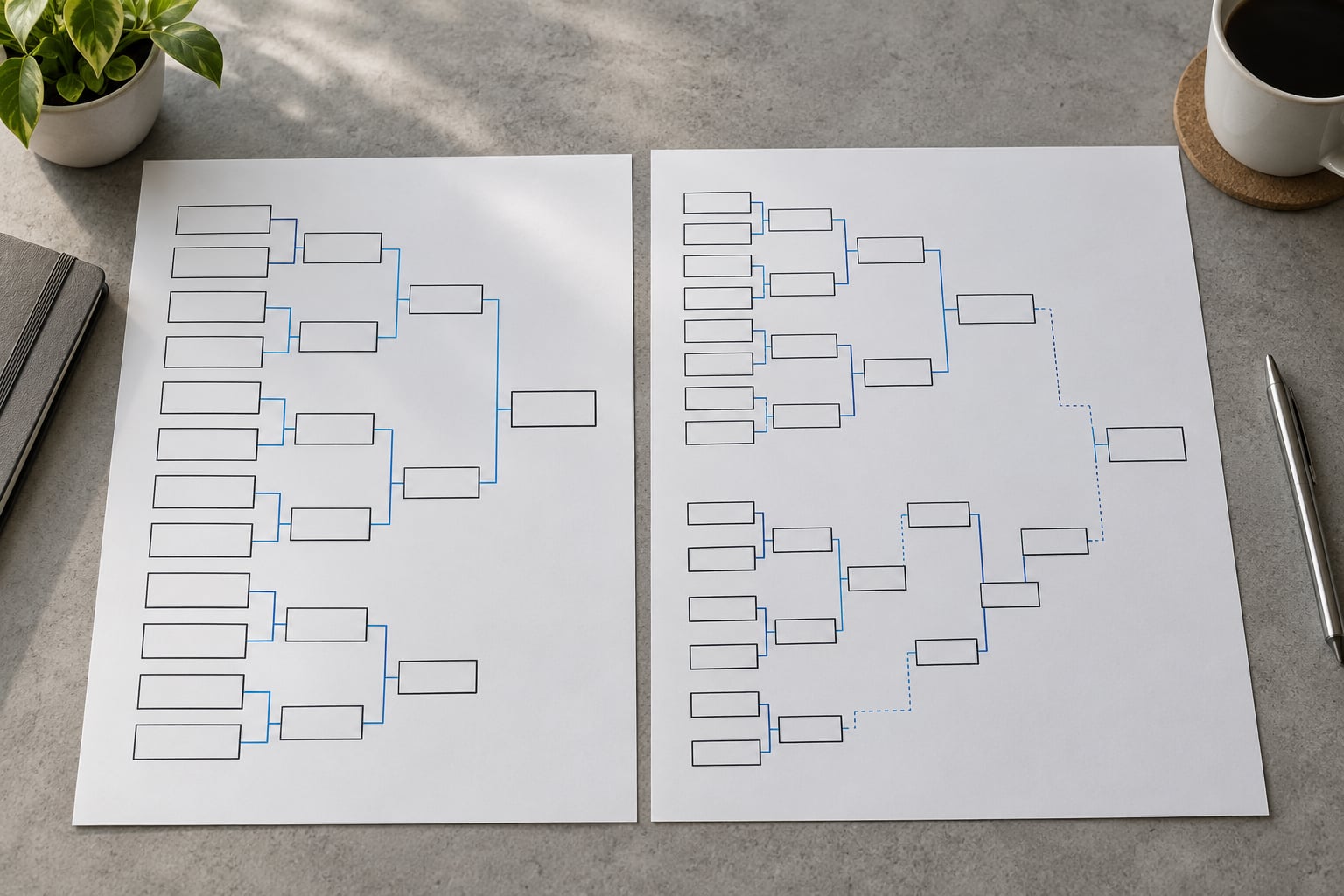
The difference between single elimination and double elimination brackets is how many losses a player can survive. Single elimination ends a run after one loss, and a double elimination bracket gives every player two lives by sending them to a losers bracket after their first defeat. That single rule changes the match count, the length of the event, the cost of running it, and who ends up lifting the trophy.
Single elimination wins on speed and simplicity. Double elimination wins on forgiveness and drama. If you run a weekly community bracket with a four-hour window, single elimination is almost always the right call. If you are staging a championship with a stream and a real prize pool, double elimination is usually worth the extra hours.
Below is the full breakdown, including match-count math, bracket reset rules, and where each format is used in competitive gaming.
Table of Contents
- Difference Between Single Elimination and Double Elimination Brackets at a Glance
- How Single Elimination Brackets Work
- Byes and non-power-of-two fields
- What the final looks like
- How Double Elimination Brackets Work
- Why the undefeated player has an advantage
- Bracket reset, spelled out
- How Many Matches Does Each Bracket Require?
- What changes those totals
- What Happens When a Player Loses?
- Which Bracket Is More Fair for Tournament Players?
- For undefeated players
- For eliminated players
- For seeds and lower-ranked competitors
- For spectators
- For organizers
- Single Elimination vs. Double Elimination: Speed, Complexity, and Cost
- Which Should You Choose?
- Casual events and local leagues
- Grassroots esports and community tournaments
- Major championships and the pro circuit
- When neither format fits
- Frequently Asked Questions
- Is double elimination always better than single elimination?
- Why does the undefeated player get a bracket advantage?
- How many games are needed for a double-elimination tournament?
- Can a player lose twice in double elimination?
- How does a double elimination bracket work?
- Conclusion
Difference Between Single Elimination and Double Elimination Brackets at a Glance
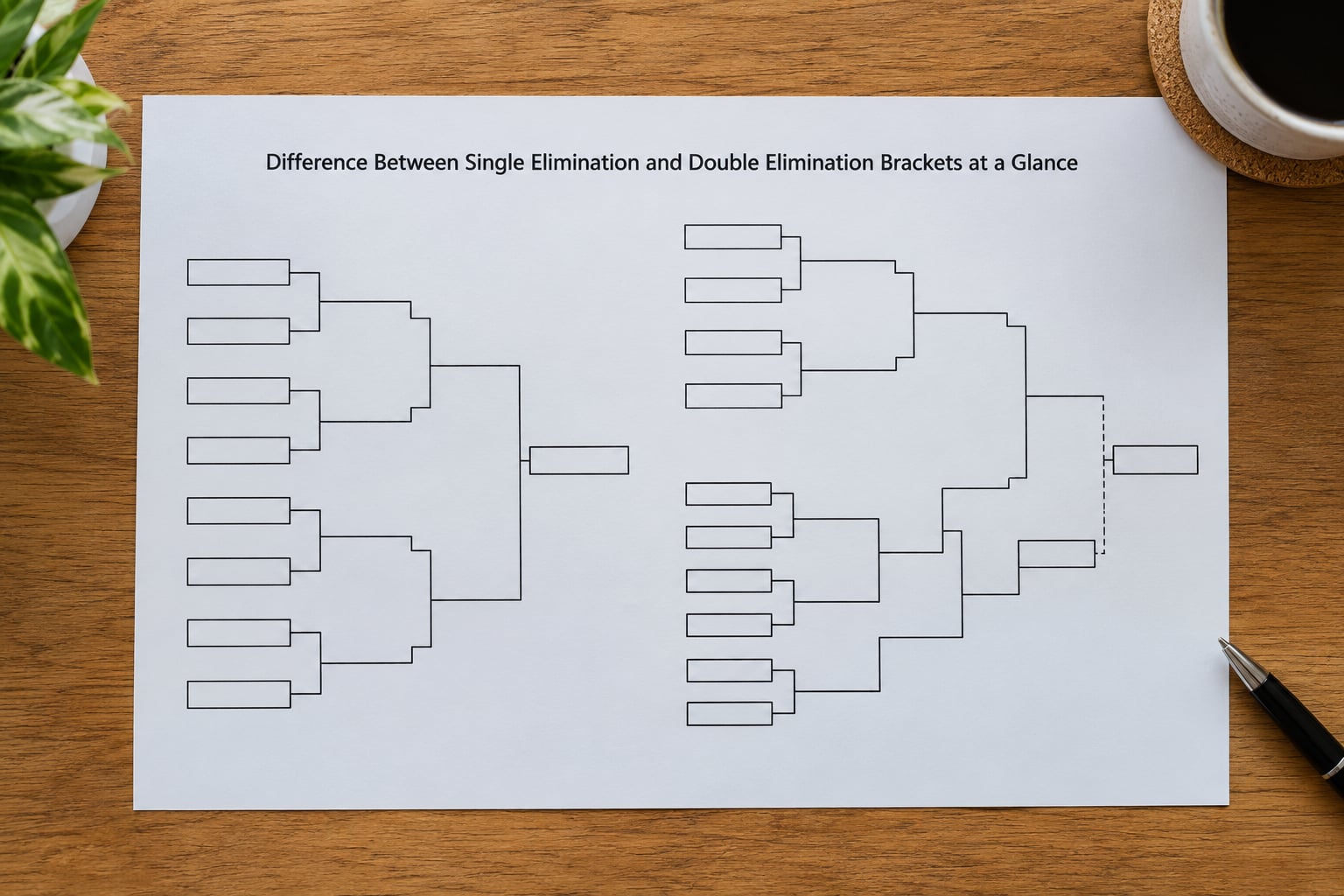
| Criterion | Single Elimination | Double Elimination |
|---|---|---|
| Elimination rule | One loss and you are out | Two losses and you are out |
| Brackets used | One | Two, plus a grand final |
| Matches for 16 entrants | 15 | 30, or 31 with a reset |
| Second chance | None | One, in the losers bracket |
| Bracket reset | Never applies | Played when the losers bracket finalist wins game one |
| Typical length | Short, often under a day | Roughly 1.5 to 2 times as many matches |
| Seed sensitivity | High, a hard first draw can end a favorite early | Lower, an early loss is recoverable |
| Scheduling complexity | One round of matches at a time | Two live brackets, or interleaved rounds |
| Upset and comeback drama | Rare, because a run lasts one match after a loss | Frequent, redemption runs are built in |
| Best for | Fast community events, tight schedules, qualifiers | Championships, majors, streamed finals |
Read that table as the short version. Everything else on this page is the reasoning behind those ten rows.
How Single Elimination Brackets Work
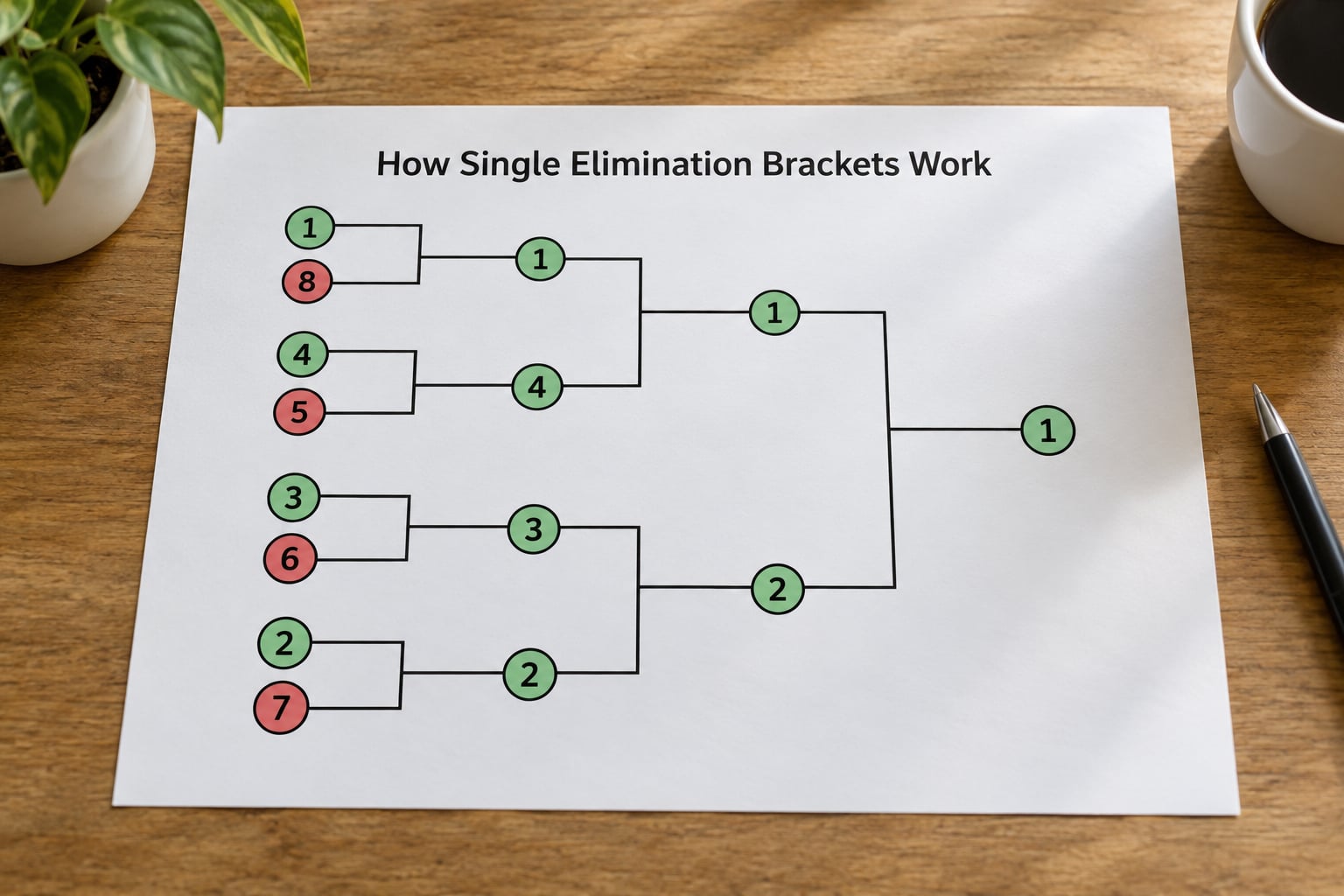
A single elimination bracket is one ladder. Every player starts at the top, winners advance, and the first loss ends the tournament for that player immediately. The last one standing wins.
The match count is the simplest math in tournament design: N minus 1. Eight players need seven matches, sixteen need fifteen, thirty-two need thirty-one. Every match eliminates exactly one player, so the number of matches always equals the number of players minus one.
Byes and non-power-of-two fields
Brackets are built in powers of two, which means eight, sixteen, thirty-two, sixty-four. If your field is not a power of two, byes fill the empty slots so the bracket still closes properly. Six players in a single elimination event means two byes and five matches.
Where the byes sit matters. Putting them against the lowest seeds gives top players a rest, while scattering them creates uneven paths. Publish the seeding method before the event starts, which is the single most common request from players in community tournament threads.
What the final looks like
The final is just another match in the ladder, with no special rules attached. A 16-player single elimination event ends after 15 matches regardless of whether those matches are best of one or best of three. That simplicity is the format’s main draw.
How Double Elimination Brackets Work
A double elimination bracket works in five steps, and the first one is where the extra life comes from.
- Everyone starts in the winners bracket, undefeated.
- A first loss sends the player down into the losers bracket rather than out of the tournament.
- A second loss eliminates them, so the losers bracket runs on elimination matches from that point on.
- The last player alive in the losers bracket meets the undefeated winners bracket champion in the grand final.
- If the losers bracket finalist wins game one, the bracket is reset, because both finalists would then carry a single loss.
That structure is often drawn as two columns, which is why you will see the terms winners bracket and upper bracket used interchangeably, and losers bracket and lower bracket used interchangeably. A flow reads like this: winners bracket, drop to losers bracket, losers bracket narrows to one finalist, grand final, optional bracket reset.
Why the undefeated player has an advantage
The undefeated finalist only needs to win once. The player coming through the losers bracket often needs to win twice, because losing the first grand final ties the score and forces a reset. An organizer can remove that edge with a rule change, and many grassroots events do exactly that: if the losers bracket champion takes game one, a reset is mandatory, but in single grand final format that champion is also seeded so they only need one win.
Bracket reset, spelled out
A bracket reset is a second grand final played immediately after the first, and it only exists in double elimination. It is not a rematch of a specific earlier match. It is the price of fairness, since a tournament that only awards the title on a unanimous run has no true champion.
One long-standing argument: in a large field, the losers bracket finalist roughly has to win one extra series, which makes their title odds about half of the undefeated player’s. A tournament in which a player can lose the first grand final and still be told they would have won the bracket outright is a different competition.
How Many Matches Does Each Bracket Require?
Single elimination always needs N minus 1 matches. Double elimination needs 2N minus 2 without a bracket reset, and 2N minus 1 with one. That is the planning rule that matters most for venue hours and staffing.
| Entrants | Single Elimination | Double Elimination | Double Elimination With Reset |
|---|---|---|---|
| 4 | 3 | 6 | 7 |
| 8 | 7 | 14 | 15 |
| 16 | 15 | 30 | 31 |
| 32 | 31 | 62 | 63 |
| 64 | 63 | 126 | 127 |
What changes those totals
Byes and uneven fields add matches rather than saving them. A 12-player double elimination field needs byes to reach 16 slots, so some players play an extra early match while others skip a round, and the real total lands somewhere between the 8-player and 16-player numbers. The same is true on the production side: a best of three match takes roughly twice the airtime of a best of one, so doubling the match count can more than double the runtime of a stream day.
For a rough estimate, double elimination runs about 1.5 to 2 times the matches of single elimination at equal field size, and considerably more in stream hours once best of three and best of five series enter the finals.
What Happens When a Player Loses?
In single elimination, a loss is the end. There is no next match, no recalculation, and no way back in. A player who traveled four hours, paid an entry fee, and studied the matchup for a week can be eliminated in twenty minutes by one bad lobby or one misread flank.
In double elimination, the same loss produces a different experience. The player drops into the losers bracket, usually with a rematch or a shortened path ahead of them, and plays on knowing the next mistake really is the last one. That difference in stakes is the entire argument players make for the format. A thread in the CompetitiveForHonor community on Reddit asks the question directly, wondering whether double elimination would be better for meritocracy than the single elimination brackets most online events run.
Here is the probability side. In an eight-player single elimination bracket, the eighth seed has one win in eight to take the title. In an eight-player double elimination bracket, every player is guaranteed at least two matches, and the last stop before the grand final decides a champion who had already lost once. Nobody takes home a title having never dropped a game, and nobody loses their only chance after a single bad map.
Which Bracket Is More Fair for Tournament Players?
Neither format is objectively fairer, because fairness means something different to each group in the bracket. An undefeated finalist would argue that double elimination gives an unfair advantage to a player working from the losers bracket. A player eliminated in round one would argue the opposite, and probably with better evidence.
For undefeated players
Double elimination is generous to them. A bad day costs a series, not the event, and no one can say they won a title without surviving a full run.
For eliminated players
Single elimination is harsh. The single-elimination argument is that a fair tournament should reward peak performance, and that hiding results behind a double elimination bracket gives inconsistent players too many ways to keep playing.
For seeds and lower-ranked competitors
Double elimination softens the impact of seeding. A top seed drawn against a specialist early in a single elimination bracket can be gone before the field narrows, which is a real complaint from players in fighting game communities, where offline bracket formats are debated constantly. The Smogon forums, which run competitive community circuits, treat double elimination as the cleanest fit once a league already runs Swiss tours, because it rewards the best record without ending a run on one bad game.
For spectators
Single elimination gives a clean, fast story with a hard ending. Double elimination gives more chances at a comeback, and the community pushback is that losers bracket matches can feel like filler to anyone who is not following the standings closely. That is a scheduling problem more than a format problem, and it is fixed by running the two brackets as one interleaved event instead of parking the losers bracket in its own time block.
For organizers
The cost debate is where most of the heat actually comes from. A thread on the AZBilliards forums argues that single elimination events are cheaper to produce, pay out less, and that players end up with similar earnings on average, which makes the single-elimination case about logistics rather than player experience. That is a fair read, and it is the one most event directors reach for first.
Single Elimination vs. Double Elimination: Speed, Complexity, and Cost
Single elimination is faster because it plays one bracket. With 16 entrants, you schedule 15 matches and everyone goes home. Double elimination schedules 30, and every losers bracket round that runs before the next winners bracket round creates dead air for players and viewers waiting on the stream.
Complexity is where double elimination costs real money. You need live bracket updates, correct loser drop slots, and a tournament director who is watching two live trees at once. Forum organizers describe the failure mode clearly: an error in the losers bracket propagates fast, and the whole event stalls while it gets fixed. Under a single elimination bracket, a mistake is usually one player re-seeded.
Reseeding and bracket resets are the two rules to write on the rules sheet before anyone plays. State whether the grand final is single or double format, state whether a bracket reset is mandatory or optional, and state how byes are distributed. Every dispute in a double elimination event traces back to one of those three lines being left vague.
On budget, the difference is roughly the difference between booking the venue for one long day and booking it for two, plus the extra staff hours and stream time a second bracket demands. Group organizers who run pickup events and local leagues usually settle on single elimination for that reason alone.
Which Should You Choose?
Choose single elimination when the schedule is tight, the venue hours are capped, the field is large, or you are running qualifiers. Choose double elimination when the event is a championship, the prize pool matters, the field is 16 players or fewer, and the audience is watching.
Casual events and local leagues
Single elimination. A Tuesday night league with eight players and a two-hour window has no room for a 14-match structure, and nobody is upset about it.
Grassroots esports and community tournaments
Either works, and the deciding factor is scheduling. If you have one stream and one moderator, single elimination keeps the show moving. If you have a dedicated bracket operator, double elimination rewards the players who show up.
Major championships and the pro circuit
Double elimination is the standard in the big competitive scenes, from Dota 2 and Counter-Strike majors to the fighting game circuits, precisely because those events have stream hours to spend and players who have traveled to compete. Grand finals there are frequently best of five, which is the real reason a championship wants the extra structure: a long series demands a format where one bad map does not end the story.
When neither format fits
Round robin and Swiss exist for specific problems. Round robin guarantees every entrant a fixed number of matches, which suits a small field with a fixed venue window. Swiss pairs players with similar records and cuts the field gradually, which suits large fields where a full bracket wastes venue time. Neither eliminates anyone on their first loss, so pick them when the complaint is about variance, not about length.
Whichever you pick, publish the format, the seeding method, and the grand final rules before the first match. Half of tournament arguments are settled by whether people knew the rules in advance.
Frequently Asked Questions
Is double elimination always better than single elimination?
No. Double elimination gives players a second chance and usually creates more matches, while single elimination is faster, simpler, and easier to schedule. Double elimination suits a championship with venue hours to spare; single elimination suits a league with a hard time limit. Pick based on your schedule and prize structure, not on the idea that one format is more professional.
Why does the undefeated player get a bracket advantage?
In a standard double elimination bracket, the undefeated player only needs to win once in the grand final, while the player from the losers bracket may need to win twice. That structure rewards consistency and is why some organizers change the seeding so the losers bracket champion also only needs one win in a single grand final.
How many games are needed for a double-elimination tournament?
The number depends on the participant count, byes, and whether a grand-final reset is allowed. For a standard 8-player double-elimination bracket without a reset, there are usually 14 matches; a 16-player field needs 30, and 31 if a reset is played. Single elimination uses the simpler N minus 1 rule.
Can a player lose twice in double elimination?
Yes. A player who loses in the winners bracket drops into the losers bracket but remains alive. After another loss, that player is eliminated. This is why double elimination generally takes longer than single elimination, and why every match in the losers bracket carries genuine stakes.
How does a double elimination bracket work?
Everyone starts in the winners bracket. A first loss drops a player into the losers bracket, and a second loss ends their run. The last player standing in the losers bracket then faces the undefeated winners bracket champion in the grand final. If the losers bracket finalist wins that first match, a bracket reset is played so both players have one loss.
Conclusion
The decision comes down to one question: can your event afford roughly twice the matches? If yes, run double elimination and let players have two lives. If no, run single elimination and be honest that one bad day ends a run.
Whichever you pick, publish the seeding method and the grand final rules before the first match. That single step prevents more arguments than the format choice ever will.