VOD review works when you treat it like debugging, not like watching a highlight reel. Pick one close match, jump to every death, rewind ten seconds before each one, write down what you did in three or four words, and carry the tag that repeats most often into your next few games as a single focus rule. Twenty focused minutes twice a week beats three hours on a Sunday, and the whole setup is free.
I want to be straight about the failure mode here, because almost everyone hits it. You play four games, lose two, feel awful, and never press rewind. Then a month later you sit down intending to watch everything, get bored in round two, and learn nothing. Learning how to use VOD review to improve faster is mostly about avoiding that gap between capturing the footage and actually looking at it.
Below is the loop I come back to. It works for shooters, MOBAs, battle royales and fighting games because the structure is game-agnostic even though the tags are not.
Table of Contents
- What You Need to Run a VOD Review
- A way to capture the round, not the whole session
- Somewhere to write four-word tags
- A stopwatch
- Step-by-Step: How to Use VOD Review to Improve Faster
- Step 1: Record Clips That Reveal Your Decision-Making
- Step 2: Watch for Patterns Instead of Judging One Moment
- Step 3: Write One Fix for Each Repeated Problem
- Step 4: Turn the Review Into a Focused Practice Drill
- Step 5: Replay the Same Situation Under Pressure
- Step 6: Compare Results and Keep the Review Loop Short
- Common Mistakes That Stall Your VOD Review
- Frequently Asked Questions
- How often should I review my own gameplay?
- How long should a VOD review take?
- Should I review wins as well as losses?
- Should I watch the whole game or only my deaths?
- What if I cannot spot my own mistakes?
- How do I know if my VOD review is working?
What You Need to Run a VOD Review
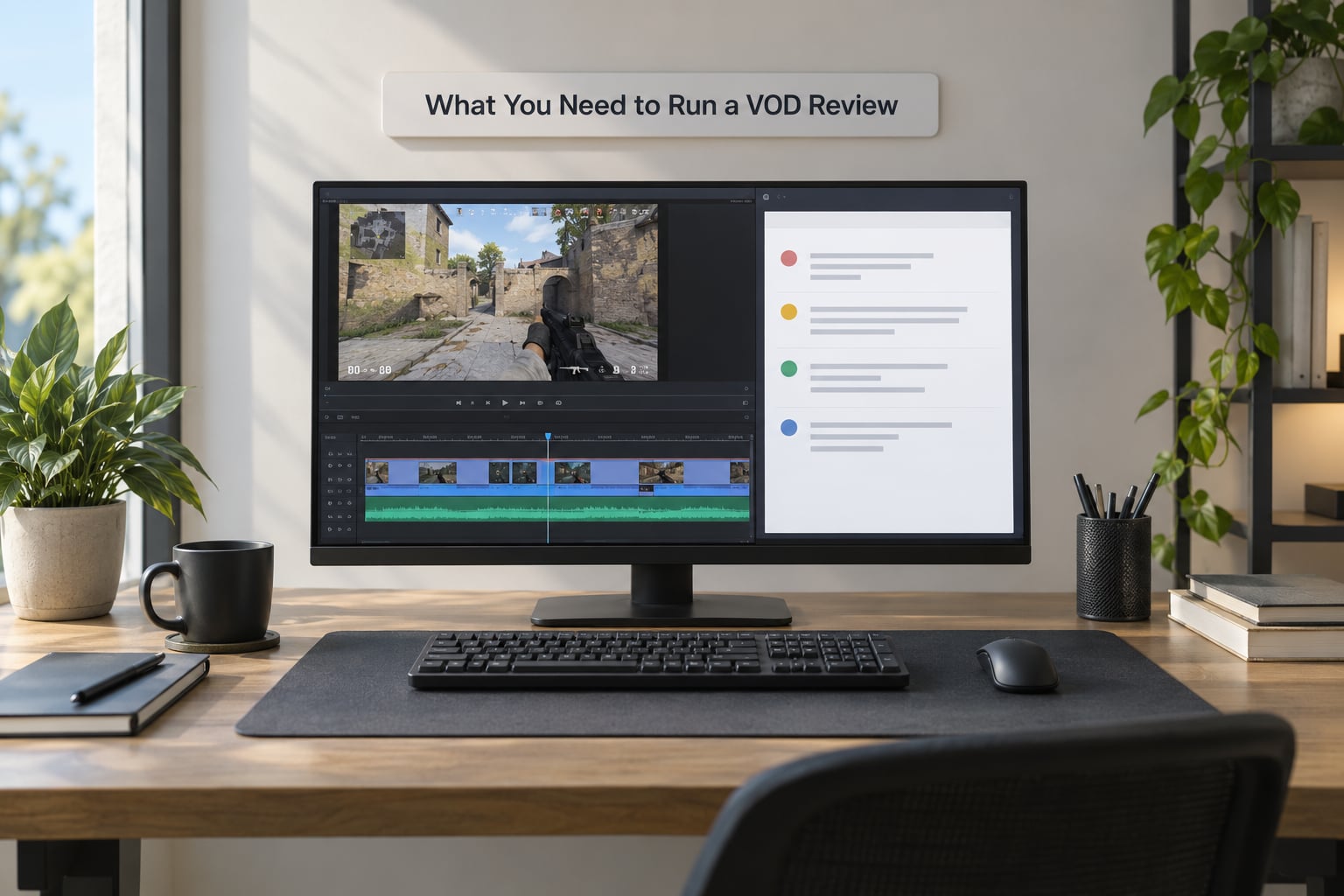
Three things, and none of them cost money. Most players already own all three and just never connect them.
A way to capture the round, not the whole session
You need the ability to retrieve an individual round, an individual life, or an individual fight. Valorant and Counter-Strike save replays with a full timeline you can scrub. Overwatch 2 and League of Legends save replays that load in a browser. Fortnite and Apex Legends record via OBS if you want full control.
Whatever your game, save the interesting bit. A forty-five second clip of the fight where you lost is far more useful than a forty-minute recording of queue, two wins and a loss. The cutting is the step people skip, and skipping it is why a two-hour review session produces nothing.
Somewhere to write four-word tags
A phone note, a text file, a Discord channel, a notebook. That is the whole requirement. The reason the note has to be short is that you will read it in the ten seconds before your next queue, and a paragraph will not survive that.
Compare two tags. “I need to be more careful” tells you nothing on a Tuesday night. “Pushed with no vision” tells you what to do differently. One is a feeling, the other is an instruction. Staying at that concrete level is usually the thing that unblocks your own analysis, and it costs nothing to do.
A stopwatch
Time-box the review at twenty minutes. Set a timer. The goal is not to finish the match; the goal is to leave with one focus rule. Reviewing past twenty minutes is where self-analysis turns into entertainment, and entertainment does not raise a rank. As of 2026 this is still the least glamorous and most effective part of the whole method.
Step-by-Step: How to Use VOD Review to Improve Faster
Step 1: Record Clips That Reveal Your Decision-Making
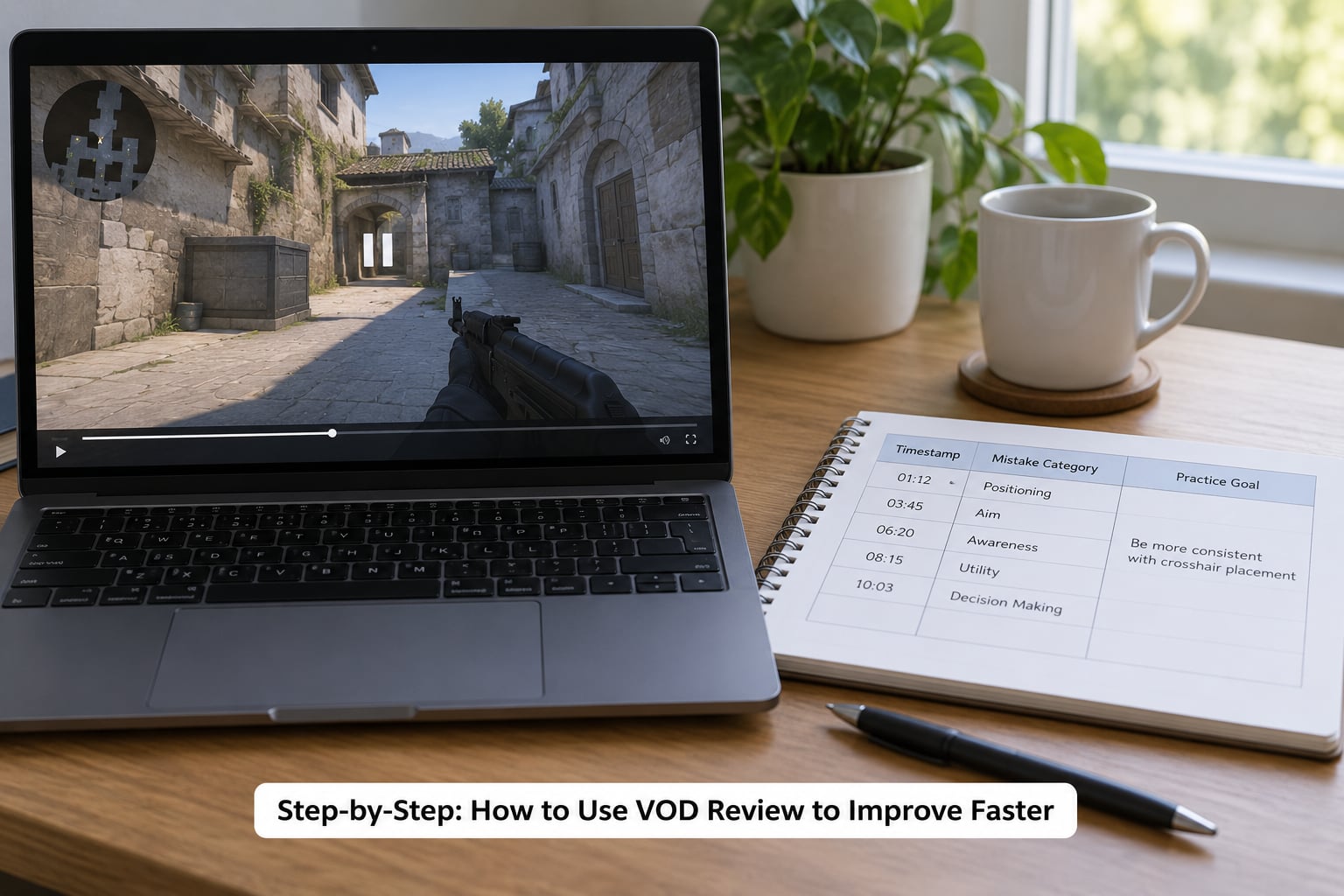
Capture positioning, rotations, aim and resource decisions, and always save the seconds before a mistake rather than the moment of it. The death is the symptom; the decision that caused it usually happened ten to fifteen seconds earlier. If you only save the highlight, you will only ever review the outcome.
Start with close games, not blowouts. A 51-49 loss is full of decisions you can actually study. A 2-15 stomp mostly teaches you that matchmaking placed you badly.
Step 2: Watch for Patterns Instead of Judging One Moment
Review several rounds in a row, marking every mistake you find, and resist reacting to a single death. One isolated death means almost nothing. The same tag appearing three or more times in one review is a pattern, and patterns are what you can fix.
Separate execution problems from strategic problems as you go. Did you lose because your hands were slow, or because you were standing somewhere you had no business standing? Fixing the second one is worth far more, and VOD review is uniquely good at exposing the second one because you can see the whole map while playing it.
Step 3: Write One Fix for Each Repeated Problem
Turn every vague observation into an action with three parts: a trigger, a replacement behavior, and a measurable result for the next session. Trigger, because you need to recognise the situation in the moment. Replacement, because knowing what went wrong is not the same as knowing what to do. Result, because “play better” is not a target and “three deaths under 30 seconds remaining” is.
A good one sounds like this: “When I hear the enemy rotate call, stop pushing and fall back to the ridge. Target: zero deaths in the first eight minutes of two of the next three games.” Vague enough to be useless tags are the reason VOD review often feels pointless.
Step 4: Turn the Review Into a Focused Practice Drill
Each tag should map to something you can rehearse in ten to twenty minutes, and most of them already have an obvious drill. Positioning tags turn into deathmatch or training-range work where you only shoot after holding an angle for a set number of seconds. Map awareness tags turn into a minimap drill: play a round, then try to reconstruct where every enemy was at the end.
For decision speed, set a timer on decision points and pause before you commit. Aiming tags belong in an aim trainer, not in a VOD, and mixing them into a film session is the most common way players convince themselves they are improving. In League, resource and objective tags look like tracking enemy cooldown timers on a second monitor. In a fighting game, a VOD tag almost always means a spacing habit, and the drill is the same matchup on training mode until the habit is automatic.
Step 5: Replay the Same Situation Under Pressure
Now test the correction in real rounds, in actual ranked games, with the same information you had at the time. The point is to make the new rule survive pressure, not to feel good in practice range.
Do not change goals after one bad attempt. If you set a focus rule and the first game goes poorly, that is the data telling you the rule needs more reps, not that the rule was wrong. Swapping focus rules every game is why some players review constantly and never move.
Step 6: Compare Results and Keep the Review Loop Short
Pull the same clips from the next batch and compare them side by side. Track a handful of numbers and nothing else: deaths in the first five minutes, gold or item lead at ten minutes, damage taken per round, first blood deaths. Three or four numbers, logged for ten games, tell you more than a full-page breakdown of one game.
Then chain the sessions instead of batching them. Play a game, review it briefly, play the next, review that. That cadence matches how deliberate practice is normally structured: short, focused, repeated, with one goal.
Common Mistakes That Stall Your VOD Review
Watching too much footage. The fix is a hard cap of twenty minutes and a set number of clips, usually three to five. You are looking for repeats, not coverage. Most of the “I reviewed my VODs and nothing changed” complaints come down to the same thing: someone trying to watch a full forty-minute match at double speed.
Reviewing without a question. A pass with no question becomes a highlight reel and teaches you nothing. Before you press play, write the question at the top of the note: “where do my first two deaths come from?” Now the footage has a job.
Watching only kills. Kills are the least informative part of a match for most players. Losses, deaths and rotations contain the decisions. If your review is mostly highlight hunting, you are entertainment, not practice.
Changing six habits at once. Fix one focus rule per review block. Players who try to correct positioning, aim, economy and communication in the same week reliably play worse than before, then blame the method. The advice repeats across competitive communities: one goal per review pass, and review the same map several times with a different goal each pass.
Reviewing mid-tilt. The worst possible moment to watch your own footage is twenty minutes after a loss, while angry. You will blame-scan the footage, find teammate faults that are easier to forgive, and reinforce the exact emotional state that is hurting you. Eat something, queue a low-stakes game, review when you are calm.
Skipping review entirely because the loss stings. This is the barrier that stops most people, and the practical fix is to review a win instead. A 13-11 win is still full of decisions, and reviewing it costs you nothing emotionally. It also shows you what to repeat, which loss reviews never do.
Frequently Asked Questions
How often should I review my own gameplay?
Two or three short sessions a week is enough for most ranked players. The cadence that works best is chained to play: review one match briefly, queue again, review the next. A single long weekly session feels productive but the insights fade before your next match, so the time gap between review and practice is what actually matters.
How long should a VOD review take?
Twenty focused minutes is the working number. A useful review covers three to five clips, a ten-second rewind before each mistake, a four-word tag per mistake, and one focus rule at the end. If you are still watching after twenty minutes, you have moved past analysis into avoidance, and the clips you have already saved are enough for the week.
Should I review wins as well as losses?
Yes, and beginners especially should. A loss is easy to watch but emotionally expensive, so many players never start. A win gives you the same decision data with no sting attached, and it shows you which habits to repeat rather than only which to remove. Reviewing a win is also the easiest way to build the habit before you are ready to face losses.
Should I watch the whole game or only my deaths?
Neither extreme works. Start at each death or lost round, then rewind ten seconds before it, because the mistake almost always happens before the moment you are reviewing. Watching the entire match catches positioning and rotation problems you would otherwise miss, so alternate: deaths first, then one full pass at double speed for the macro layer.
What if I cannot spot my own mistakes?
That is the normal starting point, and there is a fallback. Compare the round you lost with a round you won, and ask what the other version of you did differently in the ten seconds before the fight. If that is too hard, send the clip to a friend or a coach with one specific question attached, which gets a far better answer than an open request to watch your games.
How do I know if my VOD review is working?
Track three or four numbers across ten games rather than judging a single session. Deaths in the first five minutes, damage taken per round, or first blood deaths are all easy to log and hard to fake. If your focus rule keeps reappearing as a tag after two weeks of reps, the review is working and the rule just needs more time, not a replacement.
Do this next session: after your next match, save three clips from the ten seconds before each death, write one four-word tag per clip, and pick the one that repeated. That is the entire method, and it takes twenty minutes. The gap between watching pros and improving faster is not talent or hours, it is having a written rule you actually rehearse.