Creator burnout is the physical, emotional and mental exhaustion that comes from producing content on your audience’s schedule instead of your own. It shows up as dread before you record, ideas going flat, cynicism about work you used to like, and a permanent feeling of being behind. The World Health Organization classifies occupational burnout as a work-related condition, and the recovery path is mostly structural rather than motivational.
That last part is the useful bit. Most advice for burning out creators is a poster about rest. What actually works, in my experience reading through creator communities, is a system: stop the bleeding, shrink the workload, and rebuild a routine small enough that you can keep it on your worst week, not your best one.
If you want the short version while you read, here is what helps most this week:
- Stop posting anything that isn’t already scheduled or finished.
- Tell your platform, not just yourself, that you are away. Mute the analytics tab.
- Pick one format you can repeat on autopilot and drop everything else for a month.
- Fix sleep first. It changes more than any editing software.
- Tell one person outside your channel how you are actually doing.
One note before we start. If you are struggling with something that is bigger than work — your own mood, a crash, hopelessness that follows you off the screen — this guide is not a substitute for a clinician. A licensed therapist or doctor is the right call, and asking for one is not failure. More on that below.
Table of Contents
- What You Need
- Step-by-Step: How to Deal With Burnout as a Content Creator
- Step 1: The first 72 hours
- Step 2: Take a real content siesta
- Step 3: Fix the physical basics before anything creative
- Step 4: Rebuild a format library, not a content plan
- Step 5: Reset your relationship with metrics
- Step 6: Come back at a fraction of your old output
- Burnout, creative block, depression, or just a bad week
- When burnout is more than burnout
- Common Mistakes
- Frequently Asked Questions
- What is the 42% rule for burnout?
- What are the 7 signs of burnout?
- How to get over creative burnout?
- How long does creator burnout recovery take?
- Should I quit being a content creator?
- Is content creation still worth it?
- Conclusion
What You Need

Recovery goes wrong when you treat it like willpower. What you actually need first is much duller: a few things set up before you try to do anything.
An honest baseline. Write down the last two weeks as they were. Hours worked, posts shipped, nights of bad sleep, how often you checked stats. Not the version you would defend in a comment, the real one. A creator who thinks they are a little burned out is usually badly burned out, because the channel has trained them to describe their workload as normal.
One place with no connection. Not a holiday where you still “keep an eye on things.” A few days where the upload does not happen, the notifications are off, and nobody can reach you. Creators who break the cycle describe going fully offline as the thing that actually shifted something, ideally somewhere with poor wifi.
One honest person who is not your audience. A friend, a partner, a sibling, a peer creator. Comments and DMs are not support. Support is someone who will ask how you slept and actually want the answer.
A smaller version of your workflow. Before recovery, work out which parts of your process you would be happy to do with two hours a week. Format list, tools, and any recurring pieces you can reuse. If your entire system needs eight hours per post, the system is the problem.
The self-audit. Twelve questions, scored honestly, tell you where you sit. If you answer yes to six or more, treat the recovery steps that follow as the plan rather than one option among many.
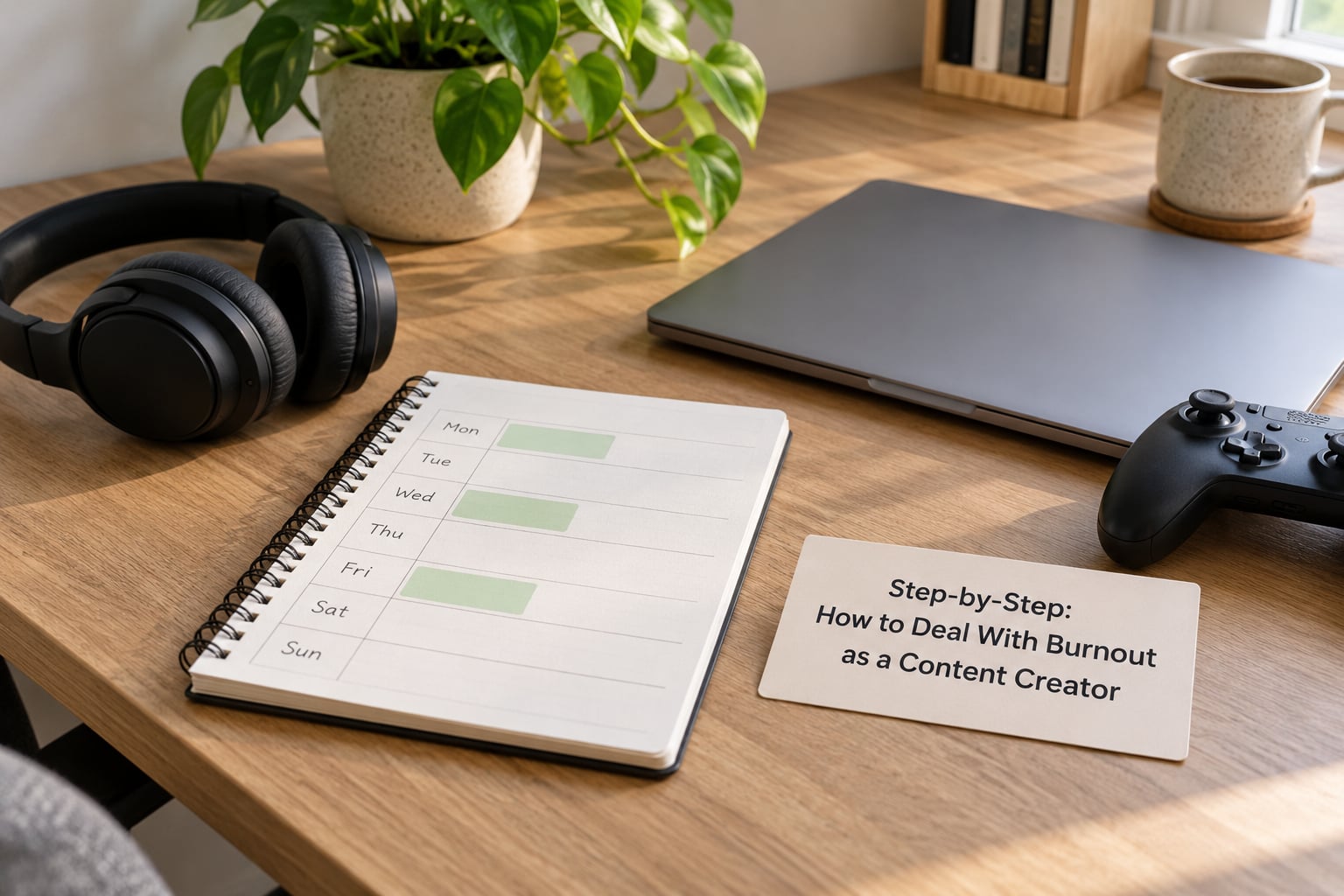
Step-by-Step: How to Deal With Burnout as a Content Creator
Step 1: The first 72 hours
Stop the compulsion, not the work. Set a hard end date and a hard stop: today you finish anything already half-made, schedule anything that must go out, and then you are done. After that, remove the analytics apps from your home screen and turn off comment notifications.
Creators on r/contentcreation describe the compulsive refresh loop as the thing that keeps the stress alive — you never actually finish a day, you just keep checking. Removing the app is cruder and works better than willpower.
Then write the message you will post. Something short and factual beats a long emotional explanation. A creator whose Instagram burnout was widely discussed put it plainly: “Taking three weeks off. Back with a smaller schedule and better videos.” Most audiences barely notice; the ones who notice respect it.
How you will know it worked: three days pass and you did not check a single metric.
Step 2: Take a real content siesta
Not a weekend. Two to four weeks, scheduled in advance so there is no decision to make later. One widely-repeated pattern is three months creating, one month recharging — treat that as a model, not a quota.
The fear of losing subscribers is the thing that stops most people taking the break, and the people who did it report the fear was worse than the outcome. Audiences largely stayed, and some came back warmer because you were not frantic in their comments.
How you will know it worked: you stop bracing for the drop. Silence from the numbers is not a verdict on your worth, and the first two weeks of reduced reach are normal.
Step 3: Fix the physical basics before anything creative
Sleep, food, daylight, and movement. This sounds like filler advice, but creators are frequently running on five hours and fluorescent light, and no amount of workflow redesign survives that.
One creator writing about her own recovery described something concrete: after several weeks off, she no longer woke up early. The compulsion itself had faded, not just the symptom. That is the kind of change you are aiming for — the alarm stops being the boss.
Pick a defensible bedtime and put the phone on Do Not Disturb before it. Keep gaming, reading, or whatever you do for fun outside the hours you create in. How you will know it worked: you stop dreading the morning.
Step 4: Rebuild a format library, not a content plan
This is where the structural advice beats the inspirational advice. The creators who recovered in communities said the same three things worked: simple repeatable formats, batching a handful of ideas once a week, and posting without obsessing over immediate engagement.
So build a list of four to six formats you can repeat without thinking. A weekly series. A question you answer every time. A reaction roundup. A short explainer with the same structure every episode. When the decision is already made, starting becomes the only hard part left.
Three situations need their own version of this:
- Creators with a day job. Pick two fixed hours a week and defend them like a meeting you cannot move. Everything else fits around them. Multi-load burnout is rarely about the channel; it is about a third of your life having no protected space in it.
- Monetized creators with brand deals. Income tied to engagement is what makes rest feel impossible. Tell sponsors before you go quiet, not after. If a deal requires you to be online during a period you have declared offline, that is a term you can decline or renegotiate, and it is worth asking which brands you actually want to work with again.
- Gamers and streamers. Nobody in this space writes about it, and it is the sharpest version of the problem. A long stream day has no natural end, and the audience is in the room, so the “off clock” feeling is gone entirely. Stream days need a hard stop decided before you go live, and a cooldown block after. If you are running a co-stream or a competitive grind schedule, treat that like a shift rota, because it is one.
How you will know it worked: you can describe your next month in one sentence.
Step 5: Reset your relationship with metrics
Decide in advance which two numbers you are allowed to look at, and when. Once a week, on a fixed day, with a five-minute timer. Everything else goes away. Comments can be read once a day, in one sitting.
This is the step people skip and the one that keeps burnout running, because a metric checked at midnight is not data, it is a mood. A creator in r/PartneredYoutube put the scale of it plainly: two years in and barely able to muster the energy to write a sentence of script. That is not a motivation problem. It is a load problem with a self-measurement loop built on top.
How you will know it worked: a bad number is mildly annoying instead of ruinous.
Step 6: Come back at a fraction of your old output
Start at roughly a third of your previous output for the first month. People who broke the cycle describe moving from daily posting to lower-frequency, higher-quality work — quantity down, quality up.
Pick one recurring slot and hold it. Repurpose rather than create: one long piece becomes a short, a short becomes three stills. A first month back is for rebuilding rhythm, not for chasing the numbers you had before.
Set milestones in advance so you can tell whether you are improving. Recovery is not a straight line, and one bad week is not a relapse. Useful markers: you stop dreading the upload, you can start a session without a fight, and you can take a day off without anxiety. A creator in r/Productivitycafe put the honest version: whether people actually know when they are getting better or whether we are all guessing. Milestones are how you stop guessing.
Burnout, creative block, depression, or just a bad week
These get confused constantly, and the difference matters because only one of them needs a professional.
| What it is | Typical duration | Does time off help | When to get help |
|---|---|---|---|
| Ordinary tiredness | A few days | Yes, almost immediately | No |
| Creative block | Days to a couple of weeks | Yes — you want to make things, you just cannot start | No |
| Creator burnout | Weeks to months, building slowly | Partly — you need structural change, not just rest | If sleep and structure are not shifting it |
| Depression | Two weeks or longer, affecting life outside work | Not on its own | Yes — this is a clinical matter |
When burnout is more than burnout
Burnout is defined by its tie to work. If the low mood, the numbness, or the hopelessness shows up on days you are not creating, that is a different conversation, and it belongs with a doctor or therapist. So does anything involving your sleep, your appetite, or your ability to function, and any thought that you would be better off not existing. Those are not character flaws and they are not a content problem.
Lower-barrier options exist: many therapists offer sliding-scale sessions, and a doctor can rule out physical causes of exhaustion first. Creator communities such as r/contentcreation, r/ContentCreators and r/VirtualYoutubers are useful for the practical mechanics, and a poor substitute for care.
Common Mistakes
Waiting for motivation to return. Motivation is a consequence of a workable schedule, not a precondition. Nobody feels like starting a task they have been dreading for four months.
Overproducing during recovery. Coming back at full volume feels like proving you are fine, and it puts you straight back where you started. A third of your old output for a month is the whole point.
Treating every comment and metric as a verdict. A rough week is data, not a judgement. The loop of checking, reacting, adjusting, checking again is the burnout engine — cut it and the engine stops.
Working through the break. Posting from the holiday, editing on the aeroplane, “just keeping an eye on things.” Half a break is not a break. Disconnect properly or do not bother.
Identity lock-in. If the channel is the only thing that makes you feel like you matter, quitting feels like admitting wasted years. The years were not wasted because you stopped, and nothing about resting requires a farewell speech.
Vague rest. A week of “taking it easy” while still refreshing stats is not recovery. Say what you are doing: no posting, no checking, no streaming, and a specific return date.
One more worth naming, because it comes up constantly: producing content you do not care about because a trend is moving. Chasing trends is the fastest route to a channel full of videos you would rather not sign your name to.
Frequently Asked Questions
What is the 42% rule for burnout?
It is a rule of thumb, not a clinical test. The idea is that once roughly 42% of your waking life has become work, burnout risk climbs steeply, and the threshold is well below most creators notice. Treat it as a prompt to count your hours honestly over two weeks, not as a diagnosis. If the number is uncomfortable, that is usually the signal you were looking for.
What are the 7 signs of burnout?
1. Dread before you start, even on ideas you like. 2. Chronic fatigue that sleep does not fix. 3. Ideas going flat or feeling forced. 4. Cynicism about your content and your audience. 5. Compulsive checking of analytics and comments. 6. Sleep and schedule slipping, week after week. 7. Feeling that the effort is pointless, or that you are always behind.
How to get over creative burnout?
Stop posting, take two to four weeks fully offline from the channel, and fix sleep before you touch the workflow. Then rebuild a library of four to six repeatable formats, batch a handful of ideas once a week, and limit analytics to one fixed five-minute session. Return at about a third of your old output for a month. Structure does the work; motivation rarely does.
How long does creator burnout recovery take?
Most people describe two to four weeks of real time off to get the compulsion to fade, then a month of light work to rebuild rhythm. A month away once a quarter is a common pattern among creators who stay in the game. If several weeks off with genuine rest changes nothing and the low mood is following you into non-work days, speak to a doctor or therapist.
Should I quit being a content creator?
Quitting is a legitimate option, not a failure, and a short break is a reasonable middle path. Decide with a head rather than during a bad week: check whether the burnout comes from the format, the platform, the income pressure, or the medium itself. If a smaller weekly schedule fixes it, the problem was the load. If nothing fixes it, stopping is a reasonable answer.
Is content creation still worth it?
It depends entirely on whether the version you are running is sustainable. Attention is more crowded than ever, short-form is saturated, and sponsor expectations have not softened, so the old daily-posting playbook is harder than it used to be. Lower-frequency, higher-quality work with clear boundaries is a different and more durable model. If you are asking this question while exhausted, wait until you have recovered before deciding.
Conclusion
Do one thing today: finish or schedule whatever is half-made, write the “stepping back” post, and set a return date. Then let the metrics go quiet for two to four weeks. The goal for the first month back is not the same output you used to force — it is a schedule you would still keep during your worst week. If the low mood is showing up on days you are not creating, book the appointment.