Most players lose team fights the same way: they are standing in the wrong spot, hitting three different enemies at once, and reacting to a plan nobody agreed on. That is fixable, and the fix is a repeatable loop rather than more practice hours. This guide walks through seven steps you can run in any MOBA — League of Legends, Dota 2, Mobile Legends, Heroes of the Storm, Deadlock — plus a review routine that turns each loss into one correction instead of a general feeling of being bad at fighting.
A fair warning: this is not a champion guide. Nothing here depends on a specific hero, patch or item. The rules are structural, which is why they transfer between games that look nothing alike. Budget about two weeks of focused play to feel a change, and expect it to feel awkward before it feels better.
Table of Contents
- What You Need
- Step-by-Step: How to Improve Team Fighting in MOBA Games
- Step 1: Know the fight before it starts
- Step 2: Establish a reachable position
- Step 3: Choose targets by priority and threat
- Step 4: Use abilities as a sequence
- Step 5: Communicate only what changes the decision
- Step 6: Read the fight and adapt
- Step 7: Review one fight and run a targeted drill
- Reviewing a Team Fight on a Replay Timeline
- Common Mistakes
- Frequently Asked Questions
- How do I improve team fighting if my teammates do not coordinate?
- Should a carry chase a low-health enemy during every team fight?
- Which team-fight skills should supports practice first?
- How can I use pings without cluttering team communication?
- How do I tell whether I lost a fight because of positioning or target selection?
- Conclusion
What You Need
Before any of the seven steps works, you need five things in place, and most players are missing two of them.
- Role clarity. You should be able to name your job in a fight in four words or fewer — initiate, hold front, dive backline, or peel. If you cannot, you will drift into fights instead of shaping them.
- Basic map awareness. You need to know where every teammate and most enemies are before a fight starts, not during it. Fog of war hides information you needed ten seconds ago.
- Working communication. Voice chat if your team uses it, pings if it does not. What matters is that you have a channel at all.
- Objective and cooldown state. Which major objective is up, when it spawns, and roughly which enemy abilities are still on cooldown.
- A repeatable review routine. A replay tool that lets you watch your own fights frame by frame. Playing more is not a substitute.
The fifth item is where real improvement happens. Knowing the theory and executing it under pressure are different skills, and only review closes the gap between them. Players posting in r/summonerschool and r/DotA2 say the same thing repeatedly: reading guides tells you what good looks like, but watching your own losses is what changes your hands.
That is the short version of how to improve team fighting in MOBA games. The seven steps below turn that list into something you can run mid-match.
Step-by-Step: How to Improve Team Fighting in MOBA Games
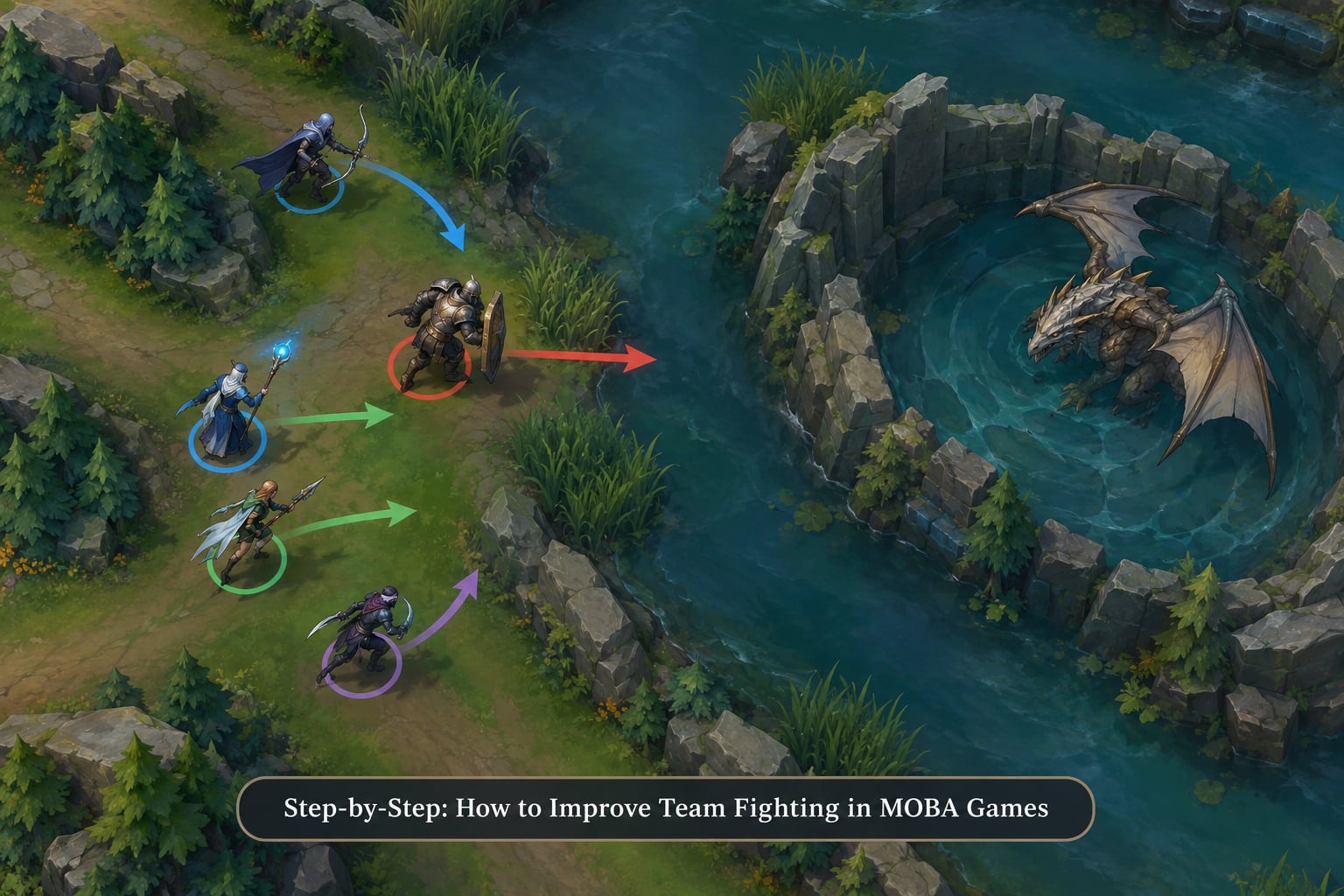
The loop below runs before, during and after a fight, and each step has a visible sign that it worked. Watch for the sign, not the kill count — a fight can end in a win while every step failed.
Step 1: Know the fight before it starts
Most fights are decided before anyone swings, and the decision is usually just: engage, wait, or disengage. Make that call deliberately.
- Gather the missing teammates, or accept you are not doing this fight as five.
- Name the objective at stake and its timer.
- Count visible enemies and guess where the rest are.
- Check your own cooldowns, ultimates and summoner spells against theirs.
- Decide: engage now, hold for a better angle, or trade the objective and reset.
The concrete case: four of you are a member down, the enemy frontline is already in position, and their engage ultimate is up. The correct call is to hold the choke and let them come onto your side, because a fight you force is a fight you have already lost half of. Saying “no, not yet” out loud is a skill most players never practise.
Step 2: Establish a reachable position
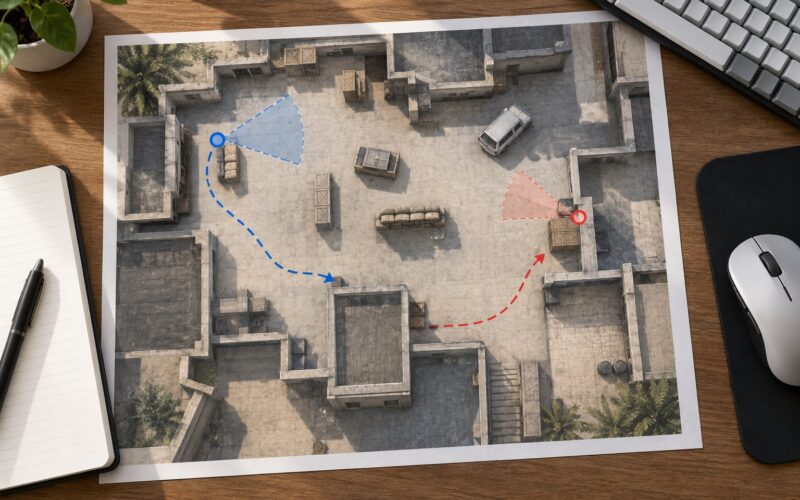
Positioning wins fights before damage happens. Your job is to stand where you can contribute and still leave, not where the most damage would look impressive.
- Frontline holds the space between the teams and absorbs the first commitment.
- Backline sits at maximum range from the enemy frontline, far enough that a single diver cannot reach you.
- Flankers take a side route and arrive late but lethal, or arrive early and zone.
- Supports stand between their carry and the threat, not next to their carry.
Two rules cover most positioning mistakes. First, tether yourself to your own frontline — if it is not moving, you are probably too far forward. Second, never enter a choke you cannot leave; the same corridor that slows a fleeing enemy slows you too. If you cannot name your exit route, you do not have a position, you have a hope.
Spacing is the version of this for carries: keep just enough distance that a single burst spell does not end your participation, while staying close enough that your damage lands before the fight is decided.
Step 3: Choose targets by priority and threat
Hit what is in range first, then let threat decide between two options. The instinct to attack the “best” target rather than the available one is the single most common way strong players throw fights.
- Anything that can kill someone this second, starting with your own carry.
- Whatever is closest and safe to hit — usually the enemy frontline.
- Exposed backline damage dealers as soon as your range covers them.
- Supports last, unless they are the ones peeling your carry.
Confirm the target once. A single ping or one word — “marksman”, “tank”, “on you” — stops five players from splitting damage across five enemies, which is how fights drag on until the enemy composition with better scaling wins them. Players on r/heroesofthestorm make the same argument from a different angle: do not stare at the tank holding your team while you walk into their backline alone.
When two targets are equally reachable, use threat. Whoever heals, shields, stuns or resets is more dangerous than whoever has more health bars.
Step 4: Use abilities as a sequence
Abilities land when they overlap, not when each player presses theirs. The initiator opens the window, damage follows inside it, supports extend it. Pressing everything at once is how fights get traded badly.
Consider a three-person engage: the frontliner commits with their control tool, the second player throws damage immediately after it lands rather than alongside it, and the backline follows a beat later so it arrives with the enemy still recovering. That sequence turns three unrelated casts into one burst the enemy cannot answer. In games with chained crowd control, the whole chain is worth saving for one confirmed go — an unused combo piece is just lost damage.
Keep one thing back deliberately. Almost every team fight is decided by whoever has a cooldown ready in the last four seconds, so track yours and treat it as a resource.
Step 5: Communicate only what changes the decision
Say things that alter what someone else does. Everything else is noise, and noise is the reason muted teams lose fights.
- Target call — one name before the damage starts.
- Missing enemies — how many are not on screen.
- Cooldown state — “engage up”, “no flash”.
- Objective timing — how long until it spawns or disappears.
- Disengage — “fall back”, used early enough to be useful.
- Flank route — the one piece of information only you have.
Before the fight, assign two things and no more: who initiates and who the first target is. Five roles and a target order is a plan nobody will execute under pressure; two decisions survive the noise. Deadlock players describe the same habit in their own comms — calling which ultimates are up and when, so the team is reacting to information instead of guessing at it.
Step 6: Read the fight and adapt
Advantage is a live value that changes every few seconds. These thresholds tell you when you have it:
- Both of your engage cooldowns are up and one of theirs is not.
- Your backline is at full health and theirs is not.
- Your resource pool supports a second rotation of abilities; theirs does not.
- Your reinforcements arrive first, or you are fighting with no reinforcements at all.
- Their damage composition is front-loaded and yours is not.
Then act on it. Retreat when two thresholds go against you and you have no answer — disengaging costs ten seconds of map position and saves your carry for the next objective. Re-engage the moment one of your key cooldowns comes back and they overcommitted. Split engagements when a flank has a clean angle and the main fight is a stalemate: two small fights beat one large one your team cannot win. Taking the first good fight and converting it into towers is usually worth more than the second fight you fight because you are behind.
Step 7: Review one fight and run a targeted drill
This step is what turns knowledge into skill. Pick one lost fight per match, watch it once, and answer six questions:
- What was our plan before contact, and did everyone follow it?
- Where was each of us when the first ability landed?
- What was the first target we hit, and did all five of us hit it?
- What did each of us have available — cooldowns, health, resources?
- What was the single earliest decision we could have made differently?
- What is the one correction I will test next match?
One fight, one correction. Reviewing five losses and changing five habits means you change none of them.
Then pick a drill that matches the correction, and give it ten matches:
- Initiation timing — call your engage before you cast it, every time, even when you are certain.
- Backline spacing — play backline and count your maximum damage range in seconds, twice.
- Focus fire — pick one target at first contact and hold it until dead or dead.
- Disengagement — the second a fight meets your retreat threshold, leave, and take the loss if you must.
Reviewing a Team Fight on a Replay Timeline
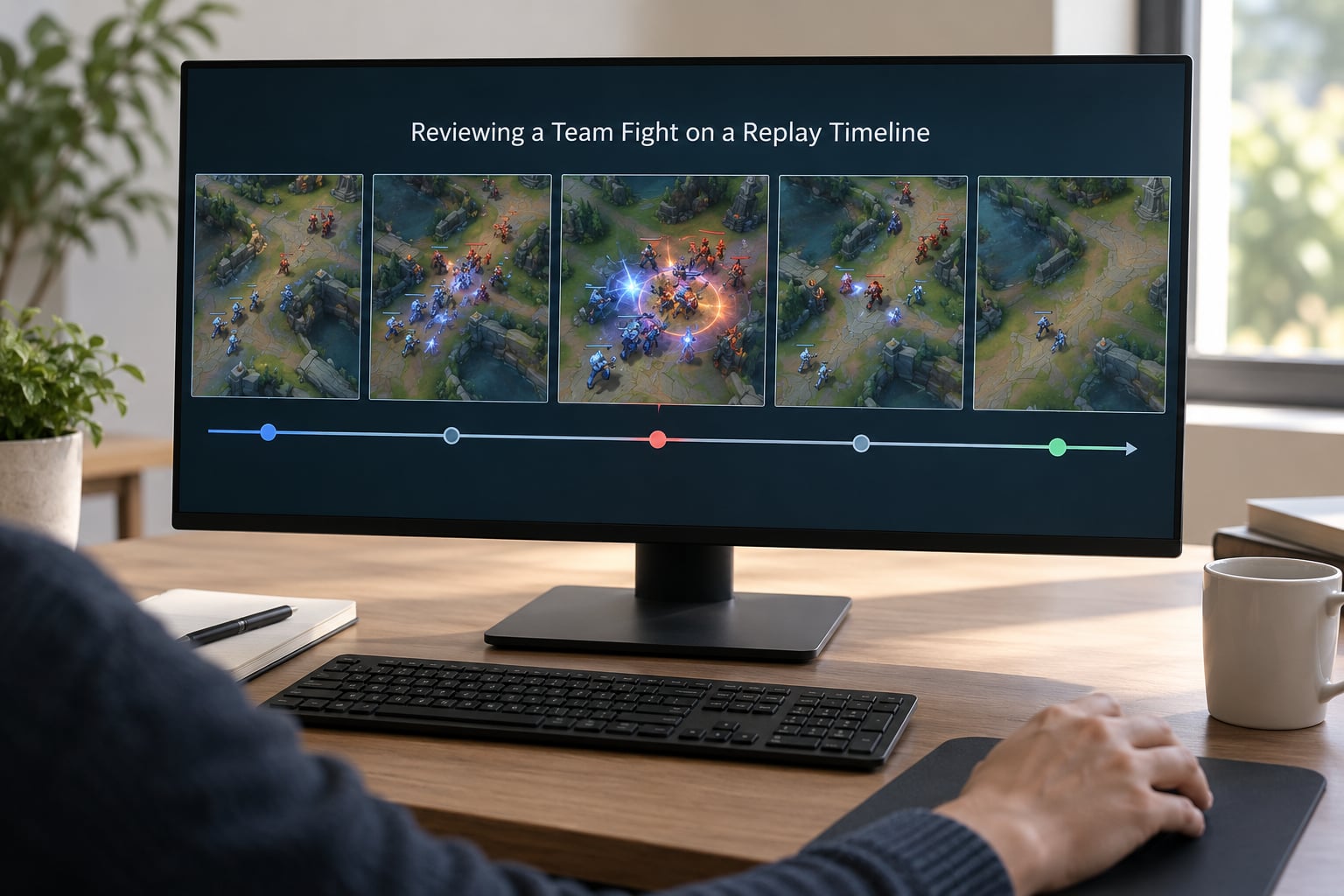
Mark the fight on the replay timeline before you watch it properly. Scrubbing frame by frame through a single sequence is where the useful information lives.
Five markers to find, in order:
- Approach — the moment your team committed to moving in. Note how spread out you were.
- Initiation — the first enemy ability that touched someone. Was it yours?
- Focus-fire decision — the second your damage landed. Watch for the point where two players started hitting different targets.
- The turning point — usually a death, a missed cooldown, or a backline caught out of position. There is almost always one.
- The failed escape — where someone had a route out and did not take it.
Markers one through three explain the fight. Markers four and five are your correction. Watch the first three replays of the week doing nothing but logging markers; you will notice patterns faster than you would by reading about them.
Common Mistakes
These are the habits that show up in almost every review, and each has a direct correction.
- Fighting as four. Correction: before engaging, count five. If you cannot, fight near your objective instead of on theirs.
- Chasing after the objective is gone. Correction: set a trigger. One death on our side ends the trade — leave immediately, no exceptions.
- Splitting damage across everyone. Correction: call one target before first contact and hold it until it is dead or no longer reachable.
- Backline over-extending. Correction: stay at the outer edge of your range, and step back the instant your frontline takes a hit.
- Pressing abilities independently. Correction: chain your casts to someone else’s. If your initiator has not committed, hold.
- Never calling cooldowns. Correction: say “engage up” or “no flash” in under two seconds whenever you see it.
- Treating every fight as mandatory. Correction: run the pre-fight check and skip any fight that fails it. Disengaging is a decision, not a loss.
- Arguing mid-fight. Correction: no comms about mistakes until the fight is over and you are both alive. Players describe the “why are you hitting tank” argument as one of the loudest, most useless things in solo queue.
If your team genuinely will not coordinate, stop trying to lead it and start building a plan they can copy. Force one specific fight — a pick on a visible overextended carry, an objective steal, a collapse from fog of war — because teams follow what is already happening more reliably than they follow instructions. Playing support for a stretch is a legitimate way to train this: the role makes you watch every fight on the map, track the jungler, and run both crowd control and protection until reading a teamfight becomes automatic.
Frequently Asked Questions
How do I improve team fighting if my teammates do not coordinate?
You cannot fix coordination, so stop trying to lead and start building a pattern. Pick one winnable engagement — a collapsed overextended carry, a stolen objective, a fog-of-war arrival — execute it cleanly, and let the team follow what already happened. Keep calls to a target, a count, and a cooldown. How to improve team fighting in MOBA games also means protecting your own position while their plan fails.
Should a carry chase a low-health enemy during every team fight?
No. Chasing is a job with conditions attached, not a reflex. Chase only if the target is already within your range, cannot reach an escape, and your team is not losing the objective race while you follow. A low-health enemy running toward their frontline means the kill costs you your health and your positioning for a trade you did not need.
Which team-fight skills should supports practice first?
Positioning and peel timing, in that order. Stand between your carry and the threat rather than beside them, and hold crowd control until something worth hitting is inside it. Then practice reading the fight before it happens: count enemies, check cooldowns, and call the target. Most support players improve fastest by treating communication as a skill to drill, not a bonus.
How can I use pings without cluttering team communication?
Ping only information someone else does not have, and only when it changes what they do. That means one target call, one missing-enemy count, one cooldown state, one retreat. Everything else is noise, and noise teaches your team to ignore pings entirely. If a ping would not make you act differently, save it.
How do I tell whether I lost a fight because of positioning or target selection?
Find the first ability that touched anyone, then check where you were standing at that exact frame. If you were outside your damage range or with no escape route, it was positioning. If you were in range but your damage was split across two or more targets, it was selection. Whichever mistake came first is the one to correct; the rest were consequences.
Conclusion
If you only change four things this week, change these. Decide before contact whether the fight is worth taking, and say no when it is not. Take a position you can leave, with a target assigned and confirmed out loud. Save one cooldown for the last four seconds. Then watch one lost fight after each match and correct the earliest mistake only.
Everything else — flank routes, comp-specific plans, cross-game terminology — is a refinement on top of that loop. Get the loop automatic first, and 2026‘s win rate takes care of itself.