Support is the role that wins by controlling information and safety rather than resources. To play support roles effectively, you set up vision, hold crowd control for the moment a team can follow, position so you can protect the player doing damage, and get back out before anyone dies. Nothing on that list is mechanical, and most of it survives every patch.
That is why support feels strange at first. You have no minion waves to farm, so the scoreboard can look empty for ten minutes, then a single well-timed engage decides the whole game. Beginners usually describe it as “basically afk but not really.” The fix is having a job to do before the fight starts, not during it.
This guide walks through a seven-step routine you can repeat every match: know the plan, pick the position, call the timing, manage your resources, support the team shot, adapt as fights change, then review one decision afterward. It works in League of Legends, Overwatch 2, Dota 2 and MMO healers or tanks, because the underlying job is the same even when the buttons differ.
Table of Contents
- What You Need
- How to Play Support Roles Effectively Step by Step
- 1. Learn Your Role, Team Comps, and Core Match Plan
- 2. Learn the Map and Choose High-Value Positions
- 3. How to Play Support Roles Effectively: Communicate Timing, Not Noise
- 4. Manage Cooldowns, Resources, and Health
- 5. Support Team Shots Instead of Chasing Damage
- 6. Adapt During Objective Fights and Rotations
- 7. Review the Match and Change One Habit
- Common Mistakes
- Frequently Asked Questions
- What is the best way to improve as a support player?
- Should a support player always stay with the carry?
- When should a support use their ultimate ability?
- How do supports communicate without overloading the team?
- Is it better for support to stay on the objective or make rotations?
- What should I review after losing a support-focused match?
- Conclusion
What You Need
Four things make support play click. Most players have the first one and skip the rest, which is why improvement stalls.
- Know what your character actually does. A support supplies healing, shielding, crowd control, vision, protection or utility, usually in a mix. Write down which of those two or three things your kit is built around.
- Know the team’s plan. Your comp usually wants something specific: a scaled late-game carry that needs protecting, an early skirmish composition that needs picks, or a warding game that buys time. Support without a plan is just standing near someone.
- A communication method that isn’t talking over yourself. Ping first, speak only for what a ping can’t say. Pick a convention before the match and keep it.
- Ten minutes to review one match afterward. Not three. One decision you can change next game is worth more than twenty minutes of general self-criticism.
There’s also an honest note worth making early. Support is one of the least rewarding roles in low-ranked play, where teammates often don’t punish a passive support and the enemy team barely punishes anything. If you’re hard-stuck, blaming your own mechanics is usually the wrong conclusion, because the win conditions in support are rarely about damage numbers.
How to Play Support Roles Effectively Step by Step
1. Learn Your Role, Team Comps, and Core Match Plan
Start by deciding what your role supplies, then connect it to the composition. If your kit is mostly crowd control and initiation, you win by turning an undecided fight into a pick. If it’s mostly healing and shields, you win by keeping a fragile teammate alive long enough to output. If it’s vision and terrain control, you win by letting the rest of the team move without fear.
Then look at the whole comp and answer one question: how does this team win? A slow, scaling backline needs space and peel, so your highest-value job is protecting. Two aggressive carries with no frontline need someone to land the first crowd control so they can follow it. Write the answer down somewhere visible during champ select.
Patch-agnostic rule: if you can name the win condition, you can decide every position and every cooldown decision against it. If you can’t, you’ll default to whatever your champion’s animation looks cool doing.
2. Learn the Map and Choose High-Value Positions
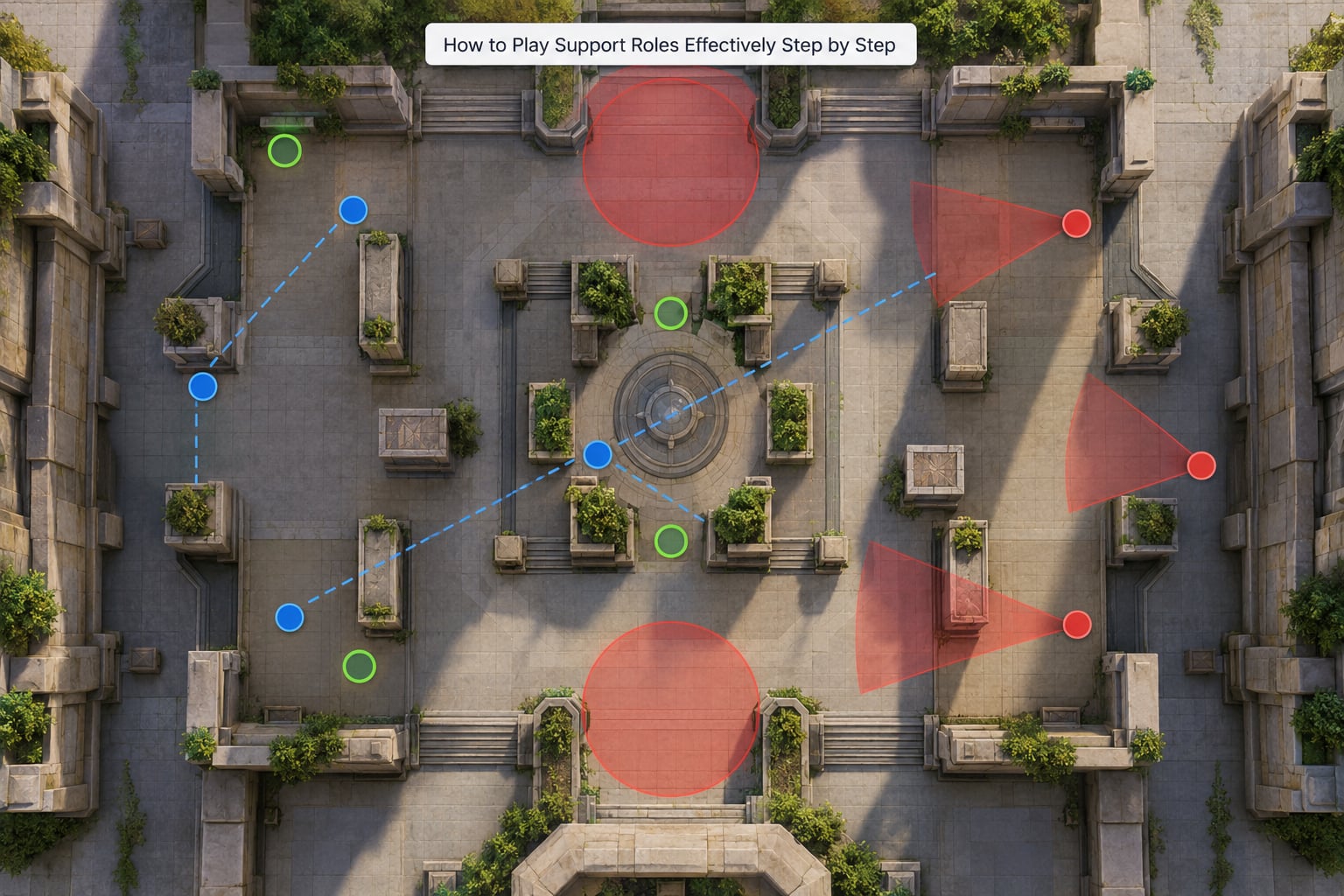
Choose positions for the information and coverage they give you, not because a teammate is standing there. On any map, five categories of ground matter: objective areas, chokepoints, flanking routes, retreat paths, and the spots enemies habitually hold.
Vision denial works the same way. A ward, totem, recon tool or vision plant placed where the enemy needs to pass turns a guessing game into information. That lets your team push a lane, take an objective or walk to a fight without checking every angle.
Community advice from r/supportlol mostly agrees on the sequence: cover the relevant river and enemy jungle area first, then commit to an aggressive play with your laner. The trap is the reverse. Warding deep with no plan to use the information is decoration, and standing so far back that you have no ability left when the fight starts is the same mistake in a different place.
A quick test for any position: can you see the objective or the enemy approach, and can you still reach your teammate within a few seconds? If either answer is no, move.
3. How to Play Support Roles Effectively: Communicate Timing, Not Noise
Communicate the four things a ping can’t carry: when something is ready, when it isn’t, where danger is, and what you need. Everything else is a ping.
- Objective timing. Say how long until spawn, then when to start moving, once, clearly.
- Ability readiness. The single most valuable callout in the game is “my engage is up.” The most harmful is calling it every five seconds.
- Missing players. One number is enough: “we’re missing two.” Names rarely help.
- Peel requests and rotations. “Behind you” and “rotating bot” beat silence.
Late information is worse than none, because it pulls attention at the wrong moment. Call things you can act on, and call them early. If your team has no comms discipline, yours still helps: two short, accurate pings from you set a pattern the others start copying.
4. Manage Cooldowns, Resources, and Health
Support abilities are the most wasteful stat in most games because they’re used early. Hold through the poke phase, spend on the engage that follows the crowd control, and keep something in reserve for the disengage.
Three rules cover most situations. Don’t spend resources on an isolated target the team can’t follow up on. Don’t use your defensive cooldown on a teammate who’s already retreating cleanly. And when the fight is lost, leave — a dead support contributes zero to the next fight, and the enemy jungler just got a free path to your carry.
Health is a resource too. There’s no prize for trading one-for-one at half health against a full-health enemy. Take the trade only when your cooldown comes back before theirs matters.
5. Support Team Shots Instead of Chasing Damage
Team shots happen when several players commit to the same target in the same two seconds. Your job is to make that happen more often and to protect the moment it lands.
Track your carry’s attack pattern rather than their target list. Damage players telegraph: a wind-up, a dash, a cooldown dump. Hold your crowd control for that instant, not for when their target happens to be walking past. Use your utility on someone the team can realistically follow, and don’t take the kill away from the player who earned it — a support who finishes the carry’s kill looks good in a scoreboard and loses the trust that makes the next engage happen.
Once the target dies, switch instantly. The next threat is usually a counter-attack on your backline, which is exactly the moment your second cooldown was saved for.
6. Adapt During Objective Fights and Rotations
Objective fights have phases, and each phase has a right answer. Before contact, hold vision and keep it as long as possible. At first contact, land crowd control on the highest-value target the team can follow. If your carry is caught, peel immediately and don’t argue about it. If the numbers turn, disengage toward your retreat path rather than sideways into the enemy backline.
Rotations have a purpose too, so gather information while you move: is the mid lanener pushing or losing, does the enemy jungler show on your side, is there a wave that arrives in four seconds. A support who arrives blind relies on a teammate; a support who arrives with two facts changes the decision the team makes.
Decide your exit before you arrive. Knowing the wall to break, the escape charge to hold, or the spot to hide at means you can play forward without the panic that ends runs early.
7. Review the Match and Change One Habit
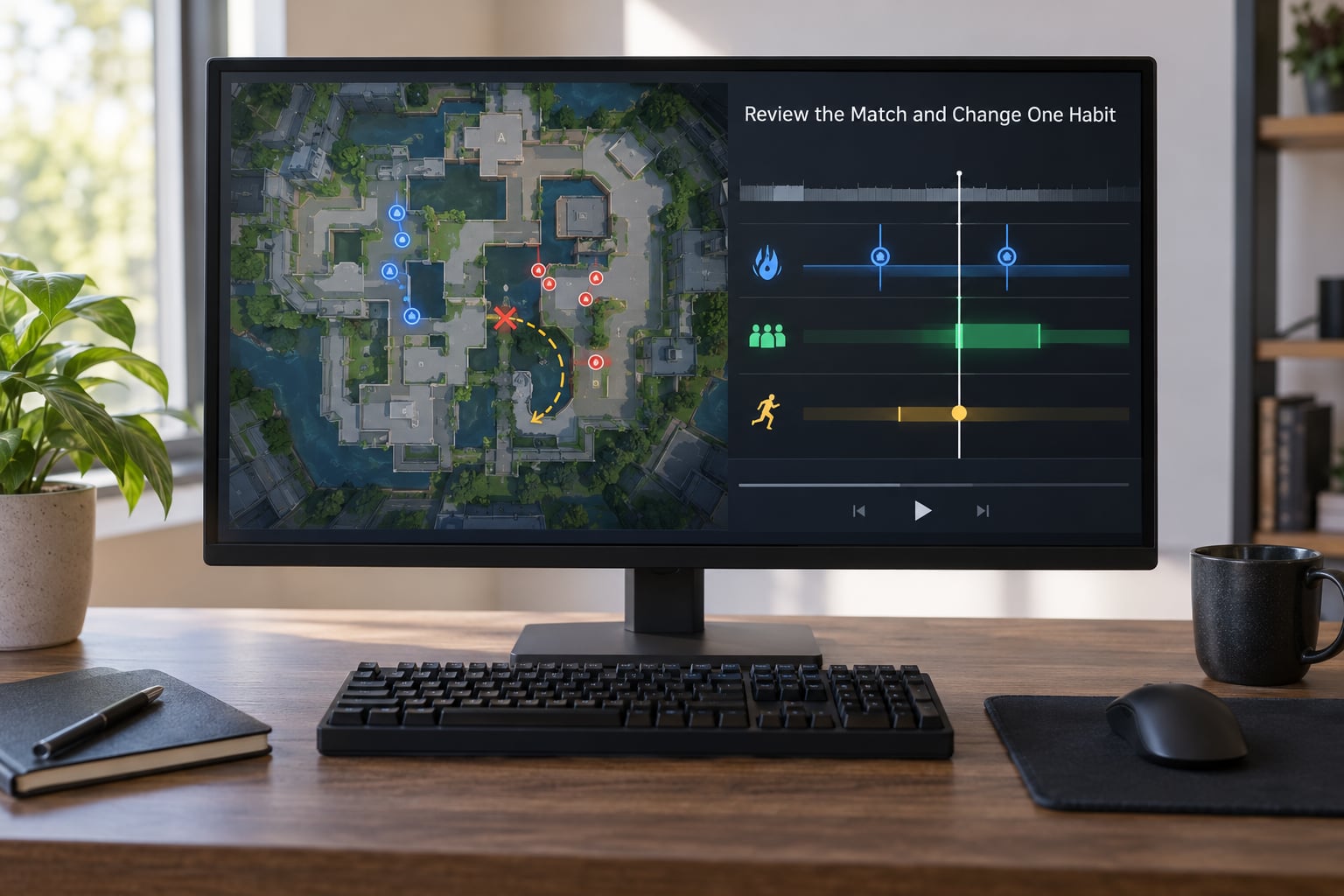
Review one thing: your positioning across the two biggest fights. Watch where you stood when each fight started, what you had available at that moment, and whether you were still alive after it ended.
Then write a single sentence describing what you’ll do differently, phrased as an action. “Stand further back in the river” works. “Play better” doesn’t. Carry that sentence into the next game and change only that.
After about ten games with the same one adjustment, pick the next one. Players improve fastest by stacking small corrections rather than rewriting their whole approach every session, and the replay is where you confirm which correction actually applies next.
Common Mistakes
These are the errors that cost the most games, with the fix next to each.
- Playing too far ahead of the team. Your ability only creates a pick if someone can follow it. Hold the play until a teammate commits.
- Hiding information. Silence reads as calm when it’s not. Call the missing player count and the cooldown timing even when you think everyone can see it.
- Forcing fights that nobody wants. If the call came late or from you alone, disengage. A support death usually costs more than a missed engage.
- Wasting utility on the wrong target. Crowd control belongs on whoever the team will follow, not on whoever is loudest.
- Chasing kills past the objective. Once the objective flips or the fight breaks, stop. The rotation was the play.
- Forgetting the objective entirely. The chat debate about the fight is worth nothing if the timer runs out while you argue. Check it before you engage.
- Ignoring cooldowns and economy. Wasted abilities compound. If your cooldown matters in the next fight, don’t spend it on the current one.
- Playing with a struggling lane partner instead of around them. Some lane partners can’t be fixed in ten minutes. Move your attention to where a play is actually possible.
One habit quietly fixes several of these: before each fight, ask what you’re doing if the fight is lost. If the answer is nothing, you’re already too deep.
Frequently Asked Questions
What is the best way to improve as a support player?
Watch one replay per game and change one decision at a time. Review positioning first, since it decides which abilities you get to use. Track the same two or three things every match, such as vision setup before an objective or how often you died after losing a fight. Most improvement comes from repeating a small correction across ten games rather than rewriting everything at once.
Should a support player always stay with the carry?
No. Staying glued to one teammate means your crowd control, vision and numbers advantage only ever apply to one lane. Follow the fight your team is actually taking, which early on is usually the lane with a winnable trade. The carry you are closest to will get the first pick, which is worth more than permanent proximity.
When should a support use their ultimate ability?
Save it for the moment the team commits to a target, not the moment the fight starts. The best timing is when your carry or tank finishes a wind-up, because the team is already locked in and your crowd control keeps that commitment alive. Using it early to look impressive usually finds enemies already split and walking away.
How do supports communicate without overloading the team?
Ping first and speak only for what a ping cannot carry: cooldown readiness, objective countdown, how many enemies are missing, and whether to peel or disengage. Keep it to one sentence per event and say it early, because late information pulls attention at the wrong moment. Repetition is the real problem, not volume.
Is it better for support to stay on the objective or make rotations?
Stay when the objective is the fight your team is taking, and rotate when it is not. Rotations are worth it when another lane is already winning, when you have vision the enemy cannot see you using, or when the fight on the far side is unavoidable anyway. Gather two facts on the way so the team is not acting blind when you arrive.
What should I review after losing a support-focused match?
Look at your deaths first, then the setup before each one. Ask whether you had a cooldown available, whether anyone could have followed your play, and whether you knew the enemy’s position. Then pick the earliest mistake in the game rather than the last one, because early mistakes usually cause the late ones you want to complain about.
Conclusion
To play support roles effectively, work through the same order every match: understand what your team needs to win, stand somewhere that gives you information and a usable ability, call timing instead of noise, hold your resources, protect the moment the team commits, and stay out of fights you already know are lost.
Start with one habit next game. Put vision where it will be used, not where it’s safe. Watch the first fight you lose and write down the position you should have held instead, then take that sentence into the following match.