
An esports transfer window is a fixed stretch of time, usually in the offseason, during which teams can register new players on their rosters. Inside a window, an organisation can pay a buyout to release a player from an existing contract, sign an expiring or out-of-contract player, or take someone on loan. Outside the window, roster changes are usually blocked by a lock until the next one opens.
Every league sets its own dates, and those dates change from season to season. If you have been trying to find when esports transfer windows open, that is not you being bad at searching. Almost nobody publishes a single page that tracks all of them, which is why a thread on r/leagueoflegends asking exactly that went without a straight answer.
So here is the whole system in one place: what a window is, how a move gets registered, what makes a player eligible, why the rules differ from game to game, and what usually goes wrong.
Last updated: October 2026. Windows are announced per season by each publisher, so confirm dates against the league’s own channels before relying on anything here.
Table of Contents
- What Is an Esports Transfer Window?
- How Esports Transfer Windows Work
- What Makes a Player Eligible to Move?
- Esports vs football transfer windows: what is the same
- What Happens During the Transfer Process?
- Why Do Transfer Windows Have Different Rules by Game?
- How Do Contracts and Buyouts Affect Transfers?
- Can Players Be Traded, Loaned, or Replaced During a Window?
- Trades
- Loans
- Substitutes and stand-ins
- Mid-window replacements
- What Are the Most Common Transfer Window Mistakes?
- Frequently Asked Questions
- Can a player be signed outside the transfer window?
- Do esports players get paid for transfers?
- What is the salary cap rule in esports?
- What happens if a team exceeds the salary cap?
- How are esports transfer windows different from football windows?
- What happens when an esports player’s contract expires?
- Conclusion
What Is an Esports Transfer Window?
An esports transfer window is a set calendar period defined by a league or tournament publisher during which teams are legally permitted to add players to their registered roster. It exists so that competitive rosters stay stable during a season, and it is the reason almost all team news drops in a tight cluster of weeks rather than trickling out all year. A window usually covers the gap between one season ending and the next beginning, and everything that happens inside it – buyouts, free agent signings, trades, loans – happens before a registration deadline. Once that deadline passes, the new season starts and the roster locks.
Six terms do most of the work in any conversation about the market:
- Transfer window – the open period itself, set by the league rather than by individual teams.
- Registration deadline – the cut-off inside the window by which a signing must be filed with the league to count.
- Buyout clause – the amount a new team pays to release a player from a contract that has not run out.
- Free agent – a player with no active contract, free for any team to sign.
- Roster lock – the period when roster changes are not permitted, often for the whole competitive season.
- Loan – a temporary move where the player remains contracted to the parent organisation.
One useful distinction: a window is a permission, not a move. Plenty of windows open and close with nothing happening, and plenty of individual signings fall outside a window under league exception rules. That gap between “announced” and “registered” causes more confusion than anything else in esports.
How Esports Transfer Windows Work
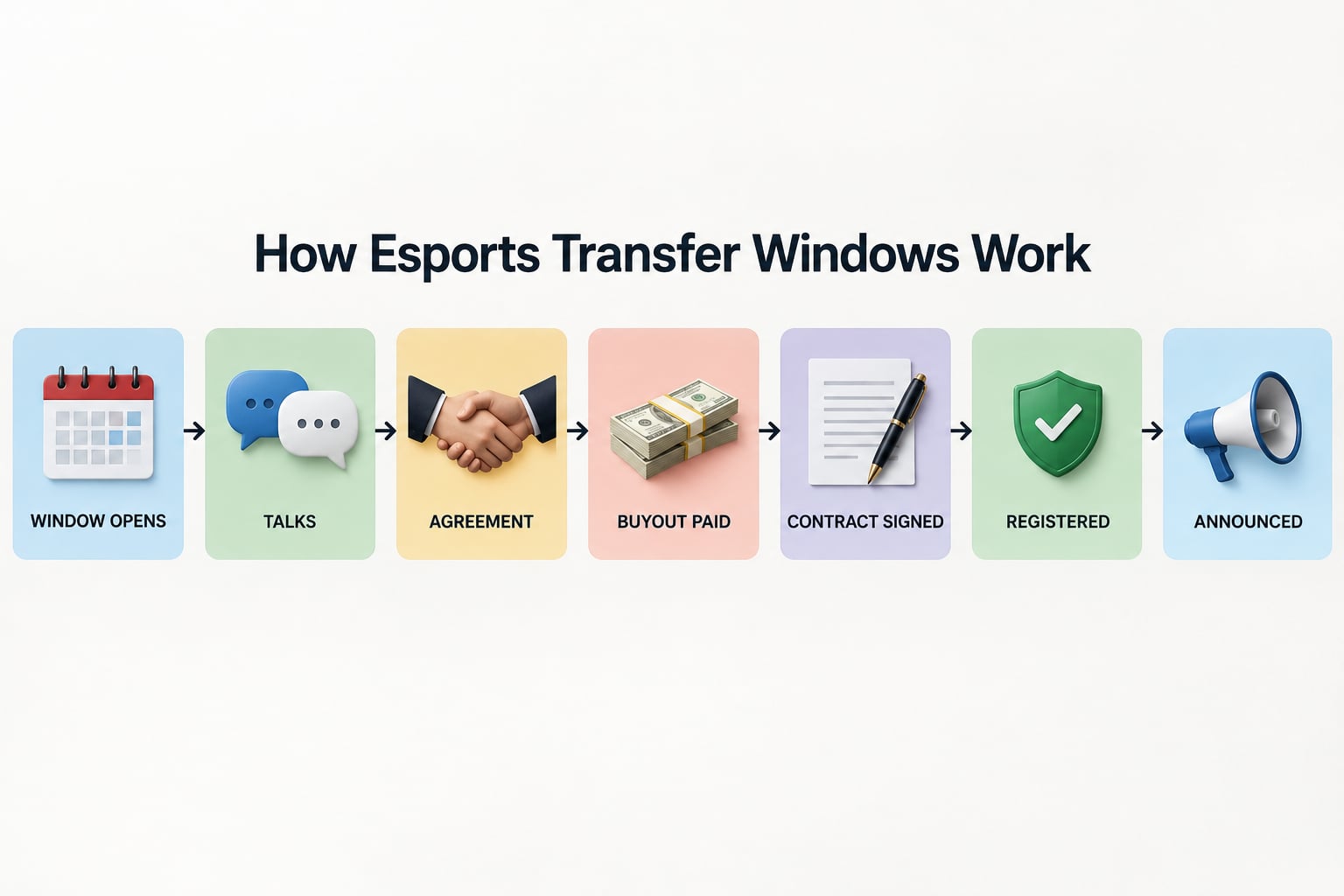
Here is how esports transfer windows work as a process, in the order a deal moves from a conversation to a legal roster spot.
- The window opens. The league publishes the start and end dates, usually alongside the dates for the season or split that follows.
- Talks begin. An organisation’s general manager or head of esports contacts a player or their representative. Clubs talk to each other about availability at the same time.
- Agreement is reached. Terms are agreed in principle between the player and the new team. Nothing is official yet, and players in this phase are often still restricted by a roster lock.
- Any buyout is triggered. If the player is under contract to another organisation, that team decides whether to accept the move and what release fee to set. Some clubs simply refuse; the deal dies there.
- The contract is signed. Once released, the player signs with the new team. Terms are usually confidential, which is why readers rarely learn what a move cost.
- The registration is filed. The new team submits paperwork to the league before the registration deadline. This is the step that makes the move real, and it is the step most often missed.
- The announcement goes out. Once the league approves the change, the team posts it officially. The window closes on its stated date regardless.
Steps six and seven are where fans get caught out. A move reported by an aggregator two days before the deadline can still fail to register on time, which produces the familiar pattern of an announcement followed by silence, then a correction a day later.
What Makes a Player Eligible to Move?
Interest from another team is the least important factor. A player is eligible when four things line up: the contract allows a move, the league roster is open rather than locked, the player’s registration status is clean, and the roster has a slot the player can occupy.
Contract status. A player out of contract can sign with anyone. A player under contract can be moved only if the current organisation agrees to a release or a loan, or if their contract has already ended by the time the registration is filed.
Roster eligibility. Most titles limit roster size and split it into roles, with slots for starters and substitutes. A team that already holds the maximum number of registered players cannot add another until someone is removed. In League of Legends that means starter slots and a substitute slot; in titles with larger lineups the split works differently, but the constraint is the same.
Age and residency. Depending on the league and the title, a player may need to meet a minimum age or hold a residency status tied to the region’s rules. These requirements vary and are set per competition.
Registration paperwork. Players must be filed with the league, and many leagues require prior registration or partner-team affiliation before a player can be entered on a starting roster. A player who has never competed in that ecosystem can need paperwork cleared before they appear.
Esports vs football transfer windows: what is the same
Most searchers arrive here with a football model already in their head, which is a reasonable place to start. The structure is genuinely similar. The differences are sharper than most pages suggest.
| Element | Esports | Football |
|---|---|---|
| Who sets the window | The league, and often the game publisher above it | The league, in agreement with club and player bodies |
| Number of windows per year | Typically one, sometimes two with a mid-season break | Summer and winter, plus emergency out-of-window deals |
| Contract length | Often one season at a time, renewed inside the window | Multi-year, commonly three to five years |
| Buyout | Common, and often the deciding factor in a move | Common, calculated from a formula in the rules |
| Loans | Allowed in some leagues, restricted in others | Standard, with limits on registrations |
| Fee disclosure | Rarely public; terms are usually confidential | Fees are commonly reported in the media |
| Mid-season movement | Usually blocked by a roster lock | Possible, including loans and frees |
| Financial rules | Salary caps or spend thresholds set by the publisher | Salary caps, squad-cost rules and revenue regulations |
The practical gap is the last row. In football a club can sign a player mid-season under limits; in esports the same move usually requires a season split that deliberately freezes rosters, or a league-approved exception.
What Happens During the Transfer Process?
The practical side of a move is paperwork and pressure. A typical window-day sequence looks roughly like this.
A team identifies a gap, usually because a starter’s contract is expiring or a role has been weak all split. They open talks with a target whose own contract situation allows a move, then wait on the player’s current organisation. If the response is a release fee, someone has to decide whether the performance gain is worth it. If the answer is no, the team moves down its list, and the target sometimes announces the same day that talks broke down.
While that runs, the player’s registration status gets verified, the roster slot is confirmed, and the team works out how the deal sits against the league’s financial rules. Only after the signature does the filing happen, and the filing is what the deadline actually measures.
End-of-window moves have their own pattern. Teams that waited until the final day tend to discover paperwork problems late, and announcements often land within hours of the cut-off. Treat any registration claim made right at the buzzer as provisional until the league or the team posts it officially.
Why Do Transfer Windows Have Different Rules by Game?
Each publisher owns its competitive ecosystem, so each one decides how rosters behave. The window length, the number of windows, the roster split and the financial regulations are all set inside that ecosystem rather than by esports as a whole.
Shooters tend to use a single roster with substitutions handled through a temporary-player roster during events, which limits in-season churn. MOBAs split the calendar into seasonal and mid-season blocks, and some have used a lock-in format that freezes registrations for part of the year. Sports simulations and fighting games often run on a single annual roster with tighter eligibility rules because the competitive calendar is short.
Regions differ too, because contracts and governing rules differ. A European league run under a central partnership agreement does not operate like a self-governed North American league, and Asian leagues generally build their windows around their own season structure.
| Ecosystem | Typical window pattern | What shapes it |
|---|---|---|
| LEC and LCS (League of Legends) | Offseason window between seasons | Publisher rulebook, regional partnership rules, roster locks during splits |
| LCK (League of Legends) | Offseason window, often split into phases | Publisher rulebook plus stricter team and player eligibility conditions |
| VCT (Valorant) | Preseason and mid-season windows | Two windows a year, partner roster rules, event-based competition |
| Counter-Strike 2 | Rosters reshuffle between ranking periods and events | Valve’s standing rules, RMR standings as the effective qualification anchor |
| Chinese-region leagues | Scheduled trading windows announced per season | Local league rules, often written to resemble football windows for familiarity |
Specific dates are set season by season, so treat any calendar you find as a historical record rather than a schedule. A page listing window dates from a past season is evidence about that season, not this one.
How Do Contracts and Buyouts Affect Transfers?
Contract length decides whether a move is even possible. In several ecosystems player contracts run one season at a time and are renewed during the window, which is why so much movement clusters into a few weeks. Players can end up choosing between extending, moving, or retiring in the same fortnight.
A buyout clause is the price written into a contract for releasing the player early. The new organisation pays it; the player does not receive it. This is a football question that arrives on esports searches constantly, and the answer is simple: the buying team pays, the selling organisation receives, and the player’s only financial change is the new salary and whatever signing bonus comes with it.
Take a hypothetical. A mid-lane player signed a one-season contract with a buyout clause attached. Another team wants them and triggers the clause partway through the window. The player’s side changes club, but the move is legal only if it registers before the deadline. Whether the original team accepts, sets a high figure, or simply says no is a real decision with real consequences, and published figures are rare because deals sit under confidentiality terms.
Extensions usually come before the window closes. A team that does not want to lose a player often tries to renew inside the window rather than risk a free agent list entry.
Can Players Be Traded, Loaned, or Replaced During a Window?
Yes, and all three sit inside a window rather than after it.
Trades
A player-for-player exchange. The two organisations agree which players move, then each file the corresponding registration changes. Trades are common in MOBAs where roster sizes are small, because a swap can solve two problems without extra paperwork complexity.
Loans
A temporary move where the player stays contracted to the parent organisation and returns afterwards. Loans give a developing player match time and let a team cover a gap, and some leagues cap how many loaned players an organisation can register.
Substitutes and stand-ins
A substitute sits in the roster but plays when needed. A stand-in is temporary and often tied to a specific event or absence. In shooters, stand-ins are common because the competitive calendar is event-based; in MOBAs, substitutes usually sit on the same roster and follow the same registration rules.
Mid-window replacements
If a player retires, is injured, or has a family emergency mid-season, organisations can sometimes register a replacement through an exception process. That process is league-specific and time-limited, which is why mid-season moves in esports are genuinely rare rather than simply uncommon.
What Are the Most Common Transfer Window Mistakes?
Most confusion comes from a handful of recurring errors, and every one of them shows up in forum threads year after year.
Treating an announcement as a registration. A post does not make a move legal. The registration has to be filed and approved before the deadline, and those are not the same moment.
Confusing legal and competitive eligibility. A player can be perfectly free to sign and still not be eligible to be entered on a starting roster for that particular competition.
Overlooking roster limits. Slot counts, starter and substitute splits, and loan limits are hard constraints. A team at the maximum cannot add anyone, no matter how good the offer is.
Missing the deadline. The cut-off is administrative and unforgiving. Discussions about a transfer deadline being an odd hour or a fixed time on a fixed date come from football; in esports the deadline is simply the time the league states for filing, and late filings do not get exceptions.
Believing rumour equals confirmation. Forums are full of unverified leaks treated as settled news. The reliable order to check things is the league’s official channel first, then the organisation’s own announcement, then reporting and databases. Anything else is speculation until one of those three confirms it.
That last point is worth repeating because it solves the exact complaint in the r/leagueoflegends thread: the information exists, it is just scattered across league channels, organisation posts and community databases rather than gathered in one evergreen place with dates attached.
Frequently Asked Questions
Can a player be signed outside the transfer window?
Sometimes, but rarely. Once a roster lock is in force, teams normally cannot register new players until the next window opens. Exceptions exist for events like a player retiring or being injured mid-season, and leagues handle those through a time-limited approval process. A signing made outside the window without that approval will not be registered, so it does not count as a legal roster change.
Do esports players get paid for transfers?
The player does not, in the football sense. The buying organisation pays any buyout or release fee to the selling organisation, and the player’s own money changes only because they sign a new contract with a new salary and possibly a signing bonus. Because most esports deal terms are confidential, reported transfer figures are rarely verifiable and you should treat them as claims rather than facts.
What is the salary cap rule in esports?
It varies by league. Some esports competitions set a hard cap on total player compensation per season, and exceeding it is not permitted. Others use a spend threshold instead, which allows teams to go over but charges a fee based on the amount of overspend, similar to a luxury tax. The exact mechanism is set by each publisher and regional league, so check the rulebook for the specific competition you care about.
What happens if a team exceeds the salary cap?
It depends on which system the league uses. Under a hard cap, the registration is simply not approved, so the move fails and any money already committed has to be unwound. Under a spend threshold, the team keeps the player but pays a penalty calculated on the overspend, often a percentage of the excess with harsher rates for larger breaches. Both systems are enforced at registration, not at the end of the season.
How are esports transfer windows different from football windows?
Football runs two main windows a year, contracts are typically multi-year, transfer fees are often reported publicly, and clubs can sign outside the window under limits. Esports usually has one window in the offseason, player contracts often run a single season at a time, deal terms are usually confidential, and roster locks make mid-season movement difficult. The registration deadline works the same way in both systems: a move only counts once it is filed and approved.
What happens when an esports player’s contract expires?
The player becomes a free agent and can sign with any team, usually inside the same window that covers the expiry. If nobody signs them, they are not registered for the season and have to compete in open qualifiers to get back into a league event. That open qualification path is a bigger part of esports than in football, and it is why an unsigned elite player can end up playing in a very different tier.
Conclusion
The short version: transfer windows are how esports transfer windows work in practice, one per ecosystem, open for a fixed period, with every move becoming real only when the paperwork is filed before the deadline. Everything else – buyouts, loans, trades, free agency, roster locks – is a variation inside that structure.
If you are tracking a specific team, check four things in order: the league calendar for that title, the roster and registration rules for that region, the player’s contract status, and the official transfer deadline. Publisher announcements for the current season are the only dates worth trusting, since last season’s window tells you nothing about this one.