Smurfing damages matchmaking quality in one specific way: it poisons the rating pool the system reads. A strong player on a low-ranked account is matched as an equal, wins fast, and drags the perceived difficulty of the whole bracket down with them, so the average skill level of that pool falls even though nobody in it was placed badly. The damage spreads well past that single lobby.
Most of the coverage I found on this topic collapses the whole problem into “new players get destroyed,” which is true and incomplete. The average-skill player in the middle of the ladder is arguably the most common victim, and almost nobody writes about them. This guide covers the mechanism, the four cohorts it hits, what detection can and cannot do, and where you can personally improve your own match quality.
Everything here applies to skill-based matchmaking in shooters, MOBAs and sports games with ranked ladders — Counter-Strike 2, Valorant, League of Legends, Dota 2, Overwatch 2, Rocket League. The rating math differs; the failure mode does not. Updated for October 2026.
Table of Contents
- What Smurfing Is and Why Players Do It
- Smurfing, boosting and account sharing are three different things
- The motives behind most smurf accounts
- How Skill Ratings and Matchmaking Work
- What a smurf does to matchmaking quality in a single match
- How Smurfing Changes the Rating Pool
- What MMR pollution actually means
- Elo inflation: when the ladder stops meaning anything
- What Smurfing Does to Matchmaking Quality
- Impact by player cohort
- Why Smurfing Can Create Easier Wins
- The feedback loop that keeps a smurf down here
- Does Smurfing Make Matchmaking Weaker for Everyone?
- New players get the worst of it
- Returning players get hit twice
- The average-skill player is the quietest victim
- High-rank players lose something different
- What it does to premade groups and queue times
- What Happens When Smurfs Are Detected or Reported
- Is smurfing considered cheating?
- What reporting a smurf actually accomplishes
- How Matchmaking Systems Try to Limit Smurfing
- Why games don’t just match smurfs with each other
- The queue time trade-off nobody wants to pay
- How Players Can Tell Whether a Match Is Unfair
- Statistical tells that survive scrutiny
- Signals that look like smurfing but are not
- Frequently Asked Questions
- Does one smurf ruin matchmaking for everyone?
- Why do matchmaking systems struggle to detect smurfs?
- Can someone smurf without using a second account?
- What happens if I report a player for smurfing?
- Are unusually skilled players automatically smurfs?
- How can game makers improve matchmaking quality?
- Conclusion: Protect the Rating Pool First
What Smurfing Is and Why Players Do It
Smurfing is playing on a second account whose rating sits below your real skill level so the matchmaker sends you into weaker lobbies. The account might be brand new, bought from a seller, or a leftover main that was manually kept at a low rank.
A second account is not automatically a smurf. Plenty of players keep a throwaway for trying a new role, for learning a hero without damaging their main’s stats, or for playing with a friend who is two divisions below them. The difference is intent and outcome: if the alt exists to win against people the system believes are your equals, it is a smurf.
Smurfing, boosting and account sharing are three different things
These get tangled together constantly in forum threads, and they have different technical footprints, which is why they need different counters.
| Practice | What it is | How hard it is to catch | Typical consequence |
|---|---|---|---|
| Smurfing | Self-played on a lower-rated account | Hardest — the account is played competently, just below its real level | Usually a warning or a rating reset, rarely a ban |
| Boosting | A better player logs into your account and plays it | Easier — impossible stats, time-zone gaps, friends playing each other | Ranked ban, account ban, sometimes a leaderboard removal |
| Account sharing | You hand your login to a friend or buyer | Moderate — hardware and location signals shift | Usually a warning, escalating to a ban on repeat offences |
The technical point matters more than the moral one. A smurf produces no forensic footprint at all, because the gameplay is internally consistent — it simply belongs to a different skill bracket.
The motives behind most smurf accounts
Ranked motivation, in the order these show up in my reading of player forums:
- Playing with friends. The most common excuse and the one players themselves call the most sympathetic. It still produces a lobby where four people are at the same level and one is not.
- Fear of losing rank. Players who believe their main account is stuck create a fresh one to prove they can still climb. A Dota 2 GitHub issue from a player with thousands of hours of experience describes exactly this loop.
- Warm-ups and practice. A genuinely warm-up account played in a low queue before a match. The clearest case where the account is not being used to gain anything.
- Ego. Enjoying the stomp. A player on the Blizzard forum thread defending smurfing put it plainly: smurfs bypass the matchmaker to face weaker opponents.
- Content creation. Streaming and video. A creator whose face is public has little incentive to hide a smurf, which is why viewer count is often a tell.
Not all of these deserve the same response, and holding all smurfs to the same standard is one reason enforcement feels arbitrary to the people who hit it.
How Skill Ratings and Matchmaking Work
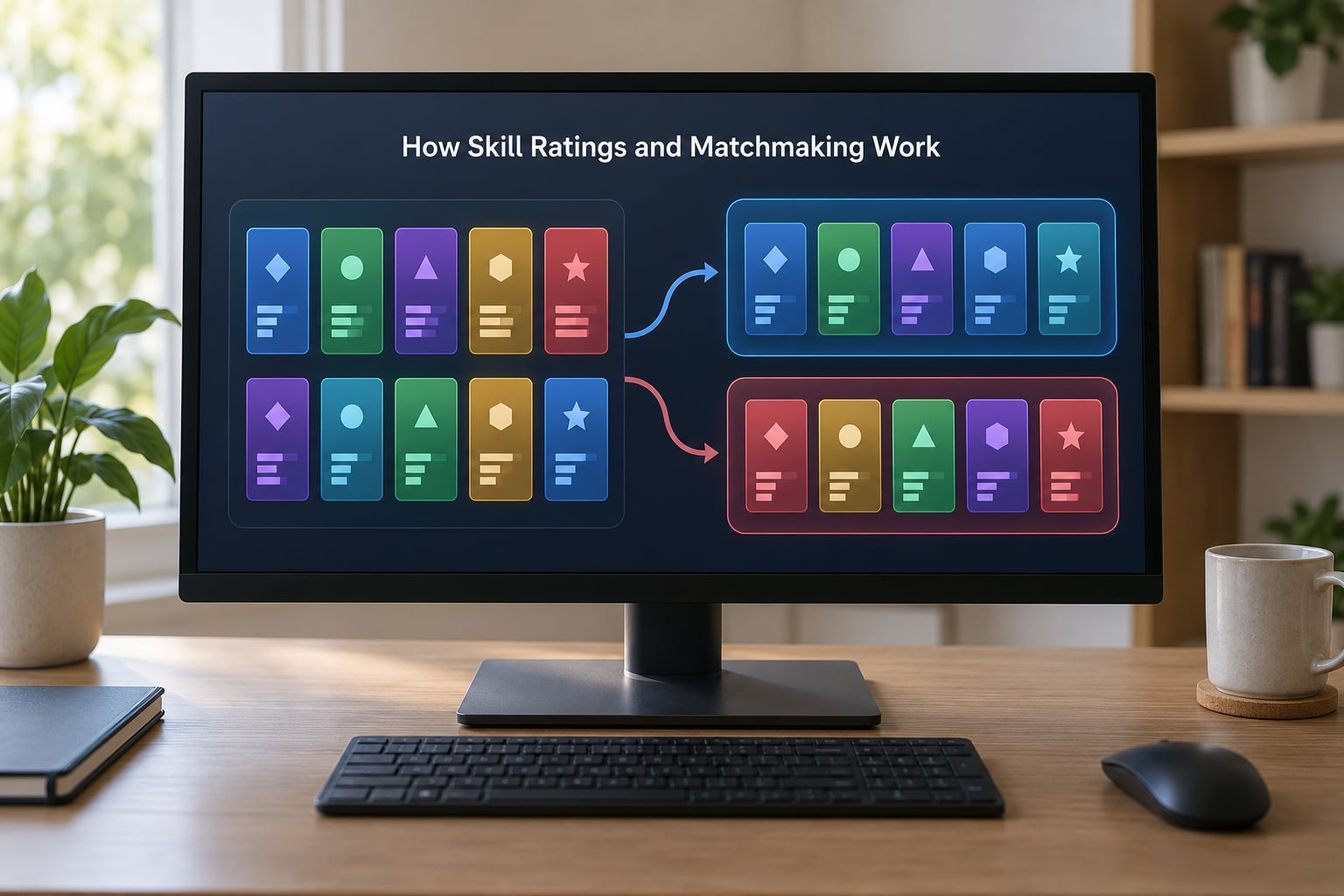
Most systems estimate a player’s skill with a rating — MMR in Riot titles, a Glicko-style rating on Steam, a modified Elo elsewhere. The rating moves up when you beat people it thought you would lose to, and down when you lose to people it thought you would beat. Add enough result signals and the system has a reasonable guess at your skill.
Placement matches exist to seed that guess for new accounts. The whole design rests on one assumption: the account’s owner is roughly the same person who will be playing it for the next six months, at the skill the account is currently showing.
Smurfing breaks the assumption at the first step. A smurf’s account rating is a fiction, and every pairing decision built on it inherits the fiction.
What a smurf does to matchmaking quality in a single match
Here is the shape of the problem in a ten-player ranked lobby, using an illustrative set of account ratings. These numbers are worked examples, not measurements from any live service.
| Account | Stated rating | Approximate real skill | Effect on the match |
|---|---|---|---|
| Player 1 | 1180 | 1180 | Balanced |
| Player 2 | 1190 | 1190 | Balanced |
| Player 3 | 1175 | 1175 | Balanced |
| Player 4 | 1185 | 1190 | Balanced |
| Player 5 | 1180 | 1180 | Balanced |
| Player 6 | 1180 | 1820 | Win condition for the other team |
| Player 7 | 1178 | 1178 | Balanced |
| Player 8 | 1190 | 1190 | Balanced |
| Player 9 | 1182 | 1182 | Balanced |
| Player 10 | 1185 | 1185 | Balanced |
Nine of the ten players were placed exactly as intended. The tenth was misread, and one misread is enough to make the game unwinnable for the other nine. That is the honest scale of the harm: a single smurf does not need to do anything subtle or coordinated to ruin a lobby.
Two players above their rating, or one player who is five hundred points above, push the lobby past the point where the result feels meaningful. Ratings systems tolerate error; they do not tolerate error with a large multiplier.
How Smurfing Changes the Rating Pool
Matchmaking does not read your rating. It reads the distribution of every rating in the queue, and it assumes that distribution reflects true skill. Smurfs distort the shape of that distribution in a specific way: the lower brackets carry more skill than their labels claim.
What MMR pollution actually means
MMR pollution is the gap between a rating’s label and the skill it represents, caused by accounts that entered a bracket below their real level. It matters because the system’s only input is the label.
Here is the uncomfortable part. Pollution is not permanently additive. A smurf who plays honestly will climb out of the bracket, and the pool slowly cleans itself — provided the account plays to win, which is the definition of a smurf. Games that avoid smurfing tend to have pollution mostly at the very bottom, where new accounts accumulate and calibration is thinnest.
The reason low brackets stay polluted anyway is supply. An enormous number of smurfs enter at Gold and below, and most exit within a few hundred matches. The inflow is constant.
Elo inflation: when the ladder stops meaning anything
Elo inflation is a different problem from smurfing, but the two reinforce each other. Inflation happens when a rating system awards points faster than skill grows — early wins in placements, long streaks that a system reads as genuine improvement, or ladder-wide rating drift as stronger players are added to an ageing pool.
When ratings inflate, a Platinum badge in 2026 represents less real skill than a Platinum badge five years ago. Players know this even if they cannot articulate it, and it is a large part of why high-rank lobbies feel like they have filled with players who do not belong. Smurfing makes it worse, because a smurf also forces genuine losses onto honest players and drags their ratings in both directions.
What Smurfing Does to Matchmaking Quality
Smurfing degrades matchmaking quality through five distinct effects, and it is worth separating them because they need different fixes. A detection system can address one of them and do nothing about the other four.
1. It breaks team balance inside a single lobby. This is the immediate, visible cost. One misread account makes a match decided in the first few minutes, and the players on the losing side get no useful information from it — a loss against a much stronger opponent teaches you almost nothing about your own play.
2. It corrupts the rating data the system learns from. Ratings improve through result comparison. When results come from mismatched games, the comparison signal is wrong, and the system learns the wrong thing about both players involved.
3. It makes low ranks lose their meaning. Ranks are only a signal if the population behind them is homogeneous. A visible, recurring presence of stronger accounts in a low bracket teaches players to discount the rank entirely, which costs the ladder its value as feedback.
4. It lengthens or distorts the onboarding window for new players. A new account is placed by a system that has no data, in a pool that may be polluted. A rough first fifty matches stop being a learning experience and become a wall.
5. It drives the churn that shrinks the pool in the first place. This is the slow one and the most expensive. Players who conclude that ranked is unfair do not complain forever; they stop queueing, or they quit, and every account they take with them makes matchmaking worse for everyone who stays.
Impact by player cohort
| Cohort | Match quality | Time to learn | Trust in the rank | Likelihood of disengaging |
|---|---|---|---|---|
| New player | Worst — no calibration data, weakest calibration pool | Longest | Low from the first loss | High, and concentrated in the first weeks |
| Returning player | Poor — placement matches plus a polluted target bracket | Long, and repeated once already | Low, and they remember their old rank | High — a common trigger for quitting outright |
| Average-skill player | Mixed — the most common lobby occupant, so the most frequently affected | Stalled, since wins stop being informative | Slowly erodes week to week | Gradual, quiet, rarely framed publicly |
| High-rank player | Often good, except when queueing with friends | Not really applicable | Damaged by inflation, not by smurfs directly | Low, but many create smurfs instead |
The row that gets skipped in most coverage is the third. The average player is not new, so onboarding advice skips them, and they are not high-rank, so ladder-integrity arguments skip them too. Yet they are the modal smurf target, which means they absorb the pollution more than anyone.
Why Smurfing Can Create Easier Wins
Smurfing works because rating and skill move in the same direction, and a smurf is a machine for exploiting that. The loop has four steps and it runs fast.
- The account enters a bracket below its real skill, so the expected outcome is a win.
- It wins, the rating climbs, and the account is now in a bracket where the wins are less free.
- Alternatively, it drops again on purpose, or its owner buys a lower-ranked account outright, and the loop restarts.
- Throughout, every honest opponent in that bracket takes a loss that their rating cannot distinguish from a normal loss.
The reason this is efficient rather than self-limiting is that the smurf is not just farming wins. It is also generating a large number of correctly-processed, statistically uninformative matches for nine other people at a time.
Coordinated smurfs are worse still. When a group queues together on low-rated accounts, one player can feed the others, and a lobby can be manufactured rather than merely unbalanced. A player on the Civilization fanatics forum put the core complaint better than any analyst has: games feel rigged even when there is no system fraud at all, because the visible evidence looks exactly like rigging.
The feedback loop that keeps a smurf down here
A single smurf does not stay in one bracket forever, and players sometimes miss that. The system is genuinely good at pushing an over-performing account upward — the problem is that the account’s owner wants the opposite. So the smurf either holds deliberately, throws on purpose to fall back down, or buys a cheap account at the level they want.
Players on forums describe the last option as the normal one now. Account marketplaces make a low-ranked account a commodity, and that changes the supply curve: smurfing is no longer something a skilled player does occasionally, it is something anyone willing to transact can do on demand.
Does Smurfing Make Matchmaking Weaker for Everyone?
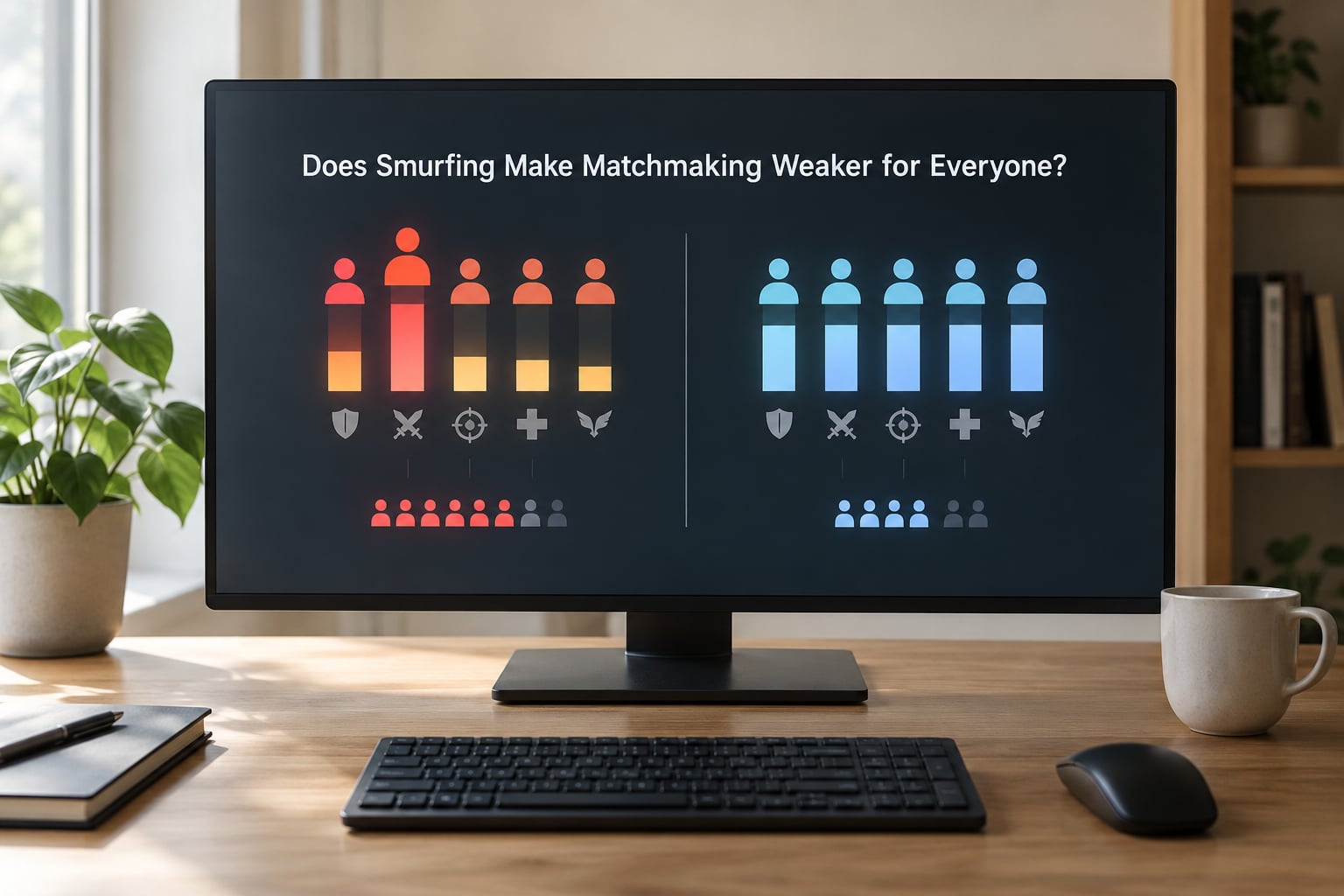
Not universally, and the distinction is worth holding onto. One smurf in a bracket of thousands has a small effect. A smurf concentration in one bracket, a coordinated group, or a smurf in a mode without smurf detection has a large one.
The effect scales with how concentrated the pollution is, and the worst-affected queues are the ones with the least data: the bottom of the ladder, the top of the ladder, and any mode where matchmaking is looser than the ranked queue. Players on the Blizzard forum thread noted that smurfs get spread across every bracket in modes without dedicated ranked matchmaking, which means a smurf in casual mode is not concentrated anywhere and is therefore harmless to casual balance but corrosive to the feeling that casual is fair.
New players get the worst of it
They have no placement data, so the system is guessing from a small number of matches, and they are landing in the bracket with the newest, least-calibrated accounts. Players on r/Competitiveoverwatch describe brand-new accounts dominating lobbies as the single most demoralizing scenario, and it is the one that most reliably produces the “this is rigged” reaction.
Returning players get hit twice
They face placement matches like a new player, but they also know what their old rank was worth. The comparison between the rank they earned and the experience of grinding back to it is what drives a lot of the quitting described in forum threads — people who take a two-year break and decide the ladder is not worth the trip back.
The average-skill player is the quietest victim
Their lobbies are polluted proportionally to how common pollution is, which is often high, and they have no public venue to complain in. The effect is a slow loss of faith: matches stop being informative, and a player who cannot improve from their results eventually stops bothering.
High-rank players lose something different
Their match quality is usually protected by thin populations at the top of the ladder, which is exactly why smurfing is unattractive to them. What they lose is the meaning of the ranks beneath them, and a chunk of them respond by becoming smurfs themselves, which is how the “ELO hell” loop starts.
What it does to premade groups and queue times
Premade groups complicate the picture because party matchmaking must respect the friends link, and the system has to average, maximise or abandon its rating objective to keep friends together. That choice alone can put a wide skill range in one lobby, with or without a smurf present. A Guild Wars 2 forum thread on partner rating disparities covers the technical version of this in detail.
Queue times get worse in a less obvious way. Every account that leaves ranked play to smurf, or leaves ranked play entirely, shrinks the effective ranked population, and a thinner population forces wider tolerances to find a match. The queue feels broken for reasons that have nothing to do with server capacity.
What Happens When Smurfs Are Detected or Reported
Penalties vary so much by title that any general claim about them is close to useless. The realistic outcomes, roughly in order of frequency, are a message, a rating adjustment or placement reset, a queue restriction, and last a ban.
Most of the time, the account that gets hit is not the obvious one. A smurf detected as a smurf is usually the account with the strongest statistical fingerprint — an impossible win rate, a time-to-rank velocity far outside the normal band, or a match history that reads like a copy of a high-level player’s habits.
Is smurfing considered cheating?
Officially, usually not. In most major titles, smurfing is a rules violation rather than a cheating offence, because the game never lost money and no system was exploited — the account was used by its owner. Boosting and account trading sit closer to the cheating line, and they are punished harder.
Community consensus disagrees sharply. A player in an r/Competitiveoverwatch thread argued that the smurf’s own experience is bad too, since their opponents are playing at or below their level, which makes a low-ranked smurf queue dull rather than triumphant. The Nadal analogy circulates constantly and lands hard: a top-ranked player masking themselves to re-run the ladder from zero would be called outrageous, and the smurf is treated as exactly that in most lobbies.
What reporting a smurf actually accomplishes
Honestly, not much on its own. Reports feed a review pipeline, and the pipeline is volume-limited, so an individual report matters most when it lands alongside a pattern. What makes a report useful is specificity: name the account, name the behaviour, and point at the matches where it is visible.
In practice, players who report consistently with evidence do see bans in these systems. Players who report on instinct mostly do not. That difference is the entire actionable part of reporting.
How Matchmaking Systems Try to Limit Smurfing
Every major publisher has attacked this from a different angle, and comparing them side by side is the clearest way to see what works. The honest summary is that verification gates work, detection heuristics catch part of the rest, and nobody has solved it.
| Title | Account gating | Detection approach | Enforcement | Known weakness |
|---|---|---|---|---|
| Counter-Strike 2 (Valve) | Steam Prime subscription requirement for some matchmaking tiers | Match history and statistical anomaly review | VAC bans, matchmaking restrictions, occasional account action | Free accounts remain plentiful, and Prime is a paywall rather than an identity check |
| Valorant and League of Legends (Riot) | Phone number verification, Riot account linking, regional restrictions | Behavioural and performance modelling plus manual review | Progressive: warnings, rank penalties, restricted queues, bans | Verification is strong at signup and weaker once an established account exists |
| Dota 2 (Valve) | Phone verification for ranked matchmaking | Rating and behaviour review | Ranked restrictions, MMR suppression, escalating penalties | Match quality complaints persist because a wide skill range is normal in the system |
| Overwatch 2 (Blizzard) | Battle.net account requirement; phone authorisation requirements have been removed | Skill and account-age heuristics | Restrictions on new accounts, competitive penalties | Account-creation friction dropped sharply, which increases smurf supply |
| Rocket League (Psyonix) | Platform account and trade restrictions on competitive play | Rating and win-rate monitoring | Competitive bans for repeat placement manipulation | Party queuing with friends remains a persistent gap |
The pattern is consistent. Where a publisher requires a verified, non-recyclable identity before ranked access, smurfing shrinks. Where it does not, the ranked queue becomes a market.
Why games don’t just match smurfs with each other
The idea of smurf quarantine — grouping suspected smurfs into their own queue — comes up constantly on forums and almost never ships. The reason is that it makes the problem visible instead of solving it.
Quarantine concentrates the best players into lobbies where nobody can win, which generates the worst possible player experience and a flood of complaints. It also fragments the population, and the account pool is finite. What would likely happen is a smaller, faster top queue and a more distorted bottom one, with the same total skill and a much worse time-to-quality distribution.
The queue time trade-off nobody wants to pay
Every hard verification measure removes accounts from the ranked pool. Fewer accounts means a thinner population, which means longer searches, which means wider skill tolerances and worse matches. This is the central tension, and it is why publishers drift toward softer measures that reduce smurfing a little without inflicting the queue cost on everyone.
A LevelUpTalk piece from April 2026 made a related point about Blizzard removing cellphone authorisation, and projected that restoring a comparable requirement would cut new smurf account creation substantially. The same change lengthens queues. Players who are skeptical of any fix that trades match quality for wait time are reasoning correctly, and the trade-off is real rather than rhetorical.
One prevalence figure is worth knowing and worth doubting. SmurfScanner’s February 2026 vendor analysis estimated that 10-20% of low-ELO lobbies contain at least one player performing two or more levels above their rank, and put new-player retention 15-25% below comparable games. Both numbers are unaudited and come from a company selling detection tooling, so treat them as an order-of-magnitude signal rather than a measurement.
How Players Can Tell Whether a Match Is Unfair
You will never confirm it in-game, and the search for certainty is mostly a way of feeling better about a loss. Still, some signals hold up better than others.
Statistical tells that survive scrutiny
- Performance far above the account’s history. A low-win-rate account posting a dominant game is a weak signal on its own. The same account doing it repeatedly is not.
- Unusually fast time-to-rank. Accounts that climb several divisions in a short window are what most review queues look for first.
- Damage or impact per round wildly out of line with the lobby. A player averaging several times the lobby’s combat contribution, game after game, is the clearest public fingerprint there is.
- Brand-new account with a full stack of new accounts. Fresh accounts queueing together is the strongest pattern, and it is why new-account party sizes get scrutiny.
- Friends clustered in a low bracket. A new player’s friend list being full of established low-ranked accounts, and the new account being added quickly, is a common shape.
- Consistency that reads as rehearsed. Players notice calm, unchanging decision-making in a chaotic low-rank game, sometimes before they notice the account age.
Account age, unusual agent or character picks and distinctive names are also cited constantly by players. They are warnings, not evidence.
Signals that look like smurfing but are not
A player dominating a lane because their main is second-position and their off-role is first is not a smurf. Neither is someone on a winning streak with a consistent build, or a friend helping another friend level a character, or a player who simply queued at the wrong time into a lopsided lobby. A thread on the Civilization fanatics forum makes the same point: playstyles match up unevenly, and a favourable matchup is not proof of anything.
Assumption is the expensive mistake here. Players who report every dominant opponent generate noise in the review pipeline, and the reports that would have mattered lose their weight.
Frequently Asked Questions
Does one smurf ruin matchmaking for everyone?
No, and the difference is scale. A single smurf in a healthy bracket with thousands of honest players has a small effect. Concentration is what does damage: several smurfs in the same low bracket, a coordinated group, or a smurf in a queue with no smurf handling at all. The impact scales with how polluted a single rating pool becomes, not with the total number of smurf accounts on the service.
Why do matchmaking systems struggle to detect smurfs?
Because a smurf produces no forensic evidence. The account is played competently and consistently, so there is no impossible stat line, no hardware change and no impossible time-zone gap. The only available signal is a gap between the account’s rating and how it performs, and the system is deliberately conservative about acting on performance alone, because the same pattern describes a player on a hot streak or playing an unfamiliar role well.
Can someone smurf without using a second account?
Yes, in a few ways. A player can deliberately lose placements to be seeded into a lower bracket, abandon a strong account to open a fresh one, or buy a ready-made low-ranked account instead of levelling their own. None of these needs a second account in the technical sense, and only the deliberate loss leaves a weak signature, since the account’s early results are too clean to be real.
What happens if I report a player for smurfing?
Your report enters a review pipeline that is limited in volume, so a single report rarely changes anything on its own. Reports matter when they are specific and when they arrive alongside a pattern from other players. Name the account, name the behaviour and point at the matches where it is visible. If the system believes you, the usual outcome is a rating adjustment or a queue restriction, with bans reserved for repeat cases.
Are unusually skilled players automatically smurfs?
No. A player can be skilled because of a recent improvement, a favourable role, a strong team around them, or a matchup that suits how they play. Forum discussion makes the same point repeatedly: a playstyle that beats yours is not evidence of anything. Account age, a new friend list and a sustained gap between performance and history are worth more together than any one of them alone.
How can game makers improve matchmaking quality?
Require a verified identity before ranked access, since phone and account-linking checks reduce smurf supply more than any detection heuristic. Detect and penalise accounts whose performance is far above their history, rather than only accounts performing poorly. Keep skill-based matching in casual modes instead of loose rules, and report outcomes to players so enforcement feels consistent. Each of these trades some queue speed for match quality.
Conclusion: Protect the Rating Pool First
What smurfing does to matchmaking quality is straightforward once you see the mechanism: it corrupts the rating pool that every pairing decision depends on, so a bracket’s average skill drifts below its labels and stays there as long as the supply of smurfs does. Nothing about this is fixable by a clever algorithm alone, because the account’s rating is a false statement and the system has no way to know.
What you can control is narrower. Report specifically rather than on instinct, since a noise-heavy report pipeline is a pipeline that stops working for the reports that matter. Treat a dominant opponent as an unexplained result rather than proof. And if your own matches feel consistently broken, your queue and your mode are the levers, not your rank.
For everyone else in the bracket, the fix belongs to the publisher: verify identity before ranked access, act on the gap between performance and history, and keep skill-based matching in the casual queues too. Games that do that shrink their smurf problem without wrecking queue times. The ones that skip it end up with a ladder nobody trusts, which is the most expensive outcome available to a competitive game.