Building team communication in competitive games comes down to four parts: a shared callout vocabulary, defined communication roles, short and consistent information, and a review loop that fixes one thing at a time. Most stacks see results within a week of drilling it, and none of the four needs more than a voice channel and ten minutes of setup.
The difference shows up in the seconds that decide rounds. A player hears a call, converts it into a move, and arrives before the enemy finishes the objective. Without that loop, four teammates see four different fights and lose all four of them.
Below is the system I would hand a new stack, with the drills, the phrases, and the review routine that turn good intentions into a habit.
Table of Contents
- What You Need
- Step-by-Step: How to Build Team Communication in Competitive Games
- Establish a Shared Callout Language
- Assign Communication Roles
- Practice Situations Before Matches
- Run a Reset and Review Routine
- Adapt Communication to the Game and Team
- Common Mistakes
- Frequently Asked Questions
- What are the best team communication tips for competitive games?
- How do you communicate effectively when players talk over each other?
- What should a team do when someone is not communicating?
- How can I improve team communication in solo queue?
- How do you know whether team communication is getting better?
- Conclusion
What You Need
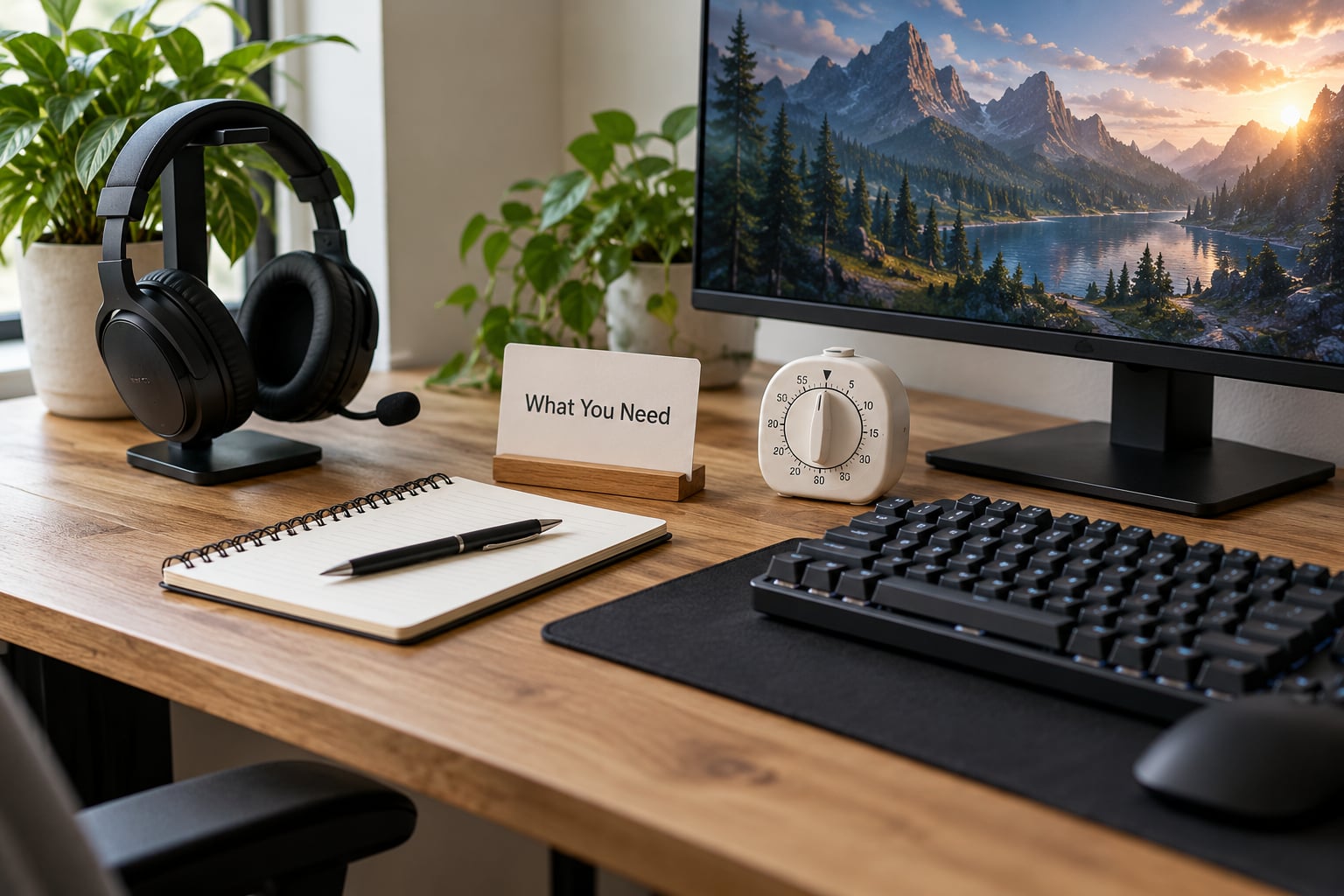
You need less than most teams assume. Everything below is either free or already on the machine you play on.
- A shared team language. A short list of agreed phrases for locations, threats and intentions. Write it on a card or a text channel everyone can see.
- Assigned roles. Someone has final say on the plan for the round, and everyone else knows who that is. Roles can change between sessions; the point is that they exist.
- A usable voice or text channel. Push-to-talk on the game’s own voice, or a third-party app if the game handles it badly. Check that teammates can actually hear you before you blame their silence.
- Clear match goals. Something narrower than win. Hold a defuse, do not lose a pistol, stop dying first contact. Goals decide which information matters.
- A way to review important rounds. Most games record your matches. Knowing where the replay file lands saves twenty minutes of hunting later.
- A callout card. One screen or one phone note with your map names, your roles and your five most important phrases. Reference it during the first weeks, then stop needing it.
If you are missing one of these, fix that before adding anything else. Teams that try to improve callouts while nobody knows who decides usually plateau fast.
Step-by-Step: How to Build Team Communication in Competitive Games
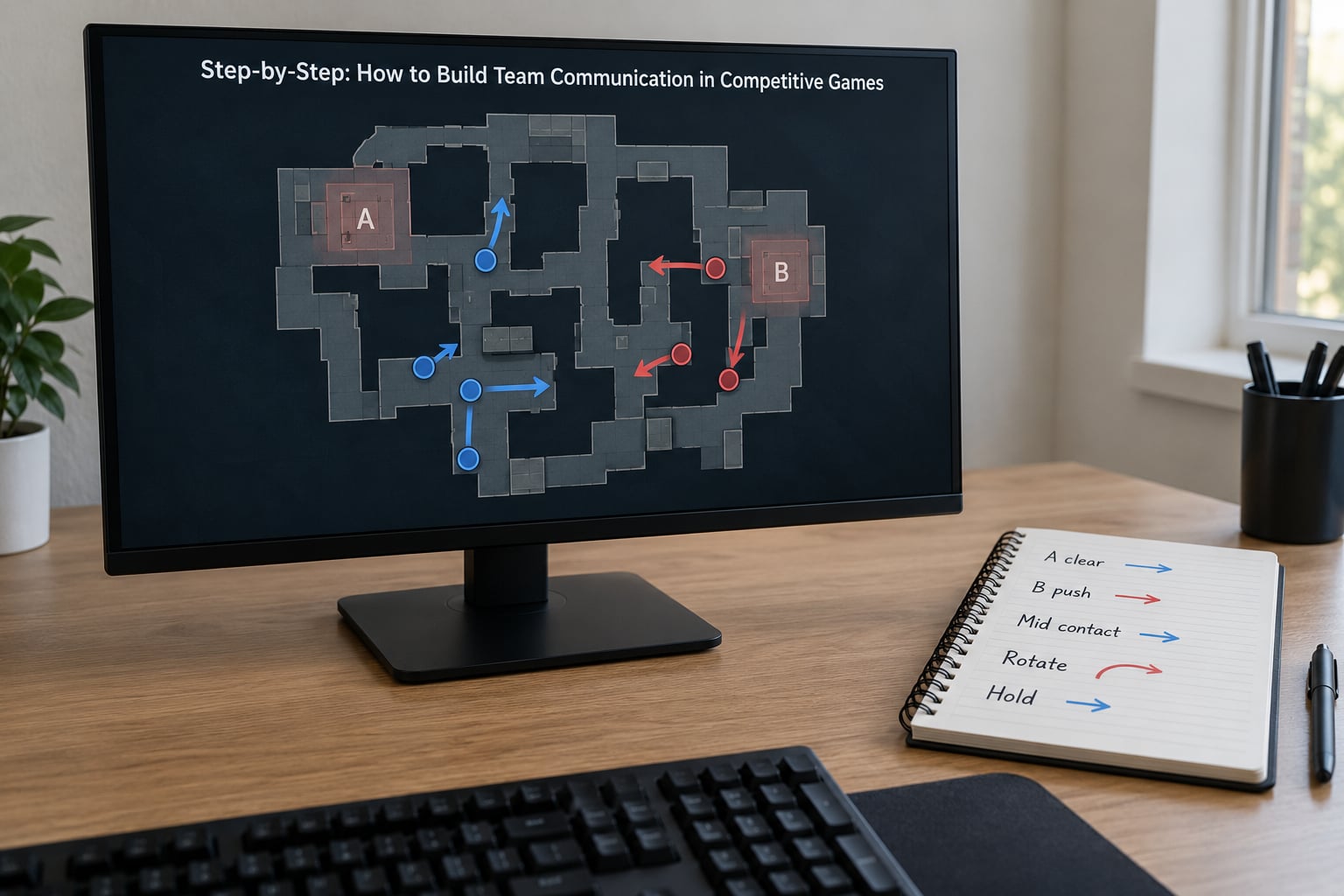
Work through the five steps in order. Each one is useless on its own, and each one is quick to set up.
Establish a Shared Callout Language
Start with five phrase types and no more, because a long vocabulary is a vocabulary nobody learns under pressure. Locations, threats, intentions, urgency and status cover most of what a round needs.
Location calls name the place and the count, never the person. Two B, one low tells a teammate what to do. Jake’s going B tells her nothing useful. Threats add what the enemy is doing: one pushing, they’re hitting us with a smoke. Intentions are your plan in three words: fake A, rotate B. Urgency is a single agreed sound or word that means drop everything. Status covers your own condition: low, one shot, I’m out.
Keep every call to three or four words and deliver it the moment you see it. A late perfect call is worth less than an early rough one, because the round has already turned by the time the good version arrives.
Say information, not commentary. Commentating what you already did adds nothing; the teammate who needs help needs to know what is happening right now, not what you were thinking two seconds ago.
Do this instead of that:
- Do say rotating B, need help mid. Don’t say guys I really think maybe B is a good idea for a hit, what do you think?
- Do say one flashed, he has no utility. Don’t say that flash was so bad, how do you even miss that.
- Do say I’m low, trading. Don’t stay silent and let a teammate walk into a duel they were told not to take.
- Do use the ping wheel or minimap for what the game already shows clearly. Don’t repeat it in words for four seconds.
- Do go completely quiet when a teammate is in a one-versus-many. Don’t coach them through it.
How you know it worked: a teammate who hears your call can state what they are about to do without asking you a follow-up question.
Assign Communication Roles
Roles stop the pile-on where four people talk at once and the useful sentence never lands. On a five stack, split the talking three ways.
- Primary caller. Owns the plan and the timing. This is usually the in-game leader, and on smaller teams the most reliable decision-maker rather than the best aimer.
- Tactical caller. Watches the minimap and the flank, and speaks up when the plan is no longer true. Says rotating, need help mid and nothing more.
- Support caller. Handles morale, timing warnings and the short confirmations: traded, no utility left, one minute. This role is the one that keeps a losing streak from becoming a disaster.
Everyone else still speaks. The difference is that a routine player reports what they see, and the roles hold the plan. If two people talk at once, the primary caller finishes their sentence first.
On three-player teams, merge the tactical and support roles and keep the primary caller. On a full pro-style roster, add one more layer: mid-round calling is handed to a designated player so the in-game leader is not juggling the plan and the fight at the same time.
How you know it worked: during a chaotic round you can hear who is speaking and why. Overlapping noise disappears within a few sessions.
Practice Situations Before Matches
Communication is a motor skill, so it trains like one. Run short drills with no ranking on the line, thirty minutes is plenty, and change one variable per session.
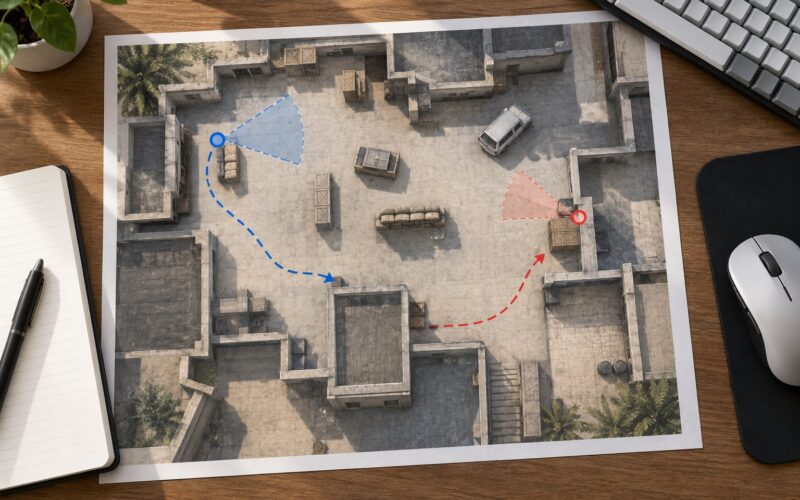
- Rotation drill, ten minutes. Run objective rotations on a map the team knows, calling every contact out loud as you move. The point is the call, not the round.
- Information drill, ten minutes. Play normally, but ban two words: why and should have. Everything must be stated as information or a request. Expect pushback for the first two sessions.
- Clutch drill, five minutes. Deliberately take fights one-versus-three and practice going silent. Teammates watch for the moment they should re-engage.
- Post-round drill, five minutes. After every round, the team says one thing that went well and one adjustment. Fifteen seconds, then start again.
- Slow-motion review, once a week. Watch one full match with audio and count the calls you each made. Most teams find the loudest player made most of them.
Then play. The purpose of a session is to fix one behaviour, and the behaviour has to show up in a real match for it to count.
How you know it worked: in your next ranked match, you catch yourself giving three short calls in a row instead of one long sentence.
Run a Reset and Review Routine
Teams rarely fail from lack of effort. They fail because nobody reviews, and the same mistake survives twenty matches.
After every match, run fifteen minutes with this order. First, each player says the one thing they did that helped the team. Second, the primary caller names exactly one adjustment for next match, phrased as behaviour rather than judgement: call the flank before you take it, not you never watch the B side. Third, the team rehearses that one adjustment in the next three rounds. Fourth, the session ends.
One adjustment per session is the hard rule, and it is the one teams break. Six corrections arrive at once, none of them sticks, and the review becomes a list of complaints nobody acted on.
Timing matters as much as content. Mid-round feedback breaks focus, especially for the player who is already in trouble. Save criticism for after the match and save encouragement for during it.
If teammates leave immediately after a loss, do the reset in voice on the way out. Two sentences of agreement on one change beats a full review nobody attends.
How you know it worked: the same adjustment keeps getting raised across different sessions, which means the team has finished with it and moved on.
Adapt Communication to the Game and Team
The four-part system transfers across genres, but the content of the calls changes completely. A tac shooter run by a team that only knows tac shooter vocabulary will be confused in any other game.
Tactical shooters and hero shooters reward positional information above all else. Counts, heights, utility state and timing decide rounds. Keep calls to three or four words and let the ping wheel carry anything the game already displays.
MOBAs shift the centre of gravity to intention and time. The valuable call is not that an enemy is missing, it is that the enemy jungler showed on your bot side, which tells the whole map to stop pushing. Target timers, level-up timings and ability cooldown calls matter more than positions.
Battle royales are mostly about resources. Call shield, health, ammunition, loot value and rotation plans. Information that does not change a decision is noise, and squads drown in it.
Fighting games use matchup and conditioning vocabulary, and the call window is tight. A single word naming the opponent’s habit is worth more than a sentence explaining it.
Two adjustments cover most awkward rooms. If the game or platform gives you unreliable voice, say your information twice in a fixed pattern, location then number, and lean on pings as confirmation. If your stack is far below a strategy’s skill level, drop the strategy. Complexity that the team cannot execute produces silence and blame, and a simple plan they can run produces the callouts you are trying to teach.
How you know it worked: a new player joins and is useful within ten rounds because the vocabulary was already written down.
Common Mistakes
1. Asking why instead of stating information. Why did you flash me? is heard as an accusation, so it gets a defensive answer and the round is gone. State the fact: flash landed on me, I’m blind. The lesson belongs after the match.
2. Talking over a teammate in a one-versus-many. Every extra word pulls their focus off the only thing keeping them alive. The polite version of this mistake is narrating their fight. Go quiet and let them work.
3. Blaming and excuses after dying. A player who dies is often the player with the most information available. Post-death criticism is the fastest way to end a teammate’s willingness to speak for the rest of the match.
4. Calling out everything. Reporting every enemy kills the useful information inside the noise. Call what changes a teammate’s decision and stay quiet about the rest. Trust the minimap for what it already shows.
5. Coaching mid-round. Telling a player what they should have done, while the round is still live, hands them a second problem on top of the first. Feedback after the round is welcome; feedback during it is an interruption.
6. Nobody owning the decision. Five players with five plans produce hesitation, and hesitation loses objective rounds more often than aim does. One person decides, everyone executes, and the plan is not debated until the round ends.
7. Running strategies above the stack’s level. A pro playbook executed by players who cannot yet hold a site produces silence and blame. Match the plan to what the team can reliably do, then raise the difficulty once execution is clean.
8. Reviewing nothing, or reviewing everything. No review means the same mistake repeats for a season. A critique session with eight points means none of them change. One adjustment, rehearsed in the next match, is the entire goal.
There is one objection worth taking seriously, because a lot of players hold it: communication does nothing for a team with no game sense. That is half right, and the half that is wrong matters. Comms will not fix bad positioning, but on any roughly equal pair of teams the round usually goes to whoever knew first, and nobody knew anything without someone saying it.
Frequently Asked Questions
What are the best team communication tips for competitive games?
The best tips are short: keep callouts to three or four words, say them the instant you have the information, state facts instead of asking why, and assign one person to own each round’s plan. Review one adjustment after every match rather than a list of complaints. Most of all, go silent whenever a teammate is in a one-versus-many, because talking over that player is the most common way a good team loses an unwinnable fight.
How do you communicate effectively when players talk over each other?
Give each kind of talk a single owner. One player owns the plan and timing, one watches the minimap and the flanks, one handles warnings and morale. When two voices collide, the plan owner finishes first and the other repeats the call once. Practise this in ten-minute drills rather than real matches, because the habit only forms where nothing is at stake. Expect it to take two or three sessions before it stops feeling like an artificial rule.
What should a team do when someone is not communicating?
Stop asking and start giving them a job. Assign the quiet player one specific report with a fixed phrase, such as a flank warning or a utility count, and use it every round without exception. Recognition of one useful call tends to produce a second. If they stay silent after several sessions, play around it: build the plan from pings and from the players who do talk, and do not let one mute teammate shape how the whole team communicates.
How can I improve team communication in solo queue?
You cannot fix the team, so fix your own contribution and your expectations. Give short, useful calls that cost you nothing, since solo players often outnumber the talkers. Accept that strangers will not read the minimap the way a premade stack does, and keep plans simple enough to execute on the first try. One useful call is enough to change a round, and that call is also the fastest way to get a good teammate to talk back.
How do you know whether team communication is getting better?
Track two numbers over ten matches: how many short calls your team makes per round, and how often a teammate repeats or corrects a call, which marks confusion. Watch one full match with audio each week and count the calls yourself. The clearest signal is behavioural: a teammate asks fewer follow-up questions because your calls already said enough. If the count is not rising, the fix is usually role confusion rather than vocabulary.
Conclusion
Building team communication in competitive games comes down to repetition of a small number of clear behaviours, not talent. Start on Monday by writing five phrases on a card and naming who owns the plan. This week, run the ten-minute rotation drill twice and finish every match with one adjustment instead of a list.
Give it a full week before you judge it. If the calls land and the follow-up questions stop, keep the review running, because that loop is what keeps a stack improving after the first hundred matches.