Knowing how to find scrims as an amateur team comes down to one habit: post a clear request, in more than one place, and confirm the details before anyone logs in. Most new rosters stall because they ask vaguely and give up after two silent days.
A scrim is an unofficial, scheduled practice match between two teams that are not facing each other in a tournament, and it is the only realistic way to rehearse a strategy, a map pool and your shot-calling as a unit. Ranked matchmaking drops you with strangers who do not share your plan, so it cannot replace it.
The whole process takes about 15 minutes of setup on your end per week. A Discord server, a shared calendar and one written rules sheet cover it. This guide covers what to have ready first, the seven steps that turn a cold post into a booked match, and the mistakes that keep good teams stuck.
Table of Contents
- What You Need Before You Start Looking
- Step-by-Step: How to Find Scrims as an Amateur Team
- 1. Choose a Scrim-Friendly Community or Platform
- 2. Build a Clear Team Availability Sheet
- 3. Post a Specific Scrim Request
- 4. Vet the Opposing Team Before You Agree
- 5. Agree on the Format and Rules
- 6. Use a Simple Schedule and Reminder System
- 7. Review the Scrim and Plan the Next One
- Common Mistakes
- Frequently Asked Questions
- How often should an amateur team play scrims?
- What is the best way to find scrims when nobody responds to my post?
- Should we scrim teams that are much stronger than us?
- How do we tell whether another team is a reliable scrim opponent?
- What should we do if an opponent no-shows or breaks the agreed rules?
- Conclusion
What You Need Before You Start Looking
You need four things, and only the first is a game account. Everything else is information other captains need in order to say yes without asking you five follow-up questions.
- A named roster with roles. Who plays, who shot-calls, and who subs in when someone is away.
- One communication channel the whole team reads. A Discord server works fine; a group chat with 40 unread messages does not.
- Real availability, including time zone. Days you can play, hours in UTC or your own offset, and how long a session can run.
- Match details. Game and mode, region or server preference, preferred format (best of 1, 3 or 5), and your honest skill bracket.
- A one-paragraph rules agreement. Map selection, bans, pauses, substitutions, spectators, recording consent, and whether the result counts for anything.
If you cannot answer those five in writing, you are not ready to post. A listing without them is the single most common reason scrim requests get ignored.
Step-by-Step: How to Find Scrims as an Amateur Team
Here is the order that works. Preparation first, then one wide post, then vetting, then a written agreement, then scheduling, then a short review that makes the next scrim easier to find.
1. Choose a Scrim-Friendly Community or Platform
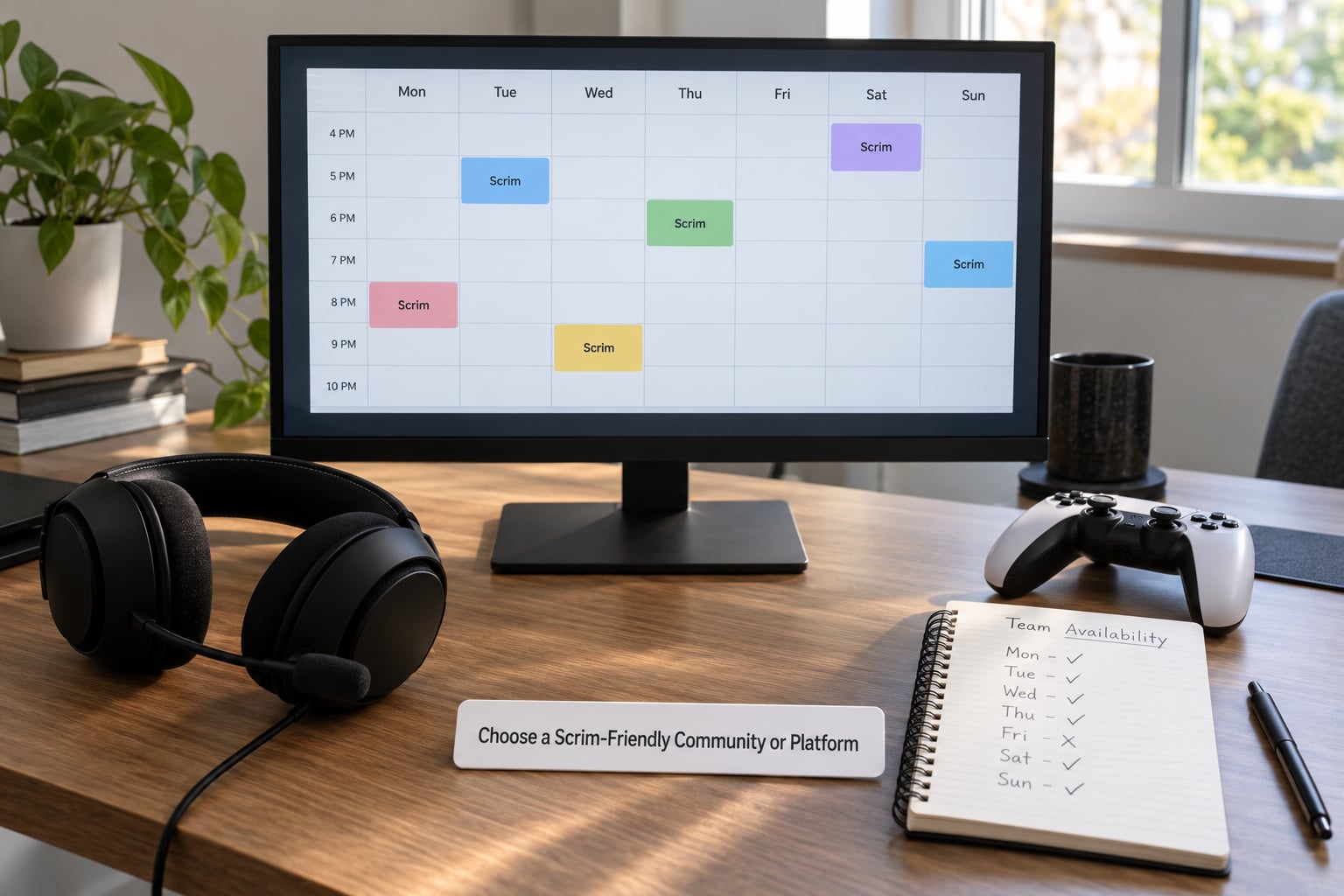
Join two or three communities, not one. Your problem is volume: a small server can be friendly and still post three listings a week, which is not enough to keep a weekly practice slot filled.
There are four kinds of places, and each is good at something different.
- Discord LFG and scrim servers. Fastest, free, and by far the most active. The cost is noise, so you filter by game, region and rank in the channel names and the bot commands.
- Dedicated scrim boards and finder sites. Structured listings with fields for game, date, time zone, format and skill tier. You post once and opponents come to you, which is far less work than chasing DMs.
- Game-specific communities. For shooters, the community often has its own ladder structure, and access can be gated on rank. Worth knowing before you invest time.
- Leagues and open circuits. Scheduled, refereed and paid in most cases. The slow starter’s answer when nothing else produces a booked match.
How do you tell a live server from a dead one? Look for message volume in the last week, not member count. A server with 40,000 members and four messages a day is worse than a 2,000-member community that posts scrims every evening. Member counts are the least reliable number on any Discord card.
Skip any server that needs a rank or age gate you do not clear, and treat a flood of sponsor ad cards as a warning that moderation is loose. Players regularly call out dead servers, ad spam and toxicity as the reason they stopped using a community, so judge on recent chat history rather than the description someone wrote.
Local groups work too. University esports societies, community meetups and regional Facebook groups often have whole teams inside them, and those teams usually show up because they are in the same building.
2. Build a Clear Team Availability Sheet
Write your availability down once, share it with your roster, and reuse it. Ten minutes here saves an hour of back-and-forth later.
Record four columns: each player’s time zone, the sessions they can reliably make, the roles that are open, and the longest session anyone wants to play in a week. Add your hard limits too, like no sessions after midnight on weeknights or a first match that has to end before a certain hour.
Time zone is the field that causes the most grief. A roster spread across three zones ends up with a “9pm” session that is really 6pm for one person and midnight for another, and the wrong half of the team stops showing up within a month. Put the offset in writing, such as UTC-5, and use UTC in listings so nobody has to convert anything.
Then match your sheet against the realistic number of sessions you can actually fill. If your sheet has one usable window, that is a constraint worth stating in your listing, because it saves you from proposing times that fall apart later.
3. Post a Specific Scrim Request
A scrim request gets accepted when the other captain can read it and picture the match without asking a follow-up question. Every field below earns its place.
- Game and mode. “Valorant, competitive 5v5” beats “looking to play.”
- Skill level, honestly. Name a rank range, a division, or an MMR band. Overstating your level is the fastest way to get a blowout and never hear back again.
- Date, time and time zone. Give two options, not an open window. Captains book concrete slots.
- Duration and format. Best of 1 for a single practice block, best of 3 when you want a full evening.
- Server or region. Mention it if low ping matters for your game.
- Ruleset in one line. Standard competitive map pool, or a custom one. State it here, not later.
- Roster size and role gaps. If you need a substitute, say so; scrims double as tryouts.
- One named contact. A person, not a channel nobody monitors.
Post the same request in every community you joined, then leave it live. Players say scrim requests posted in group chats scroll away and go unanswered within minutes, so the same message in three places beats a reshuffle every evening.
Give it a window. If a listing has not drawn interest in a few days, delete it and repost with different times rather than letting stale requests sit there and dilute your next one.
4. Vet the Opposing Team Before You Agree
Not every yes is a good practice match. A team two divisions above you teaches you almost nothing, and a team that flames a lost round teaches you something worse.
Check five things before you confirm. Look at their recent match history or tournaments if they have any. Watch how their players write in the thread, since the writing is a decent proxy for how they will call during a match. Ask whether the roster is stable or a rotating cast of substitutes. Read their scrim rules and see whether they fit what you need this week. And ask directly whether they want a competitive scrim or a casual one, because teams that want to win treat the session completely differently.
Ask to hear their comms if you can. Some communities will let you sit in on a call or join a practice briefly, and ten seconds of listening tells you more about a team than a week of messages.
New teams have no public record, and that is normal. Judge the unknown on behaviour instead: they answer questions, they show up at the agreed time, and they say so early when something breaks.
5. Agree on the Format and Rules
Most bad scrim endings start with a disagreement in voice chat that nobody could have predicted. Settle it in writing before the lobby opens.
Decide the format first: best of 1, best of 3 or best of 5, and how long each map runs. Then map selection and bans, including who picks first and whether the losing side of the previous map picks. Set the pause rules and how long a pause lasts. Allow or ban substitutions mid-series. Decide whether spectators and streamers are welcome. Get recording consent explicitly, because some players do not want their replays stored anywhere. Say whether the result affects tournament qualification, since a scrim with stakes attached stops being practice.
One more thing worth writing down: the shot-caller. Both teams should know who is calling, and your own roster should agree on it before the session so you are not debating mid-round.
Then treat the scrim as a real fixture. Play it properly, call your rotations, take the loss without breaking structure. Teams that throw a scrim to win one round teach their own players nothing and burn the relationship with the opponent.
6. Use a Simple Schedule and Reminder System
No-shows are the biggest time sink an amateur team has, and they come down to one thing: people forget. Build three habits and the problem mostly disappears.
Put every confirmed scrim in a shared calendar the moment it is confirmed, with the server details in the event description. Set reminders at 24 hours and one hour before. Send a check-in message in your own team channel the day before asking everyone to confirm, which is also your chance to call a substitute early rather than at start time. And keep a backup contact, usually a second captain, in case the primary does not answer.
Scheduling several days ahead is the norm in communities where this is most reliable, because it gives the whole roster notice and keeps the night from becoming stressful.
When you do need to cancel, cancel early and say why. One well-timed cancellation costs you far less than a silent one, and captains remember who warned them early.
7. Review the Scrim and Plan the Next One
A scrim you do not review is just a match you played. Spend fifteen minutes afterwards and the session pays off twice.
Capture three or four observations while they are fresh: what worked in the first half, what broke in the second, which comms were unclear, and whether the format gave you enough reps of what you wanted to practise. Review the replay together if you recorded one, focusing on decision-making rather than individual aim.
Then judge the opponent honestly. Was this a useful practice match? Were they communicative and respectful? Would you want to play them again next week? Send that back to them, briefly and kindly, and offer a return date. Repeat scrims with two or three reliable teams beat a rotating cast of strangers every single time, because the second match is where communication actually improves.
Log the session somewhere: a spreadsheet, a Discord channel, whatever your team already uses. A visible record of who you played, when and what format is the beginning of a match history, and match history is what later teams look at before they answer a request from an unknown roster.
Common Mistakes
These are the patterns that keep amateur teams stuck. Most are fixable in the first week.
- Vague availability. Fix: publish fixed time slots with your UTC offset. Open windows get ignored.
- Posting in only one community. Fix: run the identical request in three places. Volume is the whole game at the start.
- No rules before the match. Fix: send a short rules message at confirmation, even if it is three lines.
- Picking opponents outside your range. Fix: name your bracket honestly in the listing and filter replies to the same band.
- Ignoring time zones. Fix: use UTC in every listing and check the offset with the other captain before confirming.
- Skipping the check-in. Fix: a message the day before, plus reminders at 24 hours and one hour.
- Never following up. Fix: send feedback and propose the next date in the same message. Teams remember who follows through.
Two smaller habits help more than they sound. Keep your listing text and rules message in a reusable document so the next post takes two minutes, and treat any team that no-shows once as a name you pass on to the rest of your region.
Frequently Asked Questions
How often should an amateur team play scrims?
Two or three sessions a week is a realistic target for a roster with a school or work schedule. One well-reviewed scrim a week beats three unplayed ones, because the review is where the improvement happens. Teams preparing for a tournament usually add a second block that week and keep a lighter schedule the rest of the month.
What is the best way to find scrims when nobody responds to my post?
Post in more than one place rather than editing the same message. Three active communities, a scrim board and a direct message to two or three nearby captains is a normal week. Also widen your time window by an hour and offer a best-of-1 instead of a best-of-3, since both are common reasons a good request goes unfilled.
Should we scrim teams that are much stronger than us?
Occasionally, yes, as a learning session rather than a competitive one. A much stronger opponent exposes gaps in your structure and gives you something to study in the replay, but the result itself means nothing. Pair it with a closer match in the same week so the actual practice is against a comparable team.
How do we tell whether another team is a reliable scrim opponent?
Watch behaviour rather than reputation. Do they confirm on time, do they answer questions before the match, and do they tell you early when something breaks? A team with no public match record but a strong record of showing up is worth more than a well-known roster that cancels often. Ask other captains who have played them if you can.
What should we do if an opponent no-shows or breaks the agreed rules?
Message them once, calmly and factually, and give them a chance to explain. If it repeats, stop offering them slots and tell the other captains in your community, because unreliable teams are usually known but rarely named. Fill the time with a review of your earlier session, and treat the gap as protected practice time rather than dead time.
Conclusion
Start with three small things this week. Write one availability and rules sheet with your time zones, session windows and match format, then join two active communities and post the same specific request in both. Keep the request narrow: one game, one format, two concrete time slots, honest about your skill.
The second week matters more than the first reply. Confirm the details in writing, play the match properly, send two lines of feedback afterwards and book the next one. Teams that run a small, predictable routine get scrims; teams that wait for a good offer rarely do.