Most signed competitive esports players in the US earn somewhere between USD 20,000 and USD 100,000 a year in base team salary, while a small number of champions and established stars reach six or even seven figures once prize money, sponsorships and streaming revenue are counted. So how much do esports players make really mean? It depends almost entirely on which tier of competition they play in and whether the number you are reading is guaranteed pay or a best-case year.
I have gone through the salary surveys, team-by-team breakdowns and player forum threads that circulate these numbers, and the honest answer is that the average figures you find online describe a person who does not exist. They blend a tier-one star with a developmental player and call the result an average. The tables below break the market into tiers you can actually locate yourself in.
Table of Contents
- How Much Do Esports Players Make? US Salary Overview
- How Much Do Esports Players Make by Game?
- What Is the Salary Range for Esports Players?
- Collegiate and scholarship play
- Developmental and regional leagues
- Tier-one league rosters
- International franchise and championship level
- Why Do Some Esports Players Earn More Than Others?
- Game popularity and broadcast revenue
- Organization budget and ownership
- Role and competitive results
- Personal marketability
- Region and contract length
- How Do Esports Players Make Money?
- How prize money is actually split
- What your gross pay does not cover
- How Much Do Esports Players Make by Role?
- Do College and Amateur Esports Players Get Paid?
- What Affects the Price of an Esports Player’s Contract?
- Ways to Save and Increase Esports Earnings
- Frequently Asked Questions
- How much do most esports players make?
- Which esports game pays its players the most?
- Do esports players get paid only for tournaments?
- Can a professional esports player make a full-time salary?
- How much money do beginner esports players make?
- What Should an Aspiring Esports Player Do First?
How Much Do Esports Players Make? US Salary Overview
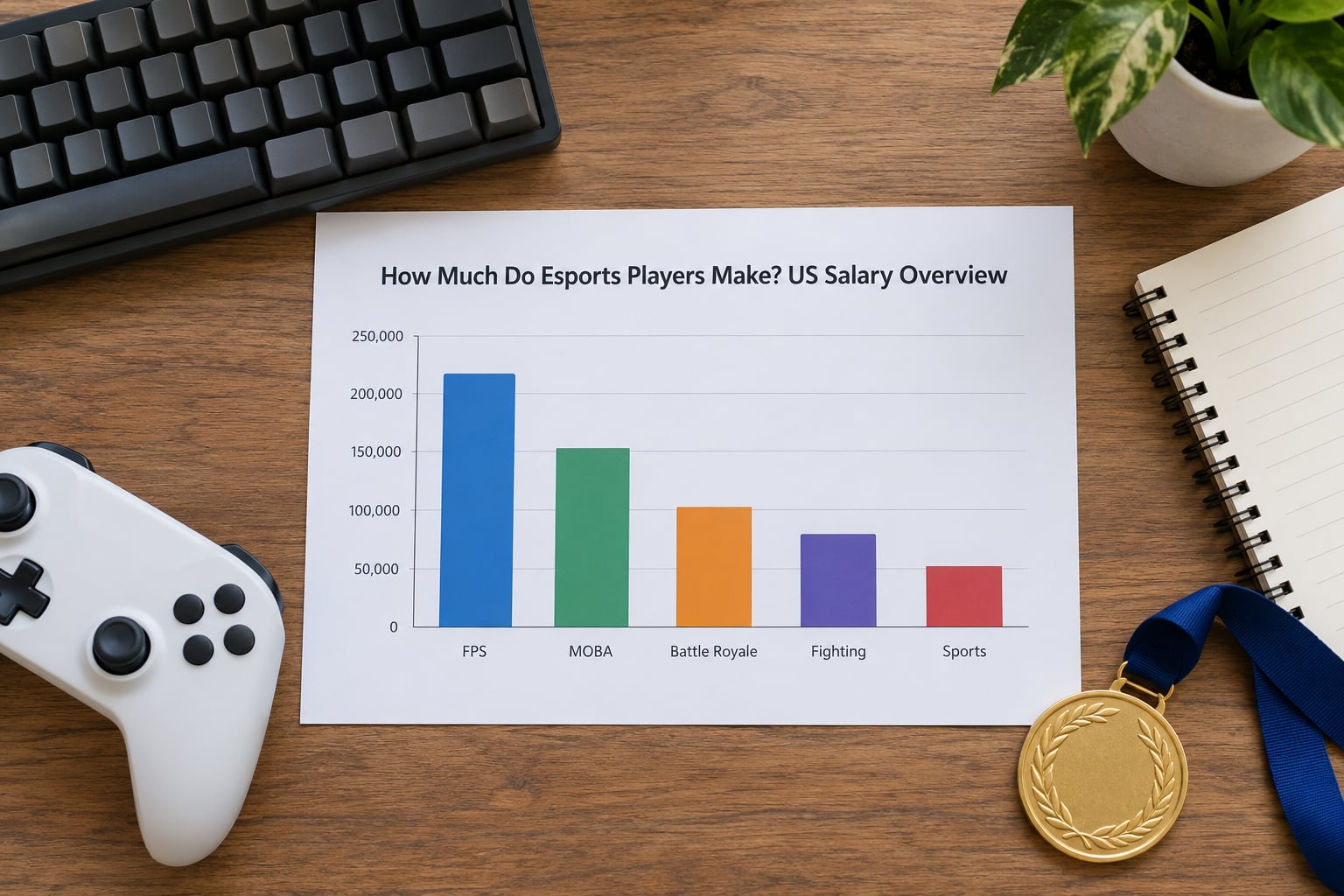
Most signed competitive players earn roughly USD 20,000 to USD 100,000 annually, while prominent champions and established stars can reach seven figures. That gap is the single most important thing to understand about esports pay. A player is rarely paid according to how good they are in a ranked ladder; they are paid according to what their presence is worth to an organization that needs results, viewers and sponsors.
Five different numbers get collapsed into the phrase esports player salary, and mixing them up is why online figures conflict so badly.
- Base team salary is the guaranteed monthly or annual amount written into a contract. This is the only money a player can count on in a bad year.
- Prize winnings come from tournament payouts and are shared between the roster and the organization, usually on a negotiated split rather than a universal one.
- League distributions are pooled payments some leagues make to participating teams, which can be a meaningful line item in scenes with strong broadcast revenue.
- Sponsorships and appearance fees are paid to individual players or to the team, and they are the least public of all income streams.
- Streaming, content and merchandise are personal income that a player keeps, though many contracts require a minimum number of broadcast hours.
The tier table below is the version I would hand to a parent or a nineteen-year-old asking whether the career is realistic. Ranges are typical US estimates and they move around with the region and the season.
| Career tier | Typical annual compensation | What this tier actually looks like |
|---|---|---|
| Amateur, collegiate and open-circuit | USD 0 to USD 10,000 | Often unpaid. Some college programs offer scholarships, and travel is usually self-funded. |
| Developmental or academy roster | USD 15,000 to USD 40,000 | Full-time practice with modest pay, frequently supplemented by streaming hours. |
| Full-time professional, lower and mid tier | USD 40,000 to USD 90,000 | Regional leagues and tier-two rosters where prize money is possible but not reliable. |
| Tier-one franchise starter | USD 100,000 to USD 300,000 | League positions with broadcast deals, revenue sharing and real sponsor interest. |
| Elite star or champion | USD 500,000 to seven figures | Global recognition, personal sponsorships, large prize hauls and in-game item revenue. |
One thread on r/esports put the floor in the LCK at about USD 6,000 a month, or roughly USD 72,000 a year, while noting that top-tier players in the same league can approach USD 1 million. Both figures are describing real contracts in the same region. That is what the market looks like up close.
Job-posting aggregators will quote a far higher number. ZipRecruiter, for example, has published an esports salary average well above USD 150,000 a year. That figure comes from listings, which over-represent coaching, management, broadcasting and analyst roles rather than player contracts. It is not a mistake, but it is not an answer to the question players are asking.
How Much Do Esports Players Make by Game?
The game matters more than the region in a surprising number of cases, because game popularity drives broadcast revenue, which drives team budgets, which drives salaries. Scenes with a deep sponsor base and a stable league structure pay more for the same level of performance.
| Game | Common earning model | Lower annual range | Upper annual range | Key caveat |
|---|---|---|---|---|
| League of Legends | League salary plus revenue pool plus Worlds prize share | USD 40,000 | USD 700,000+ | The widest spread of any scene; regional league pay varies enormously. |
| Counter-Strike 2 | Team salary plus sticker and item revenue plus major winnings | USD 35,000 | USD 500,000 | Rosters are small, so one star can carry a team budget. |
| VALORANT | Partner league salary plus bundle revenue share | USD 45,000 | USD 400,000 | Brand-new partner rosters are paid on performance, not name value. |
| Dota 2 | Team salary plus The International prize pool | USD 25,000 | USD 400,000 | Low base pay is partly offset by one enormous annual event. |
| Fortnite | Creator-led income with team and tournament support | USD 10,000 | USD 500,000+ | Income often comes from content rather than a league salary. |
| Overwatch 2 | Overwatch League salary structure | USD 40,000 | USD 300,000 | Team pay depends heavily on an individual owner’s budget. |
| Super Smash Bros. Ultimate | Tournament circuit, sponsorship and streaming | USD 0 | USD 200,000 | Many top competitors have no team salary at all. |
| Street Fighter 6 | Prize pool and appearance fees | USD 0 | USD 150,000 | A thin calendar means income is lumpy between events. |
| Rocket League | Team salary plus championship prize money | USD 25,000 | USD 250,000 | Regional pay differences are large; players on r/RocketLeagueEsports repeatedly note EU salaries running well above NA for the same tier. |
These are the same player, doing the same job, in two different scenes. That is why comparing salaries across games without naming the game is meaningless.
What Is the Salary Range for Esports Players?
Think of the competitive ladder as six rungs, and it helps to know which one you are standing on before you negotiate.
Collegiate and scholarship play
College esports in the US is usually a scholarship, tuition support or a small stipend rather than a salary. Some of the largest programs fund players directly, but the arrangement varies enormously by school and by the health of the school’s competitive program. Players who need the money now rarely have it.
Developmental and regional leagues
This is where full-time play starts for most people who reach it. Developmental leagues exist in several major titles and pay enough to live on in cheap cities, often alongside required streaming hours that quietly become a second job. Regional and lower-tier professional rosters sit slightly above this, and forum discussions about Counter-Strike semi-pro play repeatedly land in the USD 2,000 to USD 3,000 a month range before bonuses.
Tier-one league rosters
Full-time professionals in established leagues are the group most articles mean when they quote an average. Base pay here commonly sits between USD 60,000 and USD 250,000 depending on the league, with the top of the range concentrated in scenes with strong revenue sharing.
International franchise and championship level
Only a fraction of league players reach the pay band where a championship changes their career. International franchise owners in scenes with large fan bases pay for stars, not for role players, and the difference between the two is often a factor of five or more.
A note on precision: almost none of these ranges are published contracts. They come from salary surveys, anonymous player reports, leak-based spreadsheets and team announcements, and they should be read as a range of the market rather than a quote.
Why Do Some Esports Players Earn More Than Others?
Pay disparity in esports comes down to a short list of factors, and most of them are structural rather than a matter of talent.
Game popularity and broadcast revenue
A game with a large, young, sponsor-friendly audience produces more media deals, which raises the salary cap or revenue pool every team draws from. Game popularity is the strongest single predictor of pay, and it changes quickly as audiences move.
Organization budget and ownership
Two teams in the same league can pay differently because one owner spends freely on winning and the other treats the roster as a cost line. Forum threads about Overwatch salaries capture this well, with players describing a monthly range from roughly USD 1,000 to USD 3,000 depending entirely on which organization signed them.
Role and competitive results
Carrying a team matters. Players who convert standings into prize money and sponsor attention have bargaining power that their teammates do not, which is part of why support and reserve players earn less.
Personal marketability
A player who can speak, stream, appear at events and hold an audience is a marketing asset as well as a competitor. That is the single biggest lever an individual player controls, and it is why many top earners earn more off the server than on it.
Region and contract length
Scenes differ enough that a move changes pay more than a promotion. Contract term matters too, since multi-year deals at a rising organization can out-earn a short deal at a famous one.
How Do Esports Players Make Money?
There are seven income streams worth tracking, and they split into two very different groups depending on who receives the money.
- Team salary. The guaranteed base. Negotiated, usually monthly, and the only predictable component for most players.
- Tournament prize money. Paid on results. A great month and a terrible quarter can happen in the same season, and some players have never won anything at all.
- League distributions. Pooled revenue shared among participating teams or players, which smooths income in scenes that run one.
- In-game item and cosmetic revenue. Player stickers, bundles and item royalties. In several major titles this has become a serious income line for established names.
- Sponsorships and appearance fees. Both team-level and personal deals, paid on playing, streaming and appearing at events.
- Streaming and content revenue. Subscriptions, bits, donations, channel memberships and ad revenue. Usually the most scalable line, and the one most often tied to contract obligations.
- Post-career work. Coaching, analysis, casting, management and community roles. This is where many former players rebuild income after retirement.
How prize money is actually split
Prize money goes to the organization first, not the player. The split between org and roster is negotiated in the contract, and a 20% org, 80% roster split is the figure most commonly cited in reporting and discussion. Smaller tournaments sometimes distribute less to players, and some contracts treat winnings as shared with management and support staff. If you care about this, ask for the split in writing before signing.
What your gross pay does not cover
Headline salary is not take-home pay. Players carry income tax and self-employment obligations in most cases, pay an agent or manager a percentage, and often cover relocation, housing, equipment and travel. Some contracts also assign a percentage of streaming income to the team. A worked example is the clearest way to see this: on a USD 200,000 salary, taxes, a five percent management fee, agent costs and USD 20,000 of relocation and housing can take the first year’s take-home down by a third or more.
How Much Do Esports Players Make by Role?
Role matters, but the format of the game decides how much it matters. A five-player team has a very different internal pay structure from a one-versus-one game, and a battle royale with twelve squads on a roster behaves differently again.
| Role | Typical annual range | What drives the pay |
|---|---|---|
| Star carry or franchise player | USD 150,000 to seven figures | Directly decides results and carries sponsor and broadcast value. |
| Captain | USD 80,000 to USD 400,000 | Usually also a star, with the reputation and communication load on top. |
| Starter | USD 50,000 to USD 200,000 | Regular minutes and a consistent contribution to results. |
| Support or flex | USD 30,000 to USD 120,000 | Value depends on how visible the role is in that specific game. |
| Substitute | USD 25,000 to USD 100,000 | Paid less, activated by illness, rotation or meta shifts. |
| Reserve and academy | USD 15,000 to USD 50,000 | Development contracts, often the first pro pay a player receives. |
Per-game statistics are a weak predictor of salary on their own. Franchise value, contract timing, negotiation skill and marketability move the number far more than a kill-death ratio. In team titles, a player who makes teammates better can out-earn a player with better raw numbers, and that surprises people who assume stats drive everything.
Do College and Amateur Esports Players Get Paid?
Mostly no, and anyone who tells you otherwise is describing a very small slice of the market. At the bottom of the pyramid the honest list of payments looks like this: a college scholarship where one exists, a development league stipend, a small-team salary, prize money from open tournaments, and money made by streaming or creating content.
Everything else is a cost you carry yourself. Entry fees, travel to qualifiers, lodging, meals, a PC setup, peripherals and the time away from school or a job all come out of the same budget, and for most amateur competitors that budget is negative by the end of a season. Players in r/GlobalOffensive describing semi-pro pay land in roughly the USD 2,000 to USD 4,000 a month band for the better-paid rosters in that scene, with many players reporting nothing at all and self-funding their own events.
If someone is trying to decide whether to go full-time, this is the tier where that decision is genuinely risky. The earnings gap between a self-funded amateur and a signed professional is not a raise; it is a different financial existence.
What Affects the Price of an Esports Player’s Contract?
Contract terms explain why two players with the same results get different offers, and why published totals are hard to compare.
- Guaranteed compensation is the number that matters most, and it is the only one you can bank.
- Performance bonuses pay out on qualifying for events, finishing in the top of standings, or winning. Total compensation packages quoted in reporting sometimes swing enormously once bonuses are included.
- Prize-pool participation defines how much of a tournament payout actually reaches you.
- Term length affects your bargaining power. A three-year deal at a growing organization may beat a one-year deal at a famous one.
- Buyout clauses determine whether another team can sign you and what it costs.
- Streaming obligations set minimum broadcast hours, which can consume your evenings and your ability to build your own channel.
- Relocation terms cover travel, housing and whether the organization pays for a move abroad.
- Image rights and exclusivity decide how much of your personal brand you can keep.
- Sponsor income sharing determines whether personal endorsement deals go to you alone or are split with the team.
That last list explains the confusion in most salary articles. When a number is published, it may be salary, salary plus bonuses, or salary plus bonuses plus prize potential. Reading the source carefully matters more than the figure itself.
Ways to Save and Increase Esports Earnings
Esports income arrives irregularly, which makes basic money management more important than it is for someone on a steady paycheck.
- Budget around guaranteed pay only. Treat prize money and bonuses as upside, not income. A budget built on a tournament win collapses in about two months.
- Set aside taxes as they arrive. Players are often treated as self-employed, so quarterly obligations land before the money is spent.
- Control housing and relocation costs. This is the single biggest expense most players underestimate, especially when moving for a team in an expensive city.
- Read the contract before the offer. Prize split, streaming hours and buyout terms are worth more than a modest base raise.
- Keep your own streaming revenue. Audience numbers built during a career are the asset you own and the one you can still sell afterward.
- Seek sponsorships with a track record. Brands want measurable audience and reliable delivery, not raw follower counts.
- Build the second career early. Coaching, analysis, casting and community work are realistic post-retirement income, and preparing for them costs nothing while you are playing.
All compensation ranges in this article are typical US estimates. They vary by region, by game and by season, and they change over time.
Frequently Asked Questions
How much do most esports players make?
Most signed competitive players earn roughly USD 20,000 to USD 100,000 a year in base team salary, with developmental rosters at the low end and tier-one league starters in the middle. Aggregate salary sites quote averages well above USD 150,000, but those figures come from job listings for coaching, analysis and broadcasting roles rather than from player contracts. The player pool is heavily weighted toward modest regional salaries.
Which esports game pays its players the most?
League of Legends generally pays the most at the very top, with international franchise stars reaching seven figures once league revenue sharing and Worlds prize money are added. Counter-Strike 2 and Dota 2 follow, though both rely heavily on item and sticker revenue. Scenes like Super Smash Bros. Ultimate and Street Fighter 6 pay well through tournaments and sponsorships but offer very few salaried players at all.
Do esports players get paid only for tournaments?
No. Base team salary is the largest income source for most full-time professionals, and it is guaranteed whether the team wins or loses. Prize money is the most variable part, often shared with the organization on a negotiated split, frequently cited as 80% to players and 20% to the org. League distributions, in-game item revenue, sponsorships and streaming income add further layers that have nothing to do with tournament results.
Can a professional esports player make a full-time salary?
Yes, in the middle and upper tiers of the professional ladder, but not reliably in the developmental ranks. A tier-one league starter can comfortably support themselves on base pay. A developmental or semi-pro player usually cannot, and many rely on required streaming hours to close the gap. The safe approach is to treat competitive income as uncertain and build savings around the guaranteed portion of any contract.
How much money do beginner esports players make?
Beginner and amateur competitors usually make nothing at all. College players may hold a scholarship or stipend, open-circuit players pay their own entry fees and travel, and the better-paid semi-pro rosters discussed in player forums sit around USD 2,000 to USD 4,000 a month. The realistic path is to treat open competition as unpaid practice, build an audience, and treat prize money as a bonus rather than income.
What Should an Aspiring Esports Player Do First?
Start by pricing the offer honestly, not the dream. Ask a team for the guaranteed monthly figure, the prize split, the streaming requirement and the term length, then subtract what your own living and equipment costs would be in that city. A USD 2,000 monthly salary in an expensive city is a worse offer than it looks, and a smaller salary in a cheap one is often the smarter path while you are learning.
Build competitive skill and content skill in parallel from the start, because the players who last longest are usually the ones who kept an audience after the roster moved on. Savings built during a modest salary are what let you take a risk on a developmental contract later.
Treat competitive income as uncertain until a contract proves otherwise, and if you cannot live on the guaranteed number, keep open circuit or another income source running alongside your attempts.