A coach on an esports team designs the strategy, runs the practice and scrim schedule, reviews game footage with players, scouts upcoming opponents, and keeps team communication and morale healthy. In short, the coach is the person who turns a group of talented individual players into a team that performs the same way under pressure.
That job is less visible than the matches themselves, which is exactly why it is hard to picture. Players in Reddit threads asking what a coach actually does usually get the same answer: analyse performance, scout the opposition, build strategy, arrange practice, keep players in condition, and support them through the bad weeks.
Below is what that looks like in practice — the day-to-day work, the match cycle, the numbers coaches watch, the difference between a coach and a team manager, and how you get into the role if you want it. Updated for 2026.
Table of Contents
- What Does a Coach Do on an Esports Team?
- How an Esports Coach Supports Player Performance
- Feedback that lands at the right moment
- Worked example: correcting bad timing without losing the player
- Building habits and confidence
- What an Esports Coach Does Before and After a Match
- Before the match
- During the match
- After the match
- Where coaching ends and other roles begin
- A Day in the Life of an Esports Coach
- How Coaches Create and Communicate Strategy
- Finding the patterns
- Turning it into instructions
- Getting players to buy in
- What Metrics Do Esports Coaches Track?
- How Do Head Coaches and Assistant Coaches Differ?
- How Does a Coach Work with the Rest of the Team?
- How Do You Become an Esports Coach?
- Frequently Asked Questions
- What does a coach do on an esports team?
- Does an esports coach make decisions during a match?
- What is the difference between a coach and a team manager?
- How much does an esports coach make?
- Do esports coaches work full time?
- How does a coach help a player who is underperforming?
- Conclusion
What Does a Coach Do on an Esports Team?
An esports coach is responsible for the team’s performance on the server and for the development of each player inside it. The role covers preparation, analysis, communication, and wellbeing, and it changes shape depending on the game and the organisation.
The core duties most pro teams expect:
- Strategy development. Building a playbook of openings, defaults, rotations, and win conditions that the team can fall back on when a plan breaks down mid-round.
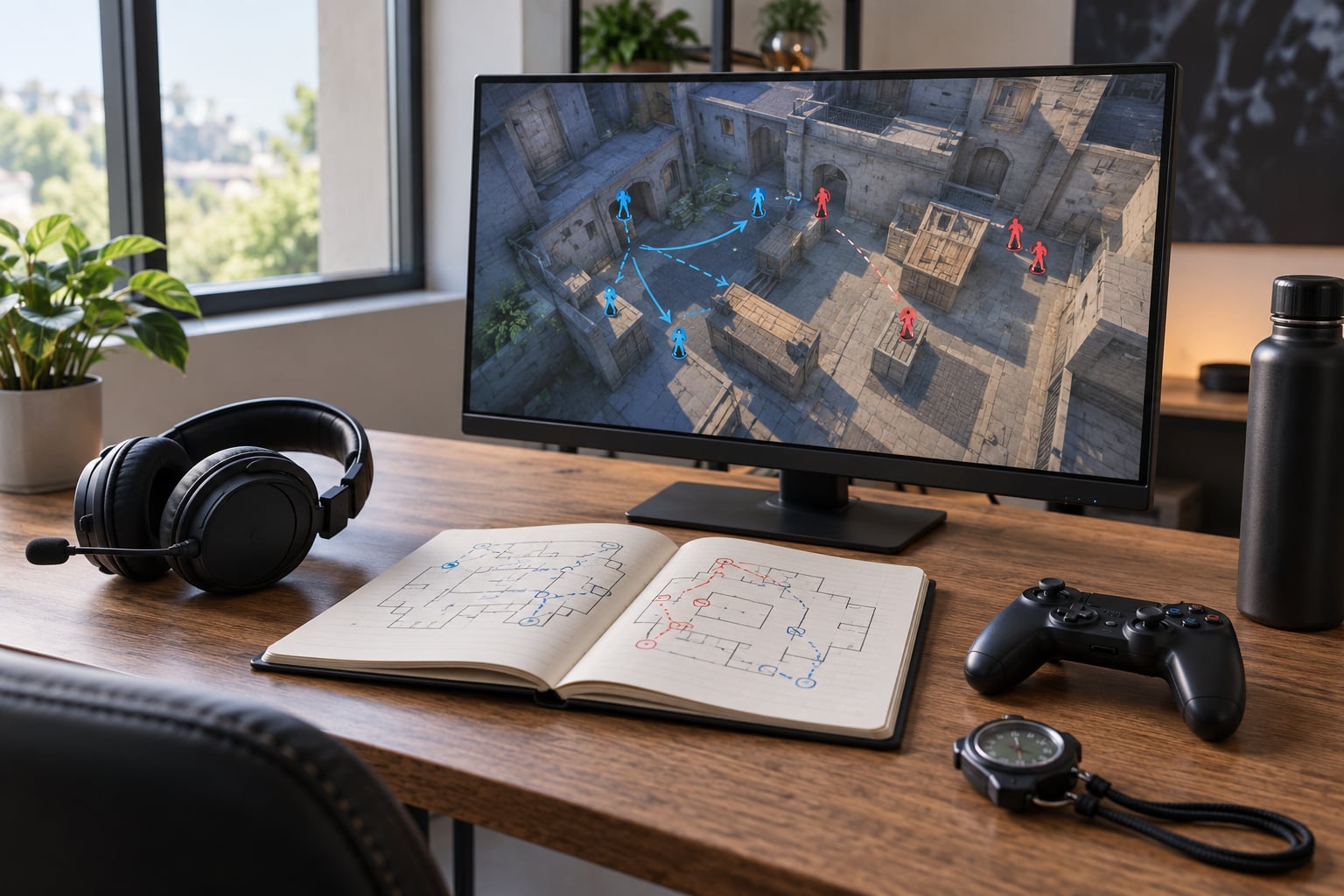
- VOD review. Watching game footage with the players, pausing at specific timestamps, and turning what happened into one or two things to fix in the next session.
- Opponent scouting. Studying the next team’s tendencies, preferred maps, and anti-strats, then building counters before anyone steps on stage.
- Practice and scrim management. Deciding what a practice block is for, booking scrims, and setting one to three objectives so a six-hour day is not six hours of warm-up.
- Draft and roster decisions (game dependent). In games like League of Legends or Dota 2, the coaching staff often shapes picks and bans and advises the in-game leader on the draft.
- Team communication and culture. Running meetings, settling disputes, and making sure the players can say a player is struggling before it turns into a slump.
- Player development. Individual plans for aim, mechanics, decision-making, and confidence, built around each player’s habits rather than a group template.
- Tournament preparation. Opponent-specific prep, schedule and travel logistics with the manager, and mental prep for LAN days.
- Mental performance and wellbeing. Watching for burnout, managing pressure, and protecting the players from a punishing schedule.
Coaches are judged on more than win rate. A team that improves but finishes fourth is usually viewed differently from a team that wins everything while two players burn out and leave.
How an Esports Coach Supports Player Performance
Elite players already have near-max mechanics. The gap between a good player and a great player is usually decision speed, discipline, and how they behave when the plan breaks, which is where coaching does most of its work.
Feedback that lands at the right moment
Timing matters more than volume. Interrupting a player mid-round to correct something is usually a mistake; you can tell them after the round is over, then again in review. Coaches in the community talk about the same split — a short comment during play, a longer conversation once the session finishes.
One common rule of thumb in esports coaching puts roughly 70 percent of a session under player control and 30 percent under coach instruction. In practice that means the coach talks less than most people expect, and spends most of the session on the two or three things that actually cost the team rounds.
Worked example: correcting bad timing without losing the player
A duelist is rotating late and the team dies every time. The wrong version is a comment in the middle of the game that the player is now playing scared for the rest of the round. The version that works is quieter: the coach notes the timestamp, lets the round finish, and in review replays it back asking the player what they were looking at. The player works out the gap themselves, and the fix is written into the team’s protocol for that map.
Building habits and confidence
Coaches also manage the boring parts — sleep and meal timing, screen breaks, posture, and warm-up routines. Players have raised this unprompted in community discussions, and a few coaches have said publicly that basic physical conditioning, something like thirty minutes of cardio, is part of the job even though it appears in no job description.
Confidence work is subtler. After a bad week, a coach’s first job is to change what the players practise, not what they are told they should feel.
What an Esports Coach Does Before and After a Match
Coaching has a rhythm that people outside the industry find surprising. It is not one thing done on match day; it is a cycle that runs all week and gets compressed into a few hours on the day itself.
Before the match
The scouting report is written first, based on the opponent’s recent games rather than their reputation. Then the coaching staff decides what to show the team and what to keep back, because preparation that is fully shared is preparation the opponent can plan around.
Warm-ups are scripted, not improvised: aim or movement work, a few practice rounds on the maps, comms checks, and a review of the anti-strats. A timeout call in-game is often agreed in advance with conditions attached, so the coach is not inventing a plan in thirty seconds.
During the match
The coach is on comms with the players and watching for patterns rather than calling every round. Between maps there is a fast adjustment window, usually short enough that only one or two changes are realistic.
Who actually calls the in-game decisions depends on the team. Some have the coach in the comms, some have the in-game leader, and some use both, with the coach on execution and the player on the live call.
After the match
Debrief happens the same day if the team travels or plays back to back, because details fade fast. A typical review starts with the players’ own read, then a short block of VOD with the two or three moments that decided the map, and ends with the objective for the next block.
Where coaching ends and other roles begin
The manager handles contracts, travel, sponsorships, and the org’s business side. The analyst produces the data and the scouting material. The coach decides what the team does with it, and owns the on-court result. Where those lines fall varies by organisation, and that ambiguity is a genuine source of confusion for people trying to understand team structures.
A Day in the Life of an Esports Coach
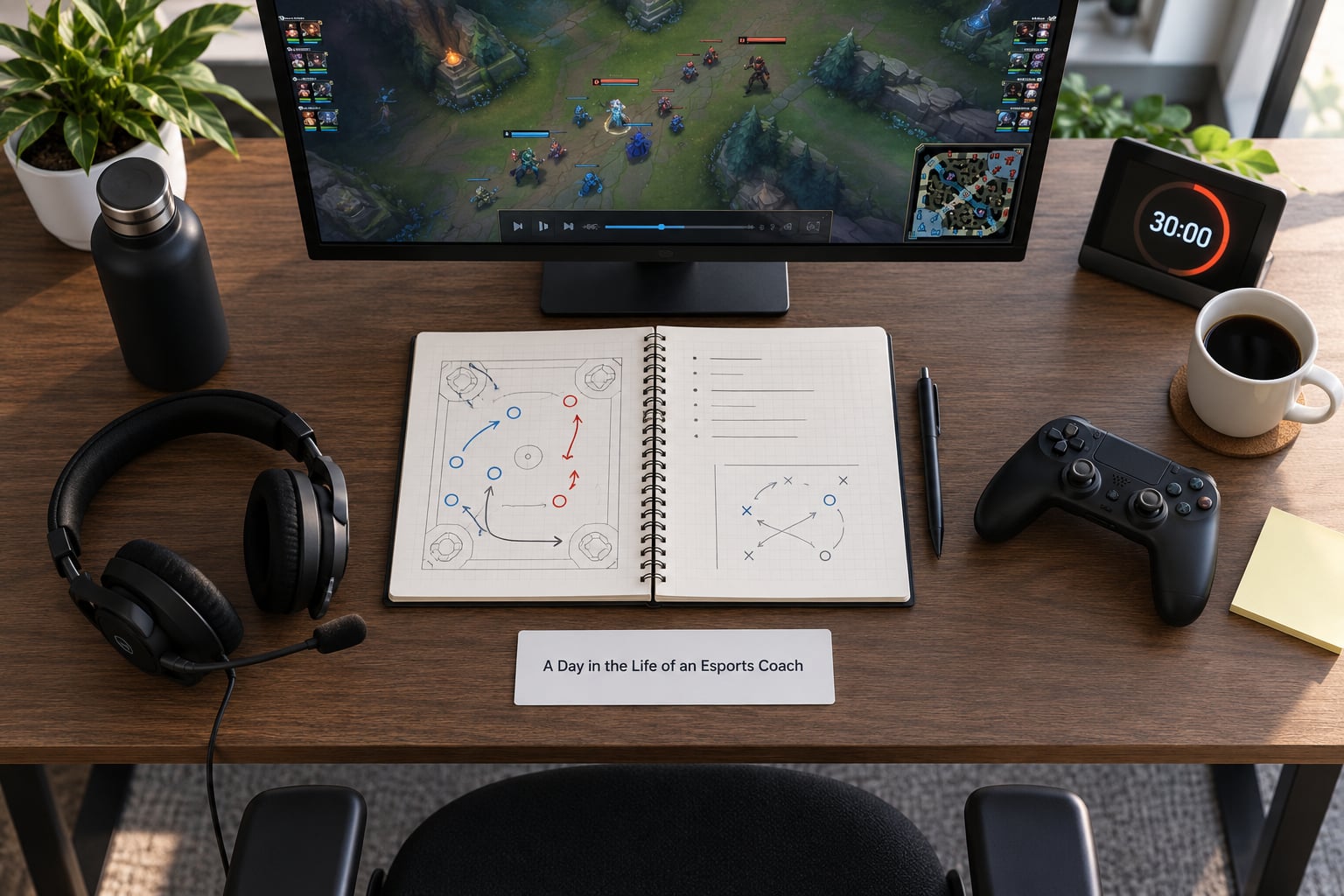
Here is a plausible day for a coach on a team in a league season, with practice in the afternoon and a match the following evening. Take it as an example, not a template — schedules swing a lot between games, leagues, and tournament weeks.
- 9:00 – 10:00. Review. Yesterday’s VOD, the analyst’s numbers, and whatever the players flagged in the shared channel overnight.
- 10:00 – 10:30. Individual video calls. Fifteen minutes each with players who flagged something, usually mechanics or a decision they want to talk through.
- 10:30 – 11:30. Strategy session with the assistant coach and analyst. Opponent tendencies for the weekend, what to show the squad, what to hide.
- 11:30 – 12:00. Admin. Schedule for travel and practice rooms, scrim bookings, availability, sponsor obligations, and the paperwork that comes with an org.
- 12:00 – 1:00. Lunch and a break away from the screens.
- 1:00 – 4:00. Practice. Warm-ups, then a scrim block built around two or three objectives, with adjustments between blocks.
- 4:00 – 5:00. Post-practice review. Players first, VOD second, next block’s objectives last.
- 5:00 – 6:00. Downtime. On a tournament week this disappears and becomes travel, setup, and a team meal.
Players notice the rhythm. A veteran coach in a Rocket League organisation described a week as tournaments plus one-on-one work with duos plus goal-setting for scrims, rather than continuous team practice. That gap is deliberate.
How Coaches Create and Communicate Strategy
Strategy is not a document. It is a set of decisions a team can make in ten seconds, with the reasoning already agreed, when a plan stops working.
Finding the patterns
Research starts with the opponent’s recent games, not their famous ones. Coaches look at which maps and rounds they default to, how they behave when they lose an early objective, and which players carry or get carried. The output is a short list of things the team should do more of, do less of, and watch for.
Turning it into instructions
Good coaching instructions are specific and conditional. Instead of “play more aggressive”, the version that survives contact is: if they hold their default on this map, we take the off-angle at this timestamp and we leave the trade. Players can execute that in a stressful round because there is no interpretation left to do.
Teams write these into a playbook that gets shorter over a season as things are proven or dropped. When a patch shifts the meta, some of it dies immediately, which is a genuine difference from traditional sports, where tactics move far more slowly.
Getting players to buy in
Instructions that come from the coach alone get followed politely and dropped under pressure. Coaches who get results tend to explain the why, invite disagreement in the meeting rather than in the round, and let players report what actually happened in the game even when it contradicts the plan.
What Metrics Do Esports Coaches Track?
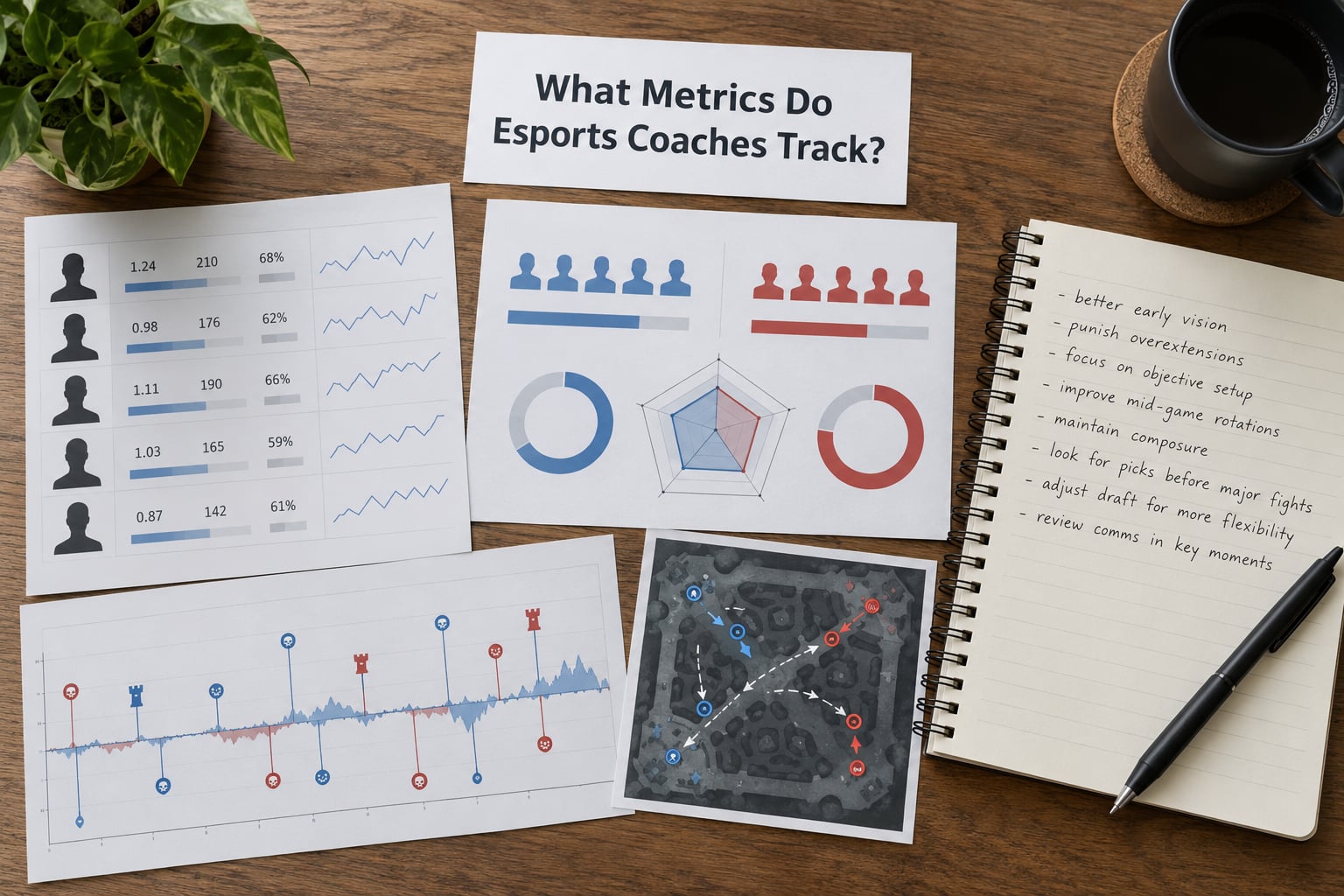
Win-loss records tell a coach almost nothing on their own. The useful numbers are the ones that explain why a game was won, and they look different in every title.
| Metric group | What it measures | Where it is used |
|---|---|---|
| Objectives | Control of the game’s win conditions, such as towers, sites, or neutral objectives | Strategy review and draft planning |
| Combat outcomes | Kill-death ratios, trade rates, first blood, survival time | Player development and fight-avoidance habits |
| Economy and resources | Credit scores, item and ability economy, time to key items | Pacing and punishing mistakes |
| Map and round splits | Performance per map, per side, per round type, opening versus closing rounds | Opponent scouting and map pool planning |
| Communication | Call clarity, timing, overlap, information given up | Comms review from recorded audio |
| Player-specific indicators | Mechanics, decision speed, positioning error, clutch conversion | Individual development plans |
The best metric depends on the game and on what the team is trying to fix. A team losing slow attrition rounds needs a different conversation from a team throwing early rounds, and the number that surfaces the problem changes accordingly. Coaches who only look at aggregate scoreboards often find out about a problem from the scoreboard itself, which is too late.
How Do Head Coaches and Assistant Coaches Differ?
Esports orgs are small, so titles get compressed and blurred. The typical arrangement looks like this:
- Head coach — owns the competitive result. Sets the strategy, runs the practice structure, makes the final call on lineups and tactics, and answers for results publicly.
- Assistant coach — owns a defined slice. Often one game, one role group, or one part of the preparation cycle, such as scrim logistics or a specialist role pool.
- Analyst — produces the data, scouting reports, and opponent breakdowns. In bigger orgs the analyst is the one who finds the pattern; the coach decides what the team does about it.
- Performance or mental coach — works on routines, stress, confidence, and communication, often alongside a sports psychologist. The growth of this title is one of the bigger changes in the role over the last decade.
- Team manager — the business side. Contracts, travel, sponsorships, org operations, and the administrative load that lets the coaching staff concentrate on the game.
- In-game leader (IGL) — a player role, not a staff role. The IGL makes the live call during a round: rotations, fights, saves, and the moments where there is no time to consult anyone.
Who makes the final call on a match varies. Some head coaches sit in comms and own the mid-round decisions; some hand the keyboard of decisions to a veteran player and manage the review. Larger orgs add reporting lines and specialisation, smaller ones have one person doing three of these jobs at once.
How Does a Coach Work with the Rest of the Team?
Coaching is a coordination job as much as a strategy job. The coach has to be aligned with an analyst who works differently, a manager who plans around practice needs, and players who have their own opinions about their own work.
Role clarity prevents most conflict. Players should know who decides lineups, who signs off on a scrim, and who to talk to when they are struggling. When those are unclear, small resentments build quietly and surface at the worst possible moment, usually a week before a big event.
Constructive disagreement is healthy and coaches are supposed to invite it, usually in the review rather than mid-round. A player who spots a coach’s mistake on stage and says so in front of the team costs the team something. A player who says it in the review, with a reason attached, usually improves the plan.
The hardest balance is authority versus trust. Players have raised this repeatedly in community forums: a coach has to genuinely care about the people in the room and still be the person who says no. Treat those as opposing forces and you get either a soft coach the team overruns or a hard coach the team stops telling the truth to.
Wellbeing sits in this section for a reason. Coaching decisions are also load decisions: how many days off, whether a player flies or plays from home, when a slump gets attention instead of more practice hours.
How Do You Become an Esports Coach?
There is no degree and no licensing. The industry runs on demonstrated game knowledge, communication ability, and a track record of helping players improve, which makes the entry path more informal than most people expect.
- Learn the game properly. Not just play it. Know the meta, the patch history, the map pool, and the pro scene for the title you want to coach.
- Coach at community level first. Grassroots LANs, school and university programmes, and amateur rosters are where the volume of real reps lives. A collegiate coach who came up through this route described the first head coach offer as a natural next step.
- Get good at VOD review. This is the actual job. Practise cutting footage, isolating the two moments that mattered, and explaining them clearly enough that a player can act on them.
- Build the people skills. Running a meeting, giving hard feedback without damage, and managing a conflict between two strong personalities are learnable and separate from game knowledge.
- Start as an assistant or scout. Assistant coach roles and analyst internships are the standard second step, and they are how most orgs vet candidates for a head coach role.
- Keep a public record of your work. A written breakdown or a review channel demonstrates the skill far better than a CV line that says esports coach.
Anyone can market themselves as a coach, and that is a known problem in the industry. The defence is a portfolio: specific examples of what you changed and what happened afterwards.
Frequently Asked Questions
What does a coach do on an esports team?
A coach designs team strategy, runs the practice and scrim schedule, reviews game footage with players, scouts upcoming opponents, manages communication and morale, and supports player development. The role is judged on results and on whether players improve and stay healthy across a season.
Does an esports coach make decisions during a match?
Sometimes, and it depends on the team. In many titles the in-game leader, who is a player, makes the live calls while the coach listens and adjusts between maps. Other organisations put the coach in comms to own pacing and execution. A timeout call is often agreed in advance with conditions attached.
What is the difference between a coach and a team manager?
A coach owns competitive performance: strategy, practice structure, VOD review, and player development. A manager owns everything around the game, including contracts, travel, sponsorships, budgets, and org operations. In small teams one person may cover both roles, which is a common source of confusion.
How much does an esports coach make?
Pay varies enormously by game, league, region, and organisation size, and it is one of the least transparent parts of the industry. Community and collegiate roles are often unpaid or stipend-based, tier teams pay a salary, and top-tier organisations pay more with bonuses tied to results. Ask for the contract structure, not just the number.
Do esports coaches work full time?
Most do, but the hours are unusual. Practice, review, and strategy work fills the day, then evening matches and travel add to it. During a tournament week a coach can be committed around the clock for days, followed by review days in the week after. Grassroots and amateur coaches usually combine it with another job.
How does a coach help a player who is underperforming?
Start with data before opinion. The coach looks for whether the drop is mechanical, decision-making, or emotional, then changes what the player practises rather than piling on more hours. Private conversations matter, as does checking in on sleep, load, and confidence, since a slump often has a cause outside the game.
Conclusion
An esports coach turns game knowledge, preparation, and communication into team performance, and the job is judged on results plus how the players develop and how they hold up over a season. The work is less about telling people what to click and more about deciding what a team practises, why, and how they are going to execute it when the plan breaks.
Pick one game and one team you follow, and read their match reports and scrim notes for a month. You will see the same three or four decisions repeating week after week, and that is the job in miniature.