
If you are trying to work out how esports leagues handle relegation and promotion, it comes down to about three approaches: an open circuit where any team can win its way into the top league, a closed system where slots belong to permanent partners, or a hybrid where a challenger earns a time-limited promotion. The label “promotion and relegation” covers very different mechanics depending on the game, so the boundary between divisions matters more than the terminology.
The confusion is understandable. League of Legends has permanent franchise slots in North America and Europe, a separate arrangement in Korea, a two-year promotion tournament in VALORANT, a points-based division ladder in Dota 2, and almost nothing resembling a ladder in CS2. Same phrase, five different systems.
Table of Contents
- How Esports Leagues Handle Relegation and Promotion
- Why Do Esports Leagues Use Relegation and Promotion?
- What Are the Main Relegation and Promotion Formats?
- How Do Points, Laps, or Standings Decide Movement?
- How Does a Promotion and Relegation Tournament Work?
- What Happens When a Relegated Team Has a Permanent Franchise Slot?
- How Do Game-Specific Ecosystems Change the Process?
- What Are the Risks for Fans and Teams When Teams Move Tiers?
- How to Follow Relegation and Promotion as a Fan
- Frequently Asked Questions
- What is the difference between promotion and relegation in esports?
- Does every esports league use relegation and promotion?
- Can a team be relegated even if it wins a lower-division tournament?
- How many teams are usually promoted or relegated each season?
- What happens to a relegated team’s players and roster?
- Can franchise ownership prevent an esports team from being relegated?
- Conclusion: Start With the Movement Rules
How Esports Leagues Handle Relegation and Promotion
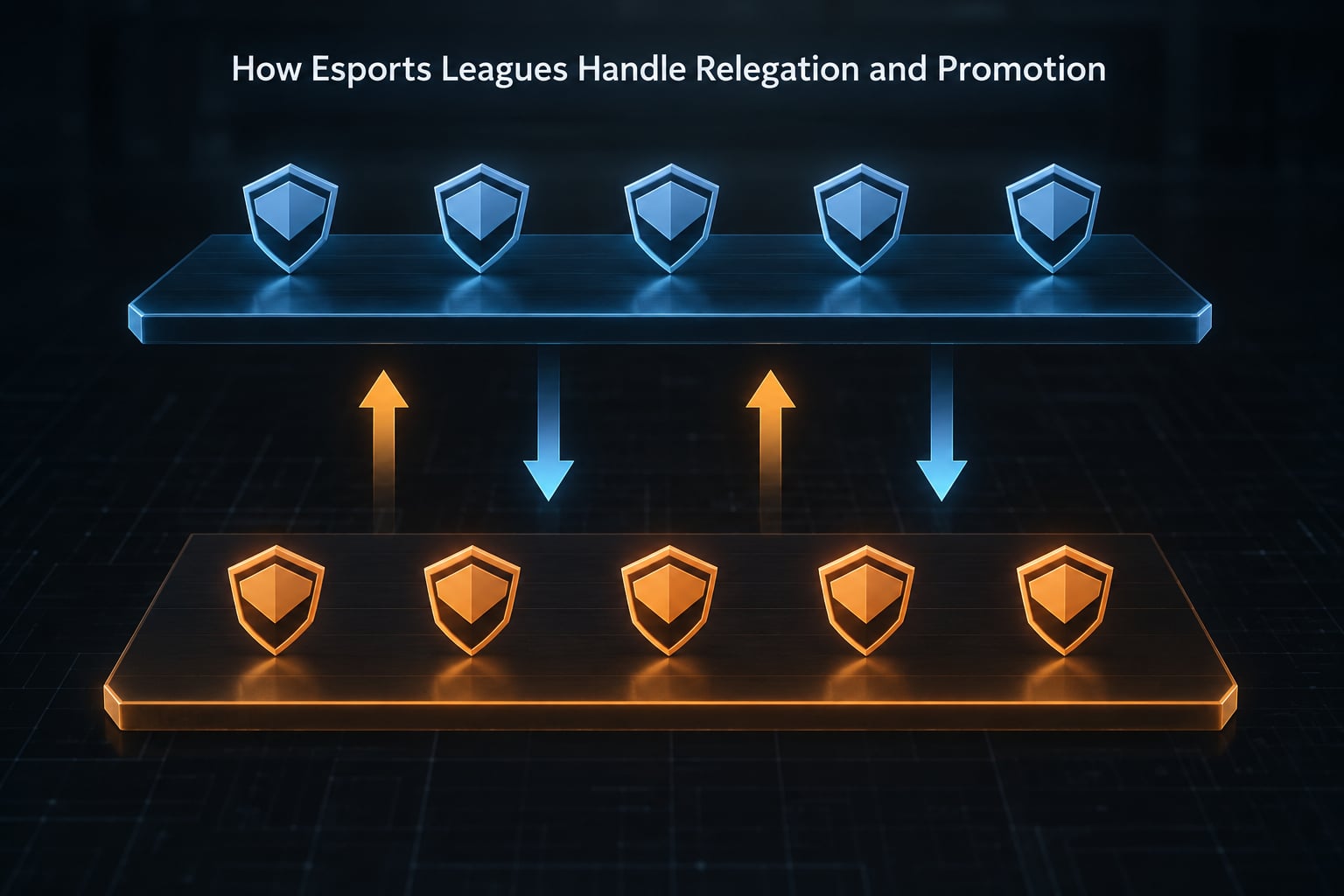
Promotion is the movement of a team from a lower division into a higher one. Relegation is the movement of a team from a higher division into a lower one. In esports, both are decided by regular-season results, playoff placement, tournament wins, or a combination, and the number of teams that move in each direction is set by league rules rather than by tradition.
Below that basic definition sits a pile of terms that newcomers usually meet before they understand the structure. Here is the vocabulary most league sites assume you already know.
- Tier 1 — the top division in a region, where the best teams play and where most of the audience watches.
- Tier 2 — the division directly beneath it, sometimes called a Challenger league, sometimes split into several regional circuits.
- Ascension — a promotion tournament whose winner trades its current place for a slot in the league above, sometimes for a limited number of years.
- Franchise slot — a permanent place in a league held by a named organization, which does not have to be re-earned on the field.
- Open circuit — a tier where any qualifying organization can compete, with no permanent holders.
- Vacancy replacement — a slot left behind by a team that disbanded, filled by whoever finishes highest in the division below.
- Yo-yo team — an organization that bounces between divisions across consecutive seasons because it is good enough to survive promotion but not to stay there.
Keep the glossary nearby. Almost every dispute about whether a league has relegation comes down to two people meaning different things by the word.
Why Do Esports Leagues Use Relegation and Promotion?
The sporting argument is straightforward. Relegation keeps the standard of the top division high, because a team cannot coast on reputation for a full season. Promotion rewards sustained performance with a measurable prize: a stage where a larger audience can see you, which is the currency every esports organization actually trades in.
There is a second argument that fans sometimes skip. Without a path upward, an organization has almost no reason to run a competitive tier 2 team, because playing there generates no exposure and no revenue. League officials and team owners both describe the ladder as a development pipeline, and in practice that is what it functions as — the place where rosters are built and tested before the top division absorbs them.
Then there are the commercial reasons, and they pull the other way. A permanent slot is an asset an organization can value, borrow against, and sell. When Riot Games moved the North American and European League of Legends leagues to a permanent-partner model, sponsors were asked to commit multi-year money into an unfamiliar scene, and a guaranteed place in the league was one way to make that commitment feel safer.
An academic critique of that model published in a SAGE journal noted that Riot’s stated plan for the Korean league included abolishing promotion and relegation outright and running the league directly.
That is the tension underneath nearly every esports league structure: sporting merit says the team that finishes last should go down, and business reality says a sponsor paid for a specific organization to be there. Both positions are rational. They just produce different leagues.
There is a third reason that is more sentimental than structural. Regional rivalries are worth real audience, and fans of independent regional leagues pushed back hard when Riot proposed merging North America with Latin America into a single League of the Americas. The merged league lasted roughly one season before both regions returned to running their own circuits in 2026, which tells you how much weight regional identity carries in these decisions.
Representation is the sore spot underneath all of it. When the top division is permanent and regional, the regions with no top-tier league have no route in at all, because nothing is ever relegated out of the division they would need to climb from. Fans in India, the CIS, and smaller Pacific markets have raised this repeatedly, and the usual answer is that adding more international leagues is a publisher decision rather than something the ladder can solve. A regional qualifier can only promote a team into a league that exists.
The other thing worth separating early is domestic placement and international qualification. Movement between divisions decides who plays in which league. International slots, whether for a mid-season event or a world championship, are usually allocated by finishing position inside the top division rather than by any promotion mechanism. Teams can change divisions without their international prospects changing at all, which is one reason the two topics get confused.
What Are the Main Relegation and Promotion Formats?
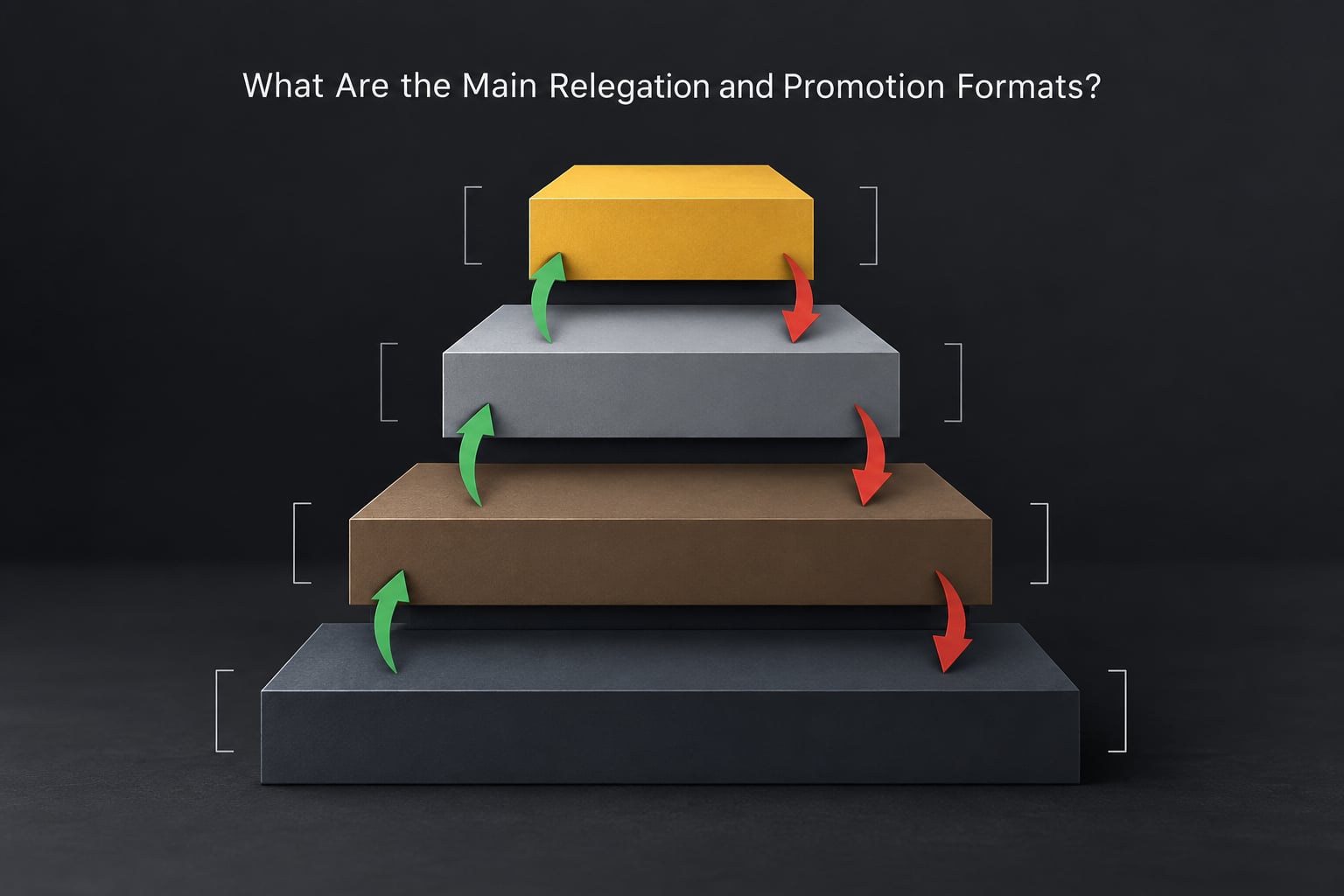
Every format is a variation on one question: who is allowed to compete, and what happens to a team that finishes where it finishes. These are the mechanisms I see most often.
| Format | Who competes | How movement works | Common use | Main risk for teams |
|---|---|---|---|---|
| Automatic placement by standings | Any team in the division | Top N finish in the regular season; bottom M drop; no playoff required | Long-running CS and Dota division systems | Season-long pressure; one bad split can trigger a drop |
| Promotion and relegation playoffs | Only teams near the cut line | Finishers play head to head; the match result decides movement, not the season record | European football style systems adopted by several league titles | A single series can erase a strong regular season |
| Open qualifiers | Any invited or qualified team | Win the qualifier and you enter the top league with no incumbent displaced | CS2 and open circuit tournaments | No guaranteed next season; entry is the only stability offered |
| Sudden-death finals | Two or more finalists | Winner takes the slot; loser takes nothing or falls one rung | Ascension tournaments in VALORANT | Extreme variance; one bad map decides the season |
| Dual-division exchange | Every team in both divisions | Regular rotation between Division 1 and Division 2, usually by points | Dota 2 and similar point-driven circuits | Yo-yo churn, where nobody establishes a foothold |
| Fixed franchise slots | Permanent partners only | No movement at all; a team can finish last and still return next season | League of Legends in North America and Europe | Competitive stagnation; no path for academy or amateur teams |
| License-controlled movement | License holders plus approved substitutes | The league can approve, deny, or reassign movement based on ownership rules | Games with published commercial agreements and transfer lists | Unpredictability; results feel disconnected from outcomes |
Read across the rows and the trade-off becomes obvious. The formats that keep competition honest are the ones that make an organization’s year unpredictable. The formats that protect an organization’s investment are the ones that make the calendar predictable. Leagues rarely get both.
How Do Points, Laps, or Standings Decide Movement?
Here is how esports leagues handle relegation and promotion at the arithmetic level, and it is simpler than most newcomers expect. A league plays a season, awards points for wins, and then converts the final table into movement using a rule written into the competition format.
In a points system, a win might be worth a fixed number of points and a loss nothing, or wins and losses might carry different weights so that teams keep playing rather than protecting a lead. In the Dota Pro Circuit, teams compete in tours and the standings in Division 1 determine who stays in Division 1 for the next tour. Straightforward, and it produces exactly the churn the community complains about.
Tiebreakers do more work here than in traditional sports, because a single round win can decide a division place. Common criteria, in roughly the order they get applied: head-to-head record between the tied teams, then the better record against the group of teams in that position, then round differential, then map differential, and finally a tiebreak match. League rules always publish the exact order, and reading it is genuinely necessary — two teams on identical points can be separated by a rule most fans have never seen.
Split wins matter in leagues that play multiple seasons per calendar year. A team that wins spring after losing winter can still finish higher overall than a consistent team that never peaked, which drives a particular kind of roster strategy in the final weeks.
One structural quirk appears in almost every system: the number of moving teams is small. Eight teams might sit in a division and only one moves up or down. That is deliberate. Leagues keep movement slots scarce so that reaching the top division stays hard, but it produces slow ladders that regular viewers describe as feeling like no system exists at all. In VALORANT, where a single Ascension winner per region earned a two-year promotion into the international league before dropping back, that complaint ran through roughly 145 replies on the forum thread following Riot’s structure announcement.
How Does a Promotion and Relegation Tournament Work?
A typical promotion and relegation tournament runs in stages, and each stage narrows the field until one series decides a season’s worth of movement.
The qualifying field. Teams enter from the division below. Entry is usually through a prior tournament win or a points finish in the regular season. In some leagues the field is eight teams; in others it is four, with the extra rounds played earlier in the year.
Seeding. The best regular-season finisher gets the bye or the favorable side of every bracket. Seeding is where the tier 2 standings actually matter, because a team that finishes first but loses its final match often has less to show for the year than a third-placed team that wins two playoff rounds.
Rounds before the tie. Lower seeds face each other while higher seeds wait. Depending on the league, matches are single-map, best of three, or split across a home and away leg. Two-legged rounds exist because some league operators want to reward the host region rather than send every deciding game to one city.
Elimination matches. Each of these is a promotion series in the practical sense: win and you move up, lose and you stay. When a lower-division challenger beats the upper-division incumbent in that match, the incumbent is relegated and the challenger’s roster changes divisions.
The final. The last series decides the last slot, usually against the top-ranked challenger and the lowest-placed defending team. This is the one that matters most, because the top-ranked challenger can afford to lose one round and the defending team cannot.
Here is how placement maps to movement in a typical eight-team lower division competing for one promotion slot and facing one relegation. A challenger who finishes first in the regular season but loses the final stays in tier 2. A challenger who finishes fifth, then wins two elimination rounds and the final, moves up. The incumbent that finishes second from the bottom but wins its elimination match stays in tier 1. The incumbent that finishes last in the regular season and loses its elimination match drops.
Notice that regular-season position alone decides nothing at the end. In most of these tournaments the playoff result overrides the table entirely, which is why a team can post a strong season and still be moving down in January.
What Happens When a Relegated Team Has a Permanent Franchise Slot?
Sometimes a team finishes last and nothing happens, because the league does not have to move it. This is the single most confusing part of the topic for newcomers, and it comes down to the difference between a sporting result and a business arrangement.
A permanent slot means the organization holds a place in the league indefinitely, and the place does not evaporate when the team loses. League of Legends in North America and Europe works this way, with a fixed set of permanent partners running each season and no relegation into a challenger circuit. Teams that finish at the bottom of those tables still return the following year.
Leagues that mix the two add conditions. VALORANT’s international leagues are permanent-partner competitions, but each region runs a Challenger league beneath them with an Ascension tournament at the top. Winning Ascension grants a two-year promotion into the international league; when those two years expire, the team drops back down to regional competition unless something changes. The team earned its place, and the place expires on a published schedule.
Ownership rules add another layer. In games where publishers maintain commercial agreements, an organization may have to be on an approved list to hold a slot, and movement between organizations can require approval, a transfer fee, or a buyout. Under those conditions, a team can finish last and still be told it must move because the slot belongs to the organization rather than the record.
Then there is the vacancy case, which is distinctly esports. When an organization disbands, its slot does not simply vanish. In the Rainbow Six EU League, the 2021 Challenger League grand final winner was automatically promoted to fill the place left by the disbanded Chaos Esports Club, rather than the club dropping into the tier below. It is a promotion that happens for a reason unrelated to the sporting ladder, and it catches new viewers completely off guard because no team was relegated to create the opening.
How Do Game-Specific Ecosystems Change the Process?
Different games have used different structures because their publishers had different problems to solve. Riot Games runs League of Legends and VALORANT and is the clearest case of one company using two different answers at the same time. Valve runs the Dota Pro Circuit and leans on points and rotation. Counter-Strike has moved toward open qualification with almost no permanent league structure.
| Game and competition | Tier 1 structure | How movement happens | Who moves each season |
|---|---|---|---|
| League of Legends — LCS and LEC | Permanent partner leagues | No promotion or relegation; international qualification comes from ranking within the league | Nobody |
| League of Legends — LCK | Permanent partner league, publisher-run | Promotion and relegation abolished in the publisher’s stated plan | Nobody |
| VALORANT — VCT international leagues | Permanent partner leagues by region | Challengers Ascension grants a two-year promotion that then expires | One Ascension winner per region under the 2023 structure |
| Dota 2 — DPC | Divisions within regional leagues across six regions | Tour points decide Division 1 and Division 2 membership; the bottom two in Division 1 drop under the Divisional system | Several teams, rotating by points |
| CS2 — open tournaments | Event-based, ranking-led | Qualification earned through ranking and open qualifiers rather than a division table | Varies by event |
| Overwatch — OWCS | Contender and Core divisions | Promotion and relegation stages decide movement between Contender and Core | One or two teams per cycle |
Two patterns show up across the table. First, games with a well-defined publisher partner program tend to protect tier 1 and let everything interesting happen underneath. Second, games without partners rely on ranking and open qualification, which keeps entry open but removes any promise of a place next season.
The fighting game and sports game ecosystems follow neither pattern cleanly. Many run annual events where a roster competes in open brackets, and the regular question is how players qualify, not how teams swap divisions. Where a season structure exists, it usually resembles a single-elimination bracket with placement matches rather than a standings table.
Battle royale scenes add a wrinkle that other games do not have. A battle royale is inherently a solo or duo performance with a team wrapper, so the unit that gets promoted is a roster that has to prove it can recruit and hold players between seasons. Two rosters can qualify through the same event and then face each other in the division above, which makes continuity of the roster a bigger part of promotion than the result itself.
What all of these have in common is that the promotion route usually runs through one competition with a published name, rather than through a season-long table. When someone says a game has promotion, they usually mean one specific tournament exists, and the useful question is always what that tournament’s winner actually receives: a permanent place, a fixed-term place, or a berth in a single event.
What Are the Risks for Fans and Teams When Teams Move Tiers?
Movement is not free. The same mechanism that creates opportunity for a challenger produces real losses for the organization that drops.
Roster uncertainty hits first. Players on contracts at the relegated team are usually free to move once the season ends, and a losing organization has little bargaining power. The practical sequence is consistent enough to expect: the stipend ends, sponsors evaluate whether their logo stays on a schedule worth paying for, roster lock lifts, players test the market, and the organization decides whether to rebuild, drop to a different title, or fold entirely.
Forum discussion of this topic keeps circling back to the same unanswered question — what happens to the players on the losing roster — and the honest answer is that it depends entirely on the contract structure the league uses.
Fans absorb losses too. Local history disappears when a long-standing organization leaves the top division, and combined regions make this worse: a fan base used to weekly matches against a familiar opponent now waits weeks for a cross-region fixture. That complaint came up repeatedly in the VALORANT community around combined Asia-Pacific regions, where players also raised server ping and travel burden.
Match quality shifts in both directions. A division that lost two established teams gets weaker, which is exactly the problem an organization raises when it argues that a smaller division cannot support sponsorships or attract viewers.
The benefit is on the other side of the ledger. Without a route up, academy teams and amateur rosters have no reason to exist, and the top division eventually plays the same opponents with the same styles indefinitely. Supporters of promotion and relegation make the talent-pipeline argument directly: a stronger second division produces more competitive players, and the losing teams do not disappear, their rosters get picked up by organizations that need them.
There is a competitive balance risk too. A team that wins promotion and then dominates the league above can hollow out the division it left. Leagues manage this with limits — sometimes a promotion winner has reduced roster flexibility or faces a schedule penalty — because a ladder that produces one permanent winner every three years stops functioning as a ladder.
How to Follow Relegation and Promotion as a Fan
Most misunderstandings come from assuming a system instead of reading one. This is the order I check things in when a team I follow changes divisions.
- Find the boundary first. Identify which division is tier 1 and which is the division immediately below it. Movement rules only exist between adjacent tiers.
- Decide whether movement is automatic or conditional. Some leagues move teams purely on final standings. Others only move them if a playoff series is won.
- Read the tiebreaker list. Identical points rarely produce identical outcomes. The published order of criteria is where a surprising placement gets explained.
- Count the slots. A twelve-team division where one team moves in each direction moves slowly. That is a rules choice, not a bug.
- Check for an expiration date. Some promotions are permanent and some last a fixed number of seasons, after which the team returns to where it came from.
- Look for ownership overrides. Permanent slots, license requirements, transfer approvals, and vacancy fills can all produce a final roster of teams that the results alone would not explain.
- Wait for the official announcement. Format rules get updated between seasons. Announcements at the end of a season are the version that matters.
Two community perspectives are worth carrying into that. Fans of regional independence fought a merged-league proposal on identity grounds and largely won it. Fans of franchised systems point to the Overwatch League as the cautionary case, and that reference shows up in almost every discussion of closed competition.
Frequently Asked Questions
What is the difference between promotion and relegation in esports?
Promotion moves a team from a lower division into a higher one, usually by finishing high in the lower division’s standings or by winning a promotion tournament. Relegation moves a team from a higher division down into a lower one, usually by finishing near the bottom of the upper table or by losing a playoff. Some esports leagues use only one direction, some use both, and many franchise-based leagues use neither.
Does every esports league use relegation and promotion?
No. League of Legends in North America and Europe uses permanent franchise slots with no movement between divisions at all. Korea’s LCK also abolished promotion and relegation under the publisher’s stated plan. VALORANT mixes both approaches, with permanent international partner slots and a Challenger league underneath feeding in through an Ascension tournament. CS2 relies mainly on ranking and open qualifiers rather than a division ladder.
Can a team be relegated even if it wins a lower-division tournament?
It depends on whether the league separates sporting results from ownership arrangements. A team that wins the top challenger league normally earns a promotion slot, but if that promotion is time-limited it may return to the lower division once the term expires. A team holding a permanent franchise slot cannot be relegated on results alone. A league can also promote a challenger into a vacated slot when an organization disbands, which is movement without any relegation.
How many teams are usually promoted or relegated each season?
Most leagues move fewer teams than the size of the field suggests. A common setup promotes one and relegates one from an eight-team division, and some regions promote only one Ascension winner per year with no automatic relegation at all. Dota-style circuits move several teams because membership rotates by points across tours. The exact number is set by each league’s published competition format, so check that document rather than assuming a rate.
What happens to a relegated team’s players and roster?
Usually the funding disappears first. The league stipend ends, sponsors reassess whether the schedule justifies their spend, and any roster lock lifts at the end of the season, freeing contracted players to sign elsewhere. Losing organizations then have a few options: rebuild for the lower division, move the roster to another title, or fold the team. Players on contract with teams that disband can also face stretch clauses or temporary stand-in arrangements until the season ends.
Can franchise ownership prevent an esports team from being relegated?
Yes, and that is the main reason the two systems feel incompatible. A permanent slot belongs to the organization rather than to the season record, so a team can finish last and still be invited back. Some publishers also require an organization to hold an approved license to compete in the top division, and movement between organizations may need approval, a transfer payment, or a buyout. Sporting merit still decides qualification for international events even when it does not decide who plays domestically.
Conclusion: Start With the Movement Rules
The label tells you almost nothing on its own. Before you assume a team has moved up or down, check five things: which division is the top one, how many slots actually move, whether movement is automatic or decided by a playoff, whether the league publishes tiebreakers that could reverse an obvious-looking finish, and whether ownership or license rules can override the results entirely. That is how esports leagues handle relegation and promotion in practice: a rulebook to check, not a label to trust.
Then follow the standings through to the end of the season and wait for the league’s own announcement. Formats get revised between seasons, and a rule that changed in 2026 may not resemble the one you remember from last year.