
Permadeath makes every decision irreversible, and that single fact reshapes how you play within the first hour. You scout before you commit, you hold items back for later, and you stop walking into rooms you have not read yet. Knowing how permadeath runs change your playstyle matters because those habits stay with you after the run ends.
Players usually describe the change as caution, and caution is part of it. The fuller picture is that risk stops being free. When a mistake costs nothing you experiment; when a mistake costs the run, you gather information first and act second.
Below is a breakdown of that change into eight concrete shifts, a boss preparation routine you can reuse, and the habits worth keeping when you return to a game with normal saves.
Table of Contents
- What Is a Permadeath Run?
- How Permadeath Runs Change Your Playstyle
- Why Permanent Death Encourages Better Decisions
- The 8 Biggest Playstyle Shifts
- 1. You explore deliberately instead of wandering
- 2. You learn attack patterns before you commit
- 3. You manage resources conservatively
- 4. You choose your encounters selectively
- 5. You build retreat routes and recovery options
- 6. You prepare for bosses instead of arriving at them
- 7. You accept slower progress
- 8. You stop confusing a mistake with a failure
- How to Prepare for a Permadeath Boss Fight
- How Exploration and Resource Management Change
- How to Avoid Frustration Without Removing the Stakes
- Frequently Asked Questions
- Does permadeath make players play worse or more cautiously?
- What is the best way to prepare for a permadeath boss fight?
- Should you explore every area during a permadeath run?
- How do you balance caution with fun when death cannot be undone?
- Can a permadeath run still use saves, checkpoints, or retries?
- What games are best for learning how permadeath changes playstyle?
- Conclusion
What Is a Permadeath Run?
Permadeath is a rule where a character or run cannot be restored once it dies. The save file is deleted, locked, or overwritten, so the loss of that run is permanent instead of something you reload away.
A permadeath run is therefore not a difficulty setting on its own. It is a run where the only things carried into the next attempt are what you learned and whatever the game explicitly unlocks. In a roguelike, that often means nothing but knowledge, which is exactly why the format rewards preparation.
It helps to separate four things that players lump together:
- Normal playthrough. Saves exist at checkpoints and in slots. A bad fight costs a reload, so the cost of experimenting is nearly zero.
- Roguelike run. A run-based structure where death resets the run. Combined with a full permadeath rule, the reset is permanent rather than a convenience.
- Roguelite run. A roguelike with meta progression, where unlocks and permanent upgrades carry over. The character dies, but you do not start from nothing, and some players argue that removes the point.
- Self-imposed ironman rules. No in-game flag. You simply decide not to reload, do not keep backup files, and do not use the game’s own ironman or hardcore mode toggle.
That last one matters for beginners, because it is the cheapest way to test the mindset. Delete your old saves, start fresh, and commit to finishing or restarting from zero. You lose nothing you cannot replace.
Two related terms come up constantly. Save scumming means reloading a state you should not have, usually to undo a death. Permafailure goes further: not only does the character die, but progress you cannot replicate next run is gone as well. RogueBasin uses that distinction to argue that a permadeath mode is only meaningful when losing removes something new.
How Permadeath Runs Change Your Playstyle

The short answer: a permadeath run turns play from improvisation into budgeting. You stop asking “can I do this” and start asking “what does this cost, and what do I learn first.”
The change is not subtle. Players on r/ultimateskyrim describe it as deliberately or unconsciously avoiding harder, higher-risk areas and gearing up far more conservatively. That is the surface of it. Underneath, the decision-making process itself gets rewired, because every fight now has two outcomes instead of one.
In a normal run, most encounters resolve into “win” or “reload”. In a permadeath run, the third option appears: retreat. A player who never considered leaving an arena will suddenly map exits before entering, because walking away intact is now a victory condition rather than a failure of nerve.
Three habits show up most often in players who adapt well:
- Information first. Watch a fight before joining it. Read the enemy, learn the timing, check what is behind the door. Knowledge is the only free resource the format gives you.
- Delayed spending. Consumables get hoarded. That healing potion used at half health on an ordinary enemy is a decision you would never make now.
- Lower aggression. Finishing blows on a wounded enemy stop being satisfying and start being expensive. Many players pull back and let the enemy whittle down instead.
The mindset that gets reported as most sustainable is simple: each run is an attempt to see how far you can get. Players describe it as one-credit arcade play, where the goal is a personal best rather than a guaranteed win. Framed that way, a bad run is data instead of a disaster.
Why Permanent Death Encourages Better Decisions
Three ordinary mental habits do the work here, and none of them require special willpower.
The first is risk budgeting. Every encounter gets a cost estimate: how much health, how many items, how long of a commitment. On a normal run that estimate is often “none, because I can reload”. Under permadeath the estimate is real, so players spend only what the situation deserves.
The second is loss aversion. Losing hours of progress is painful in a way that a wasted attempt is not, so the urge to protect the run overrides the urge to be efficient. That is also why permadeath feels tense rather than merely difficult, and why players in a Pillars of Eternity Trial of Iron group remark that it makes you take every fight seriously.
The third is ownership of mistakes. With saves, a death is an inconvenience. Without them, it becomes a decision you made, which pushes you to own it, learn from it, and stop repeating it. Players on r/RimWorld argue that commitment mode removed the autopilot out of their first run and that they had been missing what the game was actually asking of them.
That combination produces better decisions mostly because it produces more information per decision. You are not playing more carefully by accident. You are playing carefully on purpose, because the game stopped paying you for speed over safety.
The 8 Biggest Playstyle Shifts
These are the changes players actually describe after a few dozen permadeath attempts, in rough order of how fast they show up.
1. You explore deliberately instead of wandering
Curiosity becomes expensive. The room you wander into for a look might hold a mimic, a patrol, or a difficulty spike you cannot handle yet. Exploration turns into a question with a cost attached: is this detour worth what it might take from me? Route planning replaces aimless movement, and players start marking dangerous areas on the map rather than crossing them off as they go.
2. You learn attack patterns before you commit
This is the biggest jump in skill most players notice. Instead of reacting to an enemy, you watch one. Where does the swing start, how long is the recovery, is there a safe window. Under permadeath that knowledge is often the difference between a run that continues and a run that ends, and it is the one piece of progress that never gets taken away from you.
3. You manage resources conservatively
Potions, ammunition, food, parts, arrows, whatever the game counts, all get treated as a reserve rather than a resource. A common pattern: keep a fixed emergency portion that is never used for anything except a genuine crisis. This can look like hoarding from the outside, but the player knows exactly which items are for emergencies and which are for optional fights.
4. You choose your encounters selectively
Optional fights get costed. Is the elite group guarding the chest worth two healing items and a third of my health? On a normal run the answer is yes because the cost is fake. Here it is a real calculation, and players routinely skip content, farm easier zones, or set up the situation so an encounter happens on their terms rather than theirs.
5. You build retreat routes and recovery options
Before entering a fight you ask where you can go if it goes badly. That means doors you can close, corners that block line of sight, an escape item, or a healing spot two rooms back. Recovery options get planned in advance instead of hoped for in the moment, and they are what keeps a long run alive rather than merely lucky.
6. You prepare for bosses instead of arriving at them
A boss used to be a wall you met with whatever you had. Now it is an appointment. Players watch a video, read a forum post, learn the moves, and adjust gear or consumables in advance. The preparation itself becomes part of the run’s story, and the fight is the exam rather than the surprise.
7. You accept slower progress
Permadeath players farm, detour, and level up on purpose. A run that takes twice as long and survives is a better run than a fast one that ends in a corridor. Players who fight this instinct tend to burn out, so the adjustment is really about redefining what a good run looks like.
8. You stop confusing a mistake with a failure
Losing a run does not mean playing badly, and players who internalise that difference keep going. One bad opening does not sink a careful campaign, and a death caused by a random critical is not evidence that the whole approach is wrong. This is the least mechanical shift and often the hardest.
How to Prepare for a Permadeath Boss Fight
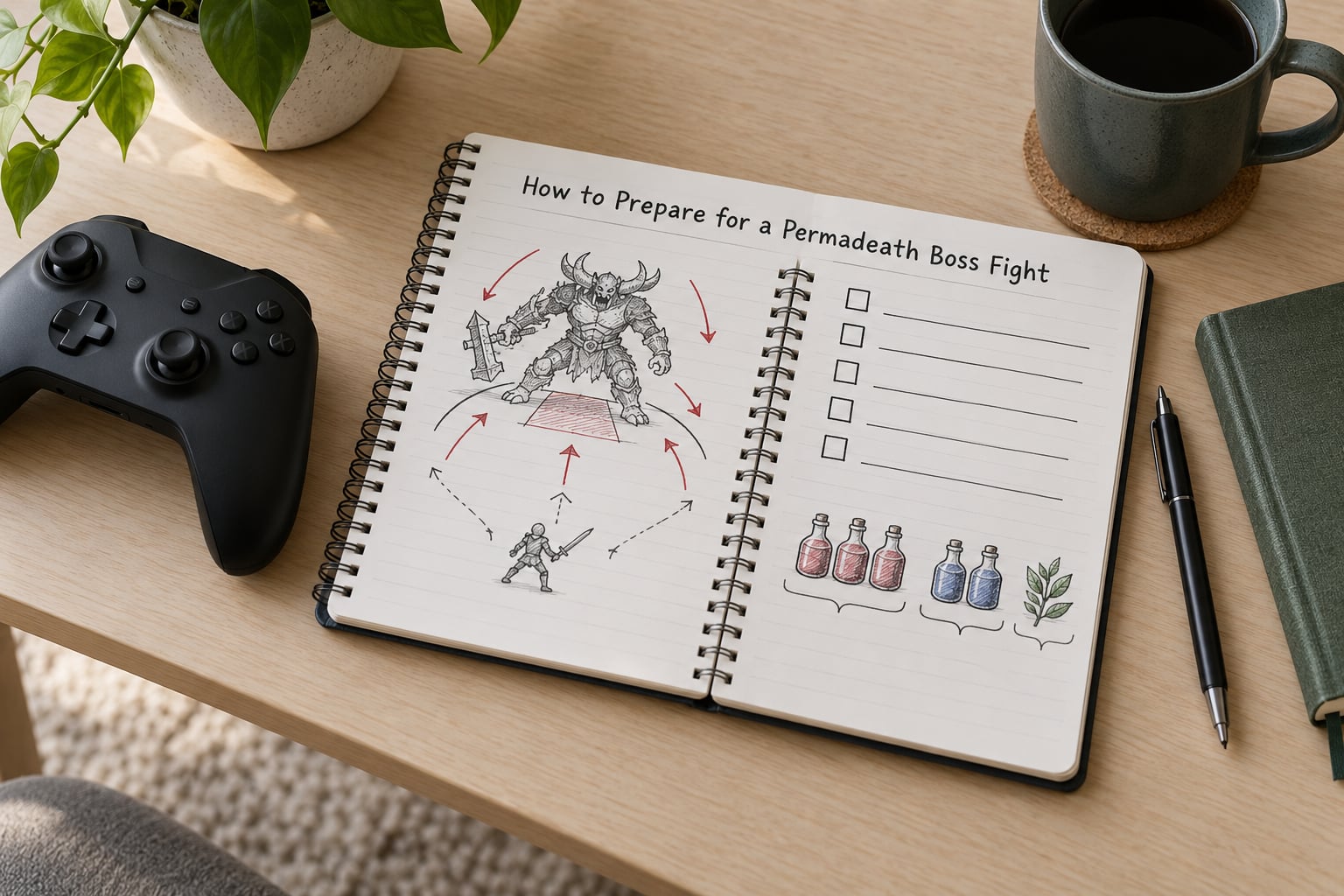
Prepare in five passes, and keep them in this order. The order matters, because the first two passes are free and the last three cost resources.
- Watch, do not fight. Find a video or a written description of the attack pattern and note the rhythm. Which attack opens the fight, which one punishes greed, and where the safe windows sit. Two minutes of watching regularly saves a run.
- Test your loadout somewhere safe. Try the exact weapon and build on easier content until the timing is familiar. A surprise at the boss with gear you have never used is two problems at once.
- Set a reserve you will not touch. Decide in advance how many healing items and how much ammunition are strictly for the fight, and leave the rest for the run. Players who set this rule on the spot always break it.
- Mark retreat points before the door. Note one safe spot inside the arena and one just outside it. Knowing you can quit the fight with most of your health intact keeps you calmer, and calm players dodge better.
- Practise at low risk. Some games let you repeat the encounter, disable damage, or set a lower difficulty for practice. Use them to learn the pattern, then turn the crutch off before the run that counts.
Then pick a good moment rather than a convenient one. Fighting a boss while tired, distracted, or right before you need to stop is how runs die for reasons that have nothing to do with skill. If the session is going badly, leave the boss for next time. The run keeps.
How Exploration and Resource Management Change
Here is the difference in one view. Normal play and permadeath play look like the same game until you put them side by side by phase.
| Phase | Normal run | Permadeath run |
|---|---|---|
| Opening hours | Test the mechanics, die, learn the loop fast | Learn the save rule first, delete old files, choose a slot you cannot come back to |
| Exploration | Follow curiosity, clear the map, see what is there | Plan a route, weigh each detour, set a boundary you do not cross yet |
| Combat | Trade hits, use items freely, learn by bleeding | Watch the pattern, kite or disengage, keep the emergency reserve sealed |
| Items and crafting | Craft what you need now, replace what breaks | Bank the good materials, craft only what the run needs, save crafting for safe zones |
| Optional fights | Take them for loot and experience | Price them in health and time, skip the ones that cost more than they return |
| Bosses | Show up and learn the fight by losing it | Watch, prepare, arrive rested with reserves set aside |
| After a death | Reload five minutes ago and try again | Write down what killed you, then restart from zero with that knowledge |
The pattern in the table is the one players report most often: exploration becomes a decision, and resources become a budget. Route planning and item timing change together, because the item you did not use in the wrong room is the one that saves you in the room you cannot leave.
Side content deserves a note of its own. Optional quests are where permadeath playtests its restraint. The reward is usually smaller than the risk of a bad fight, so many players either farm the safe version of a quest repeatedly or skip it entirely until the character is overgeared. That is not timidity, it is arithmetic.
Exploration boundaries matter for a different reason. Once you decide a region is too dangerous for the current character, the run stops being about clearing content and starts being about a specific, achievable goal. Games with an overworld punish wandering under these rules more than they punish bad fights.
The value of a retreat option is easy to underestimate. A single safe corner or healing tile behind a closed door converts a likely death into a likely reset, and that single tile lets you take fights you would otherwise skip. Players who build a recovery plan early tend to get much further than players who only get better.
How to Avoid Frustration Without Removing the Stakes
The version of permadeath that burns people out is not the one with stakes, it is the one with unfair stakes. You cannot remove every source of tension, but you can control the ones that feel arbitrary.
Study before you engage. A forum post, a wiki page, or a two-minute video costs nothing and removes most surprise deaths. Players who skip this step usually blame the game when the fight was widely documented.
Test a build before you commit. Spend an hour with the loadout you plan to use on difficult content. Badly timed weapons and unfamiliar abilities are the leading cause of avoidable deaths, and they are entirely avoidable.
Use safe zones as your base. A town, a home, a cleared camp. Doing recovery, crafting and planning in a place where nothing can kill you keeps the run moving without adding risk.
Save the hardest fights for a good session. Focus matters more than difficulty. A boss attempt made at the end of a long evening fails for reasons that have nothing to do with your build.
Play in focused blocks and stop cleanly. If the game lets you save, save, close it, and come back later. If it does not, end a session while you are still winning. A run that survives a session boundary is a run that gets finished.
Write down what killed you. One line after each death. Players value honest accounts of the exact mistake that ended a run, and the log turns a loss into a lesson you can actually use. It is also the fastest route to seeing the same pattern three times.
Two honest warnings. Random critical hits and sudden deaths feel cheap in tactical games no matter how well you played, and long open-world campaigns can cost more hours than the tension is worth, so pick runs of 15 to 60 minutes where possible. Companion permadeath, like the horse in Red Dead Redemption 2, gives you real stakes without wiping your progress, which makes it a good entry point.
Permanent technical failures are worth checking before you start. Server lag, a disconnect, or a crashed client should not be the thing that ends your run, so confirm the game handles it, and use a mode with a recovery plan if it does not.
Frequently Asked Questions
Does permadeath make players play worse or more cautiously?
It makes players more deliberate, which is not the same as timid. Most people engage earlier, fight better, and take fewer reckless risks. The caution appears in preparation, routing, and item timing rather than in refusing every fight. Players who improve under the rule usually do so because they learn patterns and plan retreats, not because they hide.
What is the best way to prepare for a permadeath boss fight?
Watch the fight before you attempt it, then test your exact loadout on easier content. Decide your reserve of healing items and ammunition in advance and do not spend it early. Mark one safe spot inside the arena and one just outside it. Only then start the encounter, and start it in a focused session when you are not tired.
Should you explore every area during a permadeath run?
No, and refusing to is a skill. Uncovered areas are optional risk, and every one of them can hold an enemy you cannot handle yet. Map what you have seen, plan a route, and set a boundary you will not cross until the character is ready. Saving an area for later is often worth more than clearing it now and losing the run doing it.
How do you balance caution with fun when death cannot be undone?
Treat each run as an attempt to see how far you can get rather than a run you must finish. Take fights that are dangerous but interesting, and skip the ones that are only tedious. Keep one or two safe, winnable fights in every session so the run has momentum. The goal is tension you chose, not constant low-level fear.
Can a permadeath run still use saves, checkpoints, or retries?
It depends on the rules you set. Strict permadeath removes manual saves, save states, and reloads, so one save exists and death ends it. Self-imposed permadeath often allows the game’s own saves and checkpoints but forbids reloading after death, which is a middle ground many players find more enjoyable. Decide the rule before the run starts and write it down.
What games are best for learning how permadeath changes playstyle?
Short-run roguelikes and tactics games teach the habits fastest because a run lasts 15 to 60 minutes and every decision is deliberate. Colony and survival sims, turn-based squad games, and skill-based action games show the shift clearly too. Long open-world campaigns are the hardest place to learn, since the cost of a mistake is measured in hours rather than in one run.
Conclusion
Permadeath changes play by making information more valuable than speed. Start with three habits: watch before you engage, protect a fixed reserve of items, and know your retreat point before the fight starts.
Those three cover most of what changes. The rest, resource timing, selective encounters, and treating a death as a note rather than a verdict, follows from them, and they are the habits that make you better in games with normal saves too.