Cheaters are hard to ban permanently because a ban can only attach to something the cheater controls: an account, an address, a hardware fingerprint. Every one of those can be replaced, spoofed or borrowed, and the evidence behind a flag is usually a strong suspicion rather than proof. Add the cost of policing millions of accounts and you get enforcement that stops a lot of people and removes very few.
There is a version of this that sounds clean. Cheater detected, account closed, case closed. Nobody plays online for long enough to believe it.
Table of Contents
- Why Cheaters Are Hard to Ban Permanently
- How Games Detect Cheating
- Why Bans Do Not Always Stop Cheaters
- What Makes Permanent Bans Difficult
- How Anti-Cheat Systems Respond
- What Players and Developers Can Do
- Frequently Asked Questions
- Are hardware bans permanent?
- Is ban evasion a permanent ban?
- Is ban evasion illegal?
- Can Easy Anti-Cheat detect DMA cheats?
- Do spoofers actually work, and can they be detected?
- Will I get banned for playing with a cheater?
- The Key Takeaway
Why Cheaters Are Hard to Ban Permanently
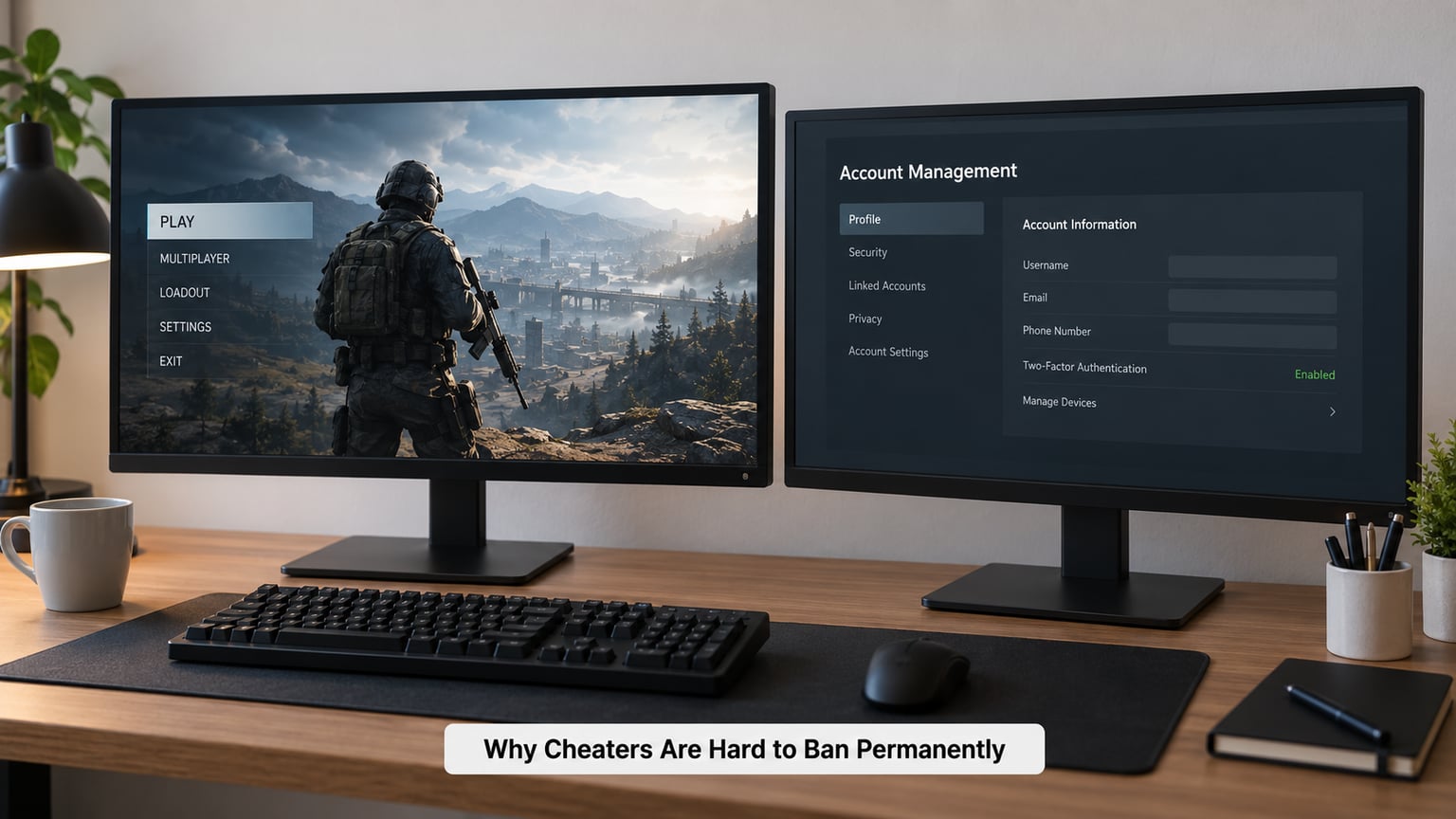
Think of a ban as a lock. It works well if the key is hard to copy. In online games the keys are made of identifiers that a determined person can change in minutes, and the locks cost money to build and cost money to police.
Every publisher sits somewhere on the same ladder, and each rung catches more while breaking more easily.
| Ban type | What it stops | How it gets broken |
|---|---|---|
| Account ban | The exact login that cheated | Registering a new account takes under a minute in a free-to-play title |
| IP ban | Further logins from one address | A VPN, a proxy, a mobile hotspot, or simply a roommate’s connection |
| Hardware ban (HWID) | The machine the cheat ran on | Replacing or spoofing parts of the fingerprint, or using a second computer |
| Console ban | The whole closed device | Little, short of modifying the console, which is why consoles enforce hardest |
An HWID ban works differently from the other three. Instead of one value, it hashes a composite fingerprint: the motherboard, the BIOS or UEFI serial, storage serials, the network card’s MAC address, and often the operating system install data. Swap one component and you usually still match, which is exactly why players keep buying the wrong part.
Here is the asymmetry that runs through the whole topic. Preventing an impossible action is hard engineering. Identifying unfair assistance is a judgement call, and it is the second one that publishers actually have to defend.
How Games Detect Cheating
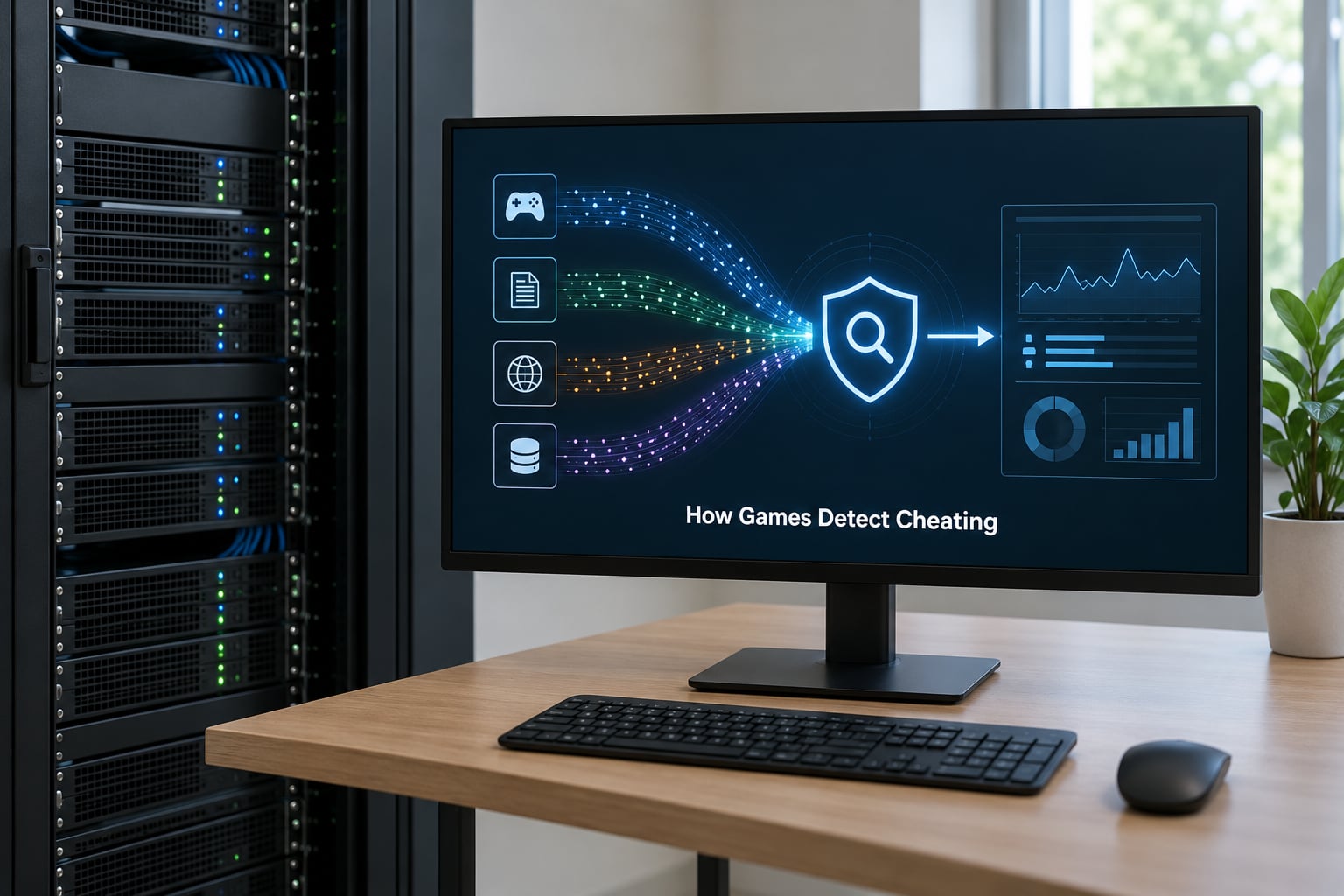
Detection runs in layers, and each layer catches a different class of cheat while letting others through.
- Client-side checks. A user-mode component scans running processes and loaded files for known signatures and looks for tampering with the game’s own code. Cheap, quiet, and defeated by anything that runs outside the game folder.
- Kernel-mode driver. A driver running in ring 0 sees everything: memory, every loaded driver, every process. Riot Vanguard goes further and loads before the operating system finishes booting, which is why its early startup behaviour felt so intrusive.
- Server-side validation. The server simply refuses to believe impossible claims. This is the most reliable layer because it does not care what is on your machine, and Valve’s developer guidance has long said the server should be the authority on any result.
- Behavioural analysis. Machine-learning models read movement, timing and aim patterns and send suspicious replays to a human. Activision’s RICOCHET reports describe exactly this pipeline, where the model ranks and a person decides.
No layer catches everything, and each one costs something. A kernel driver sees more but raises real trust and stability questions, and a machine-learning model tuned to catch subtle aim assistance will also flag gifted players.
Why Bans Do Not Always Stop Cheaters
The ban lands and the problem changes shape. The account is gone within hours, usually because it was replaced before the ban even arrived.
That delay is deliberate. Publishers batch detections into waves rather than banning the moment a flag fires, because acting instantly tells cheat makers exactly which method tripped the system and they ship a fix within days. Cheat authors describe a routine of two or three days between an anti-cheat update and the next version of the cheat, reselling access in between.
Hardware cheats add another layer. A DMA device in a second computer reads game memory over PCIe without ever touching the banned machine, which is why a hardware fingerprint alone stops nothing. Flashing firmware on a mouse or keyboard defeats signature scanning entirely.
What Makes Permanent Bans Difficult
The awkward part is proof. A human reviewer watching a replay can tell you a reaction time looked inhuman, but they cannot show a court, or a console maker, or often the player themselves that the aim came from hardware rather than a good week.
A former volunteer on an ESL tournament anti-cheat squad put it plainly on r/PUBATTLEGROUNDS: reviewing tens of thousands of replays is economically impossible, and even a successful review does not produce admissible evidence. That gap is why bans are usually issued by licence terms rather than by proof, and why appeals exist at all.
Then there is shared infrastructure. Households, university halls, cafés and mobile networks put many unrelated people behind one address, so IP bans catch innocents. Second-hand PCs carry the previous owner’s hardware fingerprint, and Linux and Steam Deck owners have been caught by blocks aimed at Windows kernel drivers. Antivirus conflicts and legitimate overlay features like AMD Anti-Lag+ have produced false positives too.
Track every repeat offender across a player base of tens of millions and the cost of enforcement climbs steeply. Most publishers settle for a rate that removes the casual majority.
How Anti-Cheat Systems Respond
When permanent removal is impractical, the systems aim at friction instead.
- Warnings and first offences. A short restriction teaches without burning the relationship.
- Queue delay and matchmaking isolation. Shadow bans put a flagged account into longer queues and rougher lobbies, which hurts a boosting service more than it hurts one person.
- Escalating penalties. Repeat bans lengthen until they reach permanent, with hardware identifiers added later.
- Ban waves. Detection accumulates, evidence ages, then accounts are closed together.
- Cross-game scope. Easy Anti-Cheat, BattlEye and Riot Vanguard all maintain blocklists that can follow a player between titles that share the anti-cheat.
None of these is permanent prevention. They are ways to make cheating expensive without making enforcement impossible.
What Players and Developers Can Do
For developers, the pattern that works is layered enforcement plus honest review: catch what you can, prove what you act on, and tell players which ban they actually received.
Concretely, that means combining client and server checks instead of relying on either, preserving evidence so appeals can be judged on something better than a flag, staffing the appeal queue properly, and watching for abuse of the report button so reviewers are not buried in noise.
For players, the leverage is smaller but real. Report with specifics: the match, the timestamp, the behaviour. A report saying someone was cheating gets sorted, one saying the enemy had good aim might get read.
Keep real money and rare items off accounts you would hate to lose. Check whether your ban names an account, an address or a machine before spending anything on parts, because HWID is a fingerprint and swapping one component rarely lifts it. If you think the ban is wrong, appeal once, calmly, with your system specs and any driver or overlay software listed.
And do not quietly leave the game. When clean players quit, the share of accounts actively cheating goes up for everyone who stays, which makes every remaining player’s experience worse.
Frequently Asked Questions
Are hardware bans permanent?
They are meant to be, but they are permanent only against the machine, not the person. A hardware ban hashes a composite fingerprint such as motherboard, BIOS serial, storage serials and MAC address, so replacing one part usually does not help. A second computer, a spoofing tool or a firmware-level cheat device sits outside that fingerprint entirely, which is why hardware bans reduce repeat offences rather than ending them.
Is ban evasion a permanent ban?
Usually yes. Most publishers treat buying, selling or trading a banned account, or using a spoofing service to defeat a ban, as ban evasion rather than cheating itself. That means the new account is closed and the original ban stays on record, which can follow you across games sharing the same anti-cheat. Some titles escalate straight to a permanent hardware ban for evasion attempts.
Is ban evasion illegal?
It breaks the game’s licence agreement in every case, so the publisher can close accounts without needing to prove cheating in court. Actual criminal liability is narrower and varies by country. Selling cheat access or hardware has produced lawsuits in several jurisdictions, while simply registering a new account is almost always civil, not criminal. Check the terms of the specific game rather than assuming.
Can Easy Anti-Cheat detect DMA cheats?
Partially. DMA cards read game memory from a second machine over PCIe, so nothing runs on the banned computer to scan. Anti-cheats instead look at indirect signs: the card’s PCIe identity and firmware, IOMMU or VT-d enforcement, memory access patterns, TPM 2.0 and Secure Boot state, and eventually human review of flagged replays. It raises the cost of using a DMA setup rather than reliably blocking it.
Do spoofers actually work, and can they be detected?
They work for a while, usually against a specific anti-cheat version, because vendors keep patching the components a spoofer fakes. Detection comes from inconsistencies: a fingerprint that changes every login, hardware values that contradict each other, or behaviour that does not match the machine. Riot’s motherboard security work and IOMMU enforcement are aimed squarely at this cat-and-mouse cycle, which is why spoofer marketing always promises the current version only.
Will I get banned for playing with a cheater?
Rarely, and not on purpose. Competitive games pair you by rating and behaviour rather than by friendship, and matchmaking systems flag accounts that repeatedly queue with known offenders. The realistic risk is indirect: if your own client trips a detection because of a driver conflict or an overlay, you can be caught up in the same ban wave. Playing alongside a cheater is not itself an offence.
The Key Takeaway
Permanent bans fail for a structural reason, not a lazy one. The only things a publisher can ban are identifiers, the identifiers are replaceable, and the evidence for most flags is probabilistic rather than provable.
What actually reduces cheating is layered enforcement that makes each method more expensive than the next, honest labelling of which ban was applied, and a review process strong enough that legitimate players trust the outcome. If you take one thing from this, check your own ban type before doing anything drastic: knowing whether you have an account, address or machine ban saves you a lot of wasted money and parts.
Updated for October 2026.