Backlogs grow because games enter your library faster than your free hours can clear them. Discounts, subscription drops, release-day hype and storefronts all push titles onto the queue while work, family and fatigue pull hours off the other side of the ledger.
The fix is not more willpower. It is shrinking the queue and stopping the inflow, which sounds obvious and is surprisingly hard because a large gaming backlog changes what games feel like. People describe the same title as a great buy on the day they purchase it and a chore six weeks later. That gap is the real problem, and once you can see where your hours go it becomes much easier to fix.
I keep three lists now instead of one enormous one, and my library stopped feeling like a debt I owed. Here is how backlogs grow, why games stay unfinished, and the system I use to finish games I actually want to finish.
Table of Contents
- How Backlogs Grow and Why Games Stay Unfinished
- Why Players Do Not Finish Games
- The expectation was set by the marketing, not by the game
- The free hours disappeared
- A difficulty wall arrived at the wrong moment
- The loop stopped being fun
- A social obligation outlasted the fun
- Returning got harder every month
- Starting is sometimes the opposite problem
- Some games ship unfinished
- The Backlog Math: When Your Queue Becomes a Problem
- Is there a completion rate figure out there?
- How to Choose What to Finish Next
- How to Actually Finish Games: A Practical Six-Step System
- Step 1: Triage into three lists
- Step 2: Cap what you actively play
- Step 3: Run the 1-2 hour quit test
- Step 4: Balance one long game with short ones
- Step 5: Stop at a clean stopping point
- Step 6: Review once a month
- The named rules worth knowing
- What to Do With Games You Will Never Finish
- How to Keep the Backlog From Growing Again
- Subscription libraries are inventory, not backlog
- Cap your wishlist at 25 titles
- Ask the pre-purchase question first
- Wait a week on release-day purchases
- Use your platform’s own data
- Set a personal limit on simultaneous games
- Frequently Asked Questions
- Is it bad to have a large game backlog?
- How many games should I finish each month?
- Should I force myself to finish every game I start?
- How do I stop buying games when my backlog is already huge?
- What is the best way to finish a game I am not enjoying?
- Where to Start This Weekend
How Backlogs Grow and Why Games Stay Unfinished
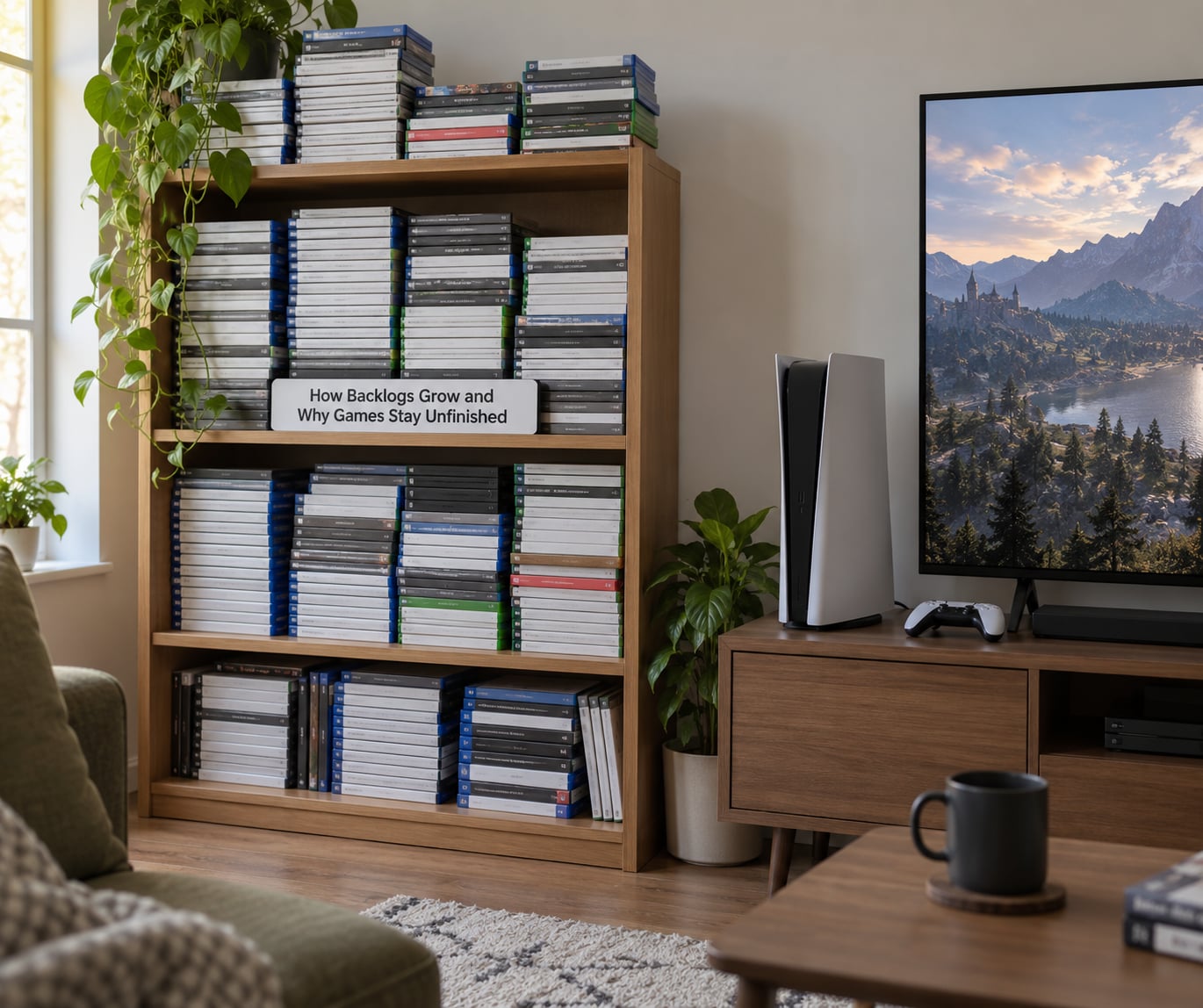
A gaming backlog is the set of video games you own that you have not finished. It includes titles you have never started and games you abandoned partway through, and unlike a to-do list it carries no deadline. Nobody is waiting on you. There is no due date on a digital purchase you made on a sale.
That absence of obligation is exactly why the list grows. Backlogs expand through five supply channels, and each one delivers a small hit at the moment of acquisition rather than at the moment of play.
Sales do most of the damage. A discount turns a maybe into a today, and the purchase itself feels good immediately. What you actually bought was a future obligation competing with your other evenings, and that obligation is invisible at checkout.
Subscriptions add titles you never chose. A monthly credit puts a game on your console with no decision on your part. It is inventory rather than debt, and treating it as debt is one of the biggest mistakes people make.
Storefronts are built to add. Recommended rows, wishlist notifications, seasonal events and countdowns all push toward buying rather than playing.
Free weekends and giveaways spike intake. Two free games a month sounds generous, and it is, but nobody ever finishes the ones they claim in a hurry.
Platform fragmentation hides the total. Steam, PlayStation, Xbox, Switch and handheld libraries each keep their own count. Nobody has ever opened all five on the same screen and admitted the number out loud.
Meanwhile the output side shrinks. Most players lost hours to jobs, commutes, children and broken sleep years before the backlog started feeling heavy. The queue grows arithmetically while your capacity declines, and nothing about that is a character flaw.
The clearest description of this comes from a long-running r/Games thread that still ranks near the top for this question: a game sitting in a large backlog gets enjoyed less than the same game bought and played on the day of purchase. The backlog itself dulls it. If that matches your experience, the strategy that follows is aimed at the right target.
Why Players Do Not Finish Games
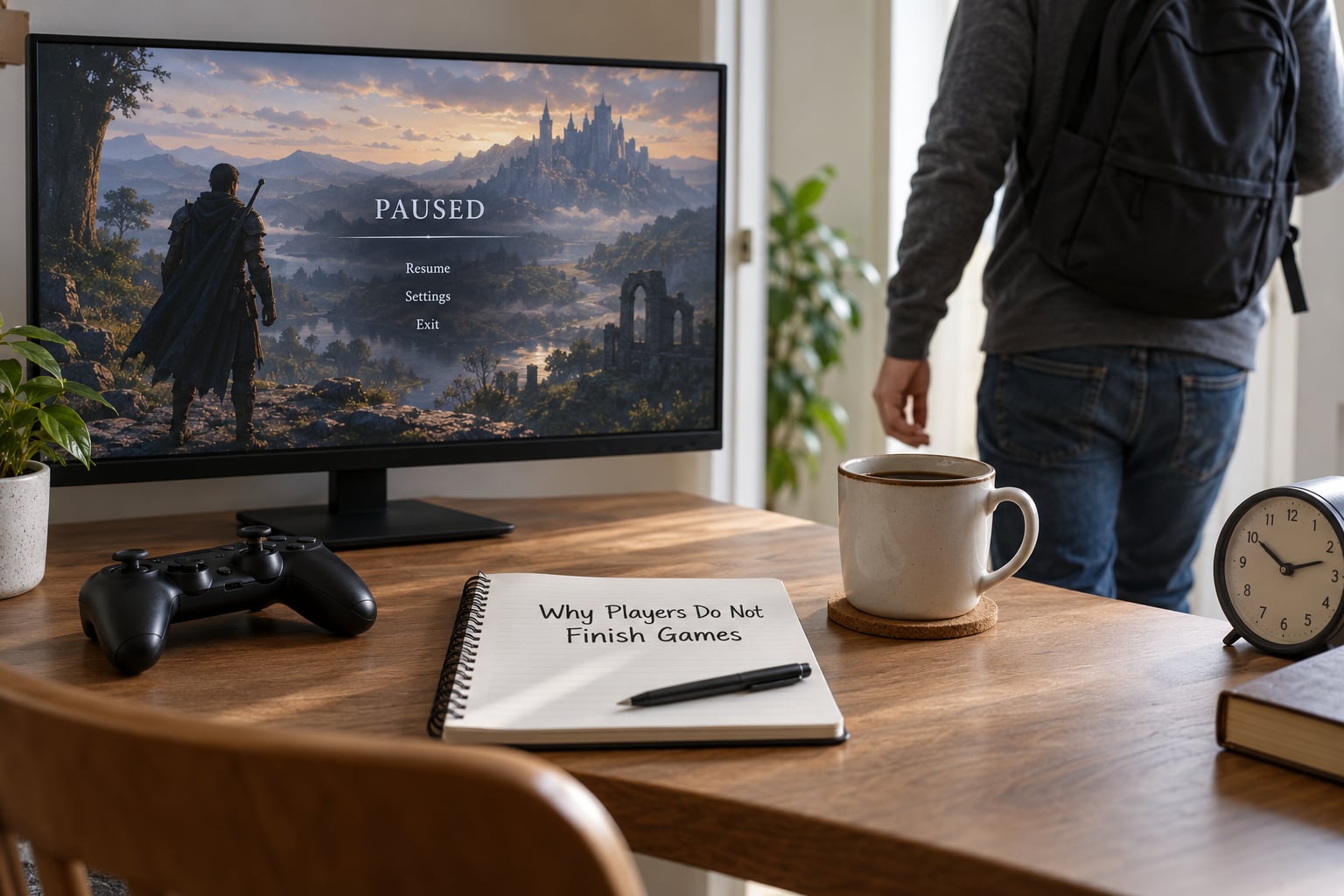
Unfinished games usually have ordinary causes. Recognising which one applies stops you from applying willpower when the actual problem is time.
The expectation was set by the marketing, not by the game
Trailers show the best forty seconds a game has. You then buy the ninety-hour version, hit the opening hour of slower systems, and conclude the game is bad when your expectations were simply wrong.
The free hours disappeared
A typical adult player gets a few evening hours on a good week and nothing at all on a bad one. A 90-hour RPG needs roughly nine months of three-hour evenings. That is a scheduling problem wearing a costume.
A difficulty wall arrived at the wrong moment
Most games have one or two spikes. Hit that spike on a tired Tuesday and the honest reaction is to put the controller down, and putting it down is what starts a shelf entry.
The loop stopped being fun
Grind sections and repetitive crafting ask for hours without offering anything new. Completing those hours feels like paying a subscription to a game you stopped wanting weeks ago.
Interest simply ran out. Sometimes a game is fine and you are just finished with it. That is not a failure to persevere, and treating it as one is how hobbies turn into obligations.
A social obligation outlasted the fun
Multiplayer games with guilds, friend groups and seasonal resets punish you for leaving. The time cost keeps rising after the enjoyment peaks, and these are the entries most likely to sit forever.
Returning got harder every month
Backlog decay is real. A game you quit a year ago has a longer re-entry ramp than one you stopped last month, because you have forgotten the systems, the story and your own reason for caring. Difficulty settings and quality-of-life options help, but the friction is genuine.
Add all of that to a queue of two hundred titles and you get backlog paralysis: the list is so large that choosing feels impossible, so nothing gets played, so the list grows.
Starting is sometimes the opposite problem
A lot of players do not struggle to finish. They struggle to start. Opening a list of two hundred titles and deciding is expensive, and a new purchase sidesteps the decision entirely because it already tells you what you are playing tonight.
Players with attention difficulties describe the same loop from the other end. The reward structure inside games is fast and well-timed, while finishing something is a slow project with no visible progress for weeks. Some enjoy the loop; others report the opposite, that starting is easy and stopping is impossible. If that second pattern sounds familiar, the honest answer is that the game design is doing the work, and the useful lever is session length rather than willpower.
Some games ship unfinished
Long-running complaints on patient-gaming forums focus on games releasing with bugs, missing content and unplayable endings. Whatever you think of those titles, they do real damage to completion rates: the player hits the bug, loses motivation, and the shelf entry was never about interest to begin with.
The Backlog Math: When Your Queue Becomes a Problem
Here is the part nobody on the internet quantifies. A backlog is an arithmetic situation, and you can work out where you stand in about five minutes.
Start with your throughput. Take the number of games you finished in the last twelve months and write it down. Most adults who play regularly finish somewhere between four and ten, and the honest number is usually lower than the number you said out loud last week.
Next estimate your input. Count the games you bought or claimed in the same period, including subscription titles you actually opened. If you added twenty-four and finished six, your queue grew by eighteen, and no amount of enthusiasm changes that line.
Now do the same with hours instead of titles. Here is a rough guide based on a typical game length of 35 hours.
| Hours per week | Hours per year | Games a year at 35h each |
|---|---|---|
| 3 | 156 | About 4 |
| 6 | 312 | About 9 |
| 10 | 520 | About 15 |
| 15 | 780 | About 22 |
Run that against your intake. If you add twenty-five games a year through sales and giveaways, you need roughly seven hours a week just to stand still, and that assumes every game you start is average length and you never take a week off for illness, overtime or a bad month.
That is why a 400-game library is not a discipline problem. It is a queue whose contents represent several years of continuous play.
Is there a completion rate figure out there?
You will see a specific percentage quoted online about what share of purchased games get finished. There is no reliable public source for it. Nobody has audited finished-state data across storefronts at scale, and storefronts have no incentive to publish one because the honest number would be embarrassing for everyone involved, including the players.
You can get a real number for yourself in about five minutes. Most platforms report a completion trophy or achievement on some titles, and while those are far from complete, sorting your library by trophy status will give you a rough completion picture in your own library rather than someone else’s guess.
Use the result to sort your backlog into one of three states:
- Aspirational. You enjoy owning games more than you enjoy playing them. Nothing needs fixing except your self-judgement.
- Seasonal. Work or family eats your hours for part of the year and frees them later. Your backlog is fine between August and December.
- Unmanageable. Intake clearly exceeds capacity, and you feel pressure every time you open the menu.
Only the third one needs action. The first two produce a lot of unnecessary shame.
How to Choose What to Finish Next
Choosing well matters more than choosing fast. Six questions will narrow any library down to one title in about two minutes.
1. Which one would you still pick with nobody watching? Interest beats seniority. The game you bought first has no claim on your time if the one you bought last is the one you want.
2. How long is it, honestly? Platform estimates are optimistic. Look at completion times for similar games in the same series, not the marketing number.
3. What matches your current mood? Some weeks want a 20-hour story game, some want a 90-hour world, and some want to shoot something for an hour. Trying to force a prestige title onto a week with 90 minutes available is how another shelf entry happens.
4. Did you buy it recently? Fresh purchases are enjoyed at their highest rate. A game bought last week can be the better pick than one you abandoned two years ago, and putting new games off forever is its own trap.
5. How hard is it to restart? Games with a clean restart and adjustable difficulty are good candidates for a comeback. Games requiring you to relearn a system for an hour are not.
6. Can you pause it safely? Anything with a save-anywhere option or a short chapter structure lets you play in 30-minute blocks. Live-service and battle-pass titles cannot, and those need their own rule.
If two titles tie, pick the shorter one. Finishing something produces the motivation to start the next thing, and that feeling is worth more than the prestige of the bigger game.
How to Actually Finish Games: A Practical Six-Step System
This is the method half. Six steps, no productivity app required.
Step 1: Triage into three lists
Empty your backlog into three columns, and nothing more complicated than that:
- Finish — games you want to play and think you can get through.
- Revisit — games you liked and want to return to someday.
- Let go — games with no intention of playing again.
Three lists beat one because the pressure disappears. A “Let go” column is not failure; it is the only honest part of the system. Do it on paper, in a notes app, or with a spreadsheet. The format does not matter, and a spreadsheet with a column for where you stopped is the version most often recommended on ResetEra and PSNProfiles forums.
Different kinds of entries need different treatment, which is where most tidy-up plans go wrong:
| Type | Treatment | Realistic time to clear |
|---|---|---|
| Never started, no interest | Let go, trade or gift | Five minutes per game |
| Never started, bought during a sale | Sample it, then decide | One to two hours |
| Started and stopped, was enjoying it | Return as a main game | Several sessions |
| Started and stopped, was not | Let go | Five minutes |
| Finished, want more | Revisit for DLC or a replay | Optional, no deadline |
| Subscription library title | Exclude from the list entirely | No action needed |
| Live-service or server-dependent | Play seasonally, never as a completion target | Until shutdown |
Notice that two of the seven rows take five minutes each. Most of a large library resolves that fast once you stop treating every entry as a promise.
Step 2: Cap what you actively play
Pick one main game. If you have a second slot, fill it with something short. Two is the practical limit, because a third title turns all three into background noise.
Step 3: Run the 1-2 hour quit test
Start a backlog game and give it one to two hours, past the tutorial. If you cannot put it down, keep going. If you are counting minutes, stop and move it to “Let go” without a trial period.
This is the single most-cited tactic across the gaming forums I looked at, and several people describe deleting or trading a game as the most freeing decision they ever made about their library.
Step 4: Balance one long game with short ones
Long stretches of a 100-hour game without visible progress drain motivation. Pair it with two or three short games so you always have a completion within reach. That balance is the idea behind the community’s “Rule of 3” method: play two or three short games alongside every long one you start.
Step 5: Stop at a clean stopping point
End sessions at a save, a chapter break or before a boss. Restarting a game costs more than most people expect, and a clean exit point turns “picking it back up” from a decision into a habit.
Step 6: Review once a month
Once a month, move finished games off the list, drop what is not working, and pick one new main game. Monthly beats daily, because a daily review turns the hobby into homework.
The named rules worth knowing
Three community rules come up constantly, and each is useful for a different reason.
The 40-second rule says you should decide whether you want to keep playing a game within the first 40 seconds, on the grounds that the opening minutes are designed to hook you. Critics are right that it encourages hoarding, which is why it works as a test for a game you already own rather than a shopping habit.
The 100-hour rule — sometimes called the 100-hour chump — means giving any game a fair 100 hours before judging it. It stops you abandoning a slow start, and it is a generous ceiling rather than a floor.
The Rule of 3 pairs one long game with two or three short ones, as described above.
What to Do With Games You Will Never Finish
Most of a large library will never be finished, and pretending otherwise is what makes the queue feel like failure. Sort honestly and act accordingly.
- Finish the ones you would enjoy revisiting for their endings.
- Revisit the ones you loved but need the right week for.
- Sample the ones you want to know about. A 40-minute session answers most questions.
- Gift or trade the ones sitting in a physical box. Moving them out of your house genuinely helps more than deleting them.
- Uninstall the ones that stopped being fun, if you want the space and you no longer feel attached.
- Archive anything you cannot play any more because its servers are gone.
That last category is genuinely new. Live-service and “forever” games structurally break the backlog idea: they re-enter your queue after you finish them through seasons and expansions, and some are switched off entirely before you reach an ending. Servers shutting down turns a backlog entry into a permanent one, and there is no version of clearing it.
The most useful response is to build your list around offline-only games for anything you actually want to complete. Live-service titles can stay in your rotation as something you drop when a season ends, but they should never sit on a completion list.
On permission to quit: forums are close to unanimous that you are allowed to stop, and the counter-argument appears just as often — you will never get on top of a backlog if you insist on finishing games you are only half enjoying. Both are right, and which one applies depends on whether you are clearing a queue or collecting a library.
How to Keep the Backlog From Growing Again
Finishing games is half the work. Everything below attacks the input side, which is where the arithmetic actually turns.
Subscription libraries are inventory, not backlog
Game Pass, PlayStation Plus and free-claim titles were never a decision you made to finish. Exclude them from your list entirely. This one rule removes dozens of entries for most players and costs nothing.
Cap your wishlist at 25 titles
This is the tactic that came up most often in forum threads. A shorter wishlist means fewer sale notifications, fewer impulse prompts and fewer purchases you will not play. Prune it twice a year, keeping only what you would buy today at full price.
Ask the pre-purchase question first
Before buying anything, ask: do I want to play this more than anything already on my list? If the honest answer is no, skip it. Buying at full price only what you will actually play improves value even when you never touch a sale.
Wait a week on release-day purchases
Reviews, patches and a friend finishing the same game change the picture. A week’s delay costs you almost nothing and catches a good share of impulse buys.
Use your platform’s own data
Every ecosystem exposes something useful, and most players have never opened it:
- Steam sorts your library by playtime and keeps a wishlist you can prune. Playtime is the fastest way to spot titles you opened for ten minutes a year ago.
- PlayStation tracks trophy progress per title, which tells you exactly how far through a game you actually are.
- Xbox records play history across Game Pass and purchased titles.
- Nintendo Switch shows play-time history per game, including launch software you have barely touched.
Menu names shift between platform updates, so look for the playtime, trophy and history sections rather than exact labels.
Set a personal limit on simultaneous games
One main game, one secondary. That is the whole rule, and it costs nothing.
Frequently Asked Questions
Is it bad to have a large game backlog?
No. A large gaming backlog is a normal state for an adult who plays across several platforms, and most people on gaming forums treat it as a collection rather than an obligation. It becomes a problem when it makes you feel pressure every time you open a console, or when you cannot pick anything to play. If dread is showing up, sort the list and cut it down. If it is not bothering you, nothing needs to change.
How many games should I finish each month?
Most adult players finish somewhere between one and two a month, and four to ten a year, depending on how many hours a week they have. At 35 hours for a typical game, three hours a week supports about four games a year and ten hours a week supports roughly fifteen. Measure your own last twelve months rather than adopting someone else’s number, then aim to match your intake instead of chasing a target.
Should I force myself to finish every game I start?
No. Quitting a game you are not enjoying is a normal decision, not a failure, and forcing completion is how a backlog turns into resentment. Give a game a fair shot with the 1-2 hour test, then move on if it does not hook you. Forum consensus is close to unanimous that quitting unfun games is what makes it possible to clear anything else at all.
How do I stop buying games when my backlog is already huge?
Attack the input, not the output. Cap your Steam wishlist at about 25 titles so sales trigger fewer impulses, exclude subscription libraries from your backlog entirely, and only buy what you would choose to play this week even at full price. Ask yourself whether the new game beats everything already on your list. If it does not, the discount will not change that.
What is the best way to finish a game I am not enjoying?
Check whether the problem is the game or your situation. Lower the difficulty, adjust the accessibility settings, or leave it for a week when your schedule is better. If the game itself is stale, stop and move it to a let-go list, then pair the gap with a short game to get a completion under your belt. Re-engaging a game you already quit months ago is a separate problem with its own fixes.
Where to Start This Weekend
Pick one game. Play it for ninety minutes. If you want more, it is your main game for the next month. If you do not, it goes on a let-go list and you pick another.
Then write down how many games you finished last year and how many you bought. That gap is the whole story, and once you can see it, understanding how backlogs grow and how to actually finish games stops being an abstract guilt problem. It becomes a numbers problem with a short list of fixes attached to it.