The whole method comes down to three habits: decide what the session is for before you press start, give yourself a real stopping point, and spend two minutes afterward writing down what actually happened. That is it. No new hardware, no tracking app, no weekly spreadsheet. Most of the work happens in the twenty minutes around the play you were already going to do.
Most of us learned the opposite habits. We open whatever is on top of the library, drift for an hour, alt-tab to a browser, come back to nothing, and quit without a memory to keep. A year of evenings like that leaves a strange feeling: tired, but unable to say what happened. Learning how to play single-player games more intentionally is the correction. You choose the game, you choose the aim, and you close the session on purpose rather than running out of energy.
It also fixes the completionist trap. Players in the r/patientgamers community keep landing on the same conclusion from different directions, that one game at a time beats juggling four, and that finishing a game nobody enjoys is worse than abandoning it on purpose. This guide is the practical version of that idea.
Table of Contents
- What You Need
- Step-by-Step: How to Play Single-Player Games More Intentionally
- Choose a Clear Purpose Before Starting
- Set a Session Length and a Stopping Point
- Learn the Game’s Core Systems
- Use a Focused Practice Loop
- Make Decisions for a Reason
- Balance Mastery, Exploration, and Story
- Record What Changed Your Understanding
- Review the Session and Choose the Next Focus
- Common Mistakes
- Treating Every Minute Like Work
- Setting Goals That Are Too Broad
- Confusing Difficulty With Poor Decisions
- Forgetting to Enjoy the Story or Atmosphere
- Frequently Asked Questions
- How long should an intentional gaming session be?
- How do I stop grinding a single-player game and start enjoying it?
- Is it better to finish one game or play several at once?
- Should I keep a gaming journal?
- What should I do when a hard game makes me frustrated instead of calm?
- Do these techniques work if I have ADHD?
- Conclusion
What You Need
Nothing to buy. Four things, and three of them take under a minute to set.
- A game that matches the state you are actually in, not the one you wish you were in.
- A session length you can protect, usually between 45 and 90 minutes.
- One objective for the session, small enough to test before you log off.
- One line of writing afterward, wherever you already keep notes.
On the game choice: judge it against your current capacity, not its reputation. A precision roguelike after a draining week asks for patience you may not have, and no amount of intention fixes that. A story-driven game or a short puzzle title costs less and gives you more to notice. The right pick is the one whose hardest moments match the mood you turned the console on in.
On the session length: pick the number before you start, not after you are invested. Forty-five minutes works for most action and puzzle games. Eighty or ninety suits a role-playing game where you want a proper chapter or a dungeon floor. Fifteen is legitimate when you have twenty minutes and a coffee, and a short puzzle title is built for exactly that.
On the note: a phone note, a sticky note on the monitor, or one line in a journal app. Its only job is to catch the question you want to answer next time, because you will not remember it at bedtime.
Step-by-Step: How to Play Single-Player Games More Intentionally
Choose a Clear Purpose Before Starting
One session, one purpose. Not a list of five things, not a vague intention to play more. Write a single sentence you could check at the end: learn the dodge timing on the second boss, clear the eastern region, finish the chapter you stopped on, or test a poison build for ninety minutes to see if it is worth keeping.
The test for a good purpose is whether you can tell, at the end of the night, whether you did it. If you cannot say yes or no, it is too vague. How to play single-player games more intentionally starts here, because attention needs a shape before it can fill up.
Set a Session Length and a Stopping Point
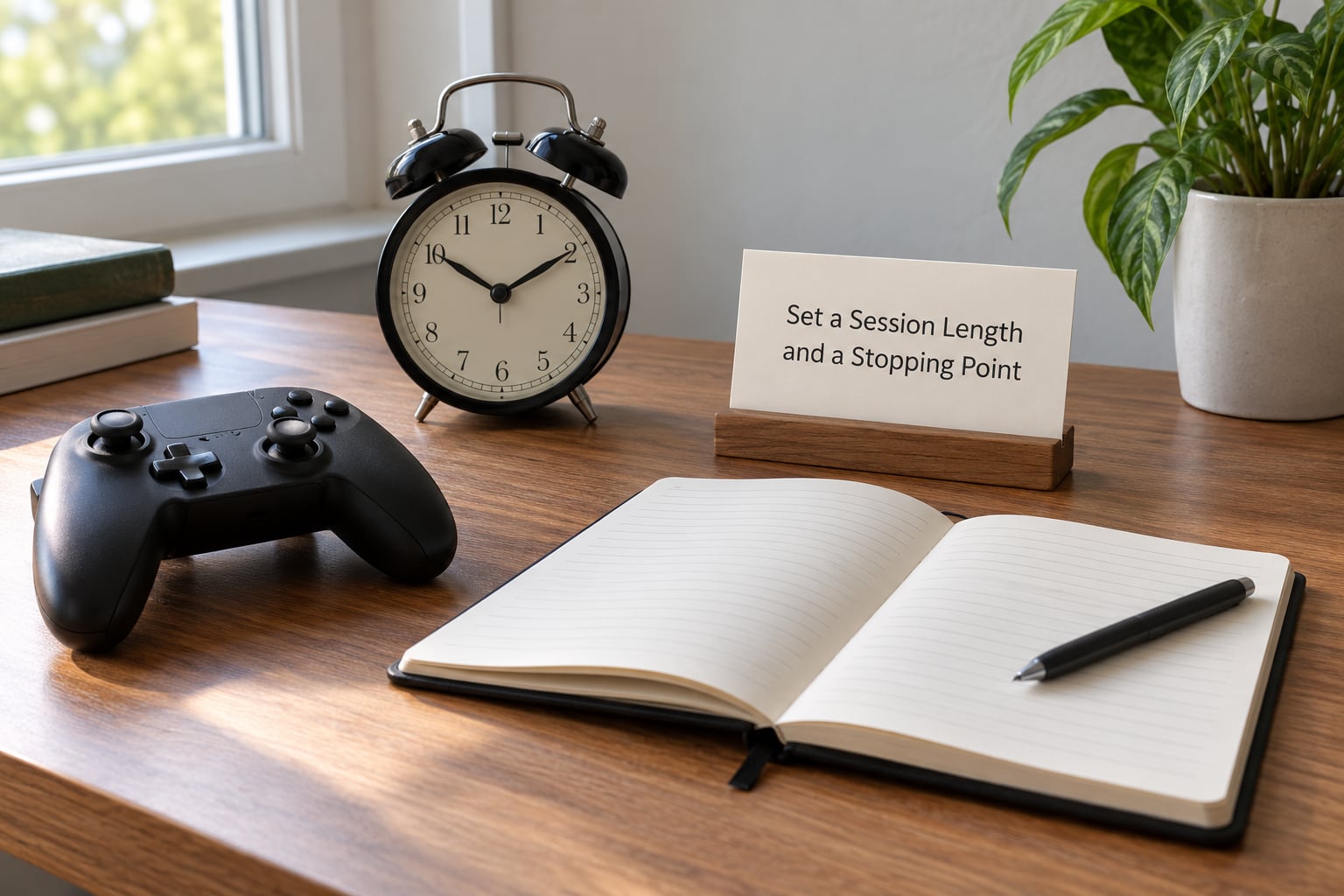
A stopping point is not the same as an alarm. An alarm says stop; a stopping point says this is a natural place to stop, so leaving feels like finishing rather than quitting. Save points, the end of a level, a village before the next dungeon, the start of a new chapter, a boss you have not beaten yet.
Set a timer for the whole window as well, and when it goes off, save and close. The timer kills the failure mode where an intended forty minutes quietly becomes four hours. Members of r/patientgamers describe the same trap from the other side, the game that is still the same unfinished thing after a year, so a defined end is the escape route.
Give yourself a hard rule about the last few minutes. No starting a new quest, no opening a shop with currency you do not need, no logging into anything online. Start those five minutes only when the session is already ending.
Learn the Game’s Core Systems
Pick the one system the game is actually built around and study it on purpose. In a difficult action game, that is usually the defensive move: its timing window, its stamina cost, its recovery frames. In a role-playing game, it may be the economy, or how companion AI reacts to being given items. In a puzzle game, it is whatever rule you keep violating without noticing.
Test it deliberately instead of by accident. Go somewhere safe, repeat the mechanic five times with full attention, then take it back into the situation that was beating you. Isolated practice plus one application is worth an hour of blind repetition, because now you know what you are doing differently.
Then connect it. Ask why the designer made that move cost stamina, or why that item exists at all. Systems stop being arbitrary rules and start being the game’s opinion about how you should behave. That understanding is what keeps later sessions from feeling like flailing.
Use a Focused Practice Loop
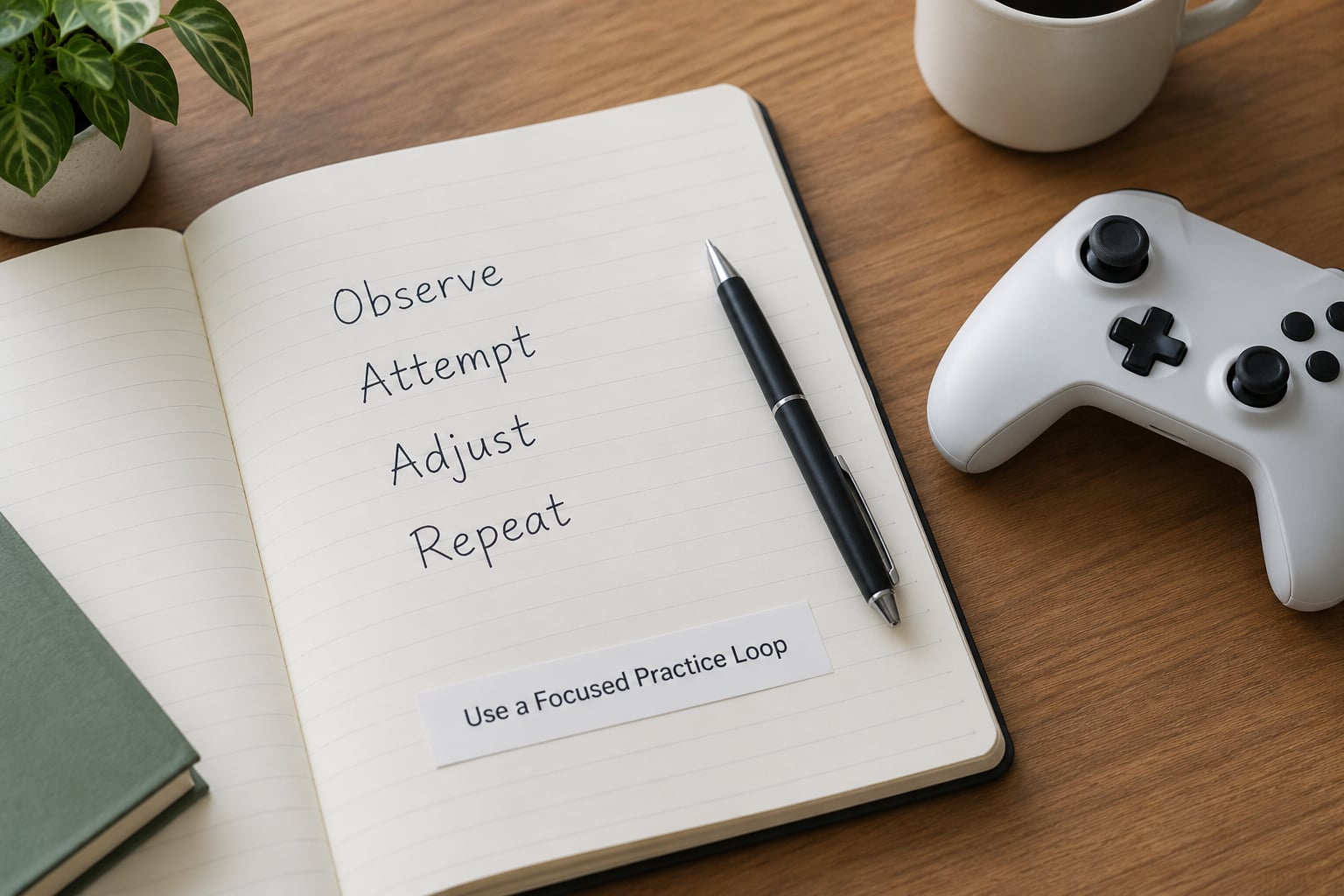
Four beats, repeated: observe, attempt, adjust, repeat. Observe means watching what actually happens, not what you assume happened. Attempt means one clean try with the change in mind. Adjust means changing exactly one variable. Repeat means going again.
That last constraint is the useful one. Changing your weapon, your route, and your timing at the same time tells you nothing about which one worked. One variable per loop means every attempt produces information, which is the difference between practice and mashing.
Cap the loop at five or six attempts, then walk away. Banging on a boss for an hour is not practice, it is frustration with extra steps. On r/patientgamers, people describe hard games like Elden Ring or Enter the Gungeon working like a focus drill, and the ones who get the benefit tend to be the ones who stop while they still feel alert.
Make Decisions for a Reason
Pause before any choice that costs something: which quest to abandon, which stat to invest, which faction to favour, whether to sell an item. Name the options out loud, predict the likely consequence of each, then choose. The prediction is the whole value, because you learn whether your mental model of the game matches the actual game.
Be less precious about reloading. If you are curious about an outcome, save and look. Treating a reload as an experiment rather than a failure keeps you curious, and curious players solve more problems than players who are quietly accumulating deaths to avoid.
Balance Mastery, Exploration, and Story
A session that is all mastery turns into training. A session that is all wandering turns into scenery. Divide it on purpose. A workable split for a ninety-minute evening is twenty-five minutes on the thing you came to improve, twenty-five on somewhere you have not been, twenty on story or dialogue, and the remainder however it goes.
Not every game supports that mix. A roguelike run is mostly mastery by design, a walking simulator is mostly exploration, and an immersive sim is a bit of all three. Match the balance to the game rather than forcing a role-playing game into a spreadsheet.
Pay attention to atmosphere while you are there, even if it is not the goal. Music, weather, the way a space is lit after a long walk, a line of dialogue you nearly skipped. Those details are most of what you are actually there for, and they vanish completely when the session is a task.
Record What Changed Your Understanding
Write one line. The most useful format is a question, not a summary: why the parry felt late, what the merchant in the second town actually wanted, what the minimap is not telling me. Questions carry forward into the next session in a way that past-tense summaries do not.
A screenshot works too, and takes two seconds. Drop one into a folder named for the game, with a few words on what you are looking at. When the game gets confusing in three months, that folder beats any guide you have to search for again.
Over a few weeks these notes turn into a record of your own learning. You will notice you stopped asking the same question twice, which is a far more motivating signal than any progress bar.
Review the Session and Choose the Next Focus
Three questions, in order. Did I do the thing I said I would do? What did I learn that I did not know when I started? How do I actually feel, rested, wired, flat, or irritated?
The third question matters most. If the honest answer is irritated, your next focus should be a smaller or different one, not the same hard fight. Aiming lower on purpose is how you keep the habit alive, and keeping the habit alive matters more than any single session.
Then write the next purpose before you close the game. You are already in the moment where you know what you want, which makes it the cheapest time to decide.
Common Mistakes
Treating Every Minute Like Work
Intentional play is supposed to increase curiosity and pleasure, and the moment it starts feeling like a productivity system you have already missed the point. If you are tracking completion percentages, optimizing routes, or dreading a session, cut the goal down. One interesting question per evening is plenty.
Setting Goals That Are Too Broad
Get better at combat is not a goal, it is a mood. Get better at combat is tested by something observable: land the dodge on the second phase four times in a row, or finish the fight without taking a hit below half health. Swap vague for small and testable, or you will never know whether the session worked.
Confusing Difficulty With Poor Decisions
Losing repeatedly does not automatically mean you are playing badly. Sometimes you are missing one mechanic, sometimes the encounter is tuned above your current build, sometimes you got unlucky twice in a row. Change one variable, run a couple more attempts, and only abandon the approach once you can name what was wrong. Rage-quitting is a decision too, and an expensive one.
Forgetting to Enjoy the Story or Atmosphere
Optimization quietly removes most of what makes single-player games worth the hours. Watch a cutscene. Read the lore item. Walk somewhere without a map marker. If a session contains nothing but efficiency, the game you spent thirty hours in has been played as a spreadsheet, and you will not remember it a year from now.
One practical habit worth keeping: play on a schedule that includes breaks rather than pushing through a marathon. The common eye-care guidance, look at something about 20 feet away for 20 seconds every 20 minutes of screen time, keeps long evenings comfortable. Stand up between chapters. Your attention holds up better when your neck and eyes are not fighting you.
Frequently Asked Questions
How long should an intentional gaming session be?
Most games fit 45 to 90 minutes well, because that is long enough to make real progress and short enough to stop cleanly. Shorter RPG chapters suit 30 minutes, and 15-minute sessions suit short puzzle games played with coffee. Pick the window before you start, set a timer, and choose a natural stopping point such as a save point or the end of a level so leaving feels like finishing rather than quitting.
How do I stop grinding a single-player game and start enjoying it?
Notice which part of the session feels like work: repetitive resource farming, endless side quests, or optimising a build you never chose. Cut that specific part for the next session and replace it with something the game does well, such as dialogue, exploration, or one hard fight you would enjoy losing. Grinding is a symptom of unclear purpose, so a single session purpose usually fixes it.
Is it better to finish one game or play several at once?
One at a time, in most cases. Players in the r/patientgamers community reach this conclusion often: juggling several games spreads attention thin, keeps every save file cold, and produces a shelf of half-played stories. Two at once can work if one is a short puzzle game and the other is your main focus. A rotation works only if each game gets real, protected time.
Should I keep a gaming journal?
Only a small one. One line per session, written as a question rather than a summary, is enough to keep a thread going between plays. It helps because questions carry forward into the next session and show you when you stop asking the same thing twice. A screenshot folder named for the game works just as well and takes even less effort.
What should I do when a hard game makes me frustrated instead of calm?
Stop the session while you are still capable of thinking, not after the anger has set in. Note what happened, change exactly one variable, and try two or three more times. If it still lands badly, switch to something with a lower ceiling for a while. Difficult games work as a focus practice for some players, but only when the frustration stays low enough to learn from.
Do these techniques work if I have ADHD?
They can, but the external structure matters more than the intention part. A timer, a fixed stopping point, and one written purpose per session do the holding that self-talk cannot. If writing at the end feels like a chore, use a screenshot or a single voice memo instead. Anyone whose attention or executive function is affected by a condition should adapt the method to fit their needs rather than forcing a template.
Conclusion
Start with the smallest version that works. Pick one game you actually want to open, write one purpose for tonight’s session, set a timer and a stopping point before the first loading screen, and leave one question for next time.
That is the whole practice. Repeat it for a couple of weeks and the noise drops away: fewer games started without a reason, more sessions you can actually describe afterwards, and a game that gives something back instead of quietly eating an evening.