Balance patches change a game meta by moving the numbers that decide which options are efficient. When a cooldown, a damage value, a cost or a movement tool shifts, every strategy built around the old value gets slightly worse or slightly better. Players notice within hours, rebuild their approach around the new numbers, and the picks, bans and win rates that follow are the new meta.
Last updated October 2026. This guide covers what the developers actually change, how to tell a real meta shift from a noisy first week, and what to do on the evening a patch lands.
Table of Contents
- What Is a Balance Patch?
- What Is a Game Meta?
- How Balance Patches Change a Game Meta
- 1. A value changes
- 2. Relative efficiency shifts
- 3. Players re-optimise
- 4. Pick, ban and win rates settle
- What Kinds of Balance Changes Matter Most?
- Reading one patch line at a time
- How to Measure Whether a Patch Changed the Meta
- Why Balance Patches Sometimes Create New Dominant Strategies
- How Players Adapt and Shift the Meta
- A seven-step routine for patch day
- When Does a Meta Change Become Stable?
- How to Tell Design Intent From Actual Impact
- Frequently Asked Questions
- How long does it take for a balance patch to change a game meta?
- Does a lower pick rate mean a character, strategy, or item is weak?
- Why can a small numerical buff create a major meta shift?
- How do indirect buffs affect the game meta?
- Should players wait for official data before changing strategies?
- Can a balance patch make an old strategy strong again?
- Conclusion
What Is a Balance Patch?
A balance patch is a set of targeted adjustments to the values, rules or systems that decide how strong each option is. It is narrower than a general update, which may add new content or fix bugs. Patch notes usually split into a balance section, a systems section and a bug-fix section, and only the first two really move the meta.
That distinction matters more than it sounds. A bug fix that corrects a broken hitbox restores the intended numbers, so it moves the meta back toward what the design team wanted. A new map or a new character does not move the meta by adjusting existing power, it moves it by adding options and by pulling attention. A balance patch changes the relative value of things that already existed.
Patches also come in different sizes. A hotfix lands days later and usually touches one broken or oppressive thing. A midseason patch rewrites several systems at once. A season launch resets ranks, brings a new character and shifts the ranked format, so it moves far more than the stat lines suggest.
What Is a Game Meta?
The meta is the set of strategies, characters, items and decks that win most often at a given moment. Players usually say it stands for most effective tactics available, and the useful part of the definition is the last clause: available. The meta is limited to what exists right now and what most players can actually execute.
That last part explains why the strongest option is often not the most picked one. A strategy with a 55% win rate that demands frame-perfect execution will see lower pick rates than a 52% strategy that works with sloppy play. Pick rate measures how popular something is, not how strong it is.
Counterplay cost does a lot of the same work. An option with few hard counters stays popular even when it is not dominant, because facing it costs your team more than facing the alternatives. Skilled players also push the meta earlier than the average player, which is why ladder data and tournament drafts can disagree for weeks at a time.
How Balance Patches Change a Game Meta
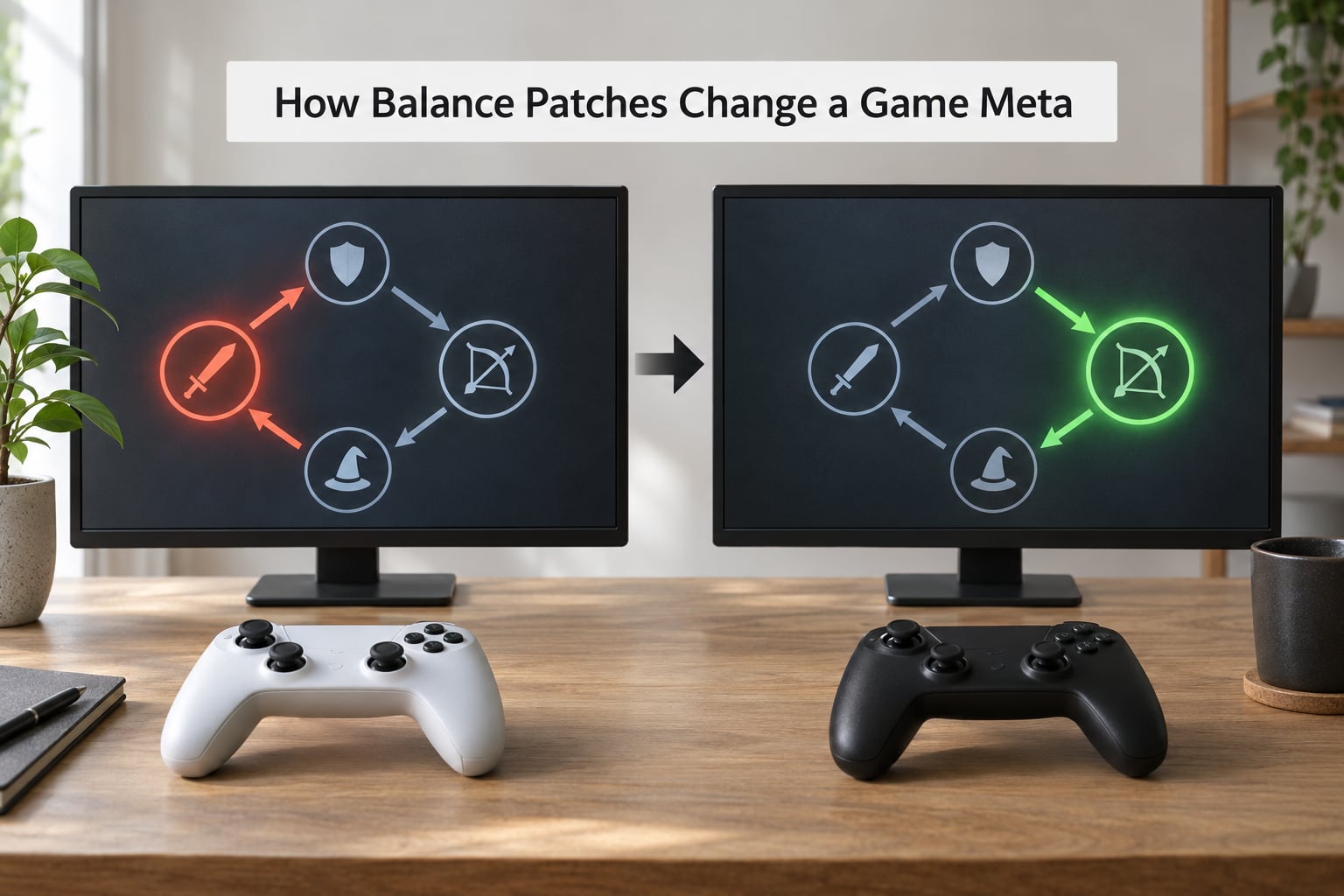
The chain has four steps, and each one can be measured separately. Once you can name which step you are looking at, most patch-day arguments stop being arguments.
1. A value changes
The developer alters a damage number, a cooldown, a resource cost, a movement tool, a duration or a rule. This is the only step the developers directly control.
2. Relative efficiency shifts
Every other option keeps its old value, so the gap between the changed option and everything else moves too. A cooldown cut from eight seconds to seven does not just make one ability stronger, it makes the whole rotation around it cheaper per unit of pressure.
3. Players re-optimise
People notice and adjust. Pros and high-rank players usually move within a day, because someone in their scene is testing the change immediately. Most of the ladder takes a week or two. Some players never move at all, which is where off-meta play comes from.
4. Pick, ban and win rates settle
The new favourite shows up first in pick and ban rates, because those react to visibility rather than to results. Win rate follows more slowly, since it needs completed games. Once those three lines stabilise, you are looking at a settled meta rather than a first-week spike.
A quick example. Imagine a character whose gap-closing ability had a long, frequent cooldown. That cooldown gets cut in half. The ability was never picked much, because holding it in reserve was better than spending it early. With the cooldown halved, the option can be used every rotation, so its effective damage over a full fight roughly doubles without a single damage number moving. Pick rate jumps in the first week, win rate climbs in the second, and opponents who had built a plan around avoiding that ability now have to reconsider. That is the whole mechanism in miniature.
The same example run in reverse shows why nerfs are so disruptive. Cut that cooldown back and the option’s damage over a fight halves again, but players keep the habits they built for a month. Old habits are why the meta can feel broken for a while after a nerf has technically landed.
What Kinds of Balance Changes Matter Most?
Not every line in the patch notes deserves equal attention. These are the categories that actually move a meta, roughly ordered by how much they tend to shift it.
| Change type | What it alters | Who it affects | Meta effect to watch |
|---|---|---|---|
| System change | Ranked rules, queue structure, economy, map rotation, spawn rules | Everyone, instantly | Fastest and largest shift, because it changes what strategies are possible |
| Mechanical change | How an ability works, not just its numbers | Every player of that option, and every counter to it | Creates new combos and new failure states; hard to predict from notes |
| Rework | An option’s whole kit, usually over several patches | Veterans of that pick and anyone who relied on countering it | Resets the pick entirely; expect a volatile first month |
| Nerf | Raw strength of the strongest option | Players who main it, and the teams built around it | Pick rate falls first, win rate second, habits last |
| Buff | Raw strength of an underused option | Players who main it, plus its new adopters | Pick rate spikes on hype, then win rate reveals whether it holds |
| Numerical adjustment | One value: damage, cooldown, cost, range, duration | Whoever uses it and whoever plays against it | Small by itself, large in combination with other lines |
Read in that order. A system line changes the rules of the game, a mechanical line changes what a strategy can do, a rework resets a pick, and a numerical line changes the price of doing business. Plenty of patch notes bury a system change halfway down and present it as housekeeping.
Reading one patch line at a time
Ask three questions of every entry. What does this option do more or less often now? Which other options does that make cheaper? And who was relying on the old value? A cooldown buff helps the option’s user and quietly hurts everyone who kept a cooldown-advantage tool in their loadout.
How to Measure Whether a Patch Changed the Meta
Judge a patch over days and weeks, not hours. Here is the sequence that holds up.
- Note the baseline. Before you play, write down the pick, ban and win rates for the options you care about. Without a baseline, every number looks like a shift.
- Wait a sample out. A few hundred games is noise. Watch for tens of thousands of matches, or a full week including a weekend, before you call anything new.
- Track pick and ban separately. Ban rate is the honest signal of threat. Pick rate is the honest signal of popularity. Neither is a strength measurement on its own.
- Check matchup frequency. An option with a great win rate that always ends up facing the same counter is fragile. If its win rate survives when it meets its counter more often, the buff has real depth.
- Watch low-level data. Game-level win rates hide skill differences. If an option wins at low rank and loses at high rank, the change rewarded execution rather than efficiency.
- Look for the second-order line. Often the option that moves most is not the one that was patched but the one that counters it.
| Signal | Why it is trustworthy | Why it is misleading |
|---|---|---|
| Ban rate over several weeks | Opponents vote with money on their draft | Tiny player pools in low-population regions |
| Win rate at high rank | Reflects real optimisation | Slow to fill after a patch |
| Pick rate in tournament drafts | Scraped by professional teams with time to test | A handful of teams can swing a champion’s rate |
| First-week pick spike | Shows attention | Mostly hype and novelty, not power |
| Win rate in one role or rank tier | Pinpoints who gained | Not representative of the whole ladder |
| Matchup spread | Shows real counterplay options exist | Needs large samples per matchup |
Free public trackers exist for most competitive games, and the community relies on names like Dotapi and Dotabuff-style sites for hero-level data. Two community discussions on r/learndota2 make the point well: heroes rose and fell in popularity across an international event with no meaningful stat changes at all.
Why Balance Patches Sometimes Create New Dominant Strategies
A patch aimed at one problem often hands a different option the lead. A few mechanisms show up repeatedly.
Opportunity cost. When one option gets cheaper, something else has to give up its place in the same limited slot. A loadout with six choices is not six independent improvements, it is six claims on the same budget. Nerf the loudest claim and a quieter one quietly takes the space.
Compensation mechanics. After weakening an option, developers often hand back power elsewhere, and the second buff is the one that lands. Players latch onto the headline nerf and miss the footnote.
Hidden bonuses. A flat value change interacts with percentages, thresholds and damage breakpoints. Two percentage changes in the same patch multiply rather than add, which is how a small line becomes a large one.
Matchup gaps. An option that beats three matchups hard and one badly gets drafted constantly in competitive play and feels weak in ranked, where matchups are spread thinner.
Execution advantage. If a change rewards a specific timing, and only a small slice of the player base can do that timing, the win rate moves less than the announcement suggests.
There is a fair criticism underneath all of this, and players on r/truegaming and r/superautopets raise it repeatedly: a live-service game that ships a change every few weeks to keep the meta moving is treating the symptom. If the same option keeps needing nerfs, the underlying system is the problem, and each patch just re-shuffles which strategy sits on top. Constant patching also skews the power curve down over time, because buffs and nerfs are not equally distributed in practice. Worth taking seriously, even if the cadence itself is not going away.
How Players Adapt and Shift the Meta
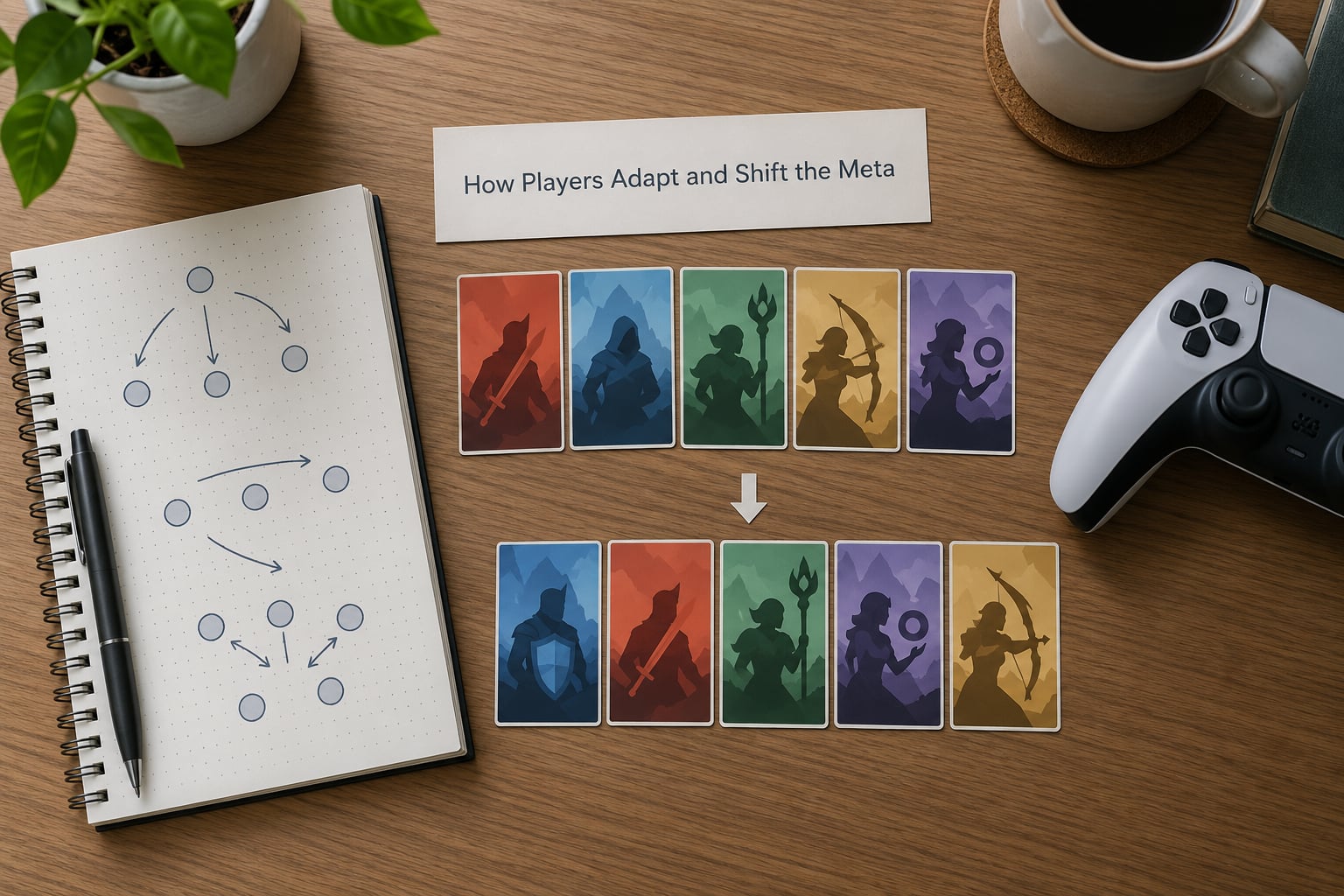
Different layers of a game community move at different speeds, and that gap explains most of the arguments about what is strong.
Professional teams move first. They test in private, draft around what their opponents prefer, and publish very little. A top team can make a strategy look weak in public play simply by not using it, which is why raw tournament rates lag reality by weeks. Fighting game players describe the top 0.1% as the real meta rather than the published tier list, for exactly this reason.
High-rank players come next, usually within a day or two. Then the top of each role, who test combinations the average player never touches. The average player moves last, often a week in, and often reacts to tier lists written by people one step ahead of them.
The result is two metas running in parallel. Tournament drafts optimise for the narrow set of situations a match produces. Solo queue optimises for the situations a random queue produces, which rewards stability and punish over peak ceiling. Ladder advice built on pro data will regularly feel wrong at rank 30.
A seven-step routine for patch day
- Read the systems and mechanical lines first, and skip the number changes until you know what rules you are playing under.
- Write down your current pick, ban and win rates before you queue. It takes two minutes and saves you from reacting to noise later.
- Watch two or three high-level matches before playing. Not to copy them, but to see which options people are even testing.
- Change one thing in your approach, not everything. Character, settings, sensitivity and team plan all at once makes it impossible to tell what worked.
- Keep your old strategy warm for a week. If the buff is real, your old pick returns to roughly its old value once the excitement fades.
- Re-check the trackers on day seven and day fourteen, and only then decide whether to invest time in the new option.
- Stop chasing anything the sample cannot support. Most early-season tier movement is noise wearing a confident voice.
When Does a Meta Change Become Stable?
A meta settles when three conditions line up: enough matches for the numbers to mean something, enough players to have copied whatever the good approach is, and no pending patch that would reset the ground. In a live-service game that third condition often arrives first.
Timeline varies by genre. In a card game or fighting game, a balance update is usually followed by a visible pick-rate swing within days and a settled meta in three to four weeks. In a battle royale or a live-service shooter, rotations run on a season cycle, so a shift can take a full season to feel normal. In a MOBA, a single hero’s meta can be decided in a week while the overall game takes longer, because the hero interacts with a hundred other picks.
Adaptation speed is the variable most people underestimate. The better the game’s teaching tools and the clearer the patch notes, the faster the population re-optimises. Shy new players and low-population queues can also slow the shift down, which is a signal in itself: if nothing has moved after a month, something structural is holding the meta in place.
How to Tell Design Intent From Actual Impact
Developers aim for a specific shape, usually somewhere between 50 and 55% win rate, and they read several signals together rather than one. Play rate matters, because an option nobody uses is a design problem even if it is balanced. Pro pick and ban rates matter, because those are the opinions of players with the most practice. And whether the option is fun to play matters more than any of the numbers.
Watch for four outcomes when a patch lands.
Overnerfs. The win rate was carried by a small, skilled slice of players, and the team read it as a population problem. Pick rate collapses, the win rate barely moves, and the next patch gives some of it back.
Uncapped power spikes. A buff pushed an option past the point where any counter exists. Nothing in the notes looks extreme, but the interaction with an existing mechanic is.
Indirect buffs. The loudest option was nerfed, and the option that profits from its cooldown, its space or its damage being contested is the real winner. It rarely shows up in preview reactions.
Emergent strategies. The patch was fine and the meta moved anyway, because players found a line the developers never considered. r/TeamfightTactics threads describe a whole season’s meta evolving through one minor patch with no real balance changes at all, which is the clearest proof that player behaviour is its own balancing force.
If the change does what it was meant to do, the follow-up patch will be small or absent. If the same option appears in the next three patch notes, the first fix did not land.
Frequently Asked Questions
How long does it take for a balance patch to change a game meta?
Pick and ban rates usually react within days, because players see the patch and adjust quickly. Win rates need a real sample, so give it a week of completed games before trusting them. A settled meta typically takes three to four weeks in card games and fighting games, and longer in a live-service shooter where the season cycle sets the pace.
Does a lower pick rate mean a character, strategy, or item is weak?
Not necessarily. Low pick rate usually means high counterplay cost or a high skill floor rather than low power. A strategy that wins often but punishes every mistake stays unpopular in ranked, where teams cannot afford to gamble. Check the win rate of the players who do pick it before you write it off.
Why can a small numerical buff create a major meta shift?
Because numbers are relative. Cutting a cooldown in half does not make an ability 50% better, it lets the player use it twice in a window where they previously used it once. That doubles effective output over a full fight without touching a single damage value. Multiply that effect by a percentage change elsewhere and a small line becomes huge.
How do indirect buffs affect the game meta?
An indirect buff happens when a change makes an option easier to use, which frees up budget elsewhere and strengthens whatever shares that budget. A cooldown cut on one ability lets a player hold a defensive tool through a whole rotation. The buffed option barely changed, but its neighbours got stronger as a side effect.
Should players wait for official data before changing strategies?
No. Start adjusting the moment the patch lands, but keep your previous approach warm. Official developer data is useful for intent, not for current strength, since it is usually published before players have adapted. Use public trackers instead, and treat anything less than a week of matches as provisional rather than proven.
Can a balance patch make an old strategy strong again?
Yes, and it is more common than players expect. When a dominant option is nerfed or a counter to an old strategy is weakened, a previously outclassed approach can return to competitive viability. It rarely returns to its old strength, but a faction or archetype that was considered dead often becomes a genuine draft option within a season.
Conclusion
Start on patch day with the systems and mechanical lines, ignore the number changes for now, and write down your baseline rates before you queue. Change one thing in your approach rather than five, and check back in a week with a real sample before you commit time to anything new.
Understanding how balance patches change a game meta is mostly about resisting two mistakes: treating hype as proof, and treating a familiar strategy as permanently dead. Patches move numbers, players move habits, and the gap between those two movements is where every meta shift lives.