Ranked matchmaking feels unfair because it is built to keep queues short and lobbies roughly even, not to give you a fair shot at winning. The system estimates your skill from a noisy rating, widens that search range the longer you wait, and balances team averages rather than the four people standing next to you. Add smurfs, party stacking and ordinary bad luck, and a 50% match turns into a blowout about as often as a dice roll says it should.
That said, the frustration is not imaginary. Some complaints are pure noise, some are real design limits, and a few point at genuine problems worth reporting. Here is how to tell them apart.
One distinction does most of the work. A match is unfair when you are treated unequally — different rules, hidden penalties, a system that bends for some players and not others. A match is unfun when you are simply outplayed, which is what happens to almost everyone more often than they expect. A correction from an Overwatch forum thread captures it well: unfair is not about good, it is about treating everyone the same.
Table of Contents
- Why Ranked Matchmaking Feels Unfair in Practice
- What Does Ranked Matchmaking Actually Try to Balance?
- Is the Matchmaker Unfair, or Are the Players Uneven?
- Why ranked matchmaking feels unfair to one player but not another
- Which Hidden Factors Make a Match Feel Unfair?
- Does Losing Streaks Prove the Matchmaker Is Rigged?
- Why Do Some Games Feel Fairer Than Others?
- What Can You Do When Ranked Feels Unfair?
- How Do You Know It Is a Bug Instead of Bad Losing?
- Frequently Asked Questions
- Is ranked matchmaking designed to give every player an equal chance of winning?
- Why do I face players with a much higher or lower rank than me?
- Can smurfs and boosted accounts make ranked matchmaking unfair?
- Why does one losing streak feel much worse in ranked games?
- Should I change my rank or region if matchmaking feels unfair?
Why Ranked Matchmaking Feels Unfair in Practice
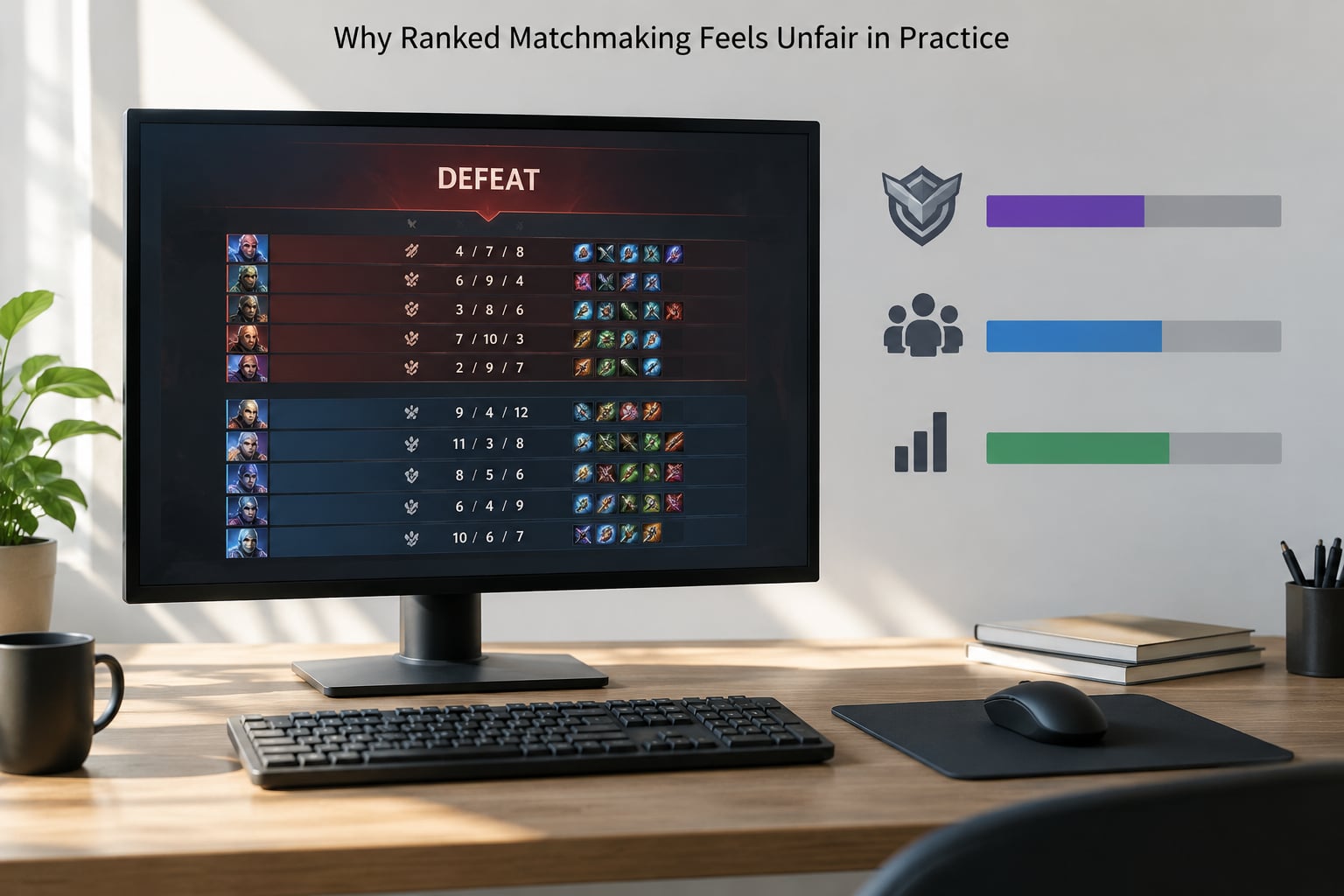
The short answer is that the matchmaker optimises for a narrow set of things and your win rate is not one of them. What it optimises for is a team-average skill gap close to zero, a queue time short enough that people keep playing, and enough variance in match types to keep sessions interesting. Your personal experience of any one match sits downstream of all three.
Most unfair-feeling matches come down to a small set of causes that are hard to see from the inside.
| What you see in the lobby | What the system is probably doing |
|---|---|
| One teammate far below the rest | Backfill players, or a party whose stack widened the acceptable range |
| Everyone picked the same role and your team has none | Role coverage is often a tiebreaker, not a guarantee |
| Your team looks like the enemy team’s floor | Team averages can match while the distribution does not |
| Three losses in a row, then four wins | Plain variance plus regression to the mean in a noisy rating |
| A dominant player on the other team | A smurf, a boosted account, or a returning player with a stale rating |
| You played well and still lost | Performance ratings often move slower than the scoreboard |
None of those rows require a conspiracy. Each one is a design choice or a limitation, and several show up in the same game at the same time.
What Does Ranked Matchmaking Actually Try to Balance?
Every ranking system starts by giving every account a hidden skill number. In shooters it is usually called MMR, in older systems ELO, in newer Bayesian systems something like Glicko or TrueSkill. The number goes up when you beat people rated above you and down when you lose to people rated below it. That is the whole idea: the rating is a running estimate, not a fact.
The estimate is only ever as good as the data behind it. A system sees your recent results, who you played against, how your performance compared to theirs, and how consistent that performance has been. It does not see your monitor, your mouse sensitivity, whether you were distracted, or that you play on a five-stack every Friday and solo at midnight.
That estimate then feeds a three-way trade-off the developers have to pick a side on:
- Match quality. Tight skill ranges make for close games, at the cost of longer waits.
- Queue time. Fast matches need a wider pool, which means wider skill gaps.
- Retention and playtime. The business model rewards hours played, and a queue that never ends is a queue people quit.
Widening the range over time is the part players notice most. You sit in queue, nothing happens, and then suddenly you get a game against someone far outside your rank. The system did not change its mind about you. It ran out of nearby players and expanded the search.
Party size feeds straight into the same maths. A five-person stack needs five nearby players at roughly one rating, which is a much harder search than one solo player does. So games either queue parties as a block with a wider tolerance, split them, or refuse to match them. Latency brackets and region choice narrow the pool further, and off-peak hours thin it out again.
Not every system has to make that trade-off. Halo 3 was built around three deliberate match types — a slightly easier game, a slightly harder game and a genuinely even game — and mixed them on purpose. The trade-off was variety versus certainty, and players who liked it still argue about it. The former Halo multiplayer lead Max Hoberman has been widely quoted saying modern skill-based matchmaking maximises perfect matches and minimises everything else, which pushes the same decision onto queue times at the top of the ladder.
Is the Matchmaker Unfair, or Are the Players Uneven?
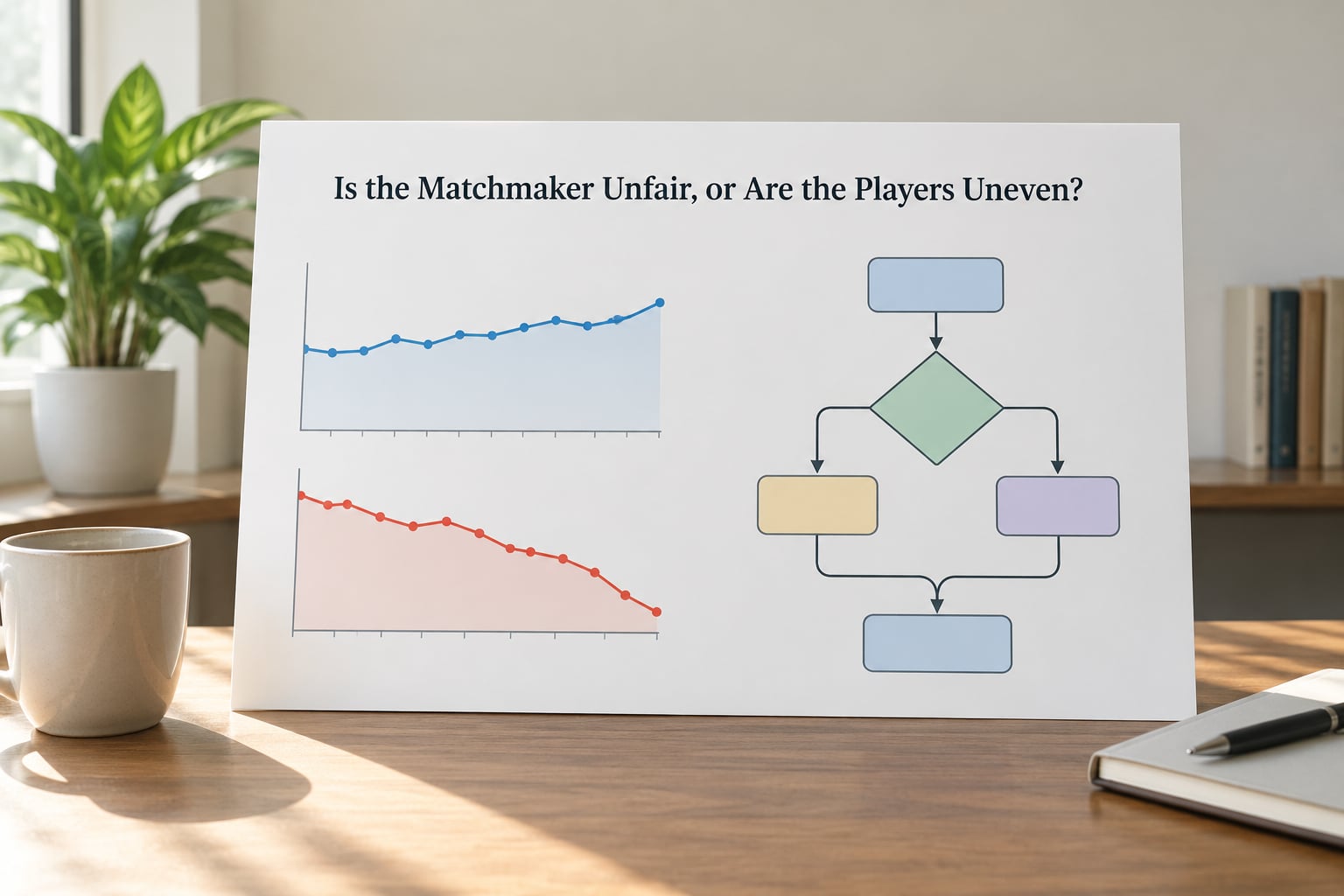
Part of the gap is that you see the scoreboard and the system sees something else. You can see that the enemy first player out-fragged your first player. The system may be weighing objective contribution, consistency across the match, opponent strength, recent volatility and account signals that never appear on the results screen.
That gap explains why two players with the same rating can describe the same lobby in completely different terms. One of you was the smurf; the other was the account about to be reported. One of you queued at 2am on a weekday; the other queued at 8pm on a Saturday.
There is also a mirror problem players rarely notice. A thread on the Dead by Daylight forums from a player whose kill rate fell from 2.4 to 1.1 after switching killers drew agreement that the lobbies were too strong. In that same thread, a veteran posted the opposite complaint: matchmaking kept giving them players way too weak. Same system, opposite experience, and both readings felt obviously true from the inside.
So when a lobby feels stacked, the useful question is not whether the system did it on purpose. It is which of the six rows in the table above applies, and whether the same pattern survives across a hundred games.
Why ranked matchmaking feels unfair to one player but not another
Role choice changes what the rating can see. In team games, a single rating per player has to compress a duelist who wins lanes into a support player who wins by keeping four people alive. Those are different skills measured on the same number, and the loss of information shows up as balance complaints from specialists on both sides.
Expectations change the reading too. A player who queues at peak hours and gets a steady lobby will judge the system fairly. A player who queues alone at 4am, plays a role the queue rarely fills, and loses four in a row has a much worse sample of what the system usually does.
Map and roster familiarity also skews perception. A loss on a character you have played two hundred times feels like evidence. The same loss on an unfamiliar pick feels like noise, even though it contributed exactly the same data point to your rating.
Which Hidden Factors Make a Match Feel Unfair?
Rating uncertainty is the quiet one. A rating is a number with a confidence margin behind it, and the margin is wide for new accounts, returning players and anyone whose results have been inconsistent. Two players can share a visible rank while sitting at opposite ends of the plausible range. Early placements and the first few games after a break are the least accurate data the system has, and they still produce a full match.
Smurfs and boosted accounts are the loud one. A smurf is a fresh account played by an experienced player; boosting means someone else plays your account for rank. Both distort a rating that assumes one skilled player per account. The economic incentive usually comes from the reward structure rather than the matchmaking itself. Players in the Dota 2 and Rocket League communities keep linking smurf prevalence to free cosmetic rewards, and in Dead by Daylight the discussion turns on dedicated accounts, not on the queue algorithm.
Party composition is a structural one. Larger stacks search a smaller eligible pool, so they either widen the range or wait. Stacking with players below your rank is a normal, allowed move that a rating-based system handles by averaging the party, which means one strong player can drag four accounts up faster than those four could climb alone.
Recent volatility matters more than people expect. A bad week pushes a rating down, the queue gets wider, the next games are messier, and the rating keeps sliding. Nothing is punishing you. You are just seeing the part of the system where estimates are least reliable.
Region and off-peak selection are boring but real. Choosing a low-latency region, queuing during work hours, or playing outside a season launch all thin the pool. Every one of those choices is a decision you made that changes the quality of the matches you get back.
And yes, some of it is a bug. Bad region routing, stale placements, results that fail to save, penalties applied to the wrong account — all of those exist and all of them break the model the developers intended. Section eight covers how to tell.
Does Losing Streaks Prove the Matchmaker Is Rigged?
A streak is not evidence. If you are a coin-flip player with a 50% win rate, four losses in a row happens often enough that you will see it in most hundred-game stretches. The maths feels wrong because losses are more memorable than wins, and because a four-game losing run costs you rank while a four-game winning run only restores it.
Your rating also moves asymmetrically. Winning against a strong opponent moves you less than winning against a weak one costs you. A rough patch therefore feels doubly punishing: you lose points, and those points come back slower than a good run delivers them.
Then there is the performance cost. Tilt narrows attention, and a narrowed player makes worse decisions for the rest of the session. The losing streak partly causes the conditions that extend it, which is why the fifth game is rarely a correction of the fourth.
Regression to the mean does the rest of the work. Any skill estimate built on noisy results swings, and swings pull back toward the average. A hot run is usually your rating catching up to you, not proof that you have levelled up. A cold run is usually the same thing in reverse.
Before you call it rigged, check three things: does the pattern hold across a sample you would actually defend to a stranger, does your raw performance match your win rate, and does the pattern disappear when you change one condition at a time. If the answer to all three is no, you have variance, not evidence.
Why Do Some Games Feel Fairer Than Others?
Fairness you can see is fairness you trust. The games that feel fairest tend to share a few habits: they show a visible rating that means something, they run a proper placement period for new accounts, they keep ranked and casual ratings separate, they publish how the system works, and they give you a match history you can read afterwards.
Separating the queues matters more than players expect. When ranked and casual share one rating, playing casually moves your ranked standing and every casual game becomes a ranked gamble. Games with two ratings feel calmer for that reason alone, even when the ranked matchmaking is no smarter.
Role queue is the other big one. A queue that fills a full team composition removes the most common source of lopsided-feeling matches, because a game with two tanks and no support is decided before the loading screen ends. It also makes some queues slow, which is the trade-off the Halo 3 model was built around.
Third-party trackers change the mood more than any of it. Players in the Dead by Daylight threads leaned on nightlight.gg distribution data rather than their in-game record, and that habit is common across communities. The system feels more fair when you can see 50 games of distribution instead of a single result screen.
What is missing everywhere is a published formula. Developers keep the exact weights private because they believe the details would be gamed, and the result is a player base that distrusts every claim of fairness that arrives without numbers attached.
What Can You Do When Ranked Feels Unfair?
Start with an audit, because it takes an evening and it settles most arguments. Pull at least 50 recent ranked games from a tracker or the in-game history, and write down three numbers: your win rate, your average performance score, and the average rank of the enemy team against your own. Ten games proves nothing. Fifty is enough to see a pattern if one exists.
Compare your scoreboard line to your team’s average rather than to the enemy. If you are above your team and below the enemy every night, the problem is your team, not your account. If you are at the bottom of both, the problem is your play, not the queue.
Change one condition at a time. Switch to peak hours for a week and compare. Try role queue instead of fill. Solo queue for twenty games and compare. One variable per test, or you will not know which change did the work.
Keep your ranking in one region and one game mode. Changing region, queue or party arrangement every session produces noise that looks like a pattern.
Be deliberate about dodging. In Dead by Daylight it is explicitly against the rules, and most competitive games penalise it in ways that are rarely spelled out in the interface. Dodge when a lobby is clearly, visibly stacked, and accept the cost when it is not.
Save the evidence when you think it is a real bug. Screenshots of an impossible scoreboard, a result that never appeared in your history, a rank change with no displayed reason. A ticket with a timestamp and a replay ID is worth ten posts of frustration.
And take the break. The most reliable way to make a bad run last longer is to queue again immediately. Two losses in a row is a normal event; five is a reason to close the game and come back tomorrow.
How Do You Know It Is a Bug Instead of Bad Losing?
Bad losing has a shape: it comes in clusters, it reverses eventually, and your performance line stays roughly in line with your results. Bugs do not follow that shape. Look for totals that should be impossible, a result on the screen that never appears in your history, a rating that changes with no reason displayed, penalties or bans you cannot account for, and the same connection or error repeating every single match.
Region routing counts too. If your ping points at a server on another continent, or matches keep dropping, the system is not evaluating your skill at all.
When you have one of those, escalate rather than post. Open a support ticket with the match ID, the timestamp and what you expected to see. Report the account through the in-game report flow if you suspect a smurf or a booster, because that is the channel developers actually read. Then quit ranked for the session, because a broken system will not correct itself in the next game.
While you wait, check whether a known issue is already listed in the game’s official channels. Reporting a bug that is already tracked is how you find out it is a bug rather than a bad night.
Frequently Asked Questions
Is ranked matchmaking designed to give every player an equal chance of winning?
No. Matchmaking balances estimated skill, queue time and player retention, not your personal win rate. A fair lobby means the two teams have similar average ratings, which still leaves room for you to be outplayed, especially in team games where one strong player cannot cover four weak ones. If every player won half the time, the ladder would never move.
Why do I face players with a much higher or lower rank than me?
The search range widens the longer you wait, so a slow queue is the main reason you see a large gap. Party stacks, low-latency region rules, role requirements and off-peak hours all shrink the eligible pool and push the range wider. A returning player with a stale rating also looks out of place until enough games update the estimate.
Can smurfs and boosted accounts make ranked matchmaking unfair?
Yes, because a rating system assumes one skilled player per account. A smurf or a booster adds skill the system never saw coming, and detection is imperfect, so penalties arrive late if at all. Players often trace the incentive to the reward structure rather than the queue itself, particularly where fresh accounts earn cosmetics or progression that existing ones have already claimed.
Why does one losing streak feel much worse in ranked games?
Three things stack up. Losses are more memorable than wins, ranking points come back slower than they leave during a rough patch, and tilt narrows your attention, which makes the next game worse. Statistically, a run of losses is normal for a player near a coin-flip win rate, so the feeling is real while the explanation is usually variance rather than the system targeting you.
Should I change my rank or region if matchmaking feels unfair?
Usually not, because changing several things at once makes the problem impossible to measure. Fix one variable at a time: play peak hours for a week, or run a role queue instead of fill, and compare your record across twenty or more games. Change region only when you have evidence of routing problems, such as consistently high ping or repeated disconnects.
So: is matchmaking rigged? Almost certainly not in the sense of deliberately handing you losses. It is built to trade exact skill matching against queue speed and time played, it estimates your skill from data that is often thin, and it balances team averages rather than the four players beside you. Those are the reasons ranked matchmaking feels unfair to almost everyone at some point.
Before you change queues, region or game, spend one evening on fifty games of your own history. Win rate, performance score, team rank averages, peak hours versus off-peak. That is the only evidence that settles it, and in 2026 it is still the evidence players trust most.