If you’ve ever watched a favourite team lose and wondered what happens next, the bracket is the answer. An esports tournament bracket is the map of a competition: it shows who plays whom in each round, how winners move forward, and how losers are knocked out until one team is left holding the trophy. Once you can read the lines, every broadcast makes more sense.
This guide breaks the idea down without the jargon. We walk through single elimination, double elimination, byes, seeding, and best-of series, then run through a full eight-team example from the opening round to the grand final. Updated for 2026 so the terminology still matches what you see on screen.
Table of Contents
- What Is an Esports Tournament Bracket?
- How Do Esports Tournament Brackets Work?
- Single-Elimination Brackets
- Double-Elimination Brackets
- Round-Robin and Swiss Brackets
- Which Esports Tournament Formats Are Most Common?
- What Are Byes in a Tournament Bracket?
- How Are Esports Teams Seeded?
- What Happens If a Match Is Tied?
- How Do Esports Tournament Brackets Work in an Eight-Team Example?
- How Do Tournament Organizers Prevent Match-Fixing?
- How Can Fans Follow a Bracket?
- Frequently Asked Questions
- How do brackets work for tournaments?
- What is the difference between single and double elimination brackets?
- Why do losers bracket teams play twice in the grand final?
- How do 12 team brackets work when 12 is not a power of two?
- What is a best of 3 series in esports?
What Is an Esports Tournament Bracket?
An esports tournament bracket is a diagram and a set of rules that decide which teams face each other, in what order, and what a loss costs you. Teams are placed into slots before the event starts, winners move forward along connecting lines, and losers either leave the tournament or drop into a second bracket.
The difference between the two outcomes is the whole point of the format. In single elimination, one loss ends your run. In double elimination, you get a second chance in the losers bracket and are only eliminated after losing twice.
Here’s the vocabulary you’ll see on almost any bracket graphic:
- Round — one stage of the bracket, such as quarterfinals or semifinals.
- Match — a single contest between two teams.
- Series — a match made up of several games, such as a best of 3.
- Advancement — moving up a line to the next round.
- Elimination — being removed from the competition.
- Seed — a team’s ranking before the event, from 1 upward.
- Grand final — the last series, which decides the champion.
A bracket is not the same thing as a group-stage table. A group stage has teams playing several opponents and earning points, and the table shows who is top after those games. A bracket is a knockout tree: it has a beginning, a middle and an end, and one of its main jobs is deciding who is out.
How Do Esports Tournament Brackets Work?
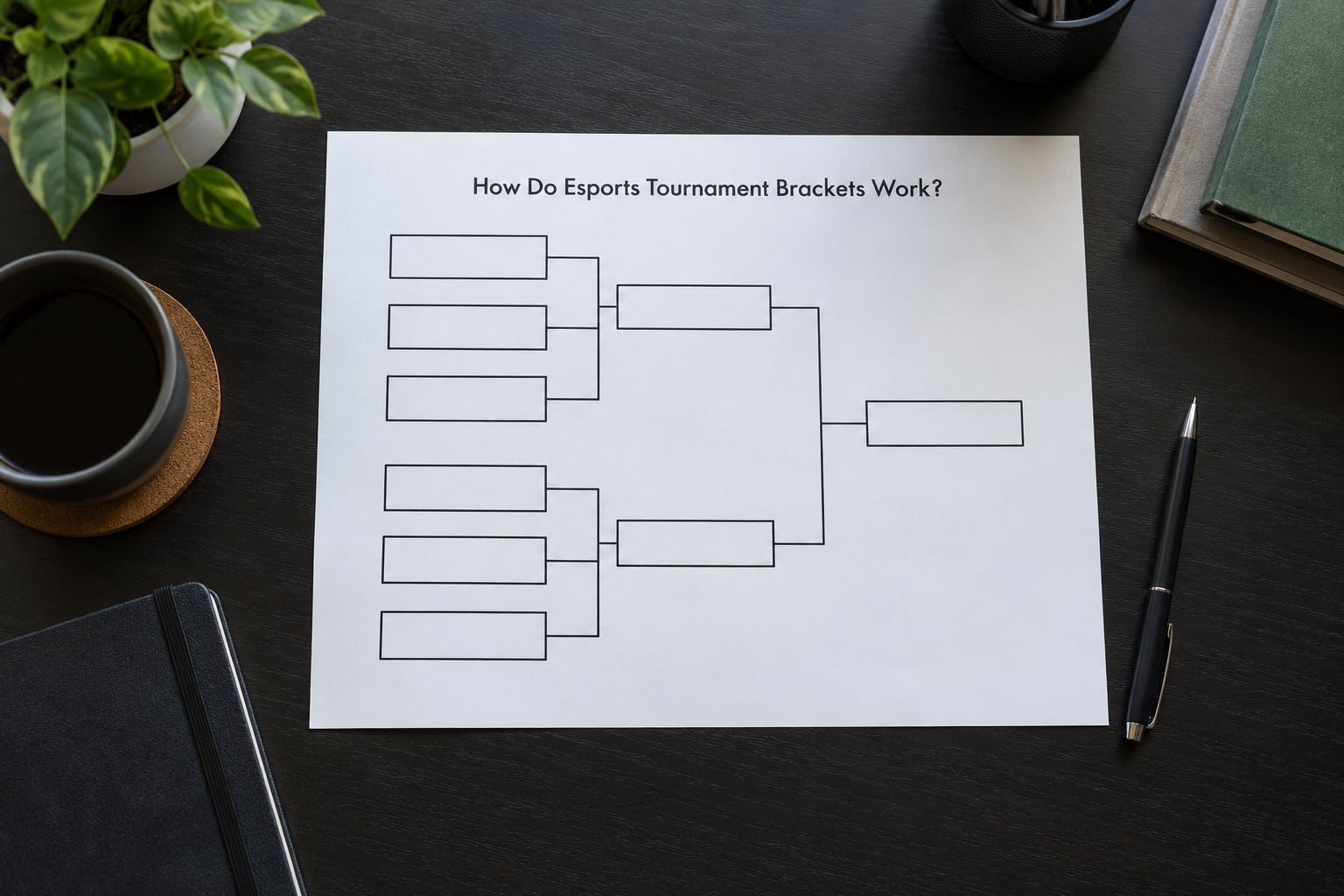
Teams are seeded into a pre-set structure, play the team opposite them in the bracket, and the winner advances to the next round. In a double elimination tournament the losing team drops into the losers bracket instead of going home, and the last two sides standing meet in a grand final.
Single elimination with eight teams works like this: four opening matches, two semifinals, then one final. Winners of the semifinals meet in the grand final, and the loser of that series finishes second. Nobody plays more than three series, and nobody is eliminated twice because there’s only one bracket.
The bracket diagram itself is a tree drawn sideways. Slots sit on the far left, each line joins two slots into a single next-round slot, and the lines converge on the right until only the champion slot remains. Reading it is just following a line one step at a time.
| Element | What it means |
|---|---|
| Round | A stage of the bracket, for example quarterfinals |
| Match | One contest between two teams |
| Series | A contest made of several games, such as a best of 3 |
| Advancement | Moving along a line into the next round |
| Elimination | Losing a match with no route back into the event |
| Grand final | The final series that decides the champion |
Single-Elimination Brackets
A single elimination bracket removes a team the moment it loses once. That’s why the format is quick: with eight teams there are seven matches, and with sixteen teams there are fifteen. Every match has a consequence, which is exactly why crowds and viewers care about every map.
The drawback is that a strong team can be sent home by one bad day. Fans of the top seed often argue this is unfair, and it’s the reason larger events use a longer format.
Double-Elimination Brackets
A double elimination bracket gives every team two lives. The top half is the upper bracket, sometimes called the winners bracket, where teams that win stay on the shorter path. Teams that lose there drop into the lower bracket, the losers bracket, and have to fight their way back up.
A team in the losers bracket that loses again is eliminated, and a team coming through the lower bracket has usually played several more series than the team waiting above it. That is the trade for the second chance.
The grand final is where the format gets interesting. If the team from the upper bracket wins, the event is over. If the team from the lower bracket wins, the organiser may reset the final and play a second series, so the team from the upper bracket has to win twice. Fans argue about this constantly, and you’ll hear it called a bracket reset.
Round-Robin and Swiss Brackets
Not every stage is a knockout tree. In a round robin, every team plays every other team, so nobody is knocked out by a single loss — the table at the end decides who advances. Round robin needs far more matches: ten teams playing each other once is 45 matches.
Swiss stages pair teams with opponents they’ve never faced, keep everyone alive through the early rounds, and use tiebreakers such as round differential or head-to-head record to separate them. Swiss is a common group stage in games like Rainbow Six Siege and Counter-Strike, and it produces a bracket stage for the teams that finish on top.
Which Esports Tournament Formats Are Most Common?
Six formats cover almost every professional event you’ll see on a schedule. This table compares them by how many matches they need, when a team is eliminated, how fair they feel, and where they’re normally used.
| Format | Matches needed (8 teams) | Elimination rule | Fairness | Typical use |
|---|---|---|---|---|
| Single elimination | 7 | One loss eliminates | Short, but one bad day ends a run | Open cups, qualifiers, small LANs |
| Double elimination | 14 (15 with a reset) | Two losses eliminate | Second chance, but extra matches | Playoffs of major leagues and tournaments |
| Round robin | 28 | Nobody is eliminated mid-stage | Maximum matches, fairest on paper | League regular seasons, group stages |
| Swiss | 24 or so, depending on the cut | Three losses usually eliminate | Strong teams still meet | Group stages before playoffs |
| Groups plus playoffs | Varies | Bottom teams eliminated after groups | Balances access with TV time | Most professional seasons |
| Best of 1 | One game per match | As above | Little room for recovery | Early rounds and Swiss ties |
Series length is a separate choice from bracket type. A best of 3 means first to two game wins, a best of 5 means first to three, and a best of 1 is a single game. Formats change by round: quarterfinals are often best of 3 while a grand final is best of 5, so the stakes rise exactly where viewership is highest.
What Are Byes in a Tournament Bracket?
A bye is an automatic advancement given to a team that doesn’t play in the opening round. Brackets are built from powers of two, because eight slots split cleanly into four matches, then two, then one. Twelve teams do not, so an organiser has to make room for the extra four.
With twelve entrants, four teams receive byes and eight teams play four qualifying matches. The four winners join the four byes in a round of eight, and from that point the bracket is a standard single-elimination tree. In a twelve-team double elimination event, the same idea applies with an extra preliminary round, and some organisers instead run two small groups of six before a playoff bracket.
Byes are not a reward, though they sometimes look like one. They usually go to the highest seeds, and fans often assume the opposite. The purpose is purely mathematical, and understanding that removes most of the confusion people raise in forum threads.
How Are Esports Teams Seeded?
Seeds come from three main sources: an official world or regional ranking, results earned in open qualifiers, and performance in a recent group stage. A regional seed reflects a team’s ranking, a qualifier seed reflects how far it went in a qualifying event, and a group seed reflects its result in a group it just played.
Seeds decide who sits opposite whom. In a standard eight-team single elimination draw, seed 1 faces seed 8, seed 4 faces seed 5, seed 2 faces seed 7, and seed 3 faces seed 6. The strongest seeds are kept apart early, so the top two can only meet in the final.
That protection is worth more than it sounds, because seeding in most major events is decided well before the event and rarely changed by the results on the day. Fans who can’t tell whether a team was seeded by ranking or by qualifier results are usually looking at a bracket without its seeding notes.
What Happens If a Match Is Tied?
Individual games can end in a draw, but a bracket always needs a winner, so rules guarantee one. Common solutions are extra rounds, tiebreaker games, stat-based tiebreakers, and coin tosses as a last resort. Which one applies is set by the event’s published rules.
It’s worth separating two things here. A tied map on its own is not the same as a tied series: in a best of 3, a 1-1 score simply means the next map decides the series. A tied series in knockout esports is rare because a series normally ends with an odd number of maps, so one side always reaches the required number of wins first.
How Do Esports Tournament Brackets Work in an Eight-Team Example?
Here is a full eight-team single elimination bracket with illustrative team names, so you can follow how a winner feeds the next position. Round one is the quarterfinals, then two semifinals, then the grand final.
- Quarterfinal 1: Seed 1 (Falcon Five) vs seed 8 (Ember Rush) — Falcon Five win 2-0 and advance to semifinal 1.
- Quarterfinal 2: Seed 4 (Vortex) vs seed 5 (Nova Line) — Vortex win 2-1 and advance to semifinal 2.
- Quarterfinal 3: Seed 2 (Iron Tide) vs seed 7 (Dust) — Iron Tide win 2-0 and advance to the other semifinal slot.
- Quarterfinal 4: Seed 3 (Cobalt) vs seed 6 (Rally) — Cobalt win 2-1 and advance to semifinal 1.
- Semifinal 1: Falcon Five vs Cobalt — Falcon Five win 2-1. Cobalt are eliminated, finished third, and go home.
- Semifinal 2: Vortex vs Iron Tide — Iron Tide win 2-0. Vortex are eliminated, finished fourth.
- Grand final: Falcon Five vs Iron Tide — Iron Tide win 3-1 and are champions. Falcon Five finish second.
Notice how the seeding shaped the run. Falcon Five never met the second seed until the final, while Cobalt had to win two series against lower opposition to reach the semifinals. If instead this had been a double elimination bracket, the losers of each quarterfinal would have started in the lower bracket with a long road back, and any team reaching the final from there would have faced a reset if it won.
How Do Tournament Organizers Prevent Match-Fixing?
Competitive integrity is handled through rules that are published before the event starts, not after a problem appears. Organisers publish their format, seeding method and disqualification policy in advance so everyone knows the standard being applied.
Matches usually run on controlled servers rather than player machines, which limits outside interference. Players are monitored during official play, and many events add extra scrutiny to a final, where a suspicious result would be most costly.
Transparent seeding matters just as much as the match itself. When a team knows exactly why it was seeded where it was, and can check the ranking or qualifier results behind that seed, a disputed elimination is much less likely. If a breach does happen, the published disqualification policy decides what happens to the team and to the bracket position it occupied.
How Can Fans Follow a Bracket?
Reading a live bracket is mostly a matter of knowing which numbers to look at. Before the event, check the seeds and where they came from, then note the series format for each round so a 2-0 means something.
During play, follow the lines rather than the team names: the winner of a match takes the next slot along the same line, and eliminated teams disappear. When a lower-bracket series is listed next to an upper-bracket one, that is the drop happening, not a scheduling error.
For official results, esports wiki databases such as Liquipedia keep archived brackets, seeding lists and event rules for most professional titles, which is the most reliable place to check what a slot actually meant. If you are running brackets yourself, the same logic applies: generate the draw, set the seeds, and make sure everyone can see the structure before the first match.
Frequently Asked Questions
How do brackets work for tournaments?
A bracket is a set of pre-set rules that decides who plays whom and in what order. Teams or players are placed into slots, winners advance along the bracket to the next round, and losers are either eliminated immediately or dropped into a losers bracket for a second chance. The competition ends when one side wins the last remaining match, the grand final.
What is the difference between single and double elimination brackets?
In a single elimination bracket, one loss eliminates a team for good, which keeps the event short and makes every match tense. In a double elimination bracket, a team that loses drops into the losers bracket and stays alive until a second loss. Double elimination needs roughly twice as many matches but gives every team a second chance.
Why do losers bracket teams play twice in the grand final?
If the team that came through the losers bracket wins the first grand final series, the organiser usually resets the bracket and plays the final again. The team from the upper bracket already holds a one-series advantage, so it must win twice. Fans regularly debate whether that extra series is fair, and some events do not use a reset at all.
How do 12 team brackets work when 12 is not a power of two?
Brackets are built from powers of two, so twelve teams need adjusting. In a single elimination event, the four highest seeds usually receive byes and the other eight play four qualifying matches, then the winners join the byes in a round of eight. In double elimination, organisers either add a preliminary round or run two groups of six before a playoff bracket.
What is a best of 3 series in esports?
A best of 3 series, usually shortened to BO3, ends when one team wins two maps. It is the standard length for most esports playoff matches because it balances broadcast time with competitive margin: a 2-1 result gives the trailing team a chance to recover, while a clean sweep ends the series quickly. Later rounds often move to a best of 5.
Start with the format the event is using, then read one line at a time. If it’s single elimination, any loss is the end; if it’s double elimination, follow the drop into the losers bracket; if there are groups first, check the standings table before you look at the knockout tree. Once the seeds and series lengths are clear, the rest is just watching the winners move up.