How to introduce a non-gamer to video games: start them on a game that is almost impossible to fail, teach the two buttons they need in the first ten minutes, and play a single 20-to-30 minute session side by side. The first session is not a test. It only needs to end with them wanting to try it once more.
Last updated October 2026. Most of what circulates on this question is forum thread and hot takes, so this guide is built as a plan you can actually follow rather than a list of games to argue about.
There are two people in this situation, and confusing them is the most common mistake. One is the person who wants to be talked into gaming. The other is the person who simply wants to spend time with you and will happily watch. Give them an easy way to take part without holding the controller and you will not be fighting the same battle every evening.
Table of Contents
- What You Need
- Step-by-Step: How to Introduce a Non-Gamer to Video Games
- 1. Find Out What They Already Enjoy
- 2. Choose a Simple First Game
- 3. Set Up the Controls Without Jargon
- 4. Start With a Short, Guided Practice Session
- 5. Make Mistakes a Normal Part of Learning
- 6. End With a Small Choice About What Comes Next
- When the person is a child
- Common Mistakes
- Starting with a hard game
- Explaining everything at once
- Correcting every mistake
- Treating the first session like a test
- Overwriting their save or taking over the account
- Assuming they must love every game
- Frequently Asked Questions
- What are the best games to introduce a non-gamer to?
- How do I teach someone video game controls?
- Should I buy them a console or start on a phone?
- What are good co-op games to play with a non-gamer partner?
- When should I introduce a child to video games?
- What if they lose interest after the first game?
- Conclusion
What You Need
A console, PC or phone is less important than most people expect. What matters is that they have their own controller and their own profile, so their progress is theirs and nothing gets overwritten.
- A second controller. Wired or wireless, whichever your setup supports. Shared-controller games where one person takes turns work too, but two controllers get to the co-op faster.
- A separate user profile with free space. Most systems let you create a second local profile in a few minutes. It costs nothing and it prevents save-file arguments later.
- Somewhere comfortable to sit. A sofa at a sensible distance from the screen, and a device with enough free storage for one download plus updates.
- One or two games chosen from their interests. Not the game you have been playing for 800 hours.
Wireless controllers need their batteries charged before they start. Discovering a flat battery in the middle of the tutorial is a bad first impression.
Step-by-Step: How to Introduce a Non-Gamer to Video Games
1. Find Out What They Already Enjoy
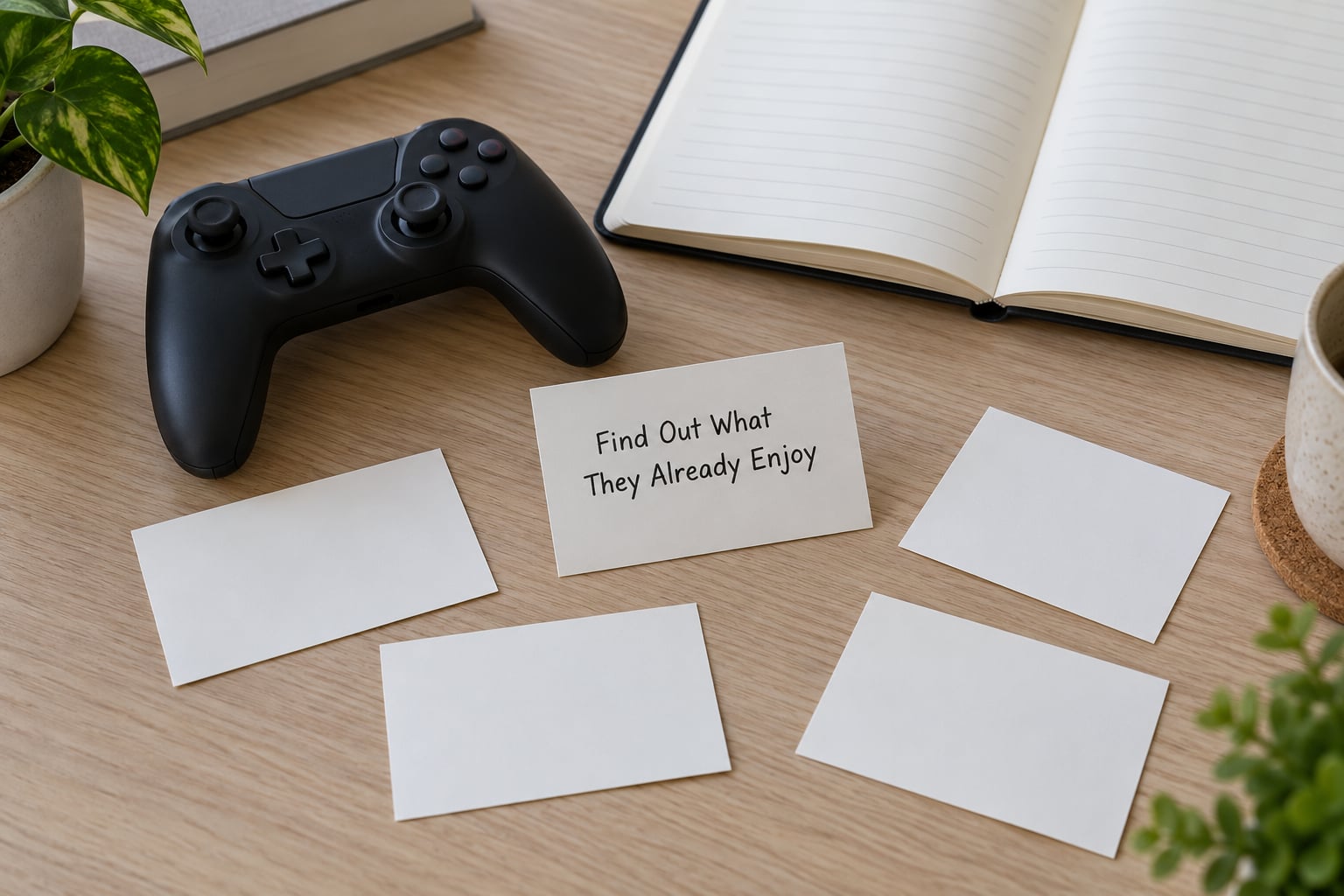
Ask what they like to do already, then match a game genre to the answer. Most people who feel wary of gaming already have a hobby that translates directly, and the translation is where the whole process succeeds or stalls.
- Puzzles and word games lead to anything with a short, solvable problem.
- Stories, books and film lead to games where you do not lose when you walk into a room.
- Sport leads to something where the rules are the same as the real thing.
- Animals, cooking or travel lead to games with nothing to lose.
- Competition and board games lead to turn-based or party games.
- Strategy and history lead to games about building rather than fighting.
Ask two questions, not twenty. A short list on paper beats a long interrogation, and it gives you something to compare your suggestions against.
2. Choose a Simple First Game
A good first game has five traits: simple controls, low punishment for failure, instant readability, short sessions and a difficulty that adjusts. If you can spot those five on a store page, you can evaluate any game yourself instead of trusting someone else’s list.
Start away from anything competitive, anything with a long opening tutorial, and anything where losing means starting again. The suggestions below are grouped by situation rather than by genre, because that is the question people are usually answering.
| First game | Platform | Why it works for a beginner | Good for |
|---|---|---|---|
| Untitled Goose Game | PC, console | Short tasks, no timers, nothing to lose | Anyone who wants to laugh in the first ten minutes |
| Stardew Valley | PC, console, phone | Daily tasks you can stop after ten minutes | Someone who enjoys routine and small tasks |
| A Short Hike | PC, console, phone | Walking and looking, no fail state at all | Readers who like stories over challenges |
| Overcooked 2 | PC, console | One rule, co-op that absorbs mistakes | Couples and friends on a shared screen |
| Snooker or Rocket League | Console, PC | Instant results, easy first shot, huge skill gap | Sports fans and mixed-ability pairs |
| Ori and the Blind Forest | Console, PC | Checkpoints everywhere, forgiving platforming | A player who wants a feeling of progress |
| Unpacking | PC, console | Short levels, calm pace, no time limit | A first-timer who dislikes noise |
| Portal 2 co-op | PC, console | Each player half solves one puzzle, failure is funny | Two people at very different skill levels |
On a phone or tablet, look for the same traits rather than the same titles. A short level-based puzzler with level select and no energy timers works well. Anything that wants you to check back in every twenty minutes is a poor first experience.
What to avoid for session one is a short list: anything with combo inputs, any online shooter, any game where the first hour is menu navigation, and anything described by its fans as “the beginning is rough but it gets good.”
3. Set Up the Controls Without Jargon
Connect the controller before they sit down, then tell them the game needs two buttons. Not all of them. Two.
- Explain that one button does an action and one button jumps or interacts. Say what each one did in the last game they liked, if you can.
- Demonstrate one action, hand the controller over, and ask them to repeat it. Do not add a second button until the first one works.
- Turn off anything that makes them move the controller rather than press buttons, including motion aiming and camera shake. Motion control is the most common reason first sessions end early.
- Set the difficulty to easy before you launch, and check whether the game has an assist option that slows enemies or extends health.
- If the keyboard and mouse is the more practical setup, say the mouse aims and the left click acts. Use the same one-action-at-a-time method.
On-screen button prompts are usually on by default. Leave them on. A new player reading “Press X to talk” is learning; a new player guessing is not.
4. Start With a Short, Guided Practice Session
Play the tutorial together and keep it to 20 or 30 minutes. Exploration matters more than finishing anything, and stopping early while they are still enjoying it is the right call.
Walk through the opening like this: complete the tutorial, then try one small objective on their own, then pause and talk about what happened. When they get stuck, point at one next action rather than taking the controller back. Pause whenever they want to pause, and say out loud that pausing is a normal part of playing.
Watch for the moment they start asking questions. That is the sign the controller has stopped being strange, which is the entire goal of session one.
5. Make Mistakes a Normal Part of Learning
New players quit over feeling stupid, not over difficulty. Treat every error as information rather than as a performance.
Use language that takes the blame off them: the game gave a bad hint, that section is fiddly, everyone gets that one wrong. Point at one next action instead of listing three corrections. Offer a pause before they ask for one, and never reach for the controller to demonstrate mid-sentence.
If they lose repeatedly on one mechanic, step back to the last checkpoint rather than starting the whole thing over. Restarting from zero after a hard section teaches them that failure costs everything, which is exactly the feeling to avoid.
6. End With a Small Choice About What Comes Next
Finish by asking a small question with an easy way out: another round, a different game, a co-op session, or done for tonight. Any of those is a good answer, including done for tonight.
Build a light routine if they want one. Thirty minutes on the same evening each week beats an ambitious plan that dies after the first weekend. Leave a game paused where they stopped so they return to the same spot rather than to a menu.
Then leave it alone. Do not raise it again for a week or two. If a game stops being something you bring up, it stops being the way they spend time with you, and that is the more valuable outcome anyway.
When the person is a child
Introduce a child the same way, with two differences: check the age ratings and the in-game purchase and chat settings before the first session, and let their own choice between two suitable games drive the first pick. Keep sessions short, stop before they are tired rather than when they are frustrated, and make sure they know they can put the controller down at any point.
Family settings on current consoles let you set a session time limit and a content filter on their account, which saves a lot of awkward conversations later.
Common Mistakes
Starting with a hard game
The mistake: handing over a game your friends call demanding, because you want them to see the good parts eventually.
The fix: pick something they can win. Confidence from an early win is what carries them into the next session; a long losing streak usually ends the project.
Explaining everything at once
The mistake: a five-minute briefing on movement, camera, aim, interact and inventory before the first screen loads.
The fix: two buttons for the first ten minutes. Add one only when the game asks for it. Everything else can wait until they want to know it.
Correcting every mistake
The mistake: narrating what they should have done, immediately, every time.
The fix: stay quiet long enough for them to correct themselves. One observation about the thing they can still fix, then nothing. Backseat commentary feels like being told you are bad at something while you are trying.
Treating the first session like a test
The mistake: showing off, talking about how much you have played, or reacting to their mistakes as if you are waiting for them to get it.
The fix: play a level together, or sit nearby while they describe what is happening. Plenty of people never take the controller and still take part fully, and watching is a real way of sharing a story rather than a consolation prize.
Overwriting their save or taking over the account
The mistake: logging in on your profile, or playing a game where your progress and theirs are the same file.
The fix: separate local profiles from day one. Shared saves get clobbered, and losing hours of progress over a profile mix-up tends to end the experiment faster than anything the game did.
Assuming they must love every game
The mistake: treating boredom after one game as a failure of your pitch.
The fix: expect the novelty to fade and have a second, different game ready. Boredom after the first week is the most commonly reported result, not a verdict on gaming itself.
Frequently Asked Questions
What are the best games to introduce a non-gamer to?
Short, forgiving games with instant results are the safest start. Think a puzzle game with levels you can replay, a cooking or farming game with daily tasks you can stop any time, or a walking game with no fail state at all. Avoid anything competitive, anything with combo inputs, and anything whose fans describe the opening as rough. Pick from something they already enjoy rather than from what you play.
How do I teach someone video game controls?
Teach one action at a time. Say what one button does in plain words, hand the controller over, and let them repeat it before adding a second button. Leave on-screen prompts on, turn off motion aiming and camera shake, and set difficulty to easy before launching rather than after. Most first sessions end early because of motion controls and surprise difficulty, not because of the number of buttons.
Should I buy them a console or start on a phone?
Start with what already exists. A phone or laptop gets you to a first session this week with no hardware decision, and many people who enjoy mobile puzzle games are closer to gaming than they think. A console makes couch co-op with other people much easier, so buy one when you want to play together rather than to convert someone faster. Borrow a console and a controller before buying anything new.
What are good co-op games to play with a non-gamer partner?
Choose games where the skills needed do not overlap. Puzzle games that give each player half a problem work well, as do cooking games where you share a kitchen and argue about the plating. Party games with huge skill gaps are forgiving because a beginner can keep contributing while an experienced player carries the round. Avoid co-op built around reflexes, since that punishes the gap between you every single round.
When should I introduce a child to video games?
Introduce them when they can read the on-screen prompts and sit through a session without frustration, and check age ratings plus in-game purchase and chat settings on their account first. Let them choose between two suitable games rather than choosing for them. Keep sessions short, stop while they are still enjoying it, and make clear that putting the controller down is always allowed.
What if they lose interest after the first game?
That is normal and it is not a verdict on gaming. The most commonly reported pattern is intense interest for a week and then nothing, so treat it as a gap between games rather than a dead end. Offer a second, completely different title and let them refuse. If they keep saying no, back off for a few weeks and leave the controller visible rather than bringing it up again.
Conclusion
To introduce a non-gamer to video games, do one thing this week: ask what they enjoy, pick a short forgiving game that matches it, set up their own profile and controller, and run one 30-minute session where you teach two buttons and stop while it is still fun. That is the whole method. If they want a second session, you already know the game to pick.