The history of esports began in the early 1970s with organized video game competitions, most commonly traced to the 1972 Intergalactic Spacewar Olympics at Stanford University. Arcade high-score culture in the late 1970s and 1980s, LAN tournaments in the 1990s, and professional leagues in the 2000s turned that first contest into today’s global circuit.
There is no single moment when esports was invented, and anyone who gives you one clean date is picking a starting line for a sport that grew in stages. What follows is the version I can defend: the documented events, the arguments around them, and the places where the record gets fuzzy.
Table of Contents
- What Counts as the Beginning of Esports?
- How the History of Esports Began in Arcades
- How Did Home Computers Build Competitive Communities?
- What Made Online Gaming Feel Like Esports?
- Which Early Tournaments Helped Establish Esports?
- How Did Professional Esports Start?
- How Did Streaming and Platforms Grow Esports?
- How Did Esports Reach the Mainstream?
- What Is the Timeline of Esports History?
- Why Is the History of Esports Hard to Define?
- Frequently Asked Questions
- When did esports officially begin?
- What was the first major esports tournament?
- Did esports begin with arcade games or the internet?
- When did esports become a professional career?
- Conclusion
What Counts as the Beginning of Esports?
Modern esports means video game competition played under rules that someone else wrote down, with results somebody keeps. That definition is deliberately narrow, and it is what separates esports from the millions of people who play multiplayer games without ever competing in a structured sense.
Three things usually have to be present: a rule set, a record of results, and a shared contest that more than one person cares about. A high score on a cabinet in an empty arcade has rules and a score, but no contest. Two players at a tournament table have all three.
That narrowness is why the “beginning” question keeps generating three different answers. Sources that count any organized game contest reach back to the 1930s. Sources that require networked play start around 1988. Sources that require professional players with contracts start in the early 2000s. All three are describing a real layer of the same history.
How the History of Esports Began in Arcades
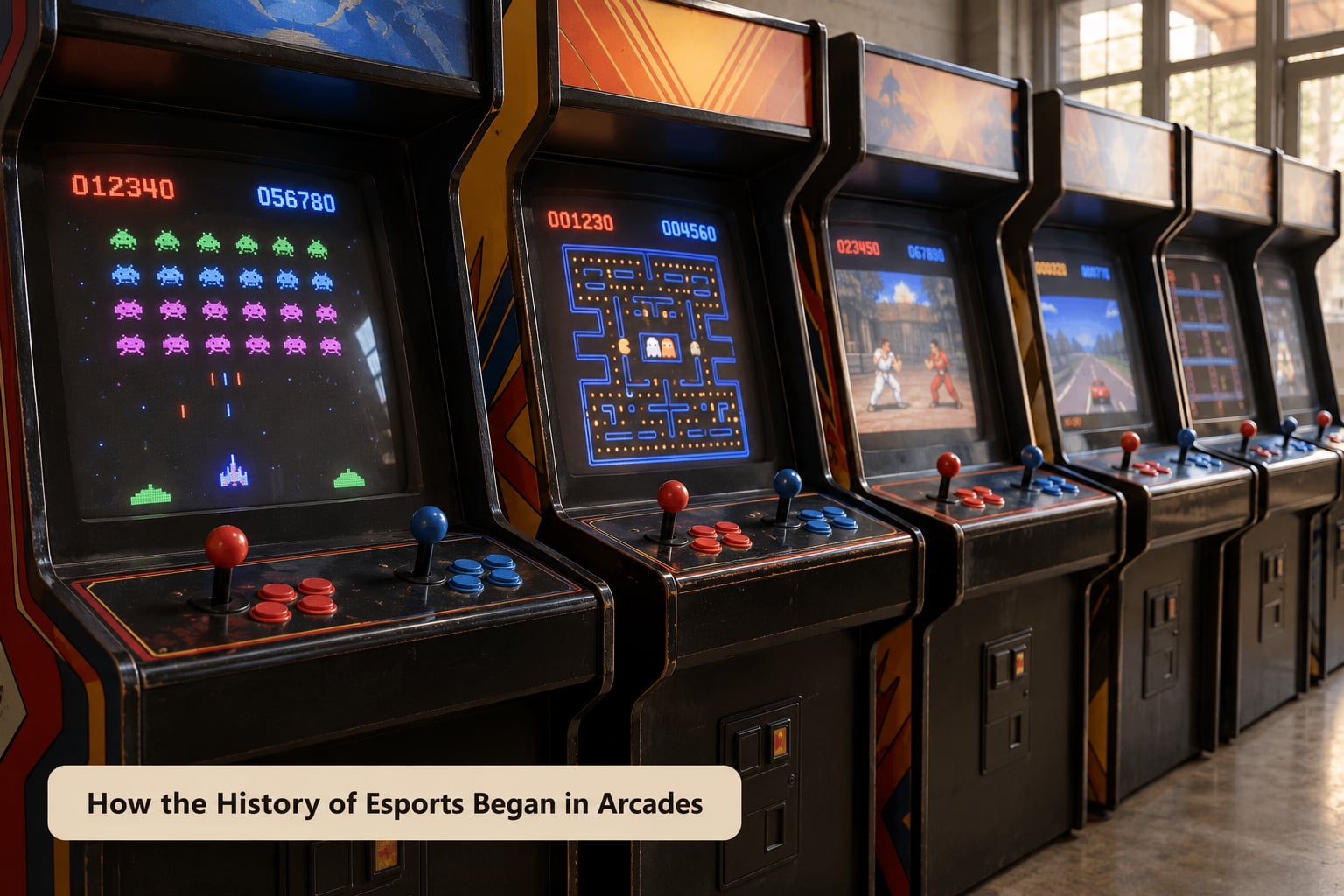
Arcades got there first, and they got there through scoreboards. Before any home console or network, a coin-operated machine had one number that mattered: the score. Early games such as Computer Space in the 1970s and Pong in 1972 turned that number into something two strangers in the same room could argue about.
Recording the number changed the behavior of everyone in the room. Once a player’s initials appeared on a machine, the next person had a target rather than a vague sense of skill, and the next machine in the row became a place where that target could be tested. Competition stopped being a mood and became a number anyone could check.
Tomohiro Nishikado’s Space Invaders from 1978 pushed this further because the score climbed visibly on screen. Players could see themselves falling behind mid-game and do something about it, which made losing legible to a spectator standing behind them. The audience arrived quietly here: not as fans watching a match, but as onlookers watching a score climb.
Walter Day turned that into a discipline. Through the 1980s he travelled to arcades recording scores, and by 1984 he had assembled enough to compile high score tables for Guinness, run the U.S. National Video Game Team, and publish Player One as a fanzine. Someone in California held a high score in Centipede worth several thousand dollars in the late 1970s and made a large share of his living from it.
By the time fighting games arrived in the 1990s, the arcade floor had an economy: ranked ladders, recorded sets on VHS tapes swapped in the parking lot, and players who traveled to a cabinet in another city to settle a scoreboard dispute. That is organized competition with results kept by the players themselves, decades before a league existed to formalize it.
How Did Home Computers Build Competitive Communities?
Home computers moved the same logic into people’s bedrooms. When a game could be copied onto a disk and mailed, competition stopped depending on which cabinet you lived near. A score set in Ohio could be challenged by a player in Seoul, provided someone knew about it.
The connective tissue was printed, not digital. In the 1980s magazines ran high score charts, readers mailed in scores, and letters in the pages described rivalries with names and insults attached. Strategy games on home computers added scheduled play rather than pure high scores: wargame players needed opponents who would commit to a date, and those appointments created the local clubs that later grew into tournament scenes.
Console competitions formalized this in public. Nintendo’s National Championships ran in 1990 and again in 1994, and the 1990 event produced a gold cartridge that kept a record of the winner’s performance, later bought by a collector for a sum well into five figures. Blockbuster Video ran its own World Championships through the 1990s with an Asteroids title that tracks high scores on the cartridge.
These events had sponsorship, rankings, national qualification rounds, and winners who went home with hardware. They also had a ceiling: a living room console or a rental store could only host so many people, and geography still decided who got to compete.
What Made Online Gaming Feel Like Esports?
The internet removed the ceiling and charged for it. Netrek, a text-based space battle game from 1988, connected players over ARPANET to servers run by volunteers. It had team play, ranked ladders, and hours-long sessions, and anyone with a modem could join. It is the first widely cited example of online competition that looks structurally like modern esports.
MUDs followed, giving persistent worlds with player rankings and in-game economies. The real shift came later, in the 1990s, when commercial multiplayer games shipped with ladders. Quake’s match servers and QuakeCon from 1996 gave players ranked ladders that anyone could check, and the counter-strike mod that shipped with Half-Life in 1999 created a game that players owned the rules of.
Battle.net in 1996 and Steam’s matchmaking later in the 2000s removed another step. A matchmaking system finds a player at your rating automatically, which means a tournament no longer depends on a group of friends deciding to practise together. Organized play moved from friendships to software.
Online competition also cost local scenes something, and most timelines skip it. A LAN party in 1995 drew dozens of people into one room precisely because most of them could not play the opponent at any time. When a good server opened, that constraint vanished along with the audience, and some venues closed.
Which Early Tournaments Helped Establish Esports?
The events below are the ones that show up repeatedly in the record. Each one contributed something specific, and each one also had a limit that shaped what came after.
| Event | Year | Game | Why it mattered | Limitation |
|---|---|---|---|---|
| Intergalactic Spacewar Olympics | 1972 | Spacewar! | First widely documented video game tournament, held at Stanford University | Documented retrospectively; tiny field; no money on the line |
| Space Invaders Championship | 1980 | Space Invaders | First large public gaming competition on a commercial game, at Atari’s own event | Split-screen play under crowd noise, not a network contest |
| U.S. National Video Game Team | 1980s | Various coin-op titles | Made scorekeeping a discipline with recorders, rankings and published tables | Records were self-submitted and rarely contested across machines |
| Red Annihilation | 1997 | Quake | First widely reported online deathmatch tournament; winner took a Porsche 944 | One game, one format, organized by a software company |
| Cyberathlete Professional League | 1997 | Multiple titles | Among the first leagues to pay players for competing | Short-lived and frequently criticized for how it treated competitors |
| Professional Gamers League | 1999 | Unreal Tournament | Treated pro play as a career with seasons, records and payroll | Single-title focus collapsed when the game moved on |
| World Cyber Games | 2000 | Multiple titles | National-team format and regular annual calendar that still echoes today | Patch rules, unequal travel budgets, and publisher-shaped formats |
| Electronic Sports League | 2000s | Multiple titles | Built the international circuit structure most players still compete inside | Paid unevenly, and willing to change formats under sponsor pressure |
| Major League Gaming | 2002 | Multiple titles | MLG Pro Circuit brought televised regular seasons to console games | Launched into the 2000s downturn and had to rebuild |
Two patterns stand out. The early events were almost always organized by a company that owned the game or the hardware, and the durable ones are the ones that produced a calendar rather than a single night. Also note how much of the modern circuit was written here: national teams, seasons, ranked ladders, and a distinction between players and organizations.
How Did Professional Esports Start?
Professional esports started when someone started paying a player to play, and that happened across two places at once. In the United States, league founders in the late 1990s put a salary on the line behind a single title and hoped the audience would follow. In South Korea, StarCraft did something different: it built a television audience first, and the professional structure followed the broadcast.
The Korean model came from MBC Game Broadcasting and later Ongamenet, which aired tournament matches as scheduled programming with commentators. StarCraft gave those broadcasts a star system, where individual players had recognizable identities and rivalries that carried across seasons. That’s a genuinely different route to professionalism, and it explains why Korean esports culture looks the way it does.
Then the industry contracted. Publishers that had funded the mid-2000s scene withdrew when they judged the audiences too small, and the early leagues lost funding and players. Community-run Counter-Strike circuits kept running through that period on ticket sales and player-run events, which is why the 2000s are described as an esports winter.
The recovery came from two directions at once: Riot Games’ League of Legends in 2009 gave publishers a game worth building a franchise around, and livestreaming gave every match an audience whether or not someone was physically in the room. Those two facts are the hinge between the competitive 1990s and the industry that exists now.
How Did Streaming and Platforms Grow Esports?
Before streaming, an esports audience had to be in the room. LAN events capped out around a few thousand people, and televised coverage was rare and local. That arithmetic is why the scene stayed small for so long, and why it grew so fast once the constraint changed.
Justin.tv, launched in 2007, let anyone broadcast a webcam feed for free. Players started streaming their matches, then their practice, then their entire week. The site that mattered most out of that era became Twitch in 2011, and the business underneath it shifted from ad revenue to subscriptions.
Streaming changed what a tournament was. A match in a small venue could reach an audience of hundreds of thousands if enough people chose to watch it, which meant a small league no longer needed a television contract to matter. Content creators built another layer on top, since a streamer with a personality could attract an audience larger than the game itself.
It also changed who ran the scene. Publishers and league operators stopped being the only gatekeepers, because players and communities could build audiences and events without permission. Some of the biggest recent tournaments exist because a community organizer decided to run one.
How Did Esports Reach the Mainstream?
Mainstream recognition came through institutions rather than events. Franchise league systems in the late 2010s and early 2020s put permanent teams in permanent slots, which let sponsors sell a season instead of a single tournament. That structure is closer to North American professional sports than to anything that existed in the 1990s.
Colleges built programs around it, with varsity teams, scholarships, and dedicated arenas. Asian Games demonstration events and inclusion in the Olympic Council of Asia’s framework gave the activity a formal sporting home in the region where audiences were largest. None of that settled the legal question, since whether esports counts as a sport differs by country and governing body.
The recurring problems came with the growth. Player burnout and shortened careers sit alongside the prize money. Cheating accusations and match-fixing allegations have surfaced repeatedly in high-stakes tournaments, and publishers keep changing formats and rules faster than players can build careers on them. Regional inequality is visible too: the audience is global, and the prize pools and stability are not.
What Is the Timeline of Esports History?
Here is the compressed version, with each row noting what changed rather than just what happened. Dates are the ones most sources agree on, with the caveats noted in the final section.
| Year | Milestone | Why it changed competitive gaming |
|---|---|---|
| 1930s | Coin-operated amusement and pinball halls | Public skill contests with money on the line, decades before video games |
| 1972 | Intergalactic Spacewar Olympics at Stanford | First widely documented video game tournament |
| 1972 | Pong in arcades | Two-player cabinets turn a coin into a match |
| 1978 | Space Invaders | On-screen scoring makes progress and losing visible to spectators |
| 1980 | Space Invaders Championship | First large public competition on a commercial arcade title |
| 1980s | Twin Galaxies and the U.S. National Video Game Team | Scorekeeping becomes recorded, ranked and published |
| 1988 | Netrek over ARPANET | Online team play with ranked ladders |
| 1990 | Nintendo National Championships | Console competition with a national structure and a trophy cartridge |
| 1993 | DOOM and shareware multiplayer | Multiplayer travels on copies passed between strangers |
| 1996 | Quake and QuakeCon | Ranked online ladders plus annual live events |
| 1996 | Battle.net | Gameplay ladders as a service rather than a fan project |
| 1997 | Red Annihilation | Online tournament with a car as the prize, widely covered in print |
| 1997 | Cyberathlete Professional League | Among the first leagues paying players to compete |
| 1999 | Professional Gamers League | Season structure, player payrolls and team organizations |
| 1999 | Counter-Strike mod released | Player-owned rules produce a scene with genuine ownership |
| 2000s | World Cyber Games, ESL, Major League Gaming | An international circuit with annual calendars |
| 2003 | StarCraft on Korean broadcast television | Competitive gaming becomes a spectator-first, star-driven broadcast product |
| 2000s | The esports winter | Publishers withdraw funding; community circuits carry the scene |
| 2009 | League of Legends launches | A game designed to sustain a permanent professional league |
| 2011 | Twitch launched | Streaming becomes the primary way audiences find matches |
| 2018 | Esports as an Asian Games demonstration title | Formal recognition inside a multi-sport framework |
| Late 2010s onward | Franchise league slots and permanent partnerships | Teams become sellable positions in a season rather than events |
| 2026 | Consolidated global circuits with streamed audiences | Competition runs continuously with a defined calendar and ranked season structure |
Why Is the History of Esports Hard to Define?
Three origin claims show up in search results constantly, and each one is defensible on its own terms.
Claim 1: 1972. This is the accepted academic and press answer, based on the Intergalactic Spacewar Olympics at Stanford. The important caveat is that the event was reconstructed from documentation years after it happened, so the field size and format are less certain than the confident retelling suggests. The claim is sound as an origin marker and weaker as a detailed account.
Claim 2: the 1970s arcade era. This claim comes from sources that trace competitive gaming through coin-op skill games and public scorekeeping rather than formal tournaments. It is the better answer if you care about why players competed at all, and it reaches back to the 1930s amusement halls that competitors rarely mention.
Claim 3: the 1980s. This comes from regional accounts, particularly ones written for UK and European audiences where local arcade and club competitions were the real starting point. It describes a genuine timeline, just not a global one. Regional scenes diverge sharply: Korea’s broadcast-led path, the US league path, and Europe’s club-and-cafe path share very little.
Other terms get mixed in and cause more confusion than the dates do. An esports tournament has organized opponents, published results, and rules that exist outside the match. A speedrun is a time attack on a single game, usually solo, and is a competitive discipline with its own history rather than a chapter of esports. Arcade play for money resembles gambling on outcome rather than competition on skill. And the word esports itself is recent, so older material never uses it.
On that last point, the term showed up on coins and in small-scale use by the late 1990s, before it entered the Oxford English Dictionary in 2017. Older writing calls the same activity competitive gaming, and some of it calls it something else entirely.
A practical way to check any esports history claim you run into: ask whether it names a date, a game, an organizer, and a record of results. If a claim supplies the date but not the other three, it is folklore doing the work of evidence. That test filters out most of the noise in this topic.
Frequently Asked Questions
When did esports officially begin?
Most historians mark the beginning at the 1972 Intergalactic Spacewar Olympics at Stanford University, the first documented video game tournament. Other sources point to 1930s coin-op contests, to 1970s arcade high-score culture, or to 1988 when online competition started. The 1972 date wins as an origin marker because it is the earliest event with a named place, date and rule set, though it was documented retrospectively.
What was the first major esports tournament?
The 1972 Intergalactic Spacewar Olympics at Stanford is generally called the first esports tournament. The first major public competition on a commercial game was the 1980 Space Invaders Championship, which drew a crowd at Atari’s own event. The first major online tournament was Red Annihilation in 1997, where the Quake winner took home a Porsche 944.
Did esports begin with arcade games or the internet?
Arcades came first by roughly fifteen years. Organized competition through scoreboards and public scorekeeping dates from the 1970s, well before any home console. The internet changed the shape of esports rather than starting it, removing the need to be in the same room, adding ranked ladders, and connecting players globally. Early online scenes also drained some local venues of their audience.
When did esports become a professional career?
Esports became a paid career in the late 1990s, when early leagues began offering players salaries for competing in specific games. The structure hardened in the 2000s with annual circuits, team organizations and player transfers, though funding pulled back mid-decade during the esports winter. Broadcasting South Korean StarCraft tournaments built a parallel model in which audiences arrived before the salaries did.
Conclusion
There is no single answer to when esports began, and the honest one is layered. Coin-op contests set up the habit of competing for money, arcades turned scores into records, home computers turned rivals into communities, and the internet turned local scenes into global ones. Professional play came last, and it came through two different regions on two different schedules.
If you are tracing this for the first time, start with the timeline table above and read it as a chain rather than a list. Each row sets up the one after it: the scoreboard makes the spectator, the spectator makes the tournament, the tournament makes the league, and the league makes the industry. Pick a single game, player, or tournament from there and follow it as deep as it goes.