Digital storefronts are sales channels, not archives. When some games disappear from digital stores, it usually means the publisher, platform holder or distributor no longer has a commercial, legal or technical reason to keep selling that title, so the product page is switched off for good.
That single sentence covers most cases, but the reasons underneath it are worth separating, because they decide what happens to the copy you already paid for. A game removed because a remaster replaced it is almost always still in your library. A game removed because its servers are gone may be unplayable no matter what you paid.
Last updated in October 2026.
Table of Contents
- Why Some Games Disappear From Digital Stores: The Process
- Why Games Disappear, in Plain English
- The Vocabulary: Delisted, Pulled, Revoked, Shut Down
- What Happens When a Publisher Loses Distribution Rights?
- What Commercial Reasons Lead to Digital Delisting?
- Low sales and an ageing catalogue
- A replacement version
- Moving to another storefront
- Server and support costs
- Generation transitions
- Studio closure
- Can Security, Bugs, or Compliance Remove a Game?
- Why mobile games get removed from the App Store and Google Play
- Is a Game Really Gone if It Is Still Sold Elsewhere?
- Why the same game is live on one store and gone from another
- What each store actually does when a game is delisted
- How Can Players Protect Access to Games They Own?
- How to track delistings before they happen
- Frequently Asked Questions
- Does buying a digital game guarantee that I can always buy it again?
- Why can I still play a digital game after the store removes it?
- Why is the same game available on one console or store but not another?
- Can I get a refund when a game I bought is delisted?
- Is a delisted digital game the same as a game that is out of print?
- What should I do if a game I want is disappearing from a digital store?
- Conclusion
Why Some Games Disappear From Digital Stores: The Process
Here is the short version of why some games disappear from digital stores: a store page goes away because someone with authority over the product tells the storefront to remove it. That decision usually traces back to the publisher, sometimes to the platform holder that owns the store, and occasionally to whoever holds the regional publishing rights.
Because digital supply is effectively unlimited, there is no such thing as a digital game being out of stock. The moment a publisher stops selling, there is no reason to keep the listing up, so the page is retired rather than left empty. That is why the industry says delisted.
Why Games Disappear, in Plain English
A game disappears when the party selling it stops wanting to sell it, or loses the right to sell it. The rights holder pulls the listing. Nobody is hiding it from you personally, and the removal is rarely about the quality of the game.
Readers who land on this question usually arrive from one of two situations. Either a game they were saving for vanished before they bought it, or a title they already own stopped showing up in their account and they want to know whether they have lost it. Those two situations have different answers, and the second one is covered further down.
The Vocabulary: Delisted, Pulled, Revoked, Shut Down
These four words get used interchangeably online, and the confusion behind them causes most of the panic. It helps to keep them apart:
- Delisted means removed from sale. The store page is gone, new buyers cannot purchase it, and existing owners usually keep their copy.
- Pulled is the same act described more loosely, sometimes by the publisher pulling the game from a sale or promotion.
- Revoked means something deeper changed. The right to play has been withdrawn, which is a different situation entirely.
- Server shutdown means the online services the game depends on are gone, so even an installed copy may stop working.
People often hear the word delisted and assume the worst. In practice, delisting on its own is the mildest of these outcomes.
What Happens When a Publisher Loses Distribution Rights?
Distribution rights are contracts. A studio may own the game it made and still lack the right to sell it in your region, because the publishing rights for that territory were licensed to someone else.
This is the single most common cause of a delisting that only affects part of the world. The well-documented case of Zero Time Dilemma shows how clean the pattern is: the title came off the PlayStation Store and the Nintendo 3DS eShop in North America and Europe while remaining purchasable on Steam and still listed on the Japanese 3DS eShop. Players watching it happen correctly deduced that the regional publisher had lost its rights, rather than the game running into a licence expiry worldwide.
The same logic explains a batch of Lord of the Rings titles that vanished from Steam while other entries in the same franchise stayed. When a publishing licence lapses, the rights holder can no longer authorise sales through that storefront, so the listing comes down.
Withdrawing a game and transferring it are different actions, and only one of them is permanent. Withdrawing means the publisher simply stops selling through a channel. Transferring means the rights move to a different company, which may then list the game on another storefront under new terms, sometimes years later. Alpha Protocol is the example that comes up most often, since it was taken down and later relisted.
Publishing disputes can produce the same result from a different direction. When a relationship between a platform holder and a third-party publisher breaks down, titles tied to that arrangement can disappear from the store with no announcement at all. The long-running speculation on Reddit about Soulcalibur vanishing from the PlayStation Store is a good example of how little players can work out from the outside, because the contract details were never public.
What players take from this: if a game vanishes in your region but not elsewhere, look for a rights story before you assume the game is being retired.
What Commercial Reasons Lead to Digital Delisting?
Most delistings have nothing dramatic behind them. A small developer decides the money from a decade-old project no longer covers the cost of running its multiplayer servers, and quietly takes it down. Nobody announces this because there is no audience to announce it to.
The commercial reasons worth knowing:
Low sales and an ageing catalogue
A title that sold well at launch and sells almost nothing now costs the publisher support staff time, server hosting and store page maintenance for a small return. Games that old are the most common delisting candidates, and small studio shutdowns account for a large share of the churn you see on tracker sites.
A replacement version
When a remaster, remake or expanded edition ships, keeping the old version on sale lets buyers who are undecided pick the cheaper option. Sega’s Yakuza remasters are the standard illustration of this: the enhanced versions arrive, and the originals step aside. Fans are openly suspicious of the pattern, and in fairness it does read as sales cannibalisation, but it is a normal catalogue decision rather than a punishment.
Moving to another storefront
Some publishers delist from one store while adding the same game to another, usually to capture a larger share of the sale or to move away from a storefront’s fee structure. If you see a game disappear and then reappear elsewhere, that is what happened.
Server and support costs
An online game that needs a live backend can become a genuine expense. Anthem and The Crew are the best-known cases of live-service games losing their online layer, and both were handled as service shutdowns rather than simple delistings.
Generation transitions
When hardware moves on, old storefronts get pruned. Titles tied to older consoles have been quietly disappearing from current-generation stores, and players with large back catalogues on PlayStation and Xbox notice this pattern faster than publishers expect. It is a business decision with a predictable trigger: the platform holder no longer has anyone left to sell those downloads to.
Studio closure
When a developer shuts down, the games it published usually follow. There is nobody left to answer support tickets, patch the servers or handle refunds, so the cleanest option for the rights holder is to take the listing down.
Can Security, Bugs, or Compliance Remove a Game?
Yes. A publisher will take a game down rather than leave it running in a state that creates legal or reputational exposure. These cases are rarer than the commercial ones, but they are the ones that end a game permanently.
An unfixed vulnerability in an always-online game is the standard example. If the flaw is serious enough to put player data or payment details at risk, shutting the game down beats shipping a patch that may not be enough. Severe unresolved defects can produce the same outcome when a patch would cost more than the revenue the game still produces.
Privacy and regulatory questions do the same thing in other regions. Collecting player data without a lawful basis, or failing to comply with rules about in-app purchases and loot boxes, gives a company a reason to remove a listing that has nothing to do with the game itself.
Age ratings change too. When a rating board reclassifies a title, stores often hide it pending new packaging, new store copy or a fresh rating submission. In several countries that means the product page becomes unavailable to new buyers in that territory while existing owners are untouched.
Why mobile games get removed from the App Store and Google Play
Mobile is the most churned store of all, and mostly for business reasons. Apps get removed when the developer stops supporting them, when a service the game depends on shuts down, when licensing for content inside the game expires, or when the developer simply decides the project is finished.
App Store and Google Play review guidelines add their own list, including privacy declarations the developer cannot satisfy and payment rules the game breaks. Because a phone game is usually a thin client talking to a server, shutting down the server is often enough to make the listing pointless.
The pattern is worth knowing in advance: mobile libraries change far more often than console or PC libraries, and a game you cannot re-download is a much bigger loss when the device holding it is lost.
Is a Game Really Gone if It Is Still Sold Elsewhere?
Usually not. Finding the same game purchasable on another storefront is the clearest signal that a delisting is about one channel rather than the game itself.
| Status | What it means | Can you still play it? |
|---|---|---|
| Delisted from sale | Product page removed from the store | Yes, if you already own it |
| Unavailable in your region | Listed, but not sold in your territory | Yes, if you already own it |
| Temporarily hidden | Unlisted while a rating or listing is updated | Yes |
| Physical edition only | Digital sales ended, disc still pressed | Only if you bought it new |
| Replaced by an upgraded edition | Original retired in favour of a remake or remaster | Yes, the original usually stays playable |
| Servers shut down | Online services switched off | Single-player may work, online usually does not |
| Removed from sale but keys still issued | Store page gone, keys still redeemable elsewhere | Yes, redeem a key you already hold |
The line that matters most is between the first four rows and the last two. A delisting is about the store’s front door. A server shutdown is about the building.
Why the same game is live on one store and gone from another
Each storefront has its own agreements, its own catalogue logic and its own reasons to remove a title. A publisher might license a game exclusively to one platform for a period, so it cannot be sold elsewhere while that runs. Platform holders also delist on their own schedule, usually without a public statement, which is why a game can vanish from the PlayStation Store while sitting comfortably on Steam.
What each store actually does when a game is delisted
| Store | After a delisting | Typical reason it happens |
|---|---|---|
| Steam | Stays in your library and can be re-downloaded | Developer or publisher ends sales, moves the game, or retires a server |
| PlayStation Store | Stays in purchased content, re-downloadable | Publishing rights changes, generation transitions, platform pruning |
| Xbox Store | Stays in your order history | Studio closure, licence expiry, server shutdown |
| Nintendo eShop | Stays in your account on the same console family | Rights expiry, age rating or legal changes by region |
| GOG | Stays in your library and re-downloadable | Studio or publisher retirement, DRM-free catalogue curation |
| App Store and Google Play | Stays downloaded on your device | Support ends, data or payment policy issues, server dependency |
Community consensus across Steam forums is consistent on the main point: a delisted game already in your library stays there. Players still ask for confirmation constantly, which tells you how little the announcements communicate.
There is a separate situation that is not a delisting at all, and it is the one that actually empties a library. Refunds, chargebacks, region locks, account transfers and licence re-evaluations can all remove an entitlement, because the store is correcting a transaction rather than closing a product. Games disappearing from a library en masse usually means a refund, a region change or a payment reversal, not a catalogue decision.
How Can Players Protect Access to Games They Own?
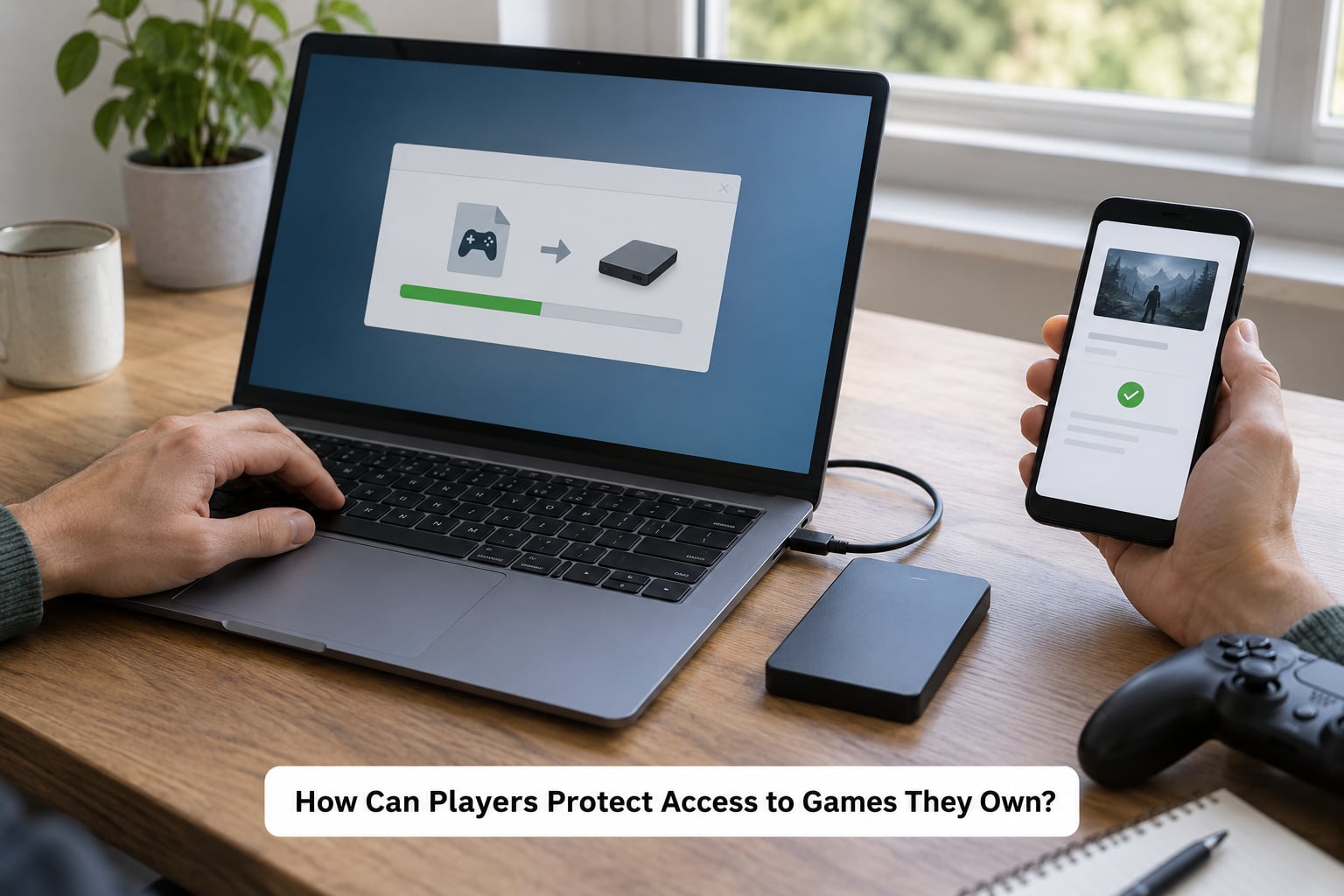
You cannot stop a publisher from delisting, but you can make sure a delisting costs you nothing. Every step below is free and most take a few minutes.
- Buy during confirmed availability. If a page is live, purchase it. Once it is delisted there is no official route back.
- Save the receipt. Store the order confirmation, the invoice and the product page screenshot somewhere outside the account. These are your evidence if support needs it.
- Check that re-download works before you need it. On Steam and GOG, try downloading a game you already own on a second machine. If it fails now, you have time to sort it out.
- Keep an offline installer or backup where the store allows it. Some games let you download the installer without launching. Copy it to external storage. This does not defeat DRM or servers, but it survives a reinstalled operating system.
- Note the store a game came from. Consoles tie purchases to a platform family. A backup matters more for PC, where a lost drive is otherwise unrecoverable.
- Watch for announcements. Publishers usually post delisting notices in their own channels before the date, and trackers exist that log them by store and region.
- Ask support early if a purchased game becomes unplayable. A server shutdown with no offline mode is a case worth raising with both the publisher and the store, since each has a different part to play.
How to track delistings before they happen
Delisting trackers publish dated notices across Steam, GOG and console stores, and they are the most reliable early warning there is. Beyond that, the developers and publishers most likely to delist are small studios, so their own social accounts and Discord servers are worth following for the games you care about.
Two habits cover most of it. Wishlist games you intend to buy, since store pages in your wishlist are a natural reminder to buy before a deadline. And when a game you own gets a remaster, buy the original at its last full price if the series matters to you.
On refunds, a delisting alone does not create a right to your money back. Refund eligibility follows the store’s standard window, and the stronger argument is that a game became unplayable through no fault of yours, which is a support question rather than a legal one. Rules vary by country and by store, so check the specific policy rather than assuming.
Frequently Asked Questions
Does buying a digital game guarantee that I can always buy it again?
No. A digital purchase gives you the right to play what you bought, not the right to buy it again. Once a listing is delisted there is no official way to buy it new, which is why saving a receipt and checking that re-download works before you need it matters so much. Regional restrictions and store policies can also stop you purchasing a title you already own elsewhere.
Why can I still play a digital game after the store removes it?
Because delisting closes the shop, not your copy. Once a purchase is registered on your account it normally stays there, and most stores let you re-download it on any compatible machine. The exceptions are server shutdowns, which can break online play and any feature needing a live connection, and situations where the store is correcting a transaction rather than closing a product page.
Why is the same game available on one console or store but not another?
Each storefront has its own agreements and catalogue decisions. A publishing licence may cover only certain territories, as happened with Zero Time Dilemma when it came off the PlayStation Store and the 3DS eShop in North America and Europe while remaining purchasable in Japan and on Steam. Platform holders also prune older titles on their own schedule, usually without a public statement.
Can I get a refund when a game I bought is delisted?
A delisting by itself does not create an entitlement to a refund, since the game usually stays playable. Refund eligibility normally follows the store’s standard window. A stronger case exists when a purchased game becomes unplayable through no fault of yours, for example after a server shutdown with no offline mode. Contact the publisher and the store, and check the specific policy because rules vary by country.
Is a delisted digital game the same as a game that is out of print?
Not quite. A physical edition going out of print means copies stop being manufactured, while used copies still circulate and can be bought second-hand. A digital delisting means the store page is closed for good, and no new copy can be purchased through that storefront. A digital version may still exist on another store or on keys issued before the delisting.
What should I do if a game I want is disappearing from a digital store?
Buy it now while the page is still live, and save the confirmation email and a screenshot of the listing. Then confirm the game re-downloads on a second machine if the store allows it. If you already own it, keep the installer backed up to external storage where possible and watch the publisher’s announcements for any server or support deadline.
Conclusion
Most games that vanish from a store are a distribution or business decision, not a change in what you legally own. Expired rights, a replacement edition, an ageing catalogue and studio closures account for the overwhelming majority of cases, and in nearly all of them the copy already in your library keeps working.
So check the listing status first, then preserve what you can. Buy before the page closes, keep the receipt outside the account, confirm re-download works while you still can, and back up the installer. The cases worth worrying about are the ones where servers go dark, and those are the ones to raise with support while the publisher still exists.