A challenge run is a playthrough of a video game played under extra rules the player sets themselves, such as banning items, forbidding healing, locking a character class or removing the ability to reload a save. Designing one means picking a single central premise, writing the restrictions so nobody can argue about what counts as a break, and setting a win condition and failure state before you press start.
Most people understand the first half of that. Far fewer design their own, and the design is where a challenge run either works or collapses two hours in.
Table of Contents
- What a Challenge Run Is and How to Design One: Quick Guide
- How Is a Challenge Run Different From a Normal Playthrough?
- What Makes a Challenge Run Fun to Play?
- How to Design the Challenge Run Rules
- How to Set the Goal, Win Condition, and Failure State
- How to Balance Difficulty So the Run Is Possible
- How to Make a Challenge Run Replayable
- How to Test and Publish a Challenge Run
- Frequently Asked Questions
- Is a Nuzlocke a challenge run?
- What is the difference between a challenge run and a speedrun?
- Is save scumming allowed in a challenge run?
- How many rules should a challenge run have?
- What should I do when a randomizer seed makes the run unwinnable?
- How hard should a first challenge run be?
What a Challenge Run Is and How to Design One: Quick Guide
Games are built around one assumed way of playing. Challenge runs take that assumption away and force the game to be finished anyway, usually by someone who already knows the normal route by heart. That combination is what makes the format interesting: the difficulty comes from the rules, not from ignorance.
Here is the compact version of the design framework, before the longer sections break it apart.
- Premise: one sentence that states the whole idea, such as “you may only use melee weapons” or “one character, one life, no revives.”
- Restrictions: two or three rules that all push the same direction. Three coherent rules beat seven contradictory ones.
- Win condition: the exact end state that counts as success, written before you start.
- Failure state: what ends the run, whether that is game over, quitting, or hitting a defined limit.
- Difficulty target: pick a tier so you know whether a loss is bad luck or a bad ruleset.
- Escape valve: a rule for what happens when the run becomes genuinely unwinnable.
- Proof: record it, stream it, or at minimum keep the rules text visible to anyone who asks later.
Every one of those seven items belongs in the ruleset you write down. If it lives only in your head, the run has no referee.
How Is a Challenge Run Different From a Normal Playthrough?
A normal playthrough and a challenge run use the same game and often the same save file. The difference is who owns the rules. In a normal run, the developer decides what is allowed. In a challenge run, the player does, and the developer never agreed to any of it.
| Aspect | Normal playthrough | Challenge run |
|---|---|---|
| Objective | Finish the story or reach the credits | Finish under conditions the game never asked for |
| Player choices | Whatever works best | Limited by the ruleset |
| Failure | Retry from a checkpoint | Often ends the run outright |
| Pacing | Set by the level design | Set by the rules the player added |
| Progression | Levels, gear and skills as designed | Route built around what the rules still allow |
| Who writes the rules | The developer | You |
Speedruns sit next to this but pull in a different direction. A speedrun optimises for time and usually strips the game down; a challenge run changes what the game means. The two can overlap, as in a no-hit Any% attempt, but they answer different questions.
What Makes a Challenge Run Fun to Play?
Altered goals. That is the whole engine. A game you have finished asks nothing of you, so a challenge run asks for something new: beat this without the thing you always rely on.
Self-imposed restrictions work because they remove the default answer. Once healing flasks are banned, potions stop being resources and potions you ignored for forty hours become strategy. Players describe this shift in their own terms constantly, with rules like a no-pause run in Breath of the Wild or a bow-only rule in Elden Ring forcing a completely different route.
Risk and reward do the rest. Every safe option you take costs you something you had planned on using later, which turns resource management into a running argument with your own past decisions.
Mastery is the part outsiders miss. Watching someone finish a run under rules you would fail immediately is genuinely relaxing to watch, the same way any clean execution is. The people who try challenge runs and assume they are silly usually come around once they see how much planning goes into one.
Discovery plays a role too. Long stretches of a finished game stay unexplored because nothing required them. A completionist rule, or a run where you must find every collectible using only one item type, pulls those systems into view.
How to Design the Challenge Run Rules
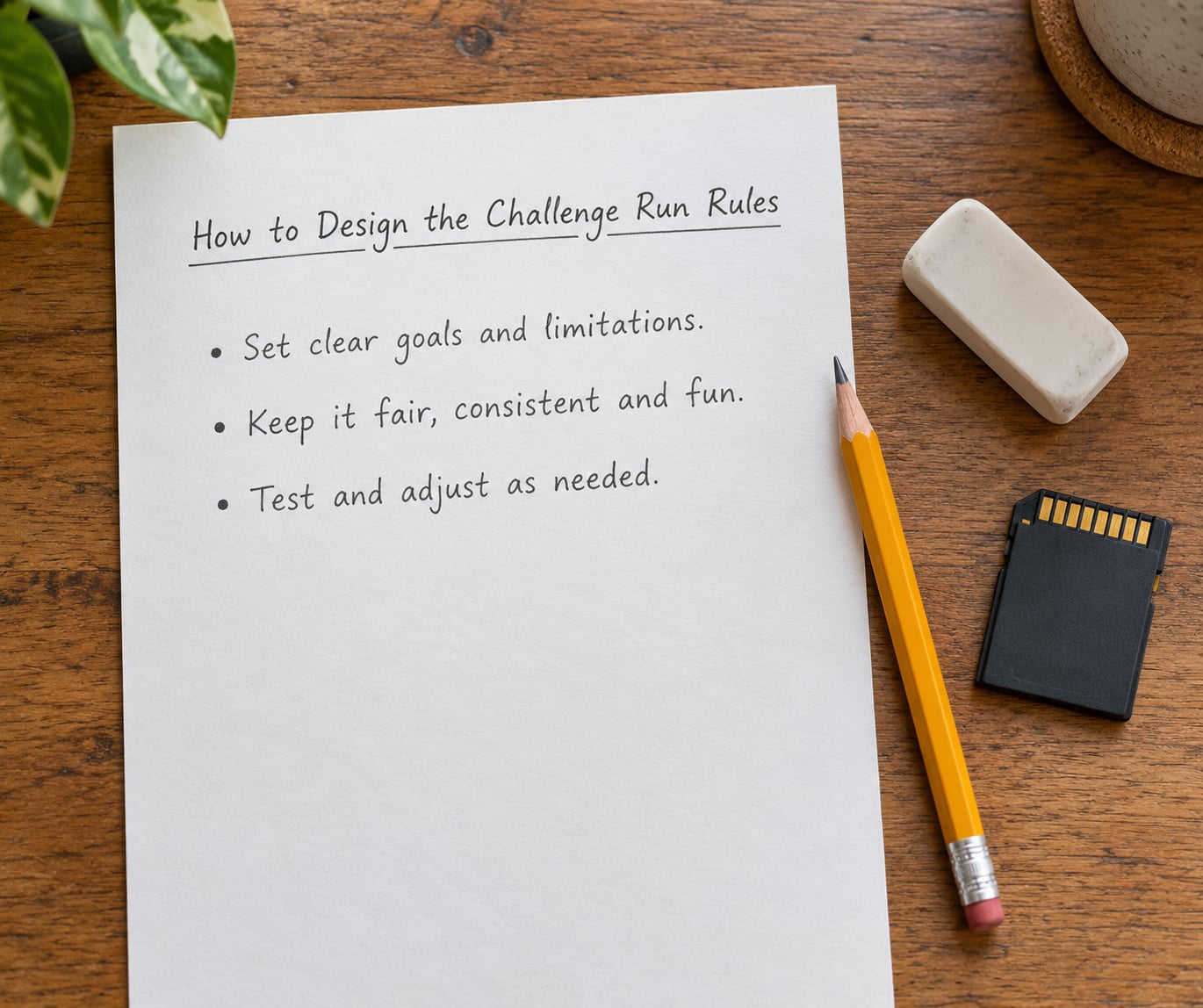
Start with one central premise and refuse to add anything that does not serve it. “Melee only” is a premise. “Melee only, plus no healing, plus a time limit, plus you must collect every key” is four rules arguing with each other, and the player will not know which one to honour when they conflict.
Then add compatible restrictions. Good stacking means each rule tightens the same axis rather than pulling in a new one. An exclusionist set like “no legendary equipment” pairs cleanly with “no upgrades at merchants,” because both attack the power ceiling. Pairing “no items” with a completionist requirement does not, since collecting is the point of that rule.
Define what is still allowed before you start, not during. Which weapons count as melee? Can the player craft a healing item from herbs if bought flasks are banned? Ambiguity here is where most failed challenge runs go wrong.
Write the wording so a stranger can follow it. Players on forums reliably reject rulesets that need a paragraph of interpretation, and a rule stated in one sentence is a rule that survives contact with a group chat.
Say explicitly whether save scumming is legal. It sounds obvious and it is still the most argued point in every ruleset discussion, because reloading quietly undoes the stakes the rules were built to create. If you forbid it, forbid it in writing.
How to Set the Goal, Win Condition, and Failure State
The win condition is the sentence you will argue about most, so it has to be written down and it has to be exact. “Beat the game” is usually enough, but only if the game’s ending is unambiguous. Where it is not, name the end state: reach the final boss and kill it, or survive twenty waves, or escape the area with every optional objective skipped.
Decide what starting means too. A fresh save from the first minute is the clean default and the easiest to verify. Starting from an existing completed save is fine for a no-items or roleplay style run, but say so, because two players arguing about a challenge run are usually arguing about the start line.
Failure needs the same treatment. The cleanest structure is: if the game kills you, the run ends, unless your rules permit a revive or a continue. Permadeath rules should state how many lives exist. Zero is a different experience from three, and it changes how the player manages every fight.
Abandonment deserves a rule too. Does closing the game end the attempt? Does putting it down for an hour break it? Answering this in advance removes the most embarrassing version of the failure, where a player quits quietly and then posts the run anyway.
Finally, build in an escape valve for the run that becomes mathematically impossible. Randomizer seeds softlock more often than people expect, and a good ruleset says what happens next: reroll a new seed and start over, or accept the seed and take a documented loss. Communities like r/Kenshi and r/Morrowind tend to handle this by agreeing on a rule before the run rather than after the argument.
How to Balance Difficulty So the Run Is Possible
Difficulty in a challenge run comes from the ruleset, so you tune the ruleset. The order matters: establish what a competent player achieves with no rules at all, then add one meaningful constraint, test that, and only then consider the next one.
Assume the player knows the game. Designing around an unfamiliar player means difficulty comes from confusion rather than from the challenge, which is a different article entirely. The exception is a first-time playthrough, and that is worth running deliberately rather than by accident.
| Tier | What it adds | Example |
|---|---|---|
| Easy | One stylistic restriction | Pacifist run: no killing, finish the story |
| Medium | Restriction plus a resource limit | No healing items, no fast travel |
| Hard | Restrictions plus harsh failure | Nuzlocke: a fainted creature stays fainted for the run |
| Brutal | Stacking plus full permadeath | Kaizo IronMon style attempts, where a death can end hundreds of hours |
One rule at a time matters most. Stack two hard constraints immediately and you will not know which one killed the run, which teaches you nothing and leaves the player annoyed rather than impressed.
Label the difficulty honestly in the rules text. Players want to know before they start whether a ruleset is beginner, intermediate or brutal, and an honest label prevents the most common disappointment, which is a first attempt chosen from a list that hid how punishing the bottom tier is.
How to Make a Challenge Run Replayable
A challenge run lasts as long as the player finds it interesting, and the easiest way to extend that is to change one variable per attempt rather than redesigning everything.
Category runs do this well. Pick a theme, a class, a faction, or a faction’s opposite, and keep the underlying rules identical so records stay comparable. Single-class runs in Baldur’s Gate 3 and party-composition rules in older RPGs are the same idea applied to different systems.
Seeded conditions add variety without extra design work, since each seed is a different puzzle built from the same rules. Randomizer runs work this way, which is also why they carry the softlock risk.
Alternate objectives change the destination rather than the route. Beat the game with a companion who never dies. Finish with the lowest possible final score. Win using only one consumable type. Each one gives the same game a different shape.
Tracked personal records turn replays into something measurable. If you note attempts, time and where each run ended, a first attempt stops being a loss and becomes data for the next ruleset.
Keep the number of tracked variables small. Six categories are fine. Sixty rules with a spreadsheet attached will lose players before they start.
How to Test and Publish a Challenge Run
Testing a challenge run is less about bugs and more about confusion. The failure mode is not a broken rule; it is a rule two people read differently and only discover at the boss fight.
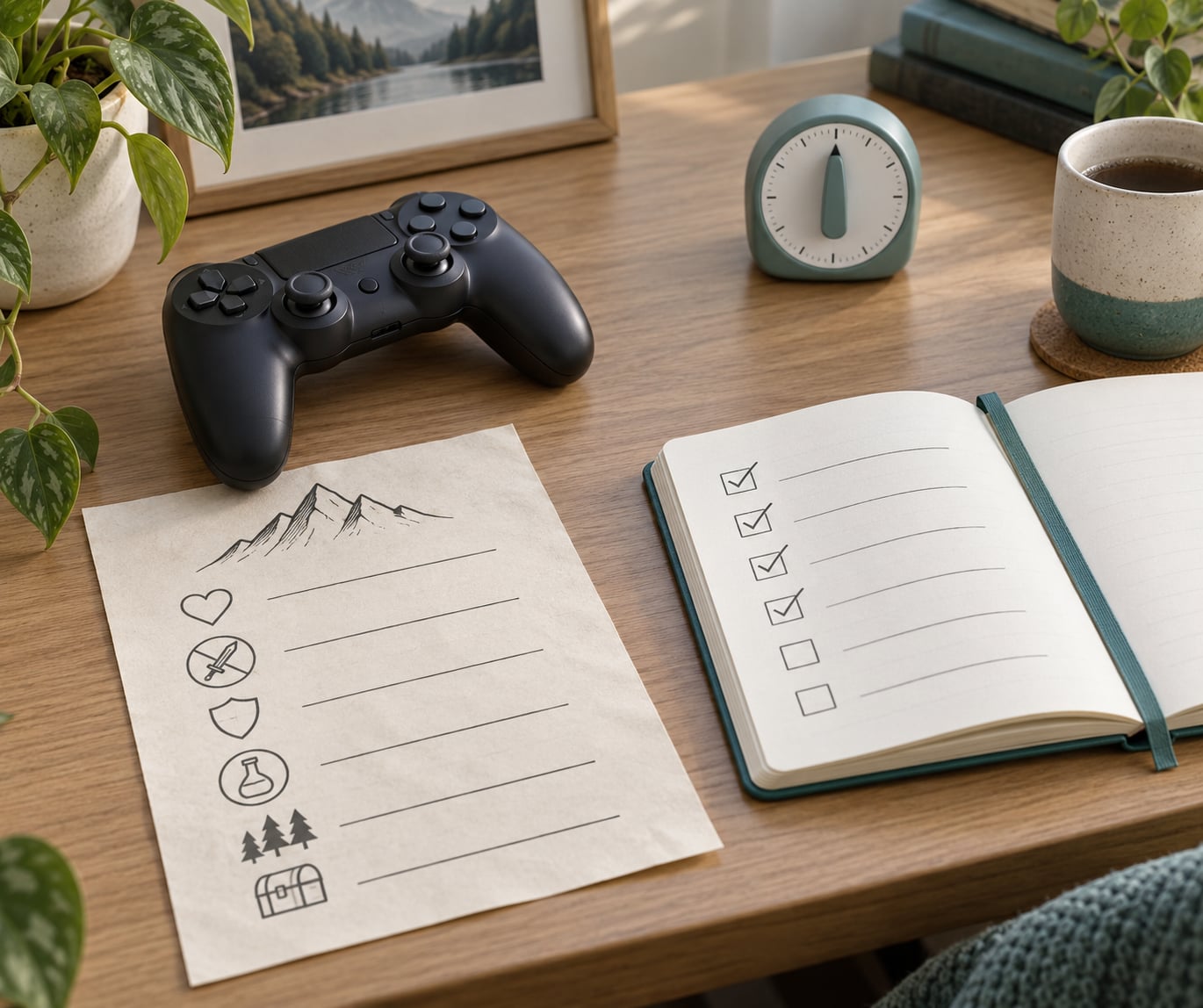
Write the ruleset as a single sheet with numbered rules, a stated win condition, a failure condition, and a difficulty label. Read it out loud to someone who has not played the game. If they ask a question, the wording is at fault, not them.
Run it yourself first, then watch one other person attempt it without interrupting them. Note every moment they stop and ask what the rules mean. Those pauses are your edit list.
Log the confusion points, then rewrite the offending lines. A ruleset that survives contact with three testers is usually good enough to publish.
When you publish, include the game version, platform, difficulty setting, mods or randomizer seed used, and the date. Half of all arguments about challenge runs are version arguments, where one player patched a bug the other did not.
If you intend to stream or record, decide beforehand what a failed run means for the video. The most-watched challenge content is usually failure-heavy and character-driven rather than optimal, so a run that ends badly is still worth posting if you frame it honestly.
The rule that quietly ruins everything is drift, where a player relaxes a single rule the moment it gets expensive and then describes the result as the same challenge. Write your rules down before the run and treat changes after that point as a new run with a new label.
Frequently Asked Questions
Is a Nuzlocke a challenge run?
Yes. A Nuzlocke is one of the best-known named challenge runs: in the Pokemon version, a creature that faints is permanently gone for the rest of the run, and captured creatures must be nicknamed. It works because the rules are stated in one sentence and they turn a familiar game into a resource-management problem. Its difficulty sits in the hard tier, so it is a poor first challenge attempt and a good third one.
What is the difference between a challenge run and a speedrun?
A speedrun is timed: the goal is to finish as fast as possible while skipping optional content. A challenge run changes what the game asks of you, such as banning items or forbidding healing, and the finish time may not matter at all. You can do both at once, as in a no-hit Any% attempt, but the two formats reward different skills and different routes.
Is save scumming allowed in a challenge run?
It depends entirely on the ruleset, which is why the ruleset has to say. Many community rulesets forbid it outright because reloading a save quietly undoes the stakes the run was built to create. Others permit limited use for handling a genuine crash or corrupted file. State the position in writing before the attempt starts, otherwise the argument happens after the run ends and nobody wins.
How many rules should a challenge run have?
Two or three compatible rules is the sweet spot. Every extra rule multiplies the number of situations players have to interpret, and once the rules contradict each other the run stops feeling fair. If you need more than three, check that they all push the same direction, or split the extra rules into a separate category run.
What should I do when a randomizer seed makes the run unwinnable?
Decide the policy before you start, because the alternative is arguing mid-run. The common options are rerolling a new seed and starting over, accepting the softlocked seed as a documented loss, or defining a short list of items or abilities that may be unlocked manually to guarantee a finish. Whichever you choose, write it into the ruleset and follow it, even if the seed feels unfair.
How hard should a first challenge run be?
Easy, and preferably on a game you have already finished. Pick one stylistic restriction with no harsh failure attached, such as a pacifist run or a no-healing rule, and get a completion under your belt before stacking constraints. Jumping straight into a permadeath or blindfolded attempt is the most common way first-timers quit, because the loss reads as a bad ruleset rather than a learning step.
If you want to start tonight, take a game you have already finished, write one premise on a single line, add two restrictions that push the same direction, and define the win and failure conditions before launching. Everything else in the design can be tuned on the second attempt; getting those five sentences right is what separates a challenge run from a rough idea.