To improve game sense, stop treating practice as hours logged and start treating it as decisions reviewed. Game sense is pattern recognition built from map knowledge, experience and deliberate practice, not a talent you either have or don’t. The players who climb out of a plateau are the ones who slow down, name what went wrong, and repeat the right choice until it becomes the default.
Most improvement guides stop at “play more.” That advice is slow and often backwards, because volume without review just rehearses whatever habits you already had. The loop below takes 20 to 30 focused minutes a day and works in shooters, battle royales, MOBAs and sports games alike.
Table of Contents
- What You Need
- Step-by-Step: How to Improve Game Sense
- 1. Learn the Core Systems
- 2. Watch With Intent
- 3. Practice One Situation at a Time
- 4. Run Decision Drills
- 5. Review Mistakes and Wins
- 6. Apply the Skill Under Pressure
- 7. Track Progress and Adjust
- Common Mistakes
- Common Mistakes and Their Fixes
- Tips for Faster Improvement
- Frequently Asked Questions
- How long does it take to improve game sense?
- Can you teach yourself game sense?
- Is game sense the same as gaming intuition?
- Does aim training improve game sense?
- How do I know if my game sense is improving?
- Which games benefit most from game-sense training?
- Conclusion
What You Need
You need very little, which is why most people skip it. Here is the whole list:
- One game to focus on. Not a genre, one game. Improvements made in one map or mode transfer slowly at best, so pick what you actually play and stay there for a month.
- Replay access. Every major competitive title records your matches or lets you subscribe to them. If yours does not, a phone recording of your screen works.
- A notebook, spreadsheet or note app. Somewhere to log deaths and mistakes. A sticky note on your second monitor does the job.
- A training partner when you have one. Two people reviewing the same clip argue about it later, which teaches you why the call was right, not just that it was.
- 20 to 30 minutes. Long enough to review a round properly, short enough that you actually do it on a bad day.
That is the entire shopping list. A whiteboard, a pen and one recorded match will carry you further than any piece of hardware.
Step-by-Step: How to Improve Game Sense
Game sense is not one skill, it is a bundle of smaller ones that get faster together. The seven habits below go in order deliberately. Skipping ahead to the live-play stages without the review stages underneath is why people play 2,000 hours and feel nothing.
1. Learn the Core Systems
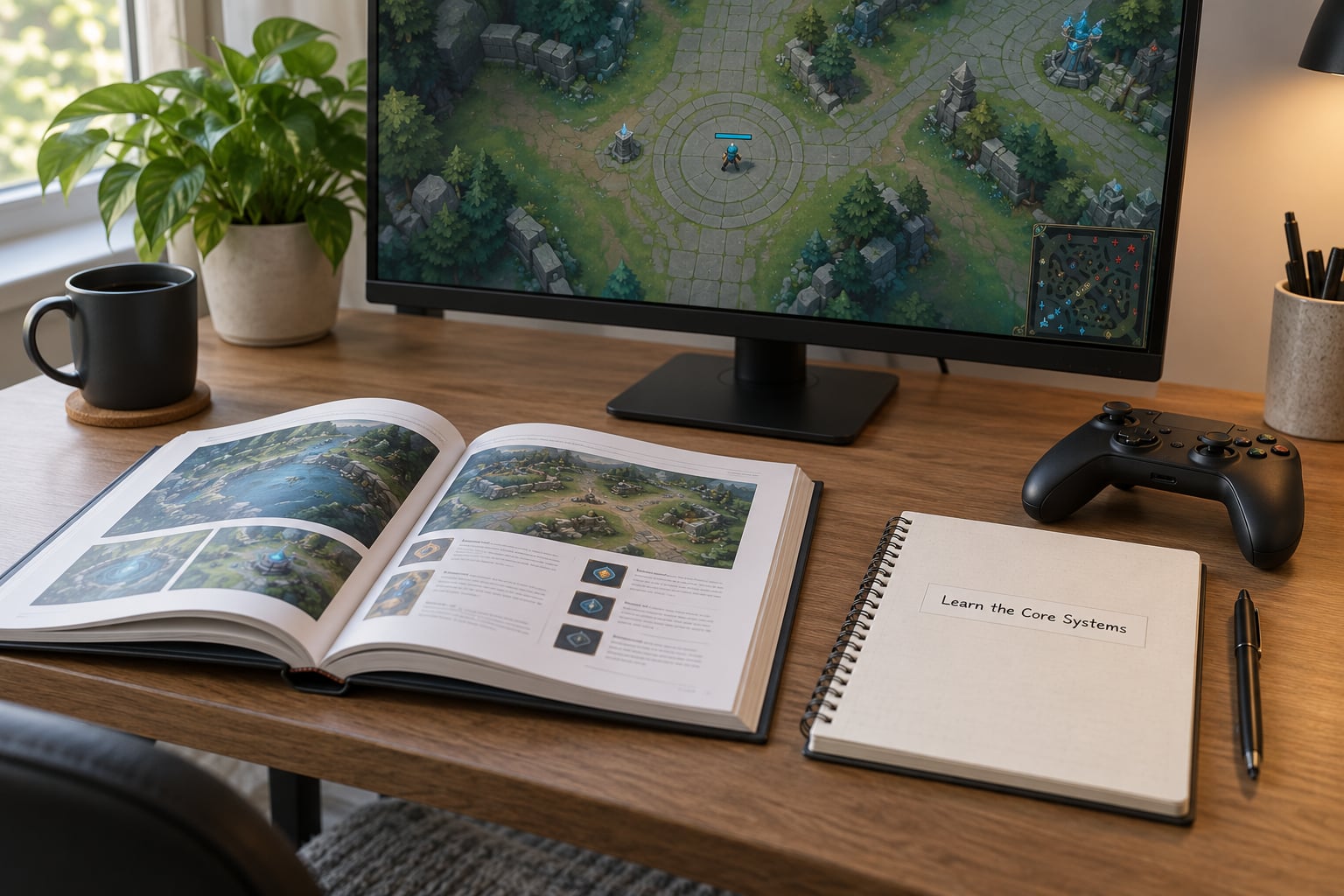
Before anything else, write down the rules the game actually rewards. What are the win conditions, which resources matter, where do players fight, and what are the recurring situations you will meet fifty times this week?
For most shooters that means time, map control and information. For a MOBA, it is wave timing and where your champion is strong. For a sports game, it is spacing and the shape of the field. The specifics change, the structure does not.
How do you know the step worked? Try explaining out loud why a common choice in your game is strong or weak, without appealing to feel. If you can only say “it felt right,” you do not know the system yet.
2. Watch With Intent
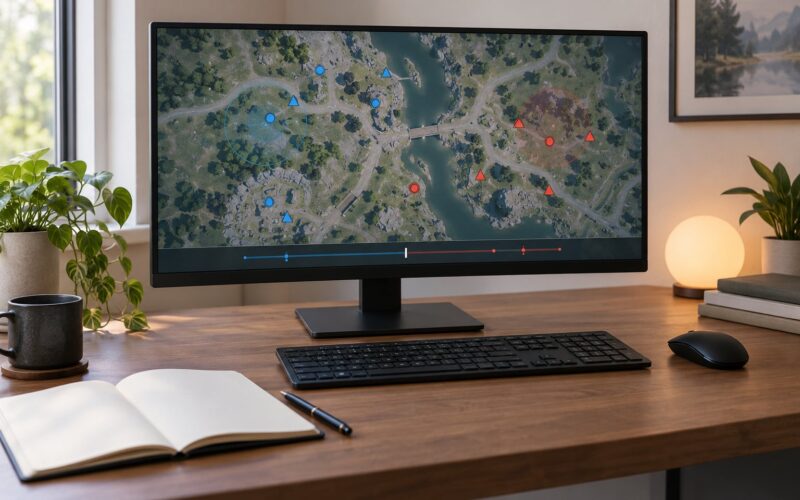
Passive watching is entertainment, not training. What you want is prediction: pause a professional match at a decision point, write down what you think happens next, then resume and check.
Every time you are wrong, you have found a gap. Five predictions in a row and you have a usable list of what stronger players notice that you do not, which becomes your personal checklist. Write that list down in your own words. Community advice about studying pros usually misses this step, and it is the reason people watch hours of footage and forget it by the next day.
3. Practice One Situation at a Time
Spread-thin practice sessions build nothing. Pick the single situation that costs you the most, isolate it, and repeat it with one goal.
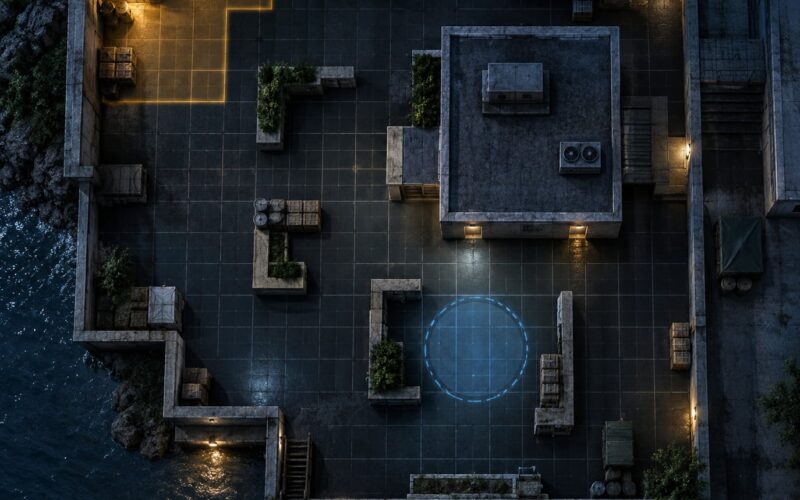
Take a death you know you earned. Then do the same again, from a different position, with the crosshair somewhere it is usually not. Positioning drills, rotation timing drills, spacing drills and resource management drills all work this way. Twenty focused repetitions beat two hundred mixed ones every time, because repetition under one variable is what builds a pattern you can retrieve later.
4. Run Decision Drills
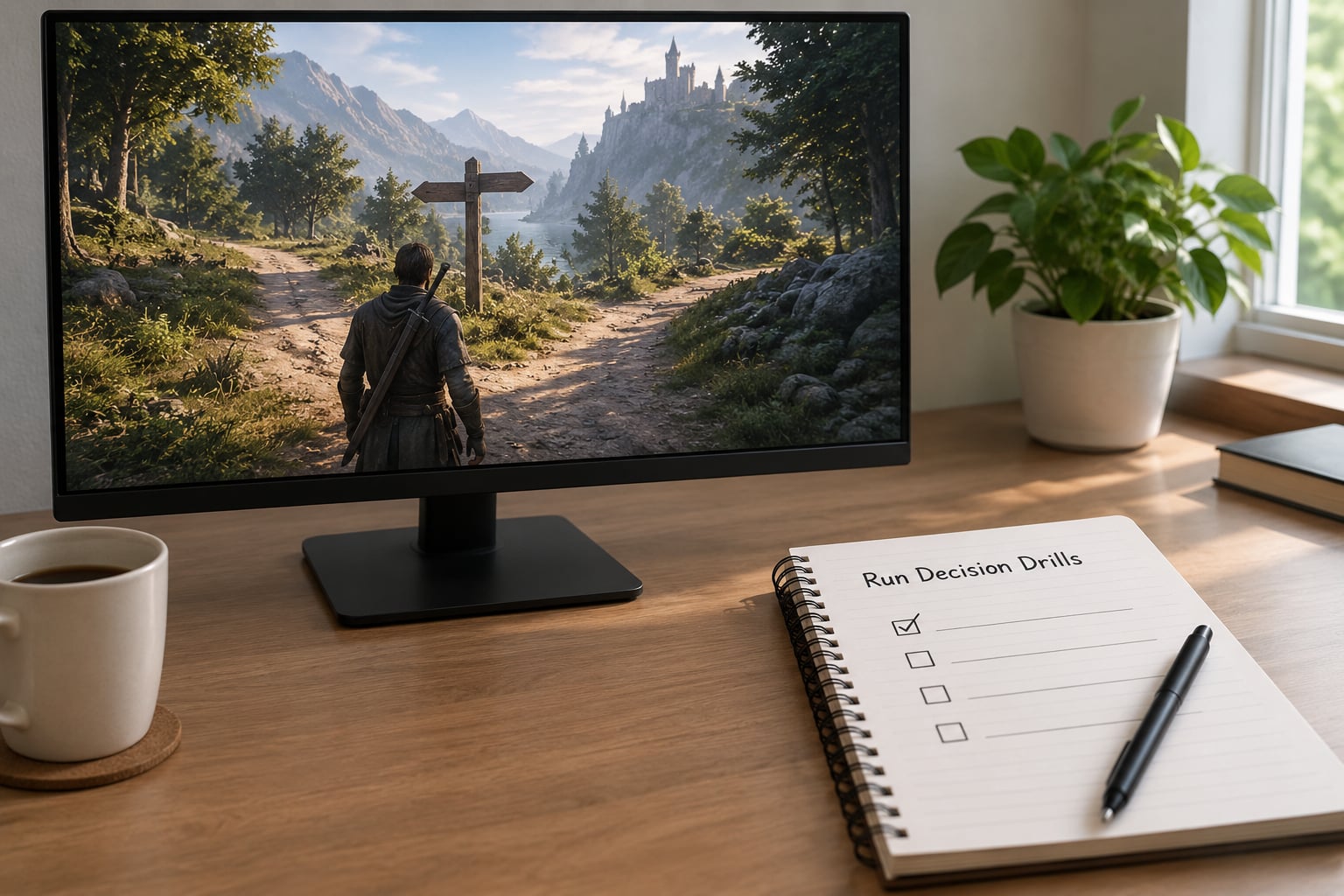
Drills here are about speed of reading, not speed of clicking. Two that players in gaming communities keep recommending:
- Ten-second recall. Play a round for about ten seconds, pause, then write down every enemy you saw, every sound you heard, every piece of utility you used and what you heard from teammates. Check the replay. The gap between what you remember and what happened is your real awareness level, and it is usually much larger than expected.
- Branch drill. Stop a replay at every point where you had a genuine choice. Commit to a decision in writing before you continue. Ten or fifteen of these a session trains the part of the brain that picks options, not the part that reacts.
Once per week, add a speed constraint: same drill, half the time to decide. Most players can tell a correct decision took too long, and time is the constraint that actually matters in a ranked round.
5. Review Mistakes and Wins
Reviewing deaths is where most of the gain lives, because a death is the one moment the game gives you a clear signal that something was wrong. Review wins too, so you learn what to repeat rather than only what to avoid.
Classify every death by cause. Did you have the information before you moved? Did you pick a sound option? Did you execute a sound option badly? Those three are different problems with different fixes, and lumping them together is why players fix aim when the real issue was an unchecked angle.
| What happened | Likely cause | The fix to drill |
|---|---|---|
| Died to the same corner repeatedly | Habit, not bad luck | Pre-aim that angle in the practice range for 15 minutes |
| Died to someone you never heard | Sound cues ignored or noise too loud | Play 10 rounds muted, then 10 with focus on footsteps only |
| Died while chasing a kill | Lost minimap and information | Ten-second recall drill, twice a session |
| Died first in a round you had won before | Overpeeking or rushing alone | Play the round, but force a trade or a reset every time |
| Died to a player who had no advantage | Crosshair was somewhere else | Pre-aim and tracking work in the practice range |
| Died without knowing where anyone was | Information economy ignored | Call every contact out loud for 20 matches |
At the end of a week you want one short pattern, not a page of notes. If every death that week was an unchecked angle, that is your focus for the next seven days. That is a far more useful output than feeling bad about a 5-13 loss.
6. Apply the Skill Under Pressure
Isolated drills are where you build the pattern; live play is where you find out whether it survives adrenaline. Move from the practice range to low-stakes modes, then team scrims, then ranked, carrying the same decision checklist with you each time.
The gap between the two is normal and is itself useful information. It usually shows up as a clean, correct decision under pressure versus a rushed, tunneled one. The correction is not more aim training, it is slowing your first three seconds: check the minimap, take the information you have, choose from your checklist rather than from impulse.
Team games add a layer most guides skip. What you know is worth more if you share it, and trading a lost fight for two is a good trade. Players who improve fastest often improve their comms before their mechanics, because information is a resource and hoarding it wastes your team’s whole round.
7. Track Progress and Adjust
Match results are too noisy to steer by. Track four things instead: how often you got the first kill or first objective, how often your entries succeeded, how often you won a one-versus-some situation, and how many times you died per round. Compare this week’s numbers to last week’s, not to someone else’s.
| Week | Focus | Daily action | Metric to watch |
|---|---|---|---|
| 1 | Systems and self-review habit | 20 min of death review after each session | Deaths per round |
| 2 | Map knowledge and sound cues | One map, one drill, 15 min | Deaths to the same angle |
| 3 | Positioning and timing | 10-second recall twice a session | First kill or objective rate |
| 4 | Pressure and team play | Scrims plus the same review routine | Entry success and clutch rate |
Then pick one weak skill for the next week. Not three. One. This is the part almost everyone skips, and it is where a four-week plan turns into a year of drifting.
Common Mistakes
Knowing the loop and not running it are different problems. These are the ones that keep capable players stuck for months.
Common Mistakes and Their Fixes
- Practicing without a goal. Ten warm-up rounds feel productive and teach nothing specific. Name the one thing before you start.
- Reviewing only losses. Losses are usually team problems and make poor study material. Your deaths from a 13-5 win are more actionable.
- Watching highlights instead of your own deaths. Watching a pro frag is entertainment. Watching your own unwon fights, slowly, is training.
- Changing everything after one bad session. Three bad games say nothing. Twenty games of consistent data says plenty.
- Ignoring what other people do. The minimap is the most repeated piece of tactical advice across gaming communities, and it is still the most neglected. Check it, especially right after you hear something.
- Learning callouts but not the map behind them. Knowing a location’s name is not the same as knowing where you can be shot from, how long the rotation takes, and what happens if you lose it.
- Playing tired. Fatigue reads as bad game sense when it is really just slow processing. A short session after sleep beats a long one at 1am, every time.
Tips for Faster Improvement
- Keep sessions short. Twenty focused minutes beats two hours of queueing. Long sessions mostly train tilt tolerance.
- Keep the mistake log. Three lines per session, read on Sunday. Trends show up in the log, never in the moment.
- Play a role you are weak at. Support and off-role players get few eliminations to learn from, so their game sense has to come from decisions, utility and information instead. That path works well if you log it properly.
- Ask teammates for specific feedback. “That was bad” teaches nothing. “You never called the player behind you twice” gives you a drill.
- Play stronger opponents when you can. Lobbies full of players below your level teach you their patterns, not the ones you need to beat.
- Get outside feedback if you are stuck. A coach or a second pair of eyes catches the blind spots that self-review cannot, and everyone has blind spots.
Frequently Asked Questions
How long does it take to improve game sense?
Most players notice a real shift in four to six weeks of consistent review, and a meaningful rank change in two to three months. That assumes 20 to 30 focused minutes a day rather than long unfocused sessions. Speed varies widely: if your log shows the same death cause every week, you are improving, because the repetition is shrinking. The people who never move are usually the ones playing volume without review.
Can you teach yourself game sense?
Yes. Game sense is a bundle of learnable components: map knowledge, positioning, timing, reading opponents and resource decisions. Each of those can be studied, drilled and logged, and each improves measurably with deliberate practice. What nobody can teach you is volume of experience, so self-taught players usually reach the same ceiling more slowly than players with a coach or a team environment.
Is game sense the same as gaming intuition?
Not quite. Intuition is what good game sense feels like from the inside: a fast answer with no visible reasoning. Game sense is the knowledge and pattern library underneath it. You build the library deliberately, and intuition arrives later as the shortcut. Players who chase the feeling rather than the knowledge get stuck, because intuition without an underlying model is just a habit that happens to work sometimes.
Does aim training improve game sense?
Only indirectly. Aim training makes you win more of the fights you enter, but it says nothing about which fights you enter, from where, or with what information. If you are already hitting your shots consistently, more aim work has a small return while map knowledge and death review have a large one. Fix mechanics first if they are broken, then spend most of your time on decisions and positioning.
How do I know if my game sense is improving?
Track first kill or first objective rate, entry success, clutch wins and deaths per round across comparable weeks. If deaths per round drops while your first objective rate rises, your decisions are getting better, not just your aim. Match results are too noisy on their own to prove progress. A mistake log showing fewer repeat causes is the clearest signal most players ever get.
Which games benefit most from game-sense training?
Any game with meaningful information and positioning helps, which covers most competitive shooters, battle royales, MOBAs and sports games. Shooters show gains fastest because every round repeats the same structure and the minimap makes information easy to measure. In sports and racing games the same loop works, with spacing and line choice replacing angles. Single-player games help too, mainly on planning and resource decisions.
Conclusion
Pick the decision that costs you most, the one you have no good explanation for. Watch two examples of how stronger players handle it, write down what they noticed that you do not, then do three focused repetitions of that exact situation in the practice range and one live application in your next match.
Do that this week. If you want to improve game sense, the answer is not more hours. It is a shorter session, a written record, and a decision you looked at twice.