Reading enemy patterns in competitive games means noticing how opponents behave round after round, then using that consistency to place yourself where their next action will hurt them. It is bookkeeping more than mind reading. The whole method takes about ten matches of honest note-taking to start paying off, and it works the same way in a tactical shooter, a MOBA or a hero shooter.
The version most players fail at is the memory part. They watch a great round, form an opinion about an opponent, and carry nothing into the next queue. A read that lives in your head for one round is a feeling. A read written down where you can check it is an asset.
Below is the process I use: establish a baseline, collect repeats, isolate a cue, make a prediction, then score the result. It takes five steps and one rule — never commit fully until the observation repeats.
Table of Contents
- What You Need
- Step-by-Step: Read, Predict, and Respond
- Step 1: Establish the Baseline
- Step 2: Record Repeated Sequences
- Step 3: Look for Tells and Cues
- Step 4: Predict the Next Decision
- Step 5: Test and Adapt Without Guessing
- Common Mistakes When Reading Enemy Patterns
- Frequently Asked Questions
- Can you actually read enemy patterns in ranked, or is it guesswork?
- How do I tell if a play was a real read or just a lucky guess?
- Should I look at the crosshair or at the enemy when I flick?
- How long does it take to learn an opponent’s patterns?
- How do I track a specific opponent’s habits across separate matches?
- How do I stop opponents from reading me the same way?
- Conclusion: Start With One Repeatable Cue
What You Need
You need less than most guides suggest. Nobody needs a spreadsheet template or a notebook full of notations before they can start.
First, access to at least a handful of your own recent matches. Most competitive titles keep replays, and even the ones that trim them aggressively keep a few rounds. If replays are gone, play five to ten more matches and take notes live, between rounds, on your phone.
Second, working knowledge of the current rules of the game you queue. Cooldowns, spawn timers, economy limits and objective windows determine what an opponent can physically do. If you do not know that a site hit usually opens the map for the next twenty seconds, you cannot predict what happens after it.
Third, a note method you will actually use. A notes app, a phone memo, a spreadsheet or a pen works. What matters is that recording something takes under five seconds, because you will be doing it in the ninety seconds after a round ends.
Fourth, a baseline for your own play. You cannot read an opponent cleanly if you do not know your own habits — the same angle you over-hold, the same fight you take at low health, the same rotation you always start.
Step-by-Step: Read, Predict, and Respond
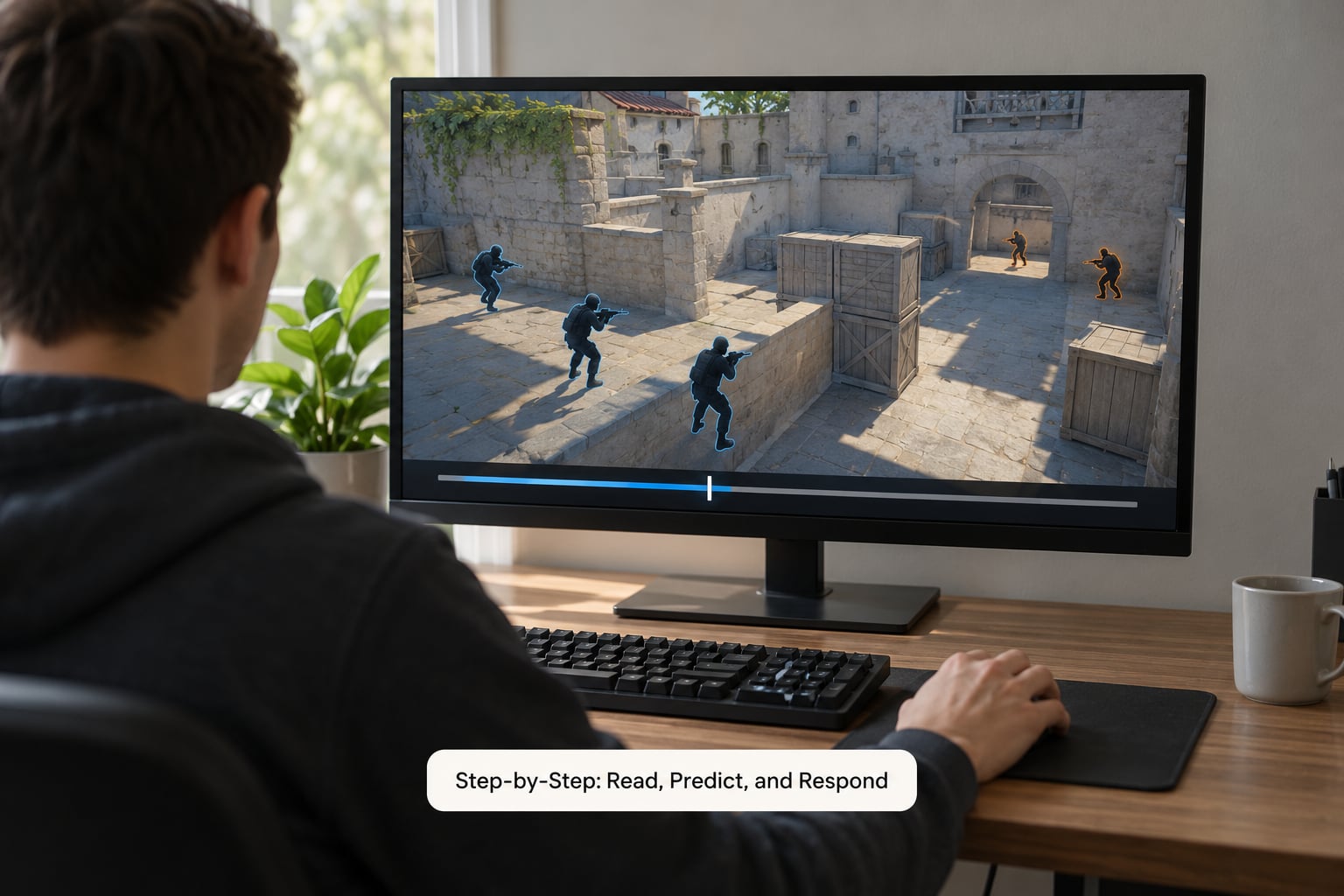
Step 1: Establish the Baseline
Before you hunt for exceptions, write down what this opponent does normally. A baseline has about six fields: where they usually start, which range they prefer to fight at, how fast they move when they commit, how often they attack, how they behave when they lose one, and which objective they favour.
Fill it in from one full match and treat it as a hypothesis, not a fact. Most players have a default that holds for three or four rounds before conditions push them somewhere else, and that default is the thing worth naming early.
Success signal: you can describe the opponent’s normal approach in one sentence without checking your notes. If you need three sentences, you have not narrowed it down yet.
Step 2: Record Repeated Sequences
One instance is coincidence. Three is a coincidence with better manners. Look for the fourth before you treat something as a pattern.
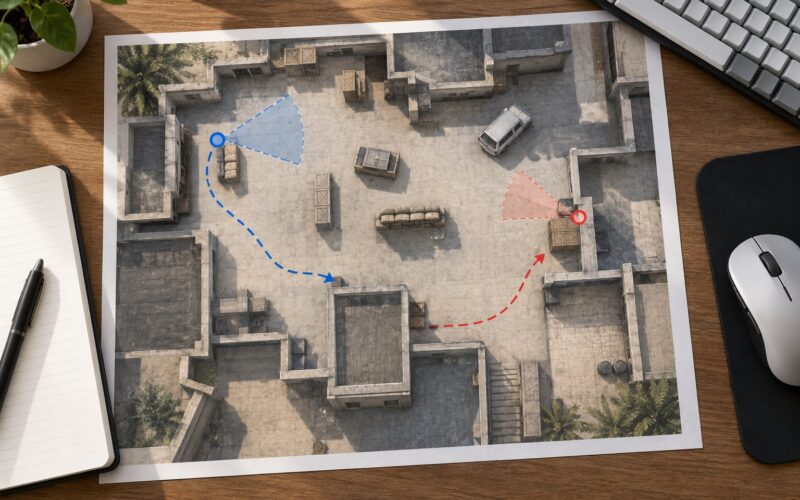
Each note needs four fields: what happened, where on the map, what the round state was, and what the opponent did next. A note like “rotated fast after they lost the first fight” is useless. “Round 6, they lost mid control, 20 seconds later both players on site A, then a dry peek from heaven” is a pattern you can act on.
Record conditions, not just actions. Enemy behavior changes with the round state — a full utility bar, a numbers advantage, an economy lead, a lost objective. If you only log the action, you will eventually predict it at the exact moment it stops happening.
Success signal: you have at least three notes where the same sequence appears under similar conditions, and you can name the condition, not only the action.
Step 3: Look for Tells and Cues
A tell is the small signal that arrives before the action. Cues come from four channels, and the channels rank differently in reliability.
- Timing cues are the most reliable. A rotation that starts the second their teammate dies on the same beat every time is a timing tell, and clocks do not lie.
- Positional cues come next. Which side they enter from, which angle they favour, whether they clear the same room first.
- Audio cues are underrated. A consistent footstep pattern or a utility sound before an entry tells you what is about to happen, not just what is happening.
- Visual tells are the weakest. Character animations and weapon handling look similar across players, and reading them usually means you lost the round already.
Now split what you have into two piles. Reliable cues repeat across players or repeat regardless of the situation. Fragile cues are one player’s quirk, learned in one game, probably gone by tomorrow.
Success signal: you can name your strongest cue in five words and say how many times you have seen it fire.
Step 4: Predict the Next Decision
A prediction is a statement about the next ten seconds, not the rest of the match. Write it in a form you can mark right or wrong: “with their next utility and a teammate on site A, they enter from B short within fifteen seconds.”
Build the prediction from the situation rather than from the pattern alone. Their health, what they control on the map, their cooldowns, where their team is, and what just happened all narrow the set of reasonable actions to two or three. Then pick the one your notes support most.
Position for the prediction, not for the action you have seen most often. If the read says they take the same angle, the play is usually to hold a different one and let them arrive into it, which is where pre-aiming pays off. Players who keep their crosshair where the head will be convert a read into a kill before the enemy is fully visible.
Success signal: before the round starts, you can state your prediction and your planned response in one sentence each.
Step 5: Test and Adapt Without Guessing
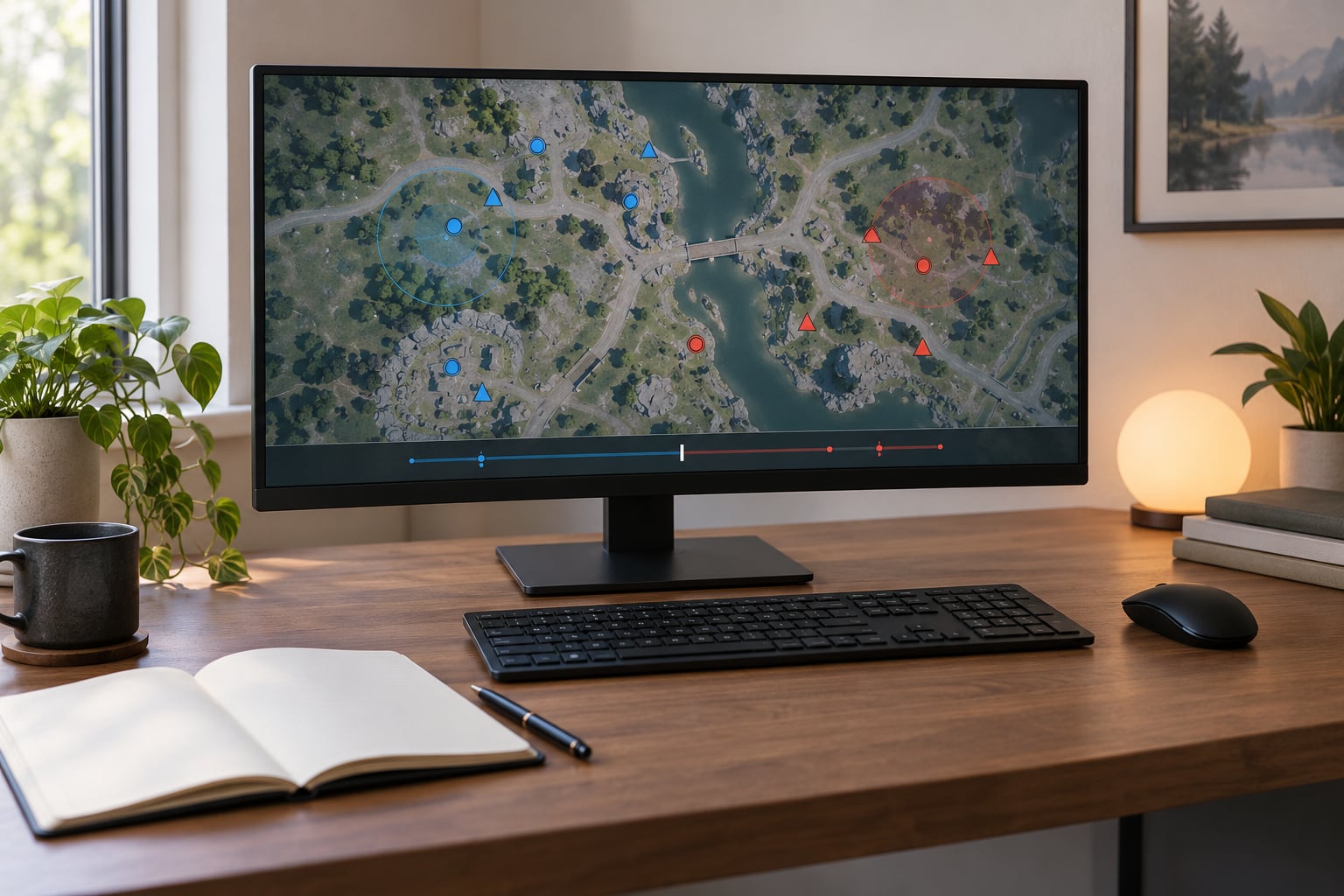
Score every prediction the moment the round ends, and score it honestly. Hit, miss, or never got the chance. Keep the misses, because that is where the model is wrong.
When you miss, ask which of three things broke: the condition was different this time, the cue fired but the action differed, or you misread the situation. Each failure points at a different fix, and guessing between them wastes the note.
After eight or ten rounds, update the pattern. Raise the weight of the conditions that kept holding and drop the ones that only appeared once. This is the step everyone skips, and it is the reason most reads decay after a single session — opponents adapt too, so a pattern with a last-verified date is worth more than one written from memory.
Success signal: your notes have a confidence grade per pattern, and you re-check them every few matches instead of once at the start.
Common Mistakes When Reading Enemy Patterns
Reacting to every movement. Every footstep is not information. If you treat every input as a cue, you end up pre-aiming at nothing and drifting out of position. Fix: only log movements that preceded an action, and only act on cues with two or more hits behind them.
Assuming the plan repeats. The first time an opponent takes the same route, it is a plan. The third time, it is a habit they have not noticed yet — and it is also the moment someone on their team says something in voice comms. Fix: re-verify old patterns whenever the scoreboard changes shape, such as a new agent pick or a different economy state.
Ignoring match context. A read that ignores cooldowns and economy is decoration. Check what the opponent can actually do right now before you predict it, and drop your confidence when the conditions are new.
Confusing animation with intention. Characters wind up, adjust and idle constantly, and the same wind-up appears before completely different decisions. Treat visuals as a weak channel, and put your weight on timing and position where the data is cleaner.
Punishing without an exit. Winning the read and then dying to the second player means the read produced nothing. Decide where you go after the punish before you take it, and prefer plays where a wrong guess still leaves you alive.
Failing to update after opponents adapt. Once your read works, it becomes public knowledge in the lobby, and the enemy gets better at beating it. Deliberately break one of your own patterns every few matches so you are not a solved problem yourself.
Frequently Asked Questions
Can you actually read enemy patterns in ranked, or is it guesswork?
Both, at different times. A read built from repeated observations under the same conditions is a real advantage, and it holds in ranked because the constraints that create patterns, map layout, cooldowns, economy, win conditions, are identical for everyone in the lobby. What you are reading is constraint-driven behaviour, not personality. Where it becomes guesswork is when conditions change between the note and the round.
How do I tell if a play was a real read or just a lucky guess?
Ask whether you predicted the action or reacted to it. A real read is stated before contact, based on a pattern you have logged at least three times, and it survives when the opponent adds one twist. A guess usually arrives after the first visible movement, and feels convincing only in hindsight. Score both the same way for ten rounds and the gap shows up fast.
Should I look at the crosshair or at the enemy when I flick?
Look at the crosshair, and place it where the head will be. Aiming at a body that has not appeared yet wastes reaction time, because you still have to correct. Players ranked at the top consistently say to pre-aim the head-level line and confirm the angle once the enemy shows, and community discussion about the target-first approach reaches the same conclusion for a different reason.
How long does it take to learn an opponent’s patterns?
A baseline takes one full match. A usable pattern takes three to five matches of consistent conditions, so roughly ten to twenty rounds of focused play before you can act on it with confidence. Strong habits can appear faster against the same opponent. The bigger time sink is verification, not collection, since a pattern you never re-check is a guess with extra steps.
How do I track a specific opponent’s habits across separate matches?
Keep a short profile with a last-verified date on each entry: name, main cue, favourite rotation, preferred range, and the round state where it holds. When you queue into the same person again, re-test the cheapest cue first before trusting the rest. Solo players say the moment they start noticing an opponent’s habits is the real turning point in a game’s learning curve, and a written profile is what makes that memory survive between sessions.
How do I stop opponents from reading me the same way?
Vary the things that are predictable rather than improving them. Change your rotation order, alternate which side you clear first, and take fights from two different ranges in the same match. Opponents build reads on repetition, so breaking your own repetition removes their evidence. If you have been predictable for weeks, expect one or two uncomfortable rounds before the read stops paying for them.
Conclusion: Start With One Repeatable Cue
Reading enemy patterns is a record-keeping habit, not a talent. Pick one opponent, write their baseline after a single match, find one cue that fires three times, and test it in the next few matches before you add a second one. Written down in 2026, that is a small habit — but it is the one that turns aim into decisions.