Most competitive games give you something usable in 20 to 50 hours, a genuinely average player somewhere around 300 hours, and a Gold-to-Diamond level account around 700. Pushing into the top percentiles of any ladder takes 1,500 hours or more, and world-class play is still measured in thousands. Those numbers assume the hours are structured, not just logged.
The honest version of this question is not really about hours. It is about how many of those hours produced a change in your decisions. Here is what the benchmarks actually look like, how to convert them into a calendar, and how to spend those hours so they stack.
Table of Contents
- How Many Hours of Practice Does Improvement Take?
- What the 10,000 hour rule actually says
- How long do 10,000 hours take in real life?
- Practice Hours by Skill Level
- How many hours of practice to improve at a competitive game, by level
- How many hours by genre?
- What Counts as Deliberate Practice?
- Raw hours versus effective practice hours
- How to Structure Practice Sessions
- A 60-minute session
- A 90-minute session
- A 120-minute session
- What team and esports schedules look like
- Which Skills Improve Fastest?
- Mechanics and aim
- Game sense and decision making
- Positioning
- Communication and role discipline
- Tournament and pressure routines
- How to Know When You Are Improving
- Track these four numbers
- How to tell a plateau from a learning curve
- Set a review date instead of a rank date
- Frequently Asked Questions
- Is 10,000 hours a lot on a game?
- How many hours a day do esports players practise?
- How many hours to get good at a fighting game?
- What is the 20-hour rule in gaming?
- How long does it take to put 10,000 hours into a skill?
- Is 700 hours a lot for a game?
- Conclusion
How Many Hours of Practice Does Improvement Take?
The direct answer, in ranges most players recognise from their own logs:
- 20 to 50 hours — you stop dying constantly, learn the controls and can finish a match without following the objective by accident.
- 200 to 400 hours — you are an average player in a game with a matchmaking system. Most of the lobby is worse than you.
- 400 to 700 hours — Gold and Platinum territory in the shooters, low Diamond in a MOBA, mid-level in a sports sim.
- 700 to 1,200 hours — Diamond and Master. You win more than you lose against comparable players and you know why.
- 1,500 to 3,000 hours — Ascendant, Immortal, Grandmaster. The top few percent of any ladder.
- 5,000 hours and up — the narrow bands at the very top, where a single rank tier holds thousands of players.
Two things move these numbers a long way. The first is genre: a fighting game and a battle royale both count hours, but a fighting game asks you to spend those hours in training mode rather than matches. The second is starting point and age. A player who arrives with shooter experience climbs a tactical shooter faster than a total beginner would, and the gap widens the higher you go.
What the 10,000 hour rule actually says
The 10,000 hour rule comes from psychologist Anders Ericsson, whose research on expert performers Malcolm Gladwell popularised in Outliers. The number was never a threshold. It came out of a study of elite violin students at a music academy, comparing them against music students and against professional players, and it described an average among people already at the top of their field.
Two corrections matter for gaming. The original comparison was not against true beginners, so the hours are additive rather than total. And practice explained roughly 26 percent of the variance in game performance in a 2014 meta-analysis, alongside 21 percent for music and 18 percent for sports. That leaves most of the gap to starting age, aptitude, coaching and match volume.
The other framing people quote is the 20-hour rule: about 45 minutes a day for 30 days to reach reasonable competence in a new skill. Both numbers are useful for different goals. Twenty hours gets you functional. Ten thousand hours is what a career-level specialist accumulated, and they were not starting from zero when they began counting.
How long do 10,000 hours take in real life?
This is where the arithmetic gets discouraging, and it is worth seeing plainly before you commit to anything.
| Hours per day | Days needed | Calendar time |
|---|---|---|
| 1 | 10,000 | about 27 years |
| 2 | 5,000 | about 14 years |
| 3 | 3,333 | about 9 years |
| 5 | 2,000 | about 5.5 years |
| 8 | 1,250 | about 3.4 years |
Ten thousand hours is 1,250 full eight-hour days. For an adult with a job and a family, one to two hours a day is the realistic number, which puts genuinely elite-level play out of reach on schedule. That is not a reason to quit. It is a reason to pick a target you can actually hit, like Diamond in a shooter, and aim the structured hours there.
Practice Hours by Skill Level
Here is the same ladder with the weekly time commitment that normally produces it, and what changes at each stage.
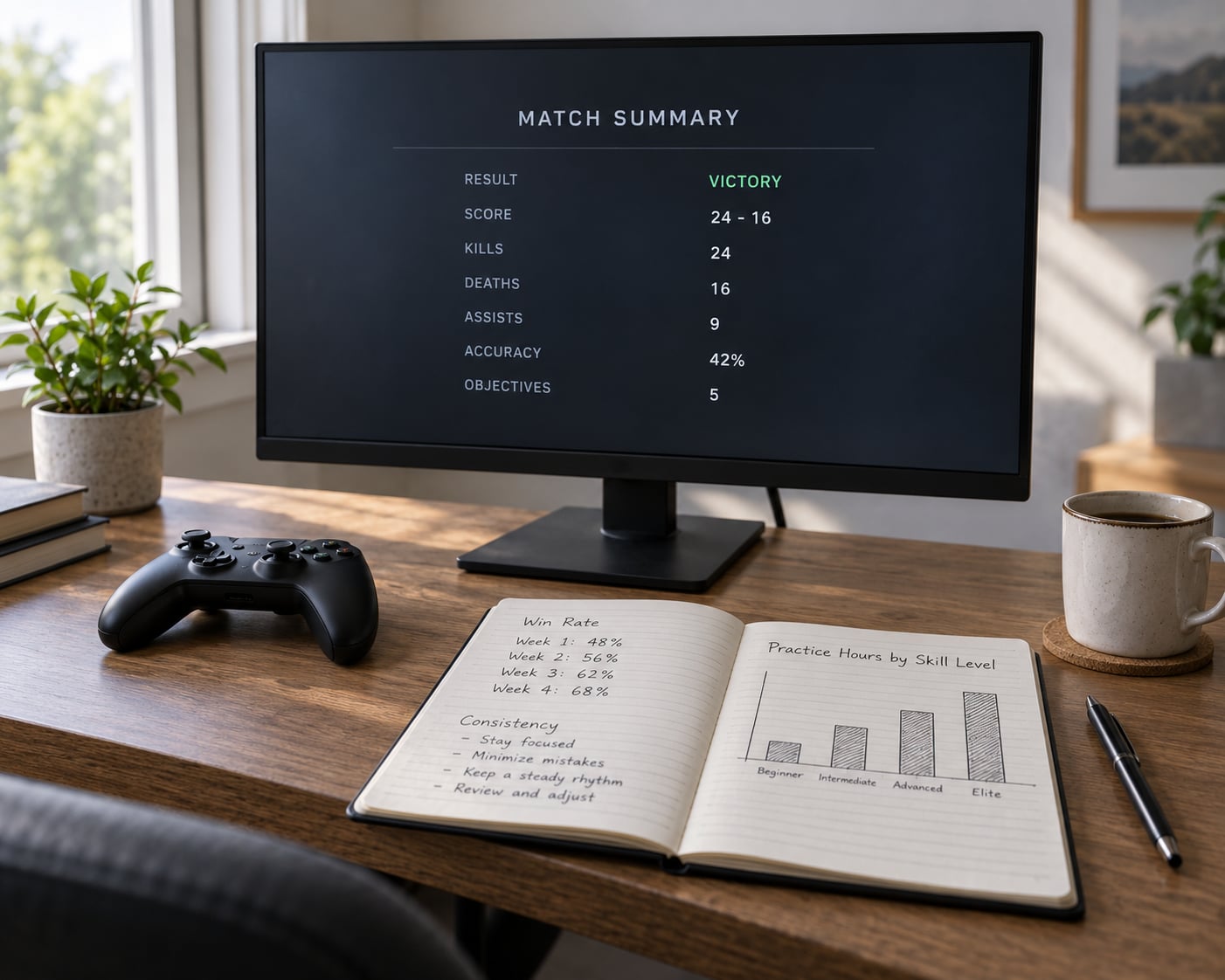
How many hours of practice to improve at a competitive game, by level
| Level | Total hours | Weekly hours | Typical time horizon | What actually changes |
|---|---|---|---|---|
| Complete beginner | 0 to 50 | 5 to 10 | 1 to 3 weeks | Controls, map layout, basic objective |
| Casual competent | 50 to 200 | 7 to 12 | 2 to 5 months | Survives fights, stops feeding, finishes games |
| Average ranked | 200 to 400 | 10 to 15 | 6 to 12 months | Consistent fundamentals, no big weaknesses |
| Gold to Platinum | 400 to 700 | 12 to 20 | 1 to 2 years | Reads rotations, stops throwing rounds |
| Diamond to Master | 700 to 1,200 | 15 to 25 | 2 to 4 years | Deliberate fight selection, holds under pressure |
| Top percentiles | 1,500 to 3,000 | 20 to 35 | 4 to 8 years | Adaptable game sense, opponent-specific preparation |
| Professional level | 3,000 to 10,000+ | 30 to 50+ | 8 years or more | Institutional habits, scrims, specialist roles |
The time horizon column assumes you play consistently across weeks. Five hours on Saturday and Sunday is not the same as ten hours spread over five days, because skill is built on spaced repetition rather than single marathons.
How many hours by genre?
Genre changes the shape of practice more than it changes the total. The battle royale is the fastest game to feel competent in and the slowest to get genuinely good at, because survival depends on hundreds of small decisions per match.
| Genre | Hours to feel competent | Hours to compete seriously | Where the hours have to go |
|---|---|---|---|
| Battle royale | 20 to 50 | 400 to 800 | Rotation timing, fight selection, endgame discipline |
| Tactical shooter | 30 to 60 | 600 to 1,200 | Utility usage, crosshair placement, pre-round reads |
| MOBA | 50 to 100 | 1,000 to 2,000 | Macro, hero pool discipline, wave and objective timing |
| Sports sim | 30 to 60 | 700 to 1,500 | Rotation, boost control, defensive positioning |
| Fighting game | 50 to 150 | 1,500 to 3,000 | Frame data, matchup labs, execution in training mode |
Fighting games sit at the top of that table for a specific reason. You cannot learn matchups by playing matches against strangers. Someone in the Blizzard Overwatch forums reported needing 1,000+ hours to reach Diamond, and a player on r/thefinals described reaching Diamond there after 1,000+ hours of simply enjoying the climb. Fighting games invert that pattern: you spend most of your hours in training mode repeating the same five minutes until your hands do it without your brain.
For per-rank numbers in one shooter, the widely circulated dataset for Valorant reads Iron at about 52 hours, Silver 240, Gold 343, Platinum 469, Diamond 610, Ascendant 840, Immortal 1,050 and Radiant around 3,000. Treat those as a rough curve rather than a promise. They come from a gaming service that sells rank boosting, and no public sample size or method is given, which is exactly the reason to treat every hour benchmark, including the ones in this article, as an estimate.
What Counts as Deliberate Practice?
Deliberate practice is the term Ericsson used for a specific kind of work, and it is narrower than most players assume. His framework has four parts: sustained focused attention, immediate feedback, working at the edge of your ability, and repetition that is intentional rather than accidental.
Ranked queue satisfies almost none of these. There is no immediate feedback on a decision you made eight rounds ago, you are rarely at the edge of your ability when you are on a five-win streak, and the repetition is not intentional because you did not choose what to repeat. You get better at queueing, which is a different skill from getting better at the game.
That gap is the whole argument. A player on r/CruciblePlaybook with roughly a 1,000 destruction ratio was grinding daily, reading guides and watching creators, and still could not tell whether top tier was reachable. Hours were present. Structured feedback was not.
Raw hours versus effective practice hours
Take a log of 100 hours of solo queue. Realistically, somewhere between 25 and 45 of those hours contained a moment where you noticed something, corrected it and carried the correction into the next match. The rest was autopilot, tilt, queue time, instalocking teammates and re-learning the same lesson for the fifth time.
| Session type | Typical share that produces a change | Best use |
|---|---|---|
| Solo queue, no review | roughly 25 to 40 percent | Match volume, learning the map pool |
| Solo queue with post-match review | roughly 45 to 60 percent | Fixing one repeated mistake |
| Training mode drills | roughly 55 to 75 percent | Mechanics and reaction time |
| Scrims or structured team play | roughly 50 to 70 percent | Comms, roles, mid-round calling |
| VOD review of your own losses | roughly 70 to 85 percent | Decision-making and game sense |
These are working estimates, not measured figures from a controlled study. The pattern behind them is not in dispute though: sessions with feedback attached beat sessions without it, every time.
How to Structure Practice Sessions
The format matters less than the order. A session with a goal, a drill, a match and a written note beats four hours of queueing, and it takes less time.
A 60-minute session
- 0 to 10 minutes — warm-up. Aim trainer or movement drill, nothing new. The goal is to raise reaction speed, not to learn something.
- 10 to 30 minutes — the targeted block. Pick one weakness from your last five losses and drill only that: a spray pattern, a flash lineup, one matchup, one positioning habit.
- 30 to 50 minutes — matches where you apply it. Queue only to test the change, not to accumulate hours.
- 50 to 60 minutes — write down what happened and one thing to fix next session. Two lines is enough.
A 90-minute session
- 0 to 15 minutes — warm-up and one focused mechanic drill.
- 15 to 40 minutes — long-form targeted work. Fighting game lab sessions, aim trainer blocks or MOBA macro review all fit here.
- 40 to 70 minutes — competitive matches with a written goal, such as win two of five while holding one behaviour.
- 70 to 85 minutes — review one loss in full. Watch your own decisions, not your teammates.
- 85 to 90 minutes — note the next target.
A 120-minute session
Two hours is where team play starts to matter. Split it into a warm-up, a 30-minute skill block, 45 minutes of matches or scrims, then 20 minutes reviewing. If you are not on a team, the 45-minute block becomes queue with a restricted hero or agent pool, which forces you to practise the thing you would rather avoid.
What team and esports schedules look like
Structured competitive teams do not play eight hours of matches. Reported schedules at the top of organised play tend to break down into roughly 2 to 4 hours of review and theory, 3 to 6 hours of practice or scrims, 1 to 3 hours of sponsor and streaming commitments and 2 to 3 hours of mechanical or aim training, across 6 to 10 hour days for academy and pro players. Collegiate players typically sit lower, around 4 to 6 hours a day.
The part almost every solo player skips is the first one. Two hours of review beats two extra hours of queueing, and it is the only part of the day that compounds.
Which Skills Improve Fastest?
Some skills move fast because they are trainable in isolation. Others take years because they depend on pattern recognition built from thousands of situations you cannot drill directly.
Mechanics and aim
Raw execution improves fastest in the first 200 to 300 hours because it responds to repetition and measurable feedback. This is the one category where a training mode genuinely beats queueing. Aim trainers help in tactical shooters, frame-data drills help in fighting games, and the improvement is visible in week-to-week comparison.
Game sense and decision making
This is the slow one. Game sense is pattern recognition built from thousands of situations, which is why it barely moves in the first hundred hours and then climbs steadily. It only responds to review. Players on r/summonerschool asking how long before rank improvement appears after taking a game seriously are usually describing this curve rather than a broken one.
Positioning
Improves surprisingly fast because it is cheap to test and the payoff is immediate. Holding an angle that keeps your crosshair on the likely approach beats a faster reaction time. You can practise it in a single session and feel the difference the next match.
Communication and role discipline
Team games compress this one. A player who can call a rotation early is worth more to a team than a mechanically stronger player who stays silent, and the habit takes 50 to 100 hours of actual team play to build. Solo players can fake it by narrating their intention before each engagement.
Tournament and pressure routines
The slowest and most overlooked. Playing under a clock, in front of an audience, with a banned agent or character, is a separate skill from playing well. Players who only ever queue rarely develop it, which is why open cups feel like a different game from ladder play for the same person.
How to Know When You Are Improving
Rank is a lagging and noisy signal. A win rate over 50 percent in a game with a skill-based matchmaking system is a decent sign but a blunt one. There are better metrics, and tracking three of them kills most of the plateau confusion.
Track these four numbers
- Win rate at your rank over 100 matches, not over your last ten. Short samples lie.
- Performance in the first five minutes of a match, before your rank habit kicks in.
- Decision speed, approximated by how often you act on a situation before you have a plan for it. Watch one match and count the obvious wrong calls.
- Consistency, measured as the spread between your best and worst match in a week. A shrinking spread means real growth even when the rank number holds.
How to tell a plateau from a learning curve
A real plateau looks like this: you play 50 hours over a month, you review your losses, and the same mistake appears in the review notes week after week. That is a training problem, and the fix is to change the drill, not to add hours.
A normal learning curve looks different: your review notes change, but the rank holds for two or three weeks. Game sense moves in steps that matchmaking does not reflect immediately, because the ranking system takes time to place you against your actual level. This is the stage where most players quit, and it is usually the stage where quitting costs the most.
Set a review date instead of a rank date
Rank goals make you feel stuck when you are improving, because rank is noisy. Review goals do not. Commit to reviewing ten losses every week for a month and to naming one thing you are fixing. After four weeks, most players can point to a change. That is progress you can see, and it is the reason to keep going when the badge has not moved.
Frequently Asked Questions
Is 10,000 hours a lot on a game?
For an adult practising one or two hours a day, yes, it is out of reach on schedule. Ten thousand hours works out to 1,250 eight-hour days, which is about 27 years at one hour a day and about 3.4 years at eight hours a day. It is also an average from a violin study, not a threshold, and it was counted on top of an existing foundation. Treat it as a career-scale figure rather than a personal deadline.
How many hours a day do esports players practise?
Organised teams at the top end tend to run six to ten hour days. A rough breakdown is two to four hours of review and theory, three to six hours of practice or scrims, one to three hours of streaming and sponsor work, and two to three hours of mechanical or aim training. Collegiate players usually sit lower, around four to six hours a day. The split matters more than the total.
How many hours to get good at a fighting game?
Expect 50 to 150 hours before you can take a set offline, and 1,500 to 3,000 hours to compete seriously. Fighting games ask for more hours than a battle royale because the hours must go into training mode rather than matches. Matchups, frame data and hit confirms cannot be learned by playing strangers, so lab work is the whole game.
What is the 20-hour rule in gaming?
It is the counter-framing to the 10,000 hour rule: about 45 minutes a day for 30 days, roughly 20 hours total, gets you to reasonable competence in a new skill. That is roughly the 20 to 50 hour range most players describe for feeling competent in a competitive game. It does not produce elite play, but it does produce a player who can finish a match.
How long does it take to put 10,000 hours into a skill?
It depends entirely on daily hours. At one hour a day it takes about 27 years, at two hours about 14 years, at three hours about 9 years, at five hours about 5.5 years, and at a full eight hours about 3.4 years. Ten thousand hours equals 1,250 full eight-hour days, which is the figure most people find useful when they plan around a job and a family.
Is 700 hours a lot for a game?
Seven hundred hours puts you around Diamond or Master in a tactical shooter, low Diamond in a MOBA, and comfortably above average in a battle royale. It is a genuinely large investment for a game that launched recently, but a modest one against a long career. The number matters less if those hours included review. Seven hundred hours of unreviewed queueing often lands below the same total with a review habit.
Conclusion
Pick one measurable weakness, block out two or three focused sessions a week, and review ten losses before you queue again. Write down what you are fixing that week and check the notes a month later, not the rank badge. If you want to know how many hours of practice it takes to improve at a competitive game, the ranges above are the honest estimate, and the review habit is what decides whether your hours land at 300 or at 1,500.