
How matchmaking rating actually works comes down to one comparison after every match: the result you got against the result the system predicted from your rating and your opponent’s. Win when you were expected to lose, and your rating climbs hard. Win when you were expected to win, and it barely moves. The number behind that comparison is called MMR, and almost every ranked game builds its matchmaking on some version of it.
Below is the mental model that makes the numbers stop feeling arbitrary: how the score is predicted, how much it moves, why it stays hidden in some games and visible in others, and what you can actually change about it.
Table of Contents
- How Matchmaking Rating Actually Works at a Glance
- What Is a Matchmaking Rating?
- What a matchmaking rating is, and what it is not
- How Do MMR and Elo Rating Systems Work?
- What Glicko-2 and TrueSkill add: confidence
- How Does the System Estimate Your Skill?
- How Do Team Size, Role, and Player Strength Affect Matches?
- Why Does Your Rank Change After a Match?
- What Affects Matchmaking Beyond Your Rating?
- How Can You Improve Your Matchmaking Rating?
- What Common Matchmaking Myths Get It Wrong?
- How to Read Your Rank Progress Correctly
- Frequently Asked Questions
- Is matchmaking completely random?
- What is the difference between MMR and visible rank?
- Why do I lose rating even when I win?
- Does matchmaking rating change every season?
- Can the system see more than a player’s win-loss record?
- How does matchmaking rating actually work in games with placement matches?
How Matchmaking Rating Actually Works at a Glance
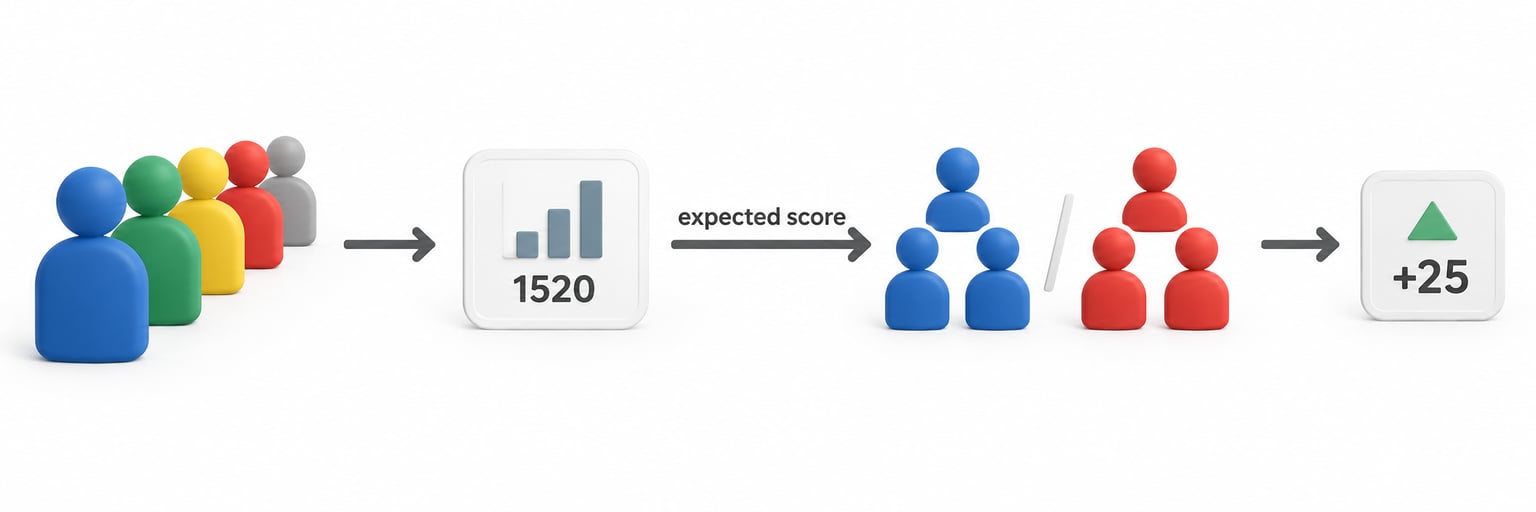
A matchmaking rating is a number, usually hidden, that estimates how strong a player is. Matchmaking uses it to build fair teams, and most games also use it to decide what rank icon you hold. The four layers below all look like “rank” to players but do different jobs.
| Layer | What it is | Can you see it? |
|---|---|---|
| Skill rating (MMR) | The hidden number used to pair players and predict outcomes | Often not, sometimes in a tracker |
| Rank score | Points earned inside one tier, decides promotion and demotion | Yes, on the ladder screen |
| Visible tier | Bronze through Immortal, cut from your skill rating by the developer | Yes |
| Leaderboard rating | The number used for top-player rankings, sometimes a second system entirely | Usually yes, if you qualify |
| Confidence | How sure the system is about your estimate, wide at first and narrow later | Rarely, though Dota 2 exposes it |
Queue conditions sit outside the rating itself. Region, latency, party composition and how long you are willing to wait all change who you get, which is why two players with identical numbers can face very different lobbies.
What Is a Matchmaking Rating?
A matchmaking rating is a running estimate of competitive skill, produced from results, opponents and context rather than from a judgement anyone makes about you. It exists for one practical purpose: to give both sides of a match a roughly even chance of winning.
That goal explains almost every oddity players complain about. The system is not trying to rank you accurately against the entire player base. It is trying to predict outcomes so it can hand out opponents near a 50% chance for the people it just queued.
What a matchmaking rating is, and what it is not
It is a prediction input, and it is a fairly good ranking signal once it has settled. What it is not: your win rate, your rank icon, your account level, your hours played, or any judgement of your mechanics in isolation.
Win rate sits uncomfortably close to the number players watch, so it deserves the clearest correction. A system that only ever gives you even matches will keep your win rate near 50% by construction, whatever your actual skill. Win rate measures how often you won, not how good you are, because who you beat is doing most of the work.
Here is the full list of what gets weighed, in rough order of how much it moves the number:
- Whether you won or lost, compared with what was predicted
- The rating of the opponents you beat or lost to
- How uncertain the system still is about you
- Party composition, role and team size adjustments
- Margin, performance or round-level detail, in the games that use it
- Penalty factors such as abandoning, going inactive or team size mismatches
How Do MMR and Elo Rating Systems Work?
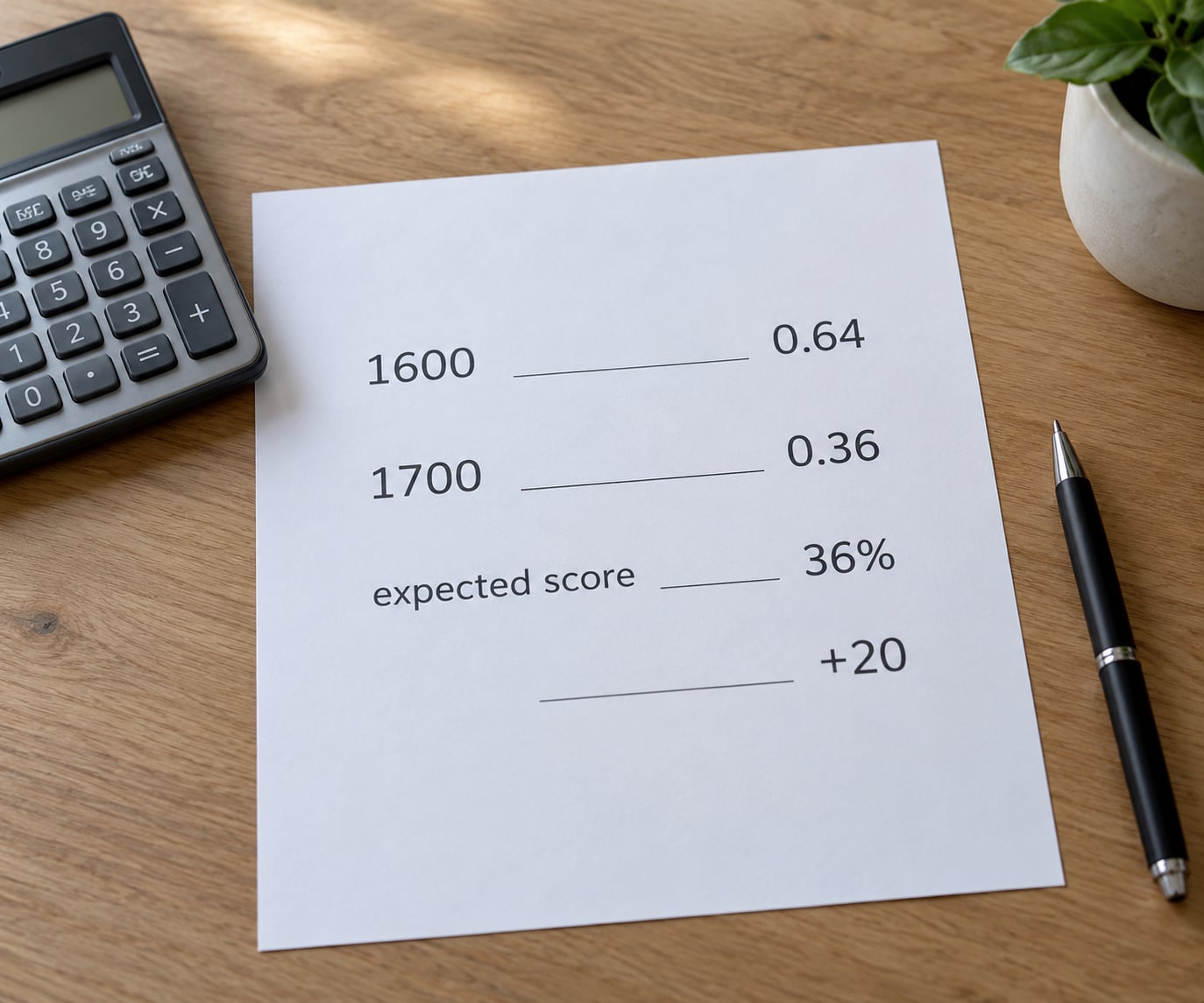
Elo is the ancestor of most modern systems. It rests on a single idea: each player has a rating, each match has a predicted score for each player, and the rating moves by the difference between the prediction and the reality.
The expected score is a lookup. If you are rated 1600 and your opponent 1700, the system expects you to win about 36% of the time. At equal ratings the expectation is 50%. A 400-point gap means the weaker player is expected to win roughly 16% of the time, which is why rating gaps that look small to you are enormous to the algorithm.
The change to your rating is then a constant, called the K-factor, multiplied by the gap between actual and expected. With a K of 32 at a 36% expectation:
- You win: change equals 32 times (1 minus 0.36), which is about +20 points
- You lose: change equals 32 times (0 minus 0.36), which is about -12 points
Same opponent rating, same K, opposite results, and the loss costs less. That asymmetry is the whole reason an upset feels like progress. Beat a player rated above you and the system has to move you toward them; lose to a player rated below you and it moves you away from them, but by less, because they were already expected to win.
K itself changes with experience. New accounts get a large K so a few results can move them a long way. Established accounts get a small K, often in the range of 8 to 16, so a single game barely shifts them. When a long absence raises the K again, your first games back move faster, which surprises people who forgot the rule existed.
What Glicko-2 and TrueSkill add: confidence
Pure Elo assumes it knows exactly how strong you is. It usually does not, so Glicko-2 adds a second number, rating deviation, a measure of how uncertain the estimate is. Dota 2 is the best documented public example, and its wiki explains this openly: new accounts carry a wide deviation, results cut it down over time, and a wide deviation produces bigger swings. That is the “swing games” feeling that new accounts hit in week one.
TrueSkill, Microsoft’s system from Halo, works the same way with different names. Instead of a rating and a deviation it tracks a mean, mu, and a standard deviation, sigma. Uncertainty is wide at the start, each match narrows it, and narrow uncertainty means slow, stable movement. Ubisoft’s stated reason for using a TrueSkill-style system in Rainbow Six Siege is exactly that: a single number cannot represent a new player.
The community often argues about whether a given game uses Elo, Glicko-2 or Bayesian estimation, as though these were rival theories. They are not. Bayesian estimation is the umbrella, Glicko-2 and TrueSkill are Bayesian systems, and Elo is the simplified ancestor. Games mix the pieces freely and usually do not publish the recipe.
How Does the System Estimate Your Skill?
Your first rating is a guess. Most games seed it from something thin – a default value for a new account, prior matches on that account, trophies or levels, or a handful of placement results. From there, every ranked match is one more observation, and the estimate tightens as the observations pile up.
Placement matches exist precisely to shorten that phase. You play a set number of games, the system watches how you did, and it drops you on the rating curve where your performance suggests you belong. Dota 2 uses ten placement games and then recalibrates; Brawl Stars places new accounts across a series of matches before settling them into a trophy band.
SuperCell’s public explanation for Brawl Stars is unusually clear that solo matchmaking considers wins, losses and total trophies together, which is a good reminder that a rating is one signal among several rather than a pure results ledger.
Three things usually get weighed: the outcome, the strength of the opposition, and your individual contribution. How visible that third input is depends on the game. A game that only tracks the winner may care about nothing else. A tactical shooter or a hero shooter has room to grade your kills, assists, damage and objective play, and Dead by Daylight forum threads show players convinced that beating a higher-rated opponent specifically is rewarded more heavily than beating an equal one.
Confidence is the part players never see. While the system is still unsure about you, it deliberately lets results move you faster, because a wide wrong estimate is worse than a temporary wrong one. Once the estimate settles, movement shrinks and your rank becomes sticky. Some players read that stickiness as the system ignoring them. It is usually the opposite: it is trusting them.
How Do Team Size, Role, and Player Strength Affect Matches?
Solo and party queue are two different problems. In solo, the system sorts one list by rating and slices it into teams. In party queue, it starts from your group and works outward, which means your effective rating is the average across the party unless the rules say otherwise. A 2500 player duoed with a 1500 player is not queued as a 2000 pair in most games; the system solves around them and gives the party a small rating advantage, which is why duo queue feels different from solo even when the average number is the same.
Party size has limits for a practical reason. Five friends at the same rating cannot all be matched against another five without the lobby becoming a mirror, so most games cap how wide a rating gap a party may be, or compensate the party with a rating bonus.
Role adds another constraint that rating alone cannot satisfy. If every player in the queue wants the same position, someone plays off-role. Off-role performance usually gets adjusted or discounted, which is why queuing a role you do not play feels like it costs you rating even when the team wins.
Recent form is the quiet input. Several games weight the last handful of matches more heavily so a player on a hot or cold streak is moved quickly toward their true level instead of sitting in a bad run for a week.
Region and latency finally set the edges. The pool of players available shrinks as you go up, so high-rated queues take longer. Queue time is a lever the system will always pull: wait less, get a wider spread of skill in the lobby. Play at peak hours and the pool is dense enough to match tightly, even at high ratings.
Why Does Your Rank Change After a Match?
Because the system compares reality to expectation, the same result produces different deltas in different lobbies. Five numbers decide the change: expected win probability, the actual outcome, your opponent’s rating, your K-factor, and your confidence.
Run through it. At 1600 against a 1700 opponent with a K of 32, the expectation is 36%. A win moves you about +20. Lose the same fixture and you drop about -12. Now imagine the same win against a 1400 opponent: the expectation is about 79%, the system predicted it, so the gain is roughly +7 even though you played just as well.
That is why people feel punished for what they call farming weaker opponents. The system is not punishing them; it is declining to pay for an expected result.
Margin of victory and performance detail only matter where they exist. In games that grade individual contribution, a dominant performance against strong opposition can move you more than the same performance against weak opposition. In games that only see the final result, it does not exist at all.
Consistency shows up as volatility. A player bouncing between 1800 and 2100 has high deviation or a high K and swings hard in both directions. A player holding steady at 1850 has converged. The identical win-loss record can produce two completely different rating graphs.
What Affects Matchmaking Beyond Your Rating?
Rating is the main input and not the only one. The rest explain the lobbies that seem to make no sense on paper.
- Party rating rules. Range limits, party size bonuses and duo restrictions change your effective rating more than any grind will.
- Role queues. A role queue narrows the pool dramatically, which loosens the skill matching and lengthens the wait.
- Region and server. You are matched against players your client can reach. A small local pool means wider skill bands, mostly off-peak.
- Latency thresholds. Many games cap the ping gap between teammates and opponents, and a hit cap plus a thin pool means a rougher lobby.
- Platform or cross-play rules. Separate ladders give the same skill two ratings.
- Recent performance and abandon penalties. Leaving a match, going inactive or feeding repeatedly lowers your effective rating for a period.
- Smurf penalties. Most systems detect a new or low-ranked account performing far above its rating and slow its climb, sometimes by requiring far more wins.
- Which model the game uses. Some rank purely on rating, some on rank score with fixed point grants, and some blend both, so a win is worth more in one tier than the next.
On that last point, rank score systems are worth separating clearly because they confuse a lot of people. There, a win is worth a set number of points and a loss a set number, so you can climb on a losing record early in a tier and drop on a winning one. Rating systems do the opposite. Knowing which model your game uses tells you instantly why the numbers behave the way they do.
How Can You Improve Your Matchmaking Rating?
Most of what moves a rating is the quality of your decisions, and the system mostly measures outcomes. The parts you control:
- Finish placement properly. Ten to twenty focused games where you win more than you lose sets a far better starting point than a rushed week.
- Play volume. Ratings move in steps. A K-factor of 8 needs a long run of consistent results to shift anything, and short sessions produce almost no movement.
- Play the role you queue. Off-role games produce adjusted results, which cancels out the wins.
- Stay in one party. Every switch resets your context, and a smurf detector watching frequent new-account logins is not a good thing to be.
- Do not abandon. A leaver penalty can cost more rating than several losses.
- Keep sessions long. Games near the end of a long session can carry a tilt penalty, so the last two matches of a five-hour evening are worth less.
- Check for edge. If your calls are frequently right in a winnable position and wrong in a lost one, the game knows even when you do not.
What you cannot change: your starting number, past results, the K-factor, your confidence band, the rating gap the system allows for a party, and the size of the pool at your level. Playing more hours helps because you make more decisions, not because time itself is rewarded.
One thing worth being blunt about: if your rank is not moving and you have played a few hundred games, the variable is almost always your performance in the matches you are currently losing, not the system. Nobody gets to a ceiling and then stalls through no further decisions.
What Common Matchmaking Myths Get It Wrong?
- “It is completely random.” It is not. Randomness is used to pick within a narrow acceptable band, and the band is narrow because the rating exists.
- “Winning should always raise my rank.” It does, but the size of the gain shrinks toward zero as your expected win probability approaches 100%.
- “A win streak is a hidden MMR boost.” There is no separate streak bonus in the systems that are documented. Streaks feel special because a wide confidence band or high K makes consecutive results compound.
- “My visible rank is my MMR.” Usually it is a cut from it, sometimes with a rank score layered on top, and sometimes a completely separate system.
- “Playing with friends does not count.” It counts, and it counts differently. Party rules change your effective rating and add a bonus.
- “Rating sits still once you reach a level.” It does sit still, and that is convergence. It sits still because the system is confident, not because it stopped reading your matches.
- “Win rate measures skill.” It measures how often you won against opponents chosen to make that number uninformative.
How to Read Your Rank Progress Correctly
Treat your rank as a noisy measurement rather than a verdict. The noise comes from your confidence band, the K-factor, the party you queued with and the opponents the pool offered you that evening. A week of bad results is a noisy sample, not a new baseline.
Compare peak to current over a season rather than today to yesterday. If you peaked in rank nine weeks ago and sit two ranks below now, that is a decline worth examining. If you sit near your peak with a 48% win rate in the last fifty games, that is a system telling you the opponents were even and you lost slightly more than you won.
Look at more than one queue. Solo and party results often diverge because they use different effective ratings, and comparing across modes is meaningless.
Finally, separate the two timescales. In the short term the system is balancing you against near-equals, which is exactly what a well-functioning rating system should do. In the long term, the only thing that moves your rating up is outplaying the players who are currently beating you. If you have genuinely improved and the rank has not followed after a hundred-plus matches, the honest conclusion is that your improvement happened against a level of opponent you are no longer facing.
Frequently Asked Questions
Is matchmaking completely random?
No. Rating decides which pool of players you are matched from, and randomness only picks within a narrow band of that pool. At higher ratings the pool is thin, so the band widens and match quality varies more. Queue time is what the system trades for a tighter band, which is why playing at peak hours usually produces a more even lobby than playing at 4am.
What is the difference between MMR and visible rank?
MMR is the hidden skill estimate used to pair players. Your visible rank is a tier cut from that estimate, plus rank score used to move up and down inside the tier. In most games the visible tier is a wide band, so two neighbours in the same tier can have very different hidden ratings. That gap is why climbing feels slow near the top of any tier.
Why do I lose rating even when I win?
You almost certainly do not. Rating only drops on a loss, but the size of the gain varies wildly. Beat an opponent rated below you and the system already expected it, so the gain is small. Beat someone rated above you and the gain is large. If you are seeing a drop after a win, check for a leaver penalty, a tilt penalty late in a session, or a party adjustment.
Does matchmaking rating change every season?
It depends on the game. Some run a soft reset that nudges everyone back toward the middle, some compress the top of the distribution, and some carry rating over untouched while resetting rank score only. Riot and Blizzard have both changed their policies several times, so the answer for any specific title is found in that game’s own seasonal notes rather than in general practice.
Can the system see more than a player’s win-loss record?
Yes. Most systems weigh the rating of the opponents, individual performance where the game can measure it, recent form, party composition, abandon and inactivity, and sometimes behaviour signals such as reports. That is why playing off-role or queueing support for a main can produce results the system discounts, and why two players with identical win-loss records can sit at different ratings.
How does matchmaking rating actually work in games with placement matches?
Placement matches are the calibration phase. Your account starts at a generic estimate with a wide confidence band, you play a fixed set of matches, and the system measures how you performed against the opponents it gave you. The results are used to place you on the rating curve, and the confidence band then narrows. Until it narrows, your rating moves a lot in both directions, which is why early ranked feels like a coin flip.
Start with one thing tonight: check whether your game shows rank score or a rating change after each match, then note how much you gained on your next win against someone rated lower than you. If the gain was tiny, you already know why climbing feels slow, and no amount of extra sessions will change the arithmetic until your decision quality does.