Whether a game is worth buying at full price comes down to one number: the hours you will genuinely play it, measured against what you are paying. Price alone tells you nothing. Reviews alone tell you little. The method below combines current price and discount history, review context, a demo, replay value, edition differences, and technical performance on your exact console, then ends with a plain buy, wait, or skip call. Fifteen minutes of research is usually enough to reach it.
I have picked the wrong one more than once, usually at midnight, usually a game I had not finished the campaign of the same series. The steps here are what I now run before checkout, and they have turned more impulse buys into ones I actually finish.
A note on the money side of this, because it comes up constantly in the discussions: standard AAA list prices rose from the old sixty-dollar baseline to around seventy dollars, and the reaction has been loud. Players are not just reacting to the number. They are reacting to the fact that content length did not rise with it. Keep that tension in mind while you read, because several of the checks below exist specifically to defend your budget against a price increase that your free time has not matched.
Table of Contents
- What You Need
- Step-by-Step: How to Tell If a Game Is Worth Buying at Full Price
- Step 1: Check the Current Price and Discount History
- Step 2: Read the Full Review Context
- Step 3: Try a Demo or Free Weekend Before Buying at Full Price
- Step 4: Estimate Replay Value
- Step 5: Check Platform and Edition Benefits
- Step 6: Verify Technical Quality on Your Platform
- Step 7: Decide Whether the Game Fits Your Play Time
- Step 8: Make a Buy, Wait, or Skip Decision
- Common Mistakes
- Frequently Asked Questions
- Is a game worth buying at full price if it already has mixed reviews?
- Should I buy a game at release or wait for reviews?
- Are demos enough to decide if a full-price game is worth it?
- Is it better to buy the standard edition or wait for a sale?
- How much discount usually makes a full-price game a better value?
- What if a game is on my backlog but I do not have time to play it?
- Conclusion: Make the Smartest Call for Your Gaming Budget
What You Need
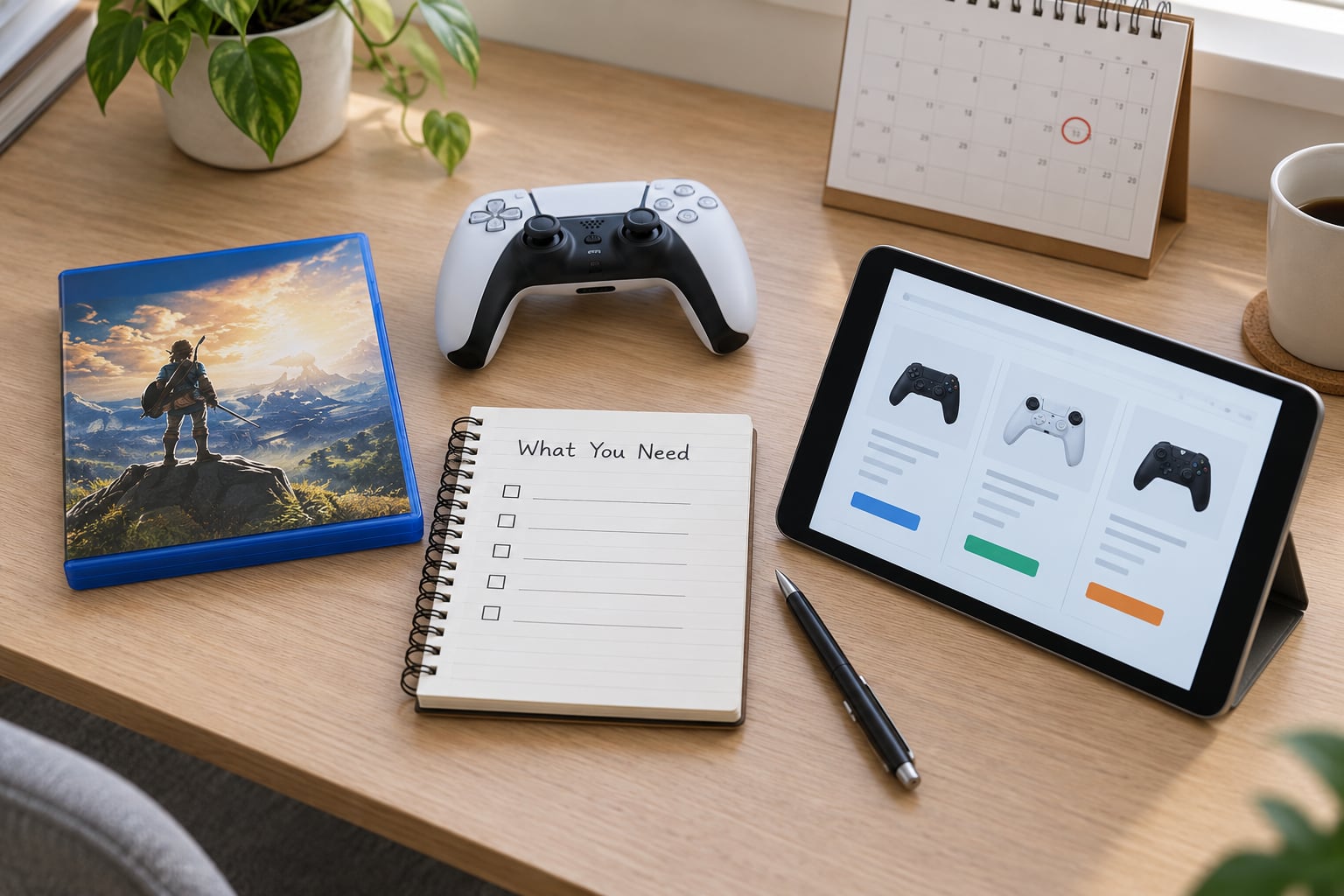
Gather these nine things before you decide. If any one is missing, your verdict is built on a guess.
- Platform. The console or PC spec sheet matters, because the same title performs differently on a base model versus the top-of-the-line version.
- Edition. Standard, deluxe, complete, or a bundle that includes DLC. The deluxe of a single-player game often adds nothing playable.
- Release window. A launch-week buy, a buy six months later, and a buy during a holiday sale are three different decisions with three different risk levels.
- Current price across stores. Compare the digital storefronts you actually use, plus physical retailers if you care about disc copies.
- Review consensus. The aggregate score and, more importantly, what reviewers keep complaining about in the first two paragraphs of their reviews.
- Demo availability. Whether a demo, a free weekend, or a playable prologue exists, and how much of the game it actually shows you.
- Discount history. How deep this game has gone before, and how quickly. A title that routinely drops deep is a bad candidate for paying list price in its first month.
- Online features. Multiplayer, a season pass, an online subscription catalog, or mods. These change what you are paying for.
- Your own time. Hours per week you will realistically play, and the size of the backlog you already have. This is the hardest number and the most decisive one.
If you cannot answer the last item honestly, stop here and skip the game for now. No review score fixes a library you will not open.
Step-by-Step: How to Tell If a Game Is Worth Buying at Full Price
Work through these eight checks in order. Each one can end the process on its own, and a game that survives all eight is one you can buy at full price without regretting the decision later.
Step 1: Check the Current Price and Discount History
Start with the price, because it sets the denominator for every calculation that follows. Look up the current price on each digital storefront you use, then look up the historical low. Price trackers and database sites do this well, and most show a full price chart for a game going back to launch.
What you are looking for is a pattern. Single-player games from established studios drop to around half price within a few months of release, and deeper at annual events. Live-service and early-access games discount irregularly and can be unpredictable. A niche or import title may rarely discount at all, which flips the usual argument: when a game essentially never goes on sale, the discount-based case for waiting is weak, and buying early is more defensible.
A few useful rules of thumb:
- Deep discount inside the first six months means the publisher itself signalled a faster value window.
- A bundled edition that includes a year of a subscription is only worth it if you were going to subscribe anyway.
- Physical copies with an included manual or a big cartridge are a different product, and price comparison across formats is meaningless unless you compare like with like.
- A game sitting in a subscription catalog gives you a free way to try it before deciding.
Write down the current price and the historic low. You will use both in the playtime math.
Step 2: Read the Full Review Context
Aggregate scores are useful and badly abused. A game averaging the low eighties across reviews is a safer buy than one averaging the low sixties, but the number tells you almost nothing about whether the game is for you.
Read the criticism, not just the verdict. Open three or four reviews from outlets that play differently from each other and search for the same complaint appearing more than once. When reviewers repeatedly describe the same flaw, it is a real feature of the release, not one person’s taste. A recurring note about uneven pacing, a shallow endgame, or a controller that feels imprecise matters more than whether one site called it a masterpiece.
Also check two things the score hides. First, platform performance: reviews often split between platforms, and the version on your console may be the worse one. Second, how the reviewer describes the ending, since a game that ends abruptly and offers nothing afterward is a different purchase than one with a long tail of content.
Then do the genre match. A 7.5-rated tactical strategy game means nothing to you if you enjoy narrative exploration and lose interest in systems-heavy games. Search the topic for the longest review available rather than the shortest, and skim for what the reviewer actually played and enjoyed.
Step 3: Try a Demo or Free Weekend Before Buying at Full Price
A demo is the single most reliable check on this list, and it settles the questions reviews cannot: whether the controls feel good, whether the difficulty settings work for you, and whether the core loop holds your attention past the first hour.
Know what a demo is telling you, though. Limited demos are curated to show the strongest thirty minutes of the game, often stripped of the tutorial and sometimes of difficulty options entirely. Treat a demo as proof that the fundamentals work, not as proof that the full game will deliver. A free weekend on a subscription service is more representative because you get the real build, but the same caution applies: the first hour is usually the best-tuned part.
Ask three questions while you play. Would you open this again tomorrow without being reminded? Does anything about the setting or the characters genuinely interest you, or are you only going along with it? And does the difficulty let you progress, or are you fighting the game rather than playing it?
If you bounce off inside the demo, that is your answer, and you got it for free instead of learning the same thing four hours in.
Step 4: Estimate Replay Value
Replay value is what happens after the credits, and it is where single-player and long-running games separate from everything else. Look at how the community engages with a game after finishing it: does it have multiple endings, a new game plus, difficulty modes that change the experience rather than just add numbers, mods, or a competitive mode people still play a year later?
For live-service titles, treat replay value as longevity instead. A game with regular seasonal updates and an active player base can justify its price across hundreds of hours, but you are committing to a recurring schedule of play rather than a single finished experience. Check whether the team has demonstrated it can sustain that schedule, since a live-service game that loses its developers usually loses its value.
Search for the average playtime reported by players rather than the developer’s estimate, and add your own instinct on top of it. If the community reports that a first playthrough runs around forty hours, and you know your own history with the genre, you can forecast your number honestly.
Genre sets a fair baseline for what counts as deep:
- Story-driven single-player: eight to fifteen hours for a tight experience, more if the world is explorable. Short is fine if the craft is high.
- Open world: thirty to sixty hours for the story plus optional content, with completionists pushing well past a hundred.
- Action RPG and monster hunting games: a hundred hours and up on a first playthrough is common, which makes them the strongest arithmetic case at full price.
- Roguelike and roguelite: built for hundreds of hours, but only if you enjoy repetition. If you do not, hours inflate and enjoyment does not.
- Competitive multiplayer: value depends entirely on skill and time. Hours are easy to accumulate and easy to waste.
- Sim, strategy and management: widely variable, and community reports often vary more than the genre average predicts.
Then apply the price-to-playtime check honestly. Multiply what you pay by how many hours you realistically expect, and compare the result to your own spending on other entertainment per hour. If the number looks outrageous on paper but the game is one you will finish and love, the math is not the only input. If the number looks fine but you know you will abandon it in ten hours, the math is flattering a purchase you will not enjoy.
One honest signal worth naming: a game you will finish and remember is worth paying more for than a game with a better hours-per-number that you will never open. Several people in the discussions behind this guide made exactly that point, arguing that a short, beautifully made experience justifies its price while a bloated one does not.
Step 5: Check Platform and Edition Benefits
Edition choice is where most of the avoidable waste happens. Compare what each edition actually adds:
- Standard: the base game. Usually the right answer unless you know you want the extras.
- Deluxe: frequently adds a cosmetic variant, a soundtrack, or art books. Rarely worth a meaningful premium on its own.
- Complete: includes the main DLC. This is the one worth upgrading to, and only if you know you will finish the base game first.
- Collector or premium physical: bundled with a season pass or a subscription year. Value only if you would have bought that subscription anyway.
Then check platform perks that cost nothing extra: achievements, cloud saves, cross-play between platforms, controller remapping, and whether your existing purchases carry over. Physical copies can be worth preferring if you like resale options, though digital libraries never lose access to a game you bought and cannot be resold.
Also check subscription catalogs. If the game is already included in a service you pay for, buying it outright duplicates what you have. Games rotate in and out of these catalogs, so the same title may be worth owning later and not today.
Step 6: Verify Technical Quality on Your Platform
Reviews rarely cover the exact combination of console model, edition, and region you own, so check this yourself. Look for reports of frame rate stability, resolution, crashes, save corruption, and controller support for your specific setup. Older console models running current releases often run at reduced frame rates, and a game that is excellent elsewhere can be genuinely unpleasant there.
Check download size against your available storage and your internet speed, since a large install on a slow connection can take most of an evening. Check whether the game requires an online connection to launch, whether it needs a subscription for multiplayer, and whether it supports offline play at all.
If you are still undecided on hardware, look at how the developer describes the game in their own materials rather than in marketing copy. A studio that lists minimum and recommended specs is telling you what to expect.
Step 7: Decide Whether the Game Fits Your Play Time
This is the step most guides skip, and it is the one that decides most purchases. Look at your backlog count. Not the number you own, the number of games you have started and not finished. If that number is high, a new full-price purchase is less an entertainment decision than a scheduling one.
Several regulars in the forums described a simple rule after years of overspending: no new purchases at list price until the backlog is back under a number they could actually clear. It is blunt, and it works better than any scoring system because it targets the real constraint, which is hours rather than money.
Then match the game to your actual habits. A slow, deliberate game that needs twenty hours a week is a poor fit for someone playing forty minutes before bed. A roguelite built on repeat runs is a poor fit for someone who wants to finish one story and move on. Some of the best value purchases are short games bought precisely because you will actually complete them, while a great epic that joins the pile for three years is worth nothing to you.
A fair minimum, in hours, by what you are paying:
- Budget tier: four to six hours of genuine play is enough.
- Mid tier: eight to twelve hours, or a shorter game you are certain to finish.
- Premium tier: twenty-five hours or more on your first playthrough, or a strong case that you will return to it.
Those are floors, not targets. A premium-priced game that gives you thirty hours is a good buy. One that gives you eight is not, however good the reviews are.
Step 8: Make a Buy, Wait, or Skip Decision
Apply this as the final test once the seven checks are done.
Buy now when the demo proved the core loop works, the review consensus has settled, the reported playtime clears your tier’s floor, and either the discount history is weak or this is the one genre you will play regardless of length. Waiting buys you nothing here.
Wait when you have not played a demo and one exists, when early reviews are still splitting, when the game launches mid-series and a previous entry is unfinished, when price history shows deep discounts inside a few months, or when you are not sure you will have time. Waiting costs nothing except patience, and it usually halves what you pay.
Skip when the technical reports show problems on your hardware, when your time will realistically go to the backlog instead, when you are buying it because of hype rather than interest, or when the edition you want adds content you will not use.
The five clearest wait-for-sale signals, collected in one place: a new release from a developer with a strong habit of discounting, an early-access game still finding its shape, a live-service title that has lost its active player base, a niche or import title with no digital discount pattern to speak of, and anything on your backlog that has already stalled twice.
If you still cannot decide, put the game in your wishlist and set an alert. That takes thirty seconds, keeps the game off your backlog, and lets price history make the argument for you.
Common Mistakes
Buying on the score alone. A high aggregate tells you most players were satisfied, not that you will be. Read what the criticism is, and play a demo.
Treating a demo as the full game. Limited demos are curated highlights, often without tutorial or difficulty options. They prove the fundamentals and nothing else.
Ignoring edition differences. Upgrading to deluxe for a soundtrack and a color variant is paying more for less play. Only the complete edition adds real content.
Skipping platform performance checks. A game that runs poorly on your console model is not the same product as the one reviewers scored, and no score reflects your hardware.
Assuming every game must be bought at launch. Launch week is the single most expensive window for a purchase. For most single-player titles, waiting a few months halves the cost and the patch bugs.
Buying while your backlog is growing. This is the most expensive habit of the six, and none of the math above catches it. Check the count before the price.
Two habits counter most of the rest. Set a hard cap on what your hobby can cost per month, and let subscription services handle the titles you are unsure about rather than owning a shelf of maybes. Players who switched to clearance buying to fund other goals generally report the same thing: the relief of not spending is larger than the occasional miss.
Frequently Asked Questions
Is a game worth buying at full price if it already has mixed reviews?
Mixed reviews are a reason to slow down, not a reason to skip. Look at the split: critics disagreeing on taste is normal, while critics agreeing on the same flaw means the flaw is real. Check whether the complaints cluster around something you personally care about, then play a demo. If the reviews split on story versus gameplay and you know which side you enjoy, you already have your answer.
Should I buy a game at release or wait for reviews?
Wait for most single-player games. Day-one patches and review splits are common in the first weeks, and discount history shows most titles dropping meaningfully within a few months. Buy at release only when the game is part of a series you follow closely, when multiplayer or an early seasonal update matters to you, or when the title almost never discounts and you expect to want it now.
Are demos enough to decide if a full-price game is worth it?
A demo tells you whether the controls, difficulty and core loop work for you, which eliminates a large share of bad purchases. It cannot tell you about pacing across a long campaign, the quality of the ending, or how technical the full build is, because limited demos are curated highlights. Use it as a filter for the first three hours, then use reviews and playtime reports for the rest.
Is it better to buy the standard edition or wait for a sale?
Both, usually. Start with the standard edition at full price only if it is included in a subscription you already pay for, or if the game is one you will play this week. Otherwise wait and buy the standard edition on sale, then decide separately whether any DLC is worth owning. Buying the deluxe early is the most common full-price regret in the hobby.
How much discount usually makes a full-price game a better value?
Around half off is the usual signal that a game is hitting its real value point for most players, and deeper discounts are where live-service and older backlogs land. What matters more is consistency: a title that has dropped deep before will almost certainly do so again, so waiting costs you nothing but patience. A game that has never discounted is a different case and a weaker argument for waiting.
What if a game is on my backlog but I do not have time to play it?
Then the purchase decision is a scheduling decision, and the price is beside the point. Count the games you have started and not finished, not the ones you own. If that number is high, make clearing it your rule for a few months and add new full-price purchases only when it falls. Your library you will actually play is worth more than another shelf of intentions.
Conclusion: Make the Smartest Call for Your Gaming Budget
Deciding how to tell if a game is worth buying at full price comes down to doing the work in a fixed order: check price and discount history, read what reviewers actually criticize, play a demo if one exists, estimate replay value against community playtime reports, compare editions and subscription overlap, verify performance on your exact hardware, and finally check the game against your backlog and weekly hours.
Start with the backlog today, before anything else. It costs nothing and it eliminates more bad purchases than any review score will. Then run the rest in about fifteen minutes and let the evidence, not the hype or the midnight impulse, make the call.