Gaming documentaries are made by researching one narrow question about a game, its makers or its players, then securing access to studios and interview subjects, filming on location and capturing gameplay, and finally cutting all of it into a narrated film with music, captions and a published release.
That pipeline looks different depending on who is paying. A crowdfunded YouTube channel, a festival feature film and a studio-backed series all move through the same stages, but they differ in crew size, runtime, access and how the work gets funded.
This guide walks the whole process in order, from the first research pass to the day a film goes live. It is written for aspiring filmmakers, gaming creators, developers thinking about their own film, and anyone who has watched a documentary about a game and wondered where the footage came from.
Table of Contents
- How Gaming Documentaries Are Made
- What Is a Gaming Documentary?
- How Do Filmmakers Research Gaming History?
- Where Do Filmmakers Get Gameplay and Archival Footage?
- How Are Developer and Player Interviews Filmed?
- How Do Filmmakers Turn Footage Into a Story?
- What Happens During the Editing and Post-Production Process?
- How Are Gaming Documentaries Published and Promoted?
- What Makes a Gaming Documentary Credible?
- Frequently Asked Questions
- What is Noclip in gaming?
- How do documentary makers get access to game studios?
- How long does it take to make a documentary about a video game?
- Can I use gameplay footage in a documentary legally?
- How much footage do you need for a 30 minute documentary?
- Conclusion
How Gaming Documentaries Are Made
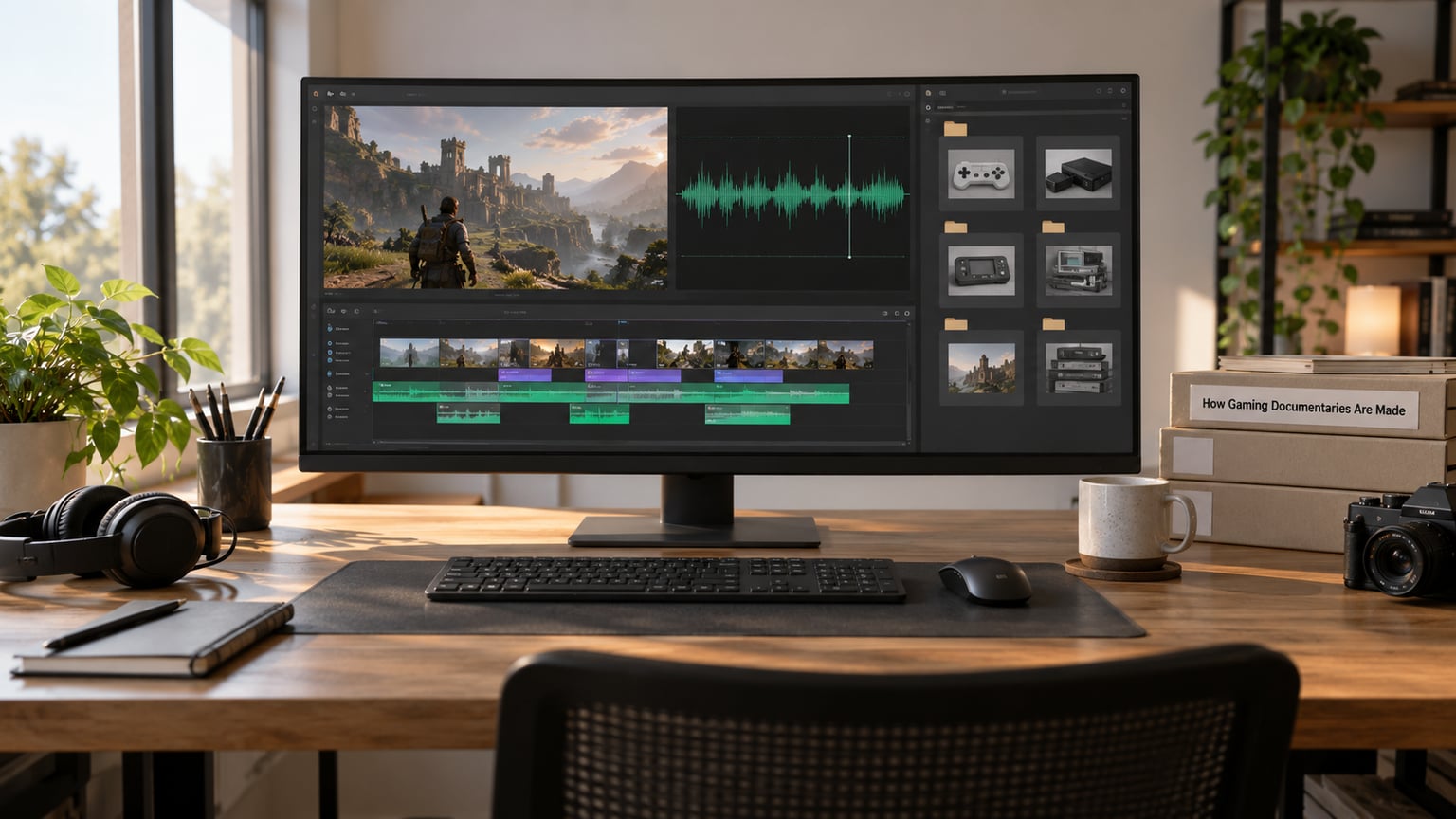
Short version: they are built the same way as any other documentary, with the addition that a large share of the picture comes from inside a game rather than from a camera pointed at the world. Research, access, filming, sourcing, editing, sound, publishing.
The nine steps below are the order most creators describe when they walk through a production. In practice several of them overlap, because a rough assembly cut often exposes a research gap that sends the filmmaker back to step one.
- Choose one story and one question. A film about a single decision, launch or player is makeable; a film about an entire studio usually is not.
- Verify the story before filming. Read primary sources, developer posts, contemporaneous coverage and archived material so the premise survives contact with facts.
- Get access and permissions early. Contact publicists, outline the angle, agree on review rights and footage reuse before any camera comes out.
- Build a written structure and shot list. Decide the spine of the story so the edit does not have to be improvised later.
- Source footage from more than one place. Original gameplay capture, licensed clips, press demos, developer sessions, magazines, television archives.
- Film interviews with a designed question set. Ask specific, open questions, record clean audio, and capture reactions as well as answers.
- Cut the assembly, then find the film. Order scenes, cut repetition, and let the strongest interview moments carry the argument.
- Finish sound, graphics, colour and captions. Music, lower thirds, mixing, subtitles and a transcript are part of the deliverable, not extras.
- Publish and promote honestly. Choose a platform, write the title and thumbnail, disclose funding, and correct the record when something is wrong.
The stages that trip up first-time filmmakers are usually the third and the seventh. Access sounds obvious until a studio asks what you are going to say, and the assembly cut is where a three-hour interview becomes a ninety-second sequence or gets abandoned entirely.
What Is a Gaming Documentary?
A gaming documentary is a non-fiction film whose subject is video games, the people who make them, or the people who play them. It uses interviews, archival material, gameplay and observation to argue something about that subject, rather than simply showing it.
That last part is what separates it from the rest of the gaming video ecosystem. A gameplay video shows the game working. A review is a judgement about whether the game is worth your time. A retrospective looks back through personal memory, often years later, and can be pure opinion. A making-of or behind-the-scenes video is usually commissioned by the studio and sticks close to the official line.
- Gameplay video demonstrates the product. Little or no argument, often no voice at all.
- Review ranks the product against alternatives and recommends or warns.
- Retrospective revisits an old game from a present-day perspective, usually one person’s memory.
- Promotional trailer is marketing material produced or approved by the publisher.
- Documentary investigates a specific claim using named sources, evidence and competing perspectives.
Common subjects fall into a few families: the history of a game or genre, the making of a specific title, the culture around a community, the professional or competitive scene, and preservation work that recovers lost or fragile material.
Jargon shows up constantly in this field, and it is worth defining up front. Noclip is a crowdfunded YouTube channel founded by Ross Scott that publishes long-form documentaries about game history and design, supported by audience memberships rather than studio sponsorship. A devlog is a developer-published diary of work in progress. A post-mortem is a retrospective written by the team after a project ends, often published publicly by studios. A greenlight is the internal go-ahead to fund a project. A prototype is an early build used to test an idea, not to demonstrate a finished game.
How Do Filmmakers Research Gaming History?
Research starts by shrinking the subject until it can be stated as one question. “The history of an FPS” is unfilmable. “Why this particular project was cancelled” is filmable, because it has documents, people and a verifiable timeline.
Good sources sit in a rough hierarchy. Developer interviews, post-mortems, conference talks and archived official blogs come first because they come from people who were in the room. Contemporaneous trade coverage and magazine features come next, with the caveat that magazine features are written to promote. Retrospectives, forums and social posts are useful for reaction and reception, rarely for technical claims.
Everything gets checked twice. Dates, revenue figures and headcounts are the three claims that get repeated and get wrong most often, so they are the three a filmmaker verifies against a second independent source before scripting a line about them.
The other half of research is deciding what to cut. A developer will happily talk for three hours about a design decision that matters to them and nothing to the audience. Filmmakers building gaming history documentaries on small budgets routinely report that the reception, the production trouble and the games themselves carried the film, while the technical setup went on the cutting-room floor.
Where Do Filmmakers Get Gameplay and Archival Footage?
Archival material comes from five places: the game’s own trailers and launch announcements, old print magazines and box art, television coverage such as tournament broadcasts or late-night segments, publisher and developer press kits, and community archives of demo discs, VHS transfers and fan captures.
Most of it arrives in poor condition. Older titles were not recorded digitally, so the only surviving image of a 1990s build might be a magazine disk, a fan upload, or a clip ripped from a broadcast tape. Filmmakers budget for restoration, because upscaling and stabilisation take real time and rarely look like the original.
Fresh gameplay is captured on the production’s own hardware and settings, which is why builds under development look different from shipped games. Some of the best sequences in development documentaries are not the finished product at all but an untextured grey-box level or an internal prototype captured on a developer’s machine.
Rights matter here. Clips used for comment or criticism are treated very differently from clips used as decoration, and a studio may grant interview access while requiring a separate written agreement for any of its footage. Getting that agreement before shooting prevents an expensive re-edit months later, and for archival material it can take weeks of chasing rights holders who no longer work in games.
How Are Developer and Player Interviews Filmed?
Interviews supply the explanation and the personality, so they get more preparation than any other part of the shoot. Filmmakers write a question set per subject, ordered so the strongest material comes early and the interview does not fall apart in the last ten minutes.
Open questions produce usable answers. “Walk me through the week the decision was made” gets a story; “What was the hardest part of this project” gets a summary of a presentation. Many creators also prepare a list of dates and names to drop in when an interviewee misremembers something, rather than confronting them on camera.
Format depends on the situation. Studio visits are shot properly: two cameras, a clip mic or a boom, controlled lighting, and a quiet room away from the developer’s monitor and keyboard noise. Remote interviews are recorded on video rather than audio-only, because a face gives editors options a voice track does not, and the subject still signs the same release form on screen as everyone else.
The audio is where budget cuts hurt most. A slightly soft image is forgivable in a documentary cut; an interview that needs noise reduction and room reverb removed cannot be fixed without artefacts. That is why the simplest, most reliable upgrade for a first shoot is a dedicated microphone.
On the consent side, release forms are not optional. They cover what the footage can be used for, whether the interviewee can review the segment before release, whether the film can be repurposed into shorter clips, and what happens to the material if the production stalls.
Editors then do the unglamorous work. Developers repeat themselves, hedge, and start sentences twice, which is normal and expected. The cut takes the cleanest version of an answer, removes the throat-clearing, and keeps the awkward moment after a difficult question because that pause is often the most honest beat in the whole film.
How Do Filmmakers Turn Footage Into a Story?
A documentary edit is an argument about what matters, made out of what was filmed. The first job is picking the angle, because the same three hours of interview footage can support a sympathetic portrait, a critical investigation, or a history piece, and only one of those can be assembled honestly.
Most creators write a spine before shooting: three to five beats that the film has to hit, each one anchored to a person who was there. Scenes then attach to beats rather than to chronology, so the strongest material lands where the argument needs it, even if it happened earlier.
Narration fills the joins. It carries dates and context that an interview participant has no reason to state, links locations the camera did not visit, and lets the filmmaker explain why a decision mattered. Overused, it flattens the film into a voice-over essay, so experienced editors write it last, once the cut is locked, and keep it short.
Pacing is the variable audiences notice most. A twenty-minute film and a ninety-minute one are built differently: the short form demands a turn roughly every ninety seconds, while the longer form can afford quiet stretches only if something is developing underneath them. Games coverage adds a specific temptation, which is the spec sheet, and the durable answer is the same as it is in print: put the numbers in a lower third and get back to the people.
What Happens During the Editing and Post-Production Process?
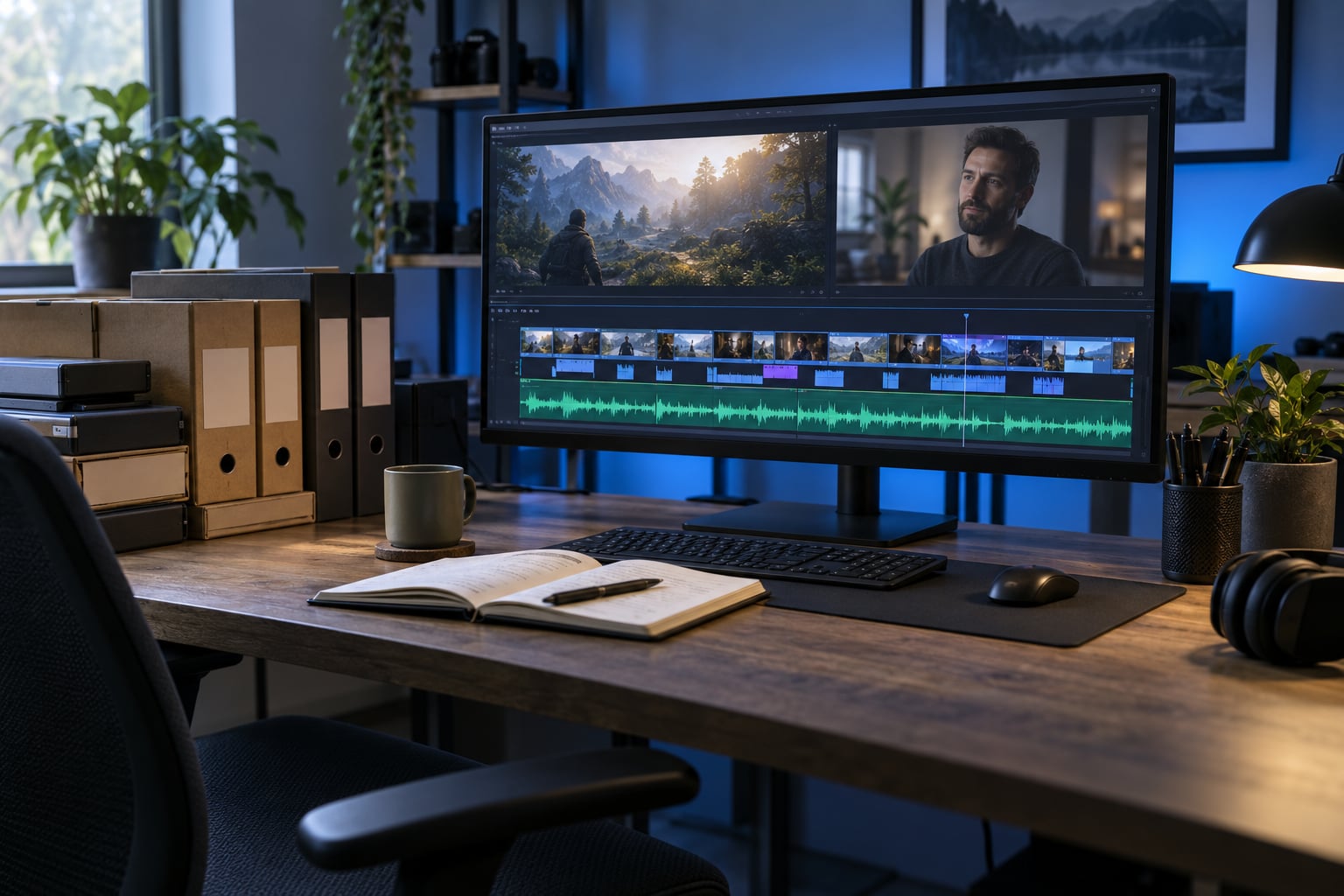
Post-production has distinct passes, and creators do them in a fixed order because each one reveals problems the previous one hid. Skipping the order is how films end up with graded footage that no longer matches and a score that fights the dialogue.
- Assembly cut. Every shot in running order, rough, no music. This is the version that tests whether the story exists.
- Story edit. Scenes reordered, repetitions cut, narration written to fill confirmed gaps. This is the version sent to interviewees or a studio for review.
- Fine cut and lock. Every frame chosen, pacing adjusted, captions timed to dialogue.
- Sound. Dialogue cleanup, ambient beds, room tone, then any design effects the footage needs.
- Music. A licensed score or a commissioned one, laid in low enough that the interview stays the focus.
- Graphics. Lower thirds with names and dates, maps and timelines, archival stills, anything that carries information the spoken line does not.
- Colour and mix. Matching separate cameras and different era sources, then a final audio pass for broadcast or platform delivery levels.
- Quality review. Watch it once end to end with the sound off, then once with the screen small.
Captions and a transcript are treated as part of the deliverable rather than an afterthought. A large share of gaming documentary viewers watch with sound off, on a phone, or with hearing loss, and the transcript is what makes the film findable through search afterwards.
How Are Gaming Documentaries Published and Promoted?
The destination decides a lot upstream. A YouTube channel release is built around retention, a festival premiere is built around a finished runtime and a submission deadline, and a streaming series is built around an episode order that can be released on a schedule.
For online releases the title and thumbnail carry as much weight as the film. Small channels competing against studio marketing regularly lose on packaging, so the useful habit is to write ten titles before the edit is locked and to test the framing with a small group of real viewers rather than with colleagues.
Short clips are the main discovery engine, but the rule is that a clip has to stand as its own piece of content. Cutting a two-minute highlight out of a forty-minute documentary works when the clip tells something; trimming arbitrary moments to chase an algorithm produces material that makes the channel look busy and the audience feel manipulated.
Promotion has a line creators are supposed to stay on one side of. Disclosing a sponsor, a paid placement, or a publisher supplying assets is normal and expected, and audiences extend considerable goodwill when it is stated plainly. Coverage of a sponsor’s own game, without that disclosure, is where independent filmmaking starts to look like advertising and the comment section turns on the filmmaker rather than the film.
Measurement is simple: watch the retention graph to find where viewers leave, read the comments for what people repeat back to you, and use both to fix the next film. Do not rebuild the finished project around the analytics.
What Makes a Gaming Documentary Credible?
Credibility in this genre is visible rather than claimed. Viewers check specific things: are the sources named on screen, is the funding disclosed, does the film correct itself when it gets something wrong, and does the person being discussed get to answer the criticism.
A working checklist for anyone judging a gaming documentary:
- Named sources with job titles, so a designer is not presented as a studio voice.
- Primary material cited, such as developer talks and published post-mortems, instead of screenshots of tweets.
- Verification of numbers and dates that carry weight in the argument.
- Clear separation of fact, reported claim and the filmmaker’s opinion.
- Response from the subject given when the film makes criticism, or a stated reason why it could not be obtained.
- Visible disclosure of sponsorship, funding source and any publisher involvement.
- A corrections process the audience can actually reach.
- Reuse rights cleared for anything not captured by the production.
Two signals consistently build the most trust among viewers: uncut extended interviews released alongside the edit, so fans can check what was trimmed out, and honest disclosure of how the film was paid for. Both are cheap, and both are rare.
One failure mode deserves naming because it is common in crowdfunded long-form work. A production backed by recurring supporters faces real pressure to ship, and a film released before it is finished damages both the work and the audience’s willingness to fund the next one. Creators who publish behind-the-scenes updates through each production cycle tend to hold that trust better than those who go quiet for a year.
Frequently Asked Questions
What is Noclip in gaming?
Noclip is a YouTube channel that publishes long-form documentaries about video game history and design. It is funded by audience memberships rather than by a studio or a publisher, which is why it can cover cancelled projects and difficult subjects. Founded by Ross Scott, it is the most cited example of the independent, crowdfunded gaming documentary model.
How do documentary makers get access to game studios?
Access usually starts with a publicist or communications team and a short written outline of the angle, the people you want to talk to and how the film will be distributed. Some studios ask to review relevant sections before release. Others grant interviews but keep a hard line on footage reuse, which is why rights for game clips are agreed in writing before any filming happens.
How long does it take to make a documentary about a video game?
An independent twenty-to-forty-minute documentary typically takes several months of active production once research begins, and longer if the same team is balancing it with other work. Research and access dominate the front of the schedule, editing always takes longer than expected, and revisions after a review pass routinely add weeks. Solo creators usually report a longer calendar because of day jobs and backer communication.
Can I use gameplay footage in a documentary legally?
Using a short clip while commenting on or analysing it is generally treated far more favourably than using footage as decoration, but the distinction is judged case by case. Publishers often require a written agreement covering which clips you may use and in which markets. Record your own gameplay where possible, keep a written note of every permission granted, and avoid assuming a trailer clip carries the same rights as a still.
How much footage do you need for a 30 minute documentary?
Plan on shooting far more than you will use, and expect a heavy cut. A finished half hour often draws from several shooting days of interviews plus a substantial amount of archival and gameplay material. Creators routinely report trimming three-hour interviews down to a few usable minutes, so the constraint is rarely how little you filmed but how well the story holds together once the extra material is cut away.
Conclusion
Gaming documentaries are made by narrowing a subject to one answerable question, verifying it against primary sources, securing access and rights before the cameras come out, filming interviews and sourcing footage, and then cutting all of it into a structure that a viewer can follow without a narrator holding their hand.
If you want to start, pick one focused gaming story this week. Write the question at the top of a page, list the ten sources you would need to prove it, and identify the three people who were actually in the room. Everything after that is production, and production is learnable.