Game demos influence buying decisions mostly by replacing an imagined experience with a real one, which calibrates your expectations and cuts the risk of a bad purchase. A good demo also filters out players the game will not suit, and sometimes a demo convinces you not to buy at all. That last effect is real, and publishers rarely mention it.
A game demo is a limited release that lets you play part of a game before buying it, usually the opening act, a self-contained level, or a capped slice with some systems disabled. That trial value is the whole mechanism behind how game demos influence buying decisions: hands-on play replaces marketing promises with actual minutes, and those minutes get weighed against the price and the length of the commitment.
Table of Contents
- How Game Demos Influence Buying Decisions at a Glance
- What Do Players Judge During a Game Demo?
- How Game Demos Influence Buying Decisions Through First Impressions
- How Much Does a Demo’s Availability Matter?
- How Do Demos Affect Preorders and Wishlists?
- Why Can a Demo Mislead Players?
- Do Demos Build Trust—or Just Interest?
- How Can Players Get More Value From a Demo?
- Frequently Asked Questions
- Do game demos make players more likely to buy the full game?
- Are game demos designed to influence purchase decisions?
- Why does a game demo sometimes feel different from the full release?
- Should I buy a game after playing only its demo?
- How long should I play a demo before deciding whether to buy?
- Can technical problems in a demo affect a game’s reputation?
- Conclusion: Use the Demo as Evidence, Not a Guarantee
How Game Demos Influence Buying Decisions at a Glance
The table below maps each way a demo shifts a purchase decision to the point in the buying journey where that influence is strongest, plus the limitation that keeps it from being a complete answer.
| Way a demo shifts the decision | Strongest at this stage | Limitation to keep in mind |
|---|---|---|
| Replacing hype with real playtime | Before wishlisting | A short slice cannot show pacing across a full campaign |
| Lowering the perceived risk of buying | Comparing two similar-priced games | Trial settings are not always the shipping settings |
| Filtering out wrong-fit players | Right before checkout | It cuts refunds but reads as lost sales |
| Setting a reference frame for reviews | After early reviews drop | Reviewers who played the demo may rate the wrong thing |
| Creating anticipation and social proof | Preorder and launch window | Community volume is not a quality signal |
| Testing hardware fit | PC purchases, handheld play | Demo builds may not match final performance |
What Do Players Judge During a Game Demo?
Core mechanics come first. Players are usually trying to answer one question: is the central loop fun enough to sustain twenty or forty hours, or is it a trick that works for ninety seconds?
Visual quality gets judged harder than it deserves. A demo is often capped at a lower resolution or a locked frame rate to keep the download small, so a blurry first impression may say more about the trial build than about the final release.
Controls matter just as much as looks. Remapping options, controller support, mouse feel, and whether the camera cooperates decide whether a game feels fair or fussy, and those verdicts rarely change after launch.
Performance is the one thing a demo can only partly answer. Frame stability on your own machine tells you something real, but only if the demo build ships with settings that match the retail one.
Accessibility options are a common blind spot. Remapping, subtitle sizing, difficulty assists and color filters are frequently absent or reduced in trials, which can produce an impression the full game will never deliver.
Players also weigh combat pacing and story tone. A demo ending on a cliffhanger will be judged as a tease; one ending on a closed tutorial will be judged as honest, and most players can tell the difference within minutes.
How Game Demos Influence Buying Decisions Through First Impressions
The opening minutes carry far more weight than their runtime suggests, because players form a working model of the game almost immediately and rarely revise it. A demo that opens with a strong showcase sequence can carry a weak hour; a demo that opens with a menu wall and a fifteen-minute walk to the first fight can bury a great one.
Both directions travel well. Players who finish a demo thinking about the next level tend to preorder, and players who finish thinking the demo was misleading tend to walk away permanently.
That is why the demo-to-wishlist step and the demo-to-purchase step are not the same number. Wishlisting is cheap and emotional; buying asks a different question about value, timing and trust in the finished product.
How Much Does a Demo’s Availability Matter?
Availability is the quiet multiplier. When a demo is easy to find on the store page, costs little bandwidth and needs no account, more people try it, and more trials end in a decision rather than an abandoned download.
Demos also remove switching cost. Checking a trailer takes a minute and tells you almost nothing about feel; installing a demo takes twenty and tells you something you cannot get anywhere else.
That is the difference players describe when they separate demos from trailers and reviews. A long-running Steam thread on whether demos influence the decision to buy keeps returning to the same point: hands-on time settles questions that preview footage cannot.
Access is uneven, though. Platform demos come with their own limits: download size caps on handheld and console storefronts, time-limited trials on some systems, and regional store differences that can hide a demo that exists elsewhere. PC storefronts generally give the most generous trials, which is why more demo-driven buying decisions happen there.
None of that makes the demo a purchase guarantee. It makes it evidence.
How Do Demos Affect Preorders and Wishlists?
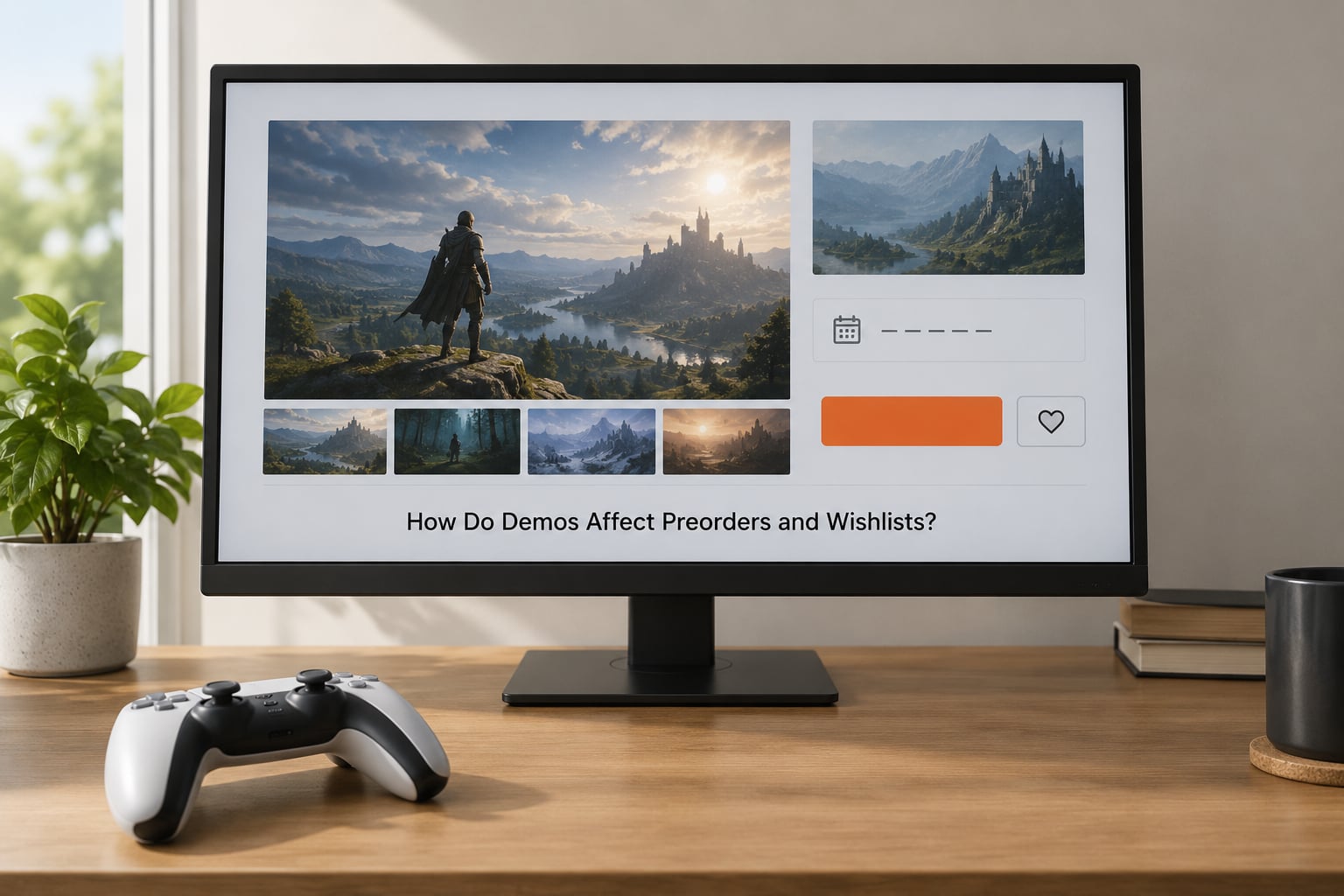
Wishlisting is the step players notice most, because it feels like commitment. In practice it is closer to a note-to-self that sets a notification and, on most storefronts, a position in a wishlist ranking the publisher watches.
Publishers read demo downloads and wishlists as separate numbers, and only the second one reliably predicts a sale. A large demo audience that produces few wishlists tells a developer that the trial was enjoyable but the game did not land as a must-have.
Timing changes the math. A demo released months ahead builds familiarity and gives streamers material to return to. One dropped weeks before launch converts better but adds little to a wishlist count, because most of the audience is already convinced.
Platform exclusivity cuts the same way. If a demo is only playable on one ecosystem, it cannot build a habit loop for players outside it, and preorder conversion suffers with it.
Confidence in the final build is the variable players weight most heavily, and it is the one a demo is least able to supply.
Why Can a Demo Mislead Players?
Most gaps between a demo and a full game are structural rather than dishonest, which is why players get irritated even when the studio behaves reasonably.
- Curated levels. The trial is usually the level the studio could finish to a high standard, not a random slice of the campaign.
- Altered progression. Skills, economy and difficulty curves are tuned or gated so the short slice ends on a satisfying beat.
- Limited variety. Enemy types, weapon pools and environmental hazards are narrower than the full game, which flatters pacing.
- Unfinished systems. Some builds ship with placeholder art, missing menus, or features listed on the store page that do not work yet.
- Placeholder performance. Resolution, frame rate and memory behavior may be capped for distribution reasons.
- Trial-only bugs. Some problems exist only in the demo branch, and some get patched out of it without touching the full game.
Players call the deliberate version of this demo bait, and the pattern is recognizable early: a very short trial, a cliffhanger ending, no progress carry-over, and a store page that promises more than the build shows. One long-running ResetEra thread puts the conditional version plainly: a demo will help sell a game if the game is actually good, and even then only a slice of players would never have bought it cold.
Progress that does not carry over is its own grievance, and a common one. Players who finish a trial and then start the purchased game from zero read it as a penalty for trying before buying.
Do Demos Build Trust—or Just Interest?
Trust comes from consistency, and it is rarer than interest. Interest is easy: a dramatic trailer or a fast combat loop produces wanting within a minute. Trust takes a demo that runs the same difficulty, the same controls and the same tone as the retail build, and that ships features it advertises.
A developer patch history matters here too. A studio that keeps updating a demo for months after release is signalling that it intends the trial to represent the game, which is itself a purchase argument.
Skepticism is warranted when the studio stays silent about what the demo excludes, when its store page describes features the trial does not contain, or when the trial ends mid-scene. Those are the patterns players who keep returning to this topic online actually complain about.
There is also a publisher-side wrinkle worth naming. Some of the loudest advocacy for demos comes from studios, and readers on developer forums are right to notice that. A demo can genuinely help a developer, and it can also just look like it does.
How Can Players Get More Value From a Demo?
Run through this before you buy, and the trial becomes a decision tool instead of a mood check.
- Test the core loop yourself. If the game is built around combat, farming, building or dialogue, do that for ten minutes before anything else.
- Check frame stability on your own hardware. Ignore the demo’s resolution cap and look at whether frame times hold steady in motion.
- Look for the accessibility settings you rely on. If remapping, subtitle sizing or assist options are missing from the trial, ask the developer before buying.
- Read what the demo does not include. Store pages and demo descriptions often list restrictions explicitly, and those lines tell you what the trial is hiding.
- Check the update history. A demo patched after release is a studio telling you it cares about the first impression.
- Ask whether progress carries over. This changes the value of finishing the trial carefully instead of brawling through it.
- Cross-check with independent reviews afterward. Demo impressions and review verdicts are different measurements, and the gap between them is usually where your real answer sits.
One practical rule: if reviews are mixed and the demo went well, wait. You will learn more from a second data point than from finishing the trial a third time.
Frequently Asked Questions
Do game demos make players more likely to buy the full game?
Usually yes, but not always, and the reason matters. A demo removes the fear of buying something that does not match its marketing, which raises wishlists and preorders. It also filters out players the game will not suit, so a developer can see fewer sales in the short term and fewer refunds plus steadier reviews later. The honest summary is that demos move more people toward a decision, and the direction of that decision depends heavily on demo quality.
Are game demos designed to influence purchase decisions?
Yes. A demo is a marketing asset released free, and studios choose its length, difficulty and ending deliberately. The useful question is whether that design serves the player or the sales pitch. Demos that show the real game, patch problems and state their limits build trust. Demos that end on a cliffhanger, hide progression and hide missing features push harder for the purchase and tend to leave players sour.
Why does a game demo sometimes feel different from the full release?
Most differences are structural. Trials often use a curated level, a tuned difficulty curve, a reduced enemy pool, capped graphics settings and a shortened or gated progression so the short session ends cleanly. Some differences are temporary: unfinished art, missing menus and trial-only bugs. Check the demo’s patch notes and the store page restrictions before assuming the full game will feel the same.
Should I buy a game after playing only its demo?
Buy when the demo answered the question you actually had, such as whether the core loop holds your attention or whether it runs well on your machine. Wait when reviews are mixed, the game is an early access release likely to change, or the demo shows features the store page does not. A demo is one strong data point among several, not a verdict on the full release.
How long should I play a demo before deciding whether to buy?
Long enough to touch the game’s central mechanic at least twice, which for most trials means twenty to forty minutes. Fifteen minutes is often just an opening sequence, and the full hour is rarely necessary unless the game is a simulation where progression pacing is your concern. If you are still unsure after that, the missing information is usually about the back half of the game, which the demo was never going to show.
Can technical problems in a demo affect a game’s reputation?
Yes, more than publishers expect. Players judge the build in front of them, so stuttering, bugs and unlisted features in a trial spread quickly through community discussion and can pre-frame the launch. A studio that patches its demo after launch limits the damage and signals competence. One that leaves a broken build up while the full game releases smooth will hear about the demo instead.
Conclusion: Use the Demo as Evidence, Not a Guarantee
Play the core loop for twenty minutes, check your own frame times, look for the accessibility settings you need, and read what the trial says it excludes. Then cross-check against independent reviews. If performance is unstable, the reviews are still split, or the game is likely to change before launch, wait, because the demo cannot answer those questions for you.
How game demos influence buying decisions comes down to this: a demo replaces imagination with a sample, and a sample is worth trusting only when it was built to be representative. Start there, then buy like you always do.